New Book | Frames that Speak
From Brill, with the ebook available for free as an open-access publication:
Chet Van Duzer, Frames that Speak: Cartouches on Early Modern Maps (Leiden: Brill, 2023), 272 pages, ISBN: 978-9004505186, $144.
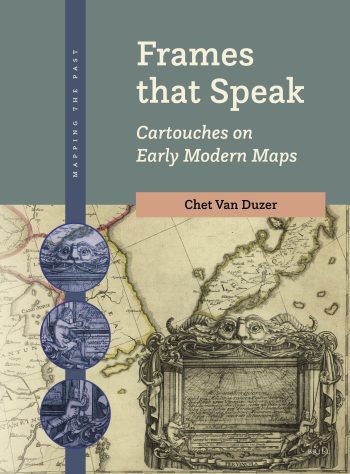 This lavishly illustrated book is the first systematic exploration of cartographic cartouches, the decorated frames that surround the title, or other text or imagery, on historic maps. It addresses the history of their development, the sources cartographers used in creating them, and the political, economic, historical, and philosophical messages their symbols convey. Cartouches are the most visually appealing parts of maps, and also spaces where the cartographer uses decoration to express his or her interests—so they are key to interpreting maps. The book discusses thirty-three cartouches in detail, which range from 1569 to 1821, and were chosen for the richness of their imagery. The book will open your eyes to a new way of looking at maps.
Chet Van Duzer is a leading historian of cartography and manages the projects involving maps and globes for the Lazarus Project at the University of Rochester, which brings multispectral imaging to cultural institutions around the world.
C O N T E N T S
Acknowledgments
List of Figures
Introduction
• Definition of ‘Cartouche’
• Names for Cartouches
• Two Ornamental Motifs of Sixteenth-Century Cartouches
• Early Cartouches, and Some Cartouche Firsts
• The Sources of Cartouches
• The Development of the Cartouche, Sixteenth to Nineteenth Centuries
• The Decline of Cartouches
• The Ontology of Cartouches
• Cartouches and Emblems: Two Distinct Genres
• The Cartouches in the Body of This Book
• The Hand-Coloring of Cartouches
• The Theatricality of Cartouches
1 Covering Emptiness with a Hope for Peace: Gerard Mercator, Nova et aucta orbis terrae descriptio ad usum navigantium, 1569
2 The Gaze of the Sea Monster: Ignazio Danti’s map of Sardinia in the Galleria delle carte geografiche, 1580–82
3 An Exotic Medicine from the Tombs of Egypt Daniel Cellarius, Asiae nova descriptio, c.1590
4 New Personifications of the Continents: Jodocus Hondius, Nova et exacta totius orbis terrarum descriptio, 1608
5 Cosmographers in the Southern Ocean: Pieter van den Keere, Nova totius orbis mappa, c.1611
6 Ingratitude Bites Kindness: Jodocus Hondius, Novissima ac exactissima totius orbis terrarum descriptio, 1611 / 1634
7 Eurocentrism on Display: Arnold Floris van Langren, terrestrial globe, 1630–32
8 The Giddy Pleasures of Mise en Abyme: Willem Hondius, Nova totius Brasiliae et locorum a Societate Indiae Occidentalis captorum descriptio, 1635
9 The Cartographer’s Self-Portrait: Georg Vischer, Archiducatus Austriae inferioris, 1670 / 1697
10 Scheming for Control in the New World: Claude Bernou, Carte de l’Amerique septentrionale et partie de la meridionale, c.1682
11 Unveiling Text, Interpreting Allegory: Vincenzo Coronelli, terrestrial globe, 1688
12 Concealing and Revealing the Source of the Nile: Vincenzo Coronelli, L’Africa divisa nelle sue parti, 1689
13 Propaganda in a Cartouche: Vincenzo Coronelli, Paralello geografico dell’antico col moderno archipelago, 1692
14 If It Bleeds, It Leads: David Funck, Infelicis regni Siciliae tabula, c.1693
15 Celebrating a Triumph of Engineering: Jean-Baptiste Nolin, Le canal royal de Languedoc, 1697
16 The Battle between Light and Darkness: Heinrich Scherer, Repraesentatio totius Africae, 1703
17 A Map in the Map as Prophesy: Nicolas Sanson and Antoine de Winter, Geographiae Sacrae Tabula, 1705
18 ‘One of the Most Singular Stories of Extreme Hardships’: Pieter van der Aa, Scheeps togt van Iamaica gedaan na Panuco en Rio de las Palmas, 1706
19 Crimson Splendor: Nicolas Sanson, Téatre de la Guerre en Flandre & Brabant, c.1710
20 Generals Presenting Maps to the Emperor: Johann Baptist Homann, Leopoldi Magni Filio Iosepho I. Augusto Romanorum & Hungariae Regi …, c.1705–11
21 How to Build a Giant Cartouche: Nicolas de Fer, Carte de la mer du Sud et de la mer du Nord, 1713
22 Advertising Makes Its Entrance: George Willdey, Map of North America, 1715
23 The Collapse of the Mississippi Bubble: Matthäus Seutter, Accurata delineatio Ludovicianae vel Gallice Louisiane, c.1728
24 ‘The Link of the Human Race for Both Utility and Pleasure’: Matthäus Seutter, Postarum seu cursorum publicorum diverticula en mansiones per Germaniam, c.1731
25 Kill the Cannibals and Convert the Rest: Jean-Baptiste Nolin, II, L’Amerique dressée sur les relations les plus recentes, 1740
26 The Cartographer and the Shogun: Matthäus Seutter, Regni Japoniae nova mappa geographica, c.1745
27 The Illusionistic Roll of the Cartouche: Gilles and Didier Robert de Vaugondy, Carte de la terre des Hebreux ou Israelites, 1745
28 A Cartographic Balancing Act: Matthäus Seutter, Partie orientale de la Nouvelle France ou du Canada, c.1756
29 Impartial Border, Partisan Cartouche: Juan de la Cruz Cano y Olmedilla, Mapa geográfico de America Meridional, 1775
30 A Tactile Illusion That Legitimates the Map: Henry Pelham, A Plan of Boston in New England with its Environs, 1777
31 Fighting Back against Colonial Cartography: José Joaquim da Rocha, Mappa da Comarca do Sabará pertencente a Capitania de Minas Gerais, c.1778
32 The Actors Begin to Leave the Stage: Jean Janvier, Maps of 1761, 1769, and 1774; Robert de Vaugondy, Map of 1778; John Purdy, Map of 1809
33 A Map on a Map on a Map: John Randel, Jr., The City of New York as Laid Out by the Commissioners, 1821
Conclusions
Index










leave a comment