Exhibition | The Petit Trianon during the Empire
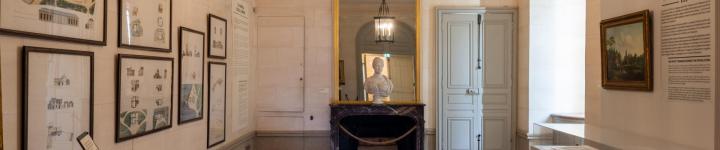
Installation view of The Petit Trianon during the Empire, 2023
(Photo by Sebastien Giles)
◊ ◊ ◊ ◊ ◊
On view this summer at the Château de Versailles:
The Petit Trianon during the Empire
Petit Trianon, Château de Versailles, 13 May — 17 September 2023
Presented by the Palace of Versailles, The Petit Trianon during the Empire tells the story of the restoration undertaken to turn Trianon into a country residence for Napoleon and Marie-Louise. The exhibition explains the work ordered by the emperor to restore the houses in the Hamlet, the farm, and the orangery—work that had become essential after twenty years of neglect.
During the Empire, the Petit Trianon was chosen as a country residence by Napoleon Bonaparte and his wife, Marie-Louise of Habsburg. Two decades of neglect, however, had left the houses in the Hamlet, the farm, and the orangery in urgent need of restoration. The work was carried out between 1805 and 1811, overseen by the architect Guillaume Trepsat and his assistant, Alexandre Dufour.

Installation view of The Petit Trianon during the Empire, 2023 (Photo by Sebastien Giles).
The working dairy, the barn, and the farmer’s cottage were all demolished. The farm was converted into a guard house, while the rest of the structures were restored and the thatched rooves repaired. The external staircases were removed, apart from the spiral staircase on the Queen’s House, which was replaced by a straight, covered staircase. The houses in the Hamlet reverted to the same use as under the Ancien Régime, with all the furniture and wall hangings replaced by classical, Empire-style pieces made by the cabinet-makers Jacob-Desmalter and Marcion, and the bronze-worker Galle.
Napoleon and Marie-Louise hosted several parties at the theatre and in the French Garden between 2 and 11 August 1810, and again, the following year, on 25 August, in the English Garden and the restored Hamlet, to celebrate the birth of their son. These parties harked back to the wonderful celebrations organised by Marie-Antoinette. The restoration work meant the heritage of the Petit Trianon was both protected and revived.
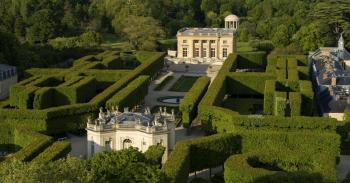
The Petit Trianon with the French Pavilion in the foreground at the left (Photo: Thomas Garnier).
During the French Revolution, from 1792, the Petit Trianon and the Queen’s Hamlet were emptied of their inhabitants and all their contents. The furniture, artworks, and everyday household items, such as mattresses, sheets, and cookware, as well as the fish in the lakes, were all auctioned off. The palace was rented to a restaurateur, while the garden became a public recreation area. The French Pavilion was turned into a café, the farm was rented to and worked by a farmer, and another restaurateur moved into the Queen’s House in the Hamlet.
By the beginning of the 19th century, the Hamlet was overgrown and decrepit. The roofs of several of the houses had collapsed and the external staircases were rotten. Two of the agricultural buildings—the barn and the working dairy—lay in ruins and the farm had been partially destroyed by fire. Sketches made by the English traveller and draughtsman John Claude Nattes in 1802 illustrate this state of neglect.










 Enfilade
leave a comment