New Book | Frames that Speak
From Brill, with the ebook available for free as an open-access publication:
Chet Van Duzer, Frames that Speak: Cartouches on Early Modern Maps (Leiden: Brill, 2023), 272 pages, ISBN: 978-9004505186, $144.
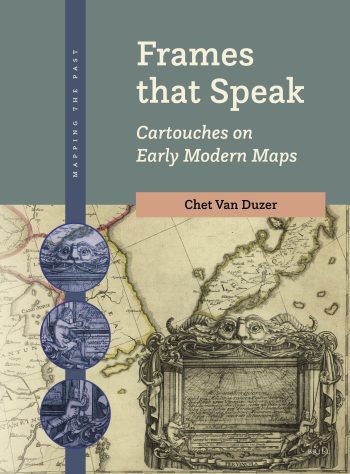 This lavishly illustrated book is the first systematic exploration of cartographic cartouches, the decorated frames that surround the title, or other text or imagery, on historic maps. It addresses the history of their development, the sources cartographers used in creating them, and the political, economic, historical, and philosophical messages their symbols convey. Cartouches are the most visually appealing parts of maps, and also spaces where the cartographer uses decoration to express his or her interests—so they are key to interpreting maps. The book discusses thirty-three cartouches in detail, which range from 1569 to 1821, and were chosen for the richness of their imagery. The book will open your eyes to a new way of looking at maps.
Chet Van Duzer is a leading historian of cartography and manages the projects involving maps and globes for the Lazarus Project at the University of Rochester, which brings multispectral imaging to cultural institutions around the world.
C O N T E N T S
Acknowledgments
List of Figures
Introduction
• Definition of ‘Cartouche’
• Names for Cartouches
• Two Ornamental Motifs of Sixteenth-Century Cartouches
• Early Cartouches, and Some Cartouche Firsts
• The Sources of Cartouches
• The Development of the Cartouche, Sixteenth to Nineteenth Centuries
• The Decline of Cartouches
• The Ontology of Cartouches
• Cartouches and Emblems: Two Distinct Genres
• The Cartouches in the Body of This Book
• The Hand-Coloring of Cartouches
• The Theatricality of Cartouches
1 Covering Emptiness with a Hope for Peace: Gerard Mercator, Nova et aucta orbis terrae descriptio ad usum navigantium, 1569
2 The Gaze of the Sea Monster: Ignazio Danti’s map of Sardinia in the Galleria delle carte geografiche, 1580–82
3 An Exotic Medicine from the Tombs of Egypt Daniel Cellarius, Asiae nova descriptio, c.1590
4 New Personifications of the Continents: Jodocus Hondius, Nova et exacta totius orbis terrarum descriptio, 1608
5 Cosmographers in the Southern Ocean: Pieter van den Keere, Nova totius orbis mappa, c.1611
6 Ingratitude Bites Kindness: Jodocus Hondius, Novissima ac exactissima totius orbis terrarum descriptio, 1611 / 1634
7 Eurocentrism on Display: Arnold Floris van Langren, terrestrial globe, 1630–32
8 The Giddy Pleasures of Mise en Abyme: Willem Hondius, Nova totius Brasiliae et locorum a Societate Indiae Occidentalis captorum descriptio, 1635
9 The Cartographer’s Self-Portrait: Georg Vischer, Archiducatus Austriae inferioris, 1670 / 1697
10 Scheming for Control in the New World: Claude Bernou, Carte de l’Amerique septentrionale et partie de la meridionale, c.1682
11 Unveiling Text, Interpreting Allegory: Vincenzo Coronelli, terrestrial globe, 1688
12 Concealing and Revealing the Source of the Nile: Vincenzo Coronelli, L’Africa divisa nelle sue parti, 1689
13 Propaganda in a Cartouche: Vincenzo Coronelli, Paralello geografico dell’antico col moderno archipelago, 1692
14 If It Bleeds, It Leads: David Funck, Infelicis regni Siciliae tabula, c.1693
15 Celebrating a Triumph of Engineering: Jean-Baptiste Nolin, Le canal royal de Languedoc, 1697
16 The Battle between Light and Darkness: Heinrich Scherer, Repraesentatio totius Africae, 1703
17 A Map in the Map as Prophesy: Nicolas Sanson and Antoine de Winter, Geographiae Sacrae Tabula, 1705
18 ‘One of the Most Singular Stories of Extreme Hardships’: Pieter van der Aa, Scheeps togt van Iamaica gedaan na Panuco en Rio de las Palmas, 1706
19 Crimson Splendor: Nicolas Sanson, Téatre de la Guerre en Flandre & Brabant, c.1710
20 Generals Presenting Maps to the Emperor: Johann Baptist Homann, Leopoldi Magni Filio Iosepho I. Augusto Romanorum & Hungariae Regi …, c.1705–11
21 How to Build a Giant Cartouche: Nicolas de Fer, Carte de la mer du Sud et de la mer du Nord, 1713
22 Advertising Makes Its Entrance: George Willdey, Map of North America, 1715
23 The Collapse of the Mississippi Bubble: Matthäus Seutter, Accurata delineatio Ludovicianae vel Gallice Louisiane, c.1728
24 ‘The Link of the Human Race for Both Utility and Pleasure’: Matthäus Seutter, Postarum seu cursorum publicorum diverticula en mansiones per Germaniam, c.1731
25 Kill the Cannibals and Convert the Rest: Jean-Baptiste Nolin, II, L’Amerique dressée sur les relations les plus recentes, 1740
26 The Cartographer and the Shogun: Matthäus Seutter, Regni Japoniae nova mappa geographica, c.1745
27 The Illusionistic Roll of the Cartouche: Gilles and Didier Robert de Vaugondy, Carte de la terre des Hebreux ou Israelites, 1745
28 A Cartographic Balancing Act: Matthäus Seutter, Partie orientale de la Nouvelle France ou du Canada, c.1756
29 Impartial Border, Partisan Cartouche: Juan de la Cruz Cano y Olmedilla, Mapa geográfico de America Meridional, 1775
30 A Tactile Illusion That Legitimates the Map: Henry Pelham, A Plan of Boston in New England with its Environs, 1777
31 Fighting Back against Colonial Cartography: José Joaquim da Rocha, Mappa da Comarca do Sabará pertencente a Capitania de Minas Gerais, c.1778
32 The Actors Begin to Leave the Stage: Jean Janvier, Maps of 1761, 1769, and 1774; Robert de Vaugondy, Map of 1778; John Purdy, Map of 1809
33 A Map on a Map on a Map: John Randel, Jr., The City of New York as Laid Out by the Commissioners, 1821
Conclusions
Index
Call for Essays | Art and Memory in Early Modern Central Europe
From ArtHist.net:
Art and Memory in Early Modern Central Europe
Edited Volume
Proposals due by 1 September 2023; completed essays due by 1 December 2023
This edited volume will explore the culture of commemoration in early modern Central Europe as a testimony to the tectonic changes in the period’s social, religious, and political life. Memorials, tomb sculptures, and portraits reflected not only the desire of early modern elites to maintain family memory and highlight their confessional identity but also the emergence of ‘collective memory’ and national identity crystallised and secured in artefacts.
During the early modern period, which was marked by political conflicts and upheavals and profound changes in religious culture exemplified by the Reformation, the culture of commemoration including its visual expression changed substantially. While Western European commemorative practices were the focus of several recent edited volumes, the Central and Eastern European culture of commemoration remains rather understudied and leaves us asking about the possible dialogue if not entanglement in the domain of commemoration between Western and East-Central Europe in early modern times.
Therefore, we encourage submissions on the following topics:
• Art and Commemoration Practices
• Memory in Religious Controversies
• Memory and Social Identity
• Cultural Practices in Politics of Memory
• Art and the ‘Places of Memory’
We are looking for papers of 5,000–8,000 words including a bibliography. Interdisciplinary and transcultural contributions are particularly welcome. Please submit a 500-word abstract and a brief biography to Stefaniia Demchuk (demchuk@phil.muni.cz) by 1 September 2023. The selected authors will be expected to deliver a full paper by 1 December 2023. All submissions will be peer-reviewed.
Call for Papers | Publics of the First Public Museums: Sources
From the Call for Papers:
Publics of the First Public Museums: I. Institutional Sources, 18th–19th Centuries
Pubblici dei primi musei pubblici: I. Le fonti istituzionali, XVIII–XIX secolo
Rome, 19–20 October 2023
Proposals due by 30 July 2023
This international work-in-progress workshop on Publics of the First Public Museums: Institutional Sources, 18th–19th Centuries is part of the research project Visibility Reclaimed: Experiencing Rome’s First Public Museums, 1733–1870, directed by Carla Mazzarelli. It is the first of a series of three workshops that will explore research methods and sources relevant to the study of publics and their experiences in visiting the first public museums during the 18th and 19th centuries. Emphasizing an interdisciplinary and transnational perspective, the workshop aims to promote scholarly exploration beyond the mere visual dimensions commonly associated with exhibition spaces—urging researchers instead to delve into the material encounters within museum spaces, the practices of collecting, and the regulatory mechanisms implemented by institutions to govern public conduct during the 18th and 19th centuries. The first workshop revolves around research questions that arise from the analysis of sources produced directly by the institutions. These sources offer valuable insights into the institutions’ perspectives and attitudes towards the public, placing particular emphasis on:
1 Access procedures
2 Regulations governing public behaviour
3 Measures for the conservation/protection of artefacts
4 Quantitative and qualitative analysis of audiences
The workshop will explore primary sources such as regulations, access registers, visitor books, museum reports, institutional correspondences, formal requests for copying and/or studying artworks, and printed catalogues. A comparative analysis of equivalent sources from other institutions or places—libraries, academies, galleries, collections, villas and gardens as well as archaeological sites and places of worship—is encouraged.
Key questions to be addressed during the workshop include:
• How do these sources contribute to the reconstruction of the dynamic relationship between publics and museum institutions?
• Which analysis methods should be prioritised?
• How did the management of museum institutions evolve in response to the historical and political changes of the 18th and 19th centuries?
We invite submissions that align with the aforementioned areas and inquiries. Please note that:
• To facilitate dialogue among the most recent ongoing research in the field, the workshop is particularly geared towards doctoral students, young researchers, and scholars who are working on original topics and sources relevant to those proposed in the seminar.
• Preference will be given to applications that involve interdisciplinary research (e.g., the intersection of arts and history or arts and sciences) and proposals from disciplinary fields other than art history and architecture will be warmly welcomed, such as the history of institutions, the history of sciences, social sciences, and economic history.
• Case studies falling within the realm of Digital Humanities will be highly appreciated, including projects related to cataloguing, databases of sources pertaining to the publics of the first public museums or other institutions and sites that the project intends to study comparatively with museums (e.g., libraries, academies, galleries, villas, ancient and modern monuments).
• Case studies that prioritize transnational and/or transregional perspectives or address geographies that have received relatively less attention within the field of Museum Studies will also be particularly valued.
Interested participants should submit an abstract (of no more than 2000 characters, including spaces), a brief biography (maximum of 1500 characters, including spaces), and a minimum of three keywords to visibilityreclaimed@gmail.com by 30 July 2023. Notification of acceptance: 28 August 2023. Languages accepted: Italian, English, French, and Spanish.
For further information, please contact
Organising secretaries: Luca Piccoli and Ludovica Scalzo, visibilityreclaimed@gmail.com
Direction and scientific coordination: Prof. Dr. Carla Mazza, carla.mazzarelli@usi.ch
Organization Committee
Giovanna Capitelli (Università di Roma Tre)
Carla Mazzarelli (Università della Svizzera italiana)
Chiara Piva (Sapienza Università di Roma)
Organizing Secretaries
Luca Piccoli (Università della Svizzera italiana)
Ludovica Scalzo (Università di Roma Tre)
The workshop is part of the research project Visibility Reclaimed: Experiencing Rome’s First Public Museums, 1733–1870, An Analysis of Public Audiences in a Transnational Perspective (SNSF 100016_212922), directed by Carla Mazzarelli (Università della Svizzera italiana, Accademia di architettura di Mendrisio, Istituto di storia e teoria dell’arte e dell’architettura).
Project Partners
Giovanna Capitelli (Università di Roma Tre), Stefano Cracolici (Durham University), David Garcia Cueto (Museo del Prado), Christoph Frank (Università della Svizzera italiana), Daniela Mondini (Università della Svizzera italiana), Chiara Piva (Sapienza Università di Roma)
New Book | The Art of Colour
From Yale UP and Thames & Hudson:
Kelly Grovier, The Art of Colour: The History of Art in 39 Pigments (New Haven: Yale University Press, 2023), 256 pages, ISBN: 978-0300267785, £30 / $38.
 As featured on BBC Worldwide, a captivating new history of art told through the storied biographies of colors and pigments
In this refreshing approach to the history of color, Kelly Grovier takes readers on an exciting search for the intriguing and unusual. In Grovier’s telling, a color’s connotations are never fixed but are endlessly evolving. Knowledge of a pigment and its history can unlock meaning in the works that feature it. Grovier employs the term ‘artymology’ to suggest that color is a linguistic device, where pigments stand in for syllables in art’s language. Color is the site of invigorating conflict—a battleground where past and present, influence and originality, and superstition and science merge into meanings that complicate and intensify our appreciation of a given work. How might it change our understanding of a well-known masterpiece like Vincent van Gogh’s Starry Night to know that the intense yellow moon in that painting was sculpted from clumps of dehydrated urine from cows that were fed nothing but mango leaves? Or that the cobalt blue pigment in Van Gogh’s sky shares a material bloodline with the glaze of Ming Dynasty porcelain? Consisting of ten chapters, each presenting a biography of a family of colors, this volume mines a rich vein of pigmentation from prehistoric cave painting to art of the present day. The book also includes beautifully designed features exploring important milestones in the history of color theory from the Enlightenment to the twentieth century.
Kelly Grovier is an acclaimed poet, columnist, and feature writer for BBC Culture. He is the author of several books, including A New Way of Seeing: The History of Art in 57 Works.
c o n t e n t s
Introduction: Artymology
1 Red
Red Ochre • Carmine • Rose Madder • Vermillion • Red Lead
Colourful Minds: Isaac Newton’s Opticks (1704)
2 Orange
Orpiment • Saffron • Chrome Orange • Cadmium Orange
Colourful Minds: Tobias Mayer’s The Affinity of Colour Commentary (1775)
3 Yellow
Yellow Ochre • Lead-tin Yellow • Naples Yellow • Indian Yellow • Chrome Yellow • Cadmium Yellow • Arylide Yellow
Colourful Minds: Mary Gartside’s Essay on a New Theory of Colour (1808)
4 Green
Verdigris • Malachite • Emerald Green • Veridian
Colourful Minds: Goethe’s Theory of Colours (1810)
5 Blue
Azurite • Ultramarine • Cobalt Blue • Prussian Blue • Artificial Ultramarines
Colourful Minds: Philipp Otto Runge’s Color Sphere (1810)
6 Purple
Tyrian Purple • Cobalt Violet
Colourful Minds: Michel Eugène Chevreul’s The Principles of Harmony and Contrast of Colours (1839)
7 Black
Charcoal • Bone Black
Colourful Minds: Emily Noyes Vanderpoel’s Color Problems (1902)
8 White
Lead White • Calcite • Kaolin
Colourful Minds: Albert Henry Munsell’s Atlas of the Munsell Color System (1915)
9 Brown
Umber • Van Dyke Brown • Mummia • Excrement
Colourful Minds: Johannes Itten’s Utopia 1921
10 Precious Metals
Gold • Silver
New Book | A Cultural History of Color in the Age of Enlightenment
From Bloomsbury Publishing:
Carole Biggam and Kirsten Wolf, eds., A Cultural History of Color in the Age of Enlightenment (London: Bloomsbury Academic, 2022), 288 pages, ISBN: 978-1474273725, $110. Volume 4 in the Cultural History of Color set.
 A Cultural History of Color in the Age of Enlightenment covers the period 1650 to 1800. From the Baroque to the Neo-classical, color transformed art, architecture, ceramics, jewelry, and glass. Newton, using a prism, demonstrated the seven separate hues, which encouraged the development of color wheels and tables, and the increased standardization of color names. Technological advances in color printing resulted in superb maps and anatomical and botanical images. Identity and wealth were signalled with color, in uniforms, flags, and fashion. And the growth of empires, trade, and slavery encouraged new ideas about color.
Color shapes an individual’s experience of the world and also how society gives particular spaces, objects, and moments meaning. The 6-volume set of the Cultural History of Color examines how color has been created, traded, used, and interpreted over the last 5000 years. The themes covered in each volume are color philosophy and science; color technology and trade; power and identity; religion and ritual; body and clothing; language and psychology; literature and the performing arts; art; architecture and interiors; and artefacts.
Carole P. Biggam is Honorary Senior Research Fellow in English Language and Linguistics at the University of Glasgow. Kirsten Wolf is Professor of Old Norse and Scandinavian Linguistics at the University of Wisconsin-Madison.
c o n t e n t s
1 Philosophy and Science — Anna Marie Roos
2 Technology and Trade — Alexander Engel
3 Power and Identity — Monika Barget
4 Religion and Ritual — Felicity Loughlin
5 Body and Clothing — Mechthild Fend and Amelia Rauser
6 Language and Psychology — João Paulo Silvestre
7 Literature and the Performing Arts — Timothy Campbell
8 Art — Karin Leonhard
9 Architecture and Interiors — Basile Baudez
10 Artefacts — Clive Edwards
Exhibition | Black Founders: The Forten Family of Philadelphia
Now on view at the Museum of The American Revolution:
Black Founders: The Forten Family of Philadelphia
Museum of The American Revolution, Philadelphia, 11 February — 26 November 2023
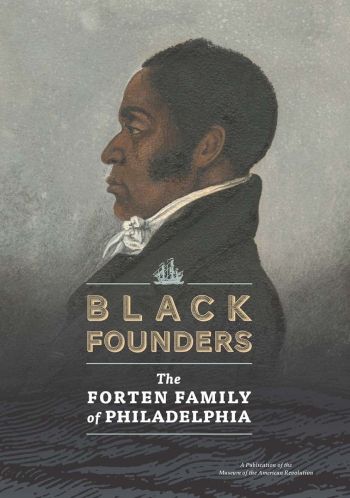 When James Forten (1766–1842) walked the streets of Philadelphia as a young man in the 1770s, he was surrounded by the sights and sounds of transformation. He heard the words of the Declaration of Independence read aloud for the first time in 1776 before setting sail to fight for independence in 1781. Born a free person of African descent, Forten built upon his coming-of-age in a revolutionary city and his wartime experience to forge himself into a changemaker in Philadelphia and the young United States, becoming a successful businessman, philanthropist, and stalwart abolitionist.
In our new special exhibition Black Founders: The Forten Family of Philadelphia, the Museum introduces visitors to Forten and his descendants as they navigated the American Revolution and cross-racial relationships in Philadelphia to become leaders in the abolition movement in the lead-up to the Civil War and the women’s suffrage movement. Using objects, documents, and immersive environments, Black Founders: The Forten Family of Philadelphia explores the Forten family’s roles in the Revolutionary War, business in Philadelphia, and abolition and voting rights from 1776 to 1876.
The exhibition features more than 100 historical artifacts, works of art, and documents from 38 different lenders, including both institutions and private collectors, as well as the Museum’s own collection. Rare historical objects on loan from descendants of the Forten family are on view for the very first time in a public exhibit.
The unique journey and exceptional story of this family of Revolutionaries explores the legacy of the American Revolution, the history of the American experiment of liberty, equality, and self-government, and the ongoing work to improve the nation’s dedication to the principle that “all men are created equal.”
Black Founders: The Forten Family of Philadelphia (Philadelphia: Museum of the American Revolution, 2023), ISBN: 978-1933153445, $38.
New Book | Woodland Imagery in Northern Art, c.1500–1800
From Lund Humphries:
Leopoldine van Hogendorp Prosperetti, Woodland Imagery in Northern Art, c.1500–1800: Poetry and Ecology (London: Lund Humphries, 2022), 160 pages, ISBN: 978-1848224940, £45 / $80.
 Woodland Imagery in Northern Art reconnects us with the woodland scenery that abounds in Western painting, from Albrecht Dürer’s intense studies of verdant trees, to the works of many other Northern European artists who captured ‘the truth of vegetation’ in their work. These incidents of remarkable scenery in the visual arts have received little attention in the history of art, until now. Prosperetti brings together a set of essays which are devoted to the poetics of the woodlands in the work of the great masters, including Claude Lorrain, Jan van Eyck, Jacob van Ruisdael, Peter Paul Rubens, Rembrandt and Leonardo da Vinci, amongst others. Through an examination of aesthetics and eco-poetics, this book draws attention to the idea of lyrical naturalism as a conceptual bridge that unites the power of poetry with the allurement of the natural world. Engagingly written and beautifully illustrated throughout, Woodland Imagery in Northern Art strives to stimulate the return of the woodlands to the places where they belong—in people’s minds and close to home.
Leopoldine Prosperetti is a writer and academic. She is Instructional Professor in the School of Art at the University of Houston, and has written and edited a number of books including Green Worlds in Early Modern Italy: Art and the Verdant Earth (Amsterdam University Press, 2019) and Landscape and Philosophy in the Art of Jan Brueghel (Ashgate, 2009).
C O N T E N T S
Preface
Introduction
Kindle’s Promise
Dürer’s Linden
Jan van Eyck’s Adoration of the Lamb
The Poet’s Catalogue
The Copse
Survivor Sole
Sights of Tivoli
Love in a Ducal Forest
In the Heart of the Forest
Down by the Riverside
Epilogue
Bibliography
Illustrations
Exhibition | Dutch and Flemish Paintings from Woburn Abbey

Aelbert Cuyp, A Landscape near Calcar with the Artist Sketching, ca. 1652
(Woburn Abbey Collection)
◊ ◊ ◊ ◊ ◊
The collection of Netherlandish works at Woburn Abbey was assembled primarily in the eighteenth and early nineteenth centuries. From the press release for the exhibition:
Mastering the Market: Dutch and Flemish Paintings from Woburn Abbey
The Barber Institute of Fine Arts, University of Birmingham, 17 June — 24 September 2023
Curated by University of Birmingham MA students alongside experts from the Barber and Woburn Abbey
This summer, the Barber Institute of Fine Arts, University of Birmingham, presents a dazzling selection of Dutch and Flemish 17th-century masterpieces from Woburn Abbey, the ancestral home of the Dukes of Bedford. Featuring a dozen Old Master paintings, the exhibition Mastering the Market: Dutch and Flemish Paintings from Woburn Abbey is one of the largest and most significant group of such works from this important ducal collection to be exhibited in a public gallery since the 1950s.
Focused on the themes of patronage and collecting, Mastering the Market is curated by four Art History and Curating MA students from the University of Birmingham, with guidance and supervision from experts at both the Barber Institute and Woburn Abbey. Other aspects of the innovative and dynamic 17th-century Dutch art market will also be explored—from the unique character of artistic culture in the newly independent Dutch Republic, through art dealership and attribution, to the demand for and development of new genres. The burgeoning wealth and rise of the merchant classes in the Netherlands in the 17th century sparked huge demand for portrait commissions, also examined here through fresh interpretations of the works from Woburn Abbey.
Assembled principally by the 4th, 5th, and 6th Dukes of Bedford between the 1730s and 1830s, the Woburn Abbey collection of Dutch and Flemish paintings is one of the finest in private hands in the UK. Works include superb portraits and head studies by Rembrandt Van Rijn, Frans Hals, and Anthony Van Dyck, exquisite landscapes and seascapes by Aelbert Cuyp and Jan van de Cappelle, and lively subject pictures by Jan Steen and David Teniers. The exceptional opportunity to see these paintings together in a public gallery has arisen due to the extensive and ongoing refurbishment of the Abbey.
Key loans include Rembrandt’s Portrait of a Bearded Old Man, 1643, Hals’s Portrait of a Man, c. 1635–38, Van Dyck’s Portrait of a Married Couple, identified as Daniel Mytens and his Wife, c. 1632–34, Cuyp’s A Landscape near Calcar with the Artist Sketching, c. 1652, Steen’s Twelfth Night or ‘Le Roi Boit’, 1670–71, and Van de Cappelle’s A Dutch Harbour with Numerous Fishing Boats, c. 1652–54.
Complementing the Woburn masterpieces is a small selection of the outstanding Dutch and Flemish paintings in the Barber’s own permanent collection, notably Jan Steen’s The Wrath of Ahasuerus, c. 1668–70, Van Dyck’s Ecce Homo, c.1625–26, and Portrait of François Langlois, early 1630s (jointly owned with the National Gallery, London), plus Hals’s Portrait of a Man Holding a Skull, c. 1611–12.
Robert Wenley, Barber Institute Deputy Director, Research and Collections, says: “The exhibition will present the public with the rare opportunity to view these works up close in a gallery setting and facilitate an appreciation of the ways in which patronage and collecting reflected and contributed to a dynamic period of European history. Our talented young team of student curators will also explore the tastes and achievements of the successive Dukes of Bedford as collectors of Dutch and Flemish paintings in the decades following their first purchases on the art market of works from these schools in the early 18th century.”
Professor Jennifer Powell, Director of the Barber Institute, says: “We are delighted to present works from this important collection in Birmingham. The Barber is proud to support this unique opportunity for students of the University of Birmingham to co-curate an exhibition of such exceptional quality in its main gallery programme.”
Matthew Hirst, Curator of the Woburn Abbey Collection, says: “We are delighted to have the opportunity to present these masterpieces from Woburn Abbey alongside other works by the same masters from the Barber’s own choice collection. This opportunity to compare these works and consider the phenomenon of the Dutch and Flemish market is only possible due to the input of the students at this unique time whilst Woburn Abbey is closed to undergo a generational refurbishment project.”
Woburn Abbey houses an outstanding collection of works of art brought together by the family over nearly 500 years. During the closure, there is an active loans programme to share some of these treasures so they can be enjoyed in different contexts. Woburn has partnered with a number of prestigious venues since 2020, including Royal Museums Greenwich, the Holburne Museum, Worcester City Art Gallery, and Gainsborough’s House. Many of the important works of art from the collection have been exhibited in new ways due to these partnerships. Full restoration and renewal of the roof at Woburn Abbey has led to a prolonged closure period. This has enabled these partnerships to continue and expand offering more opportunities to share Woburn’s impressive art collection with a wider audience.
Allegorical Painting of Two Ladies Acquired by Compton Verney

Unidentified painter (British School), Allegorical Painting of Two Ladies Wearing Beauty Patches, detail, ca. 1650s, oil on canvas, 64 × 75 cm. The painting sold at Trevanion, Fine Art and Antiques sale on 23 June 2021 (lot 564) for £220,000.
◊ ◊ ◊ ◊ ◊
From the press release from Compton Verney:
An extremely rare 17th-century painting has been acquired by Compton Verney. Allegorical Painting of Two Ladies, an English School work dating to around 1650 was at risk of permanently leaving the UK after being sold at auction in 2021, but now with generous support from the National Heritage Memorial Fund (NHMF) and V&A Purchase Grants, it will go on display at Compton Verney for the public to enjoy.
This almost unique painting shows two women, one Black and one white, side by side, presented as companions and equals, wearing similar dress, hair, and jewellery. The portrayal of a Black female sitter is highly unusual in this period, especially in showing an adult rather than a child in a position of subservience, thereby inviting important debate about race and gender during the period.
Another remarkable aspect of the painting is the depiction of beauty patches on both the women. Although in vogue at the time, the painting appears to condemn wearing these ‘spots’ as the inscription above the two women declares beauty patches to be a sin of pride, a widespread opinion in the 17th century. This style of work gives the painting an affinity with popular woodcut prints at the time, making it clear the work is allegorical and associating it with satirical verse, pamphlets, and sermons.
Following its sale at auction in 2021, the Reviewing Committee on the Export of Works of Art and Objects of Cultural Interest (RCEWA) agreed the work should remain the nation because of its “outstanding significance” to the study of race and gender in 17th-century Britain. The recent resurfacing of the painting has generated new possibilities for exploring the early history of Black culture in Britain.
Purchased with support from the Arts Council England/V&A Purchase Grant Fund and from the National Heritage Memorial Fund, Two Ladies will go on public display in the UK next year. The painting will now undergo conservation, before being unveiled in a display at Compton Verney in 2024, allowing its complicated narratives to be widely studied and understood.
Geraldine Collinge, Compton Verney CEO says: “We are absolutely delighted to be able to add this hugely important painting to the Compton Verney collection. We are also pleased to be able to work with our colleagues at Yale—their world-class conservation facilities and expertise will restore the work to the highest standard for UK display, along with providing further insight and greater understanding of the painting and its context.”
Dr Simon Thurley CBE, Chair of the National Heritage Memorial Fund, said: “We are delighted that the National Heritage Memorial Fund has been able to support the acquisition of this unique painting and that it will become part of the collection at Compton Verney in perpetuity. This dual portrait provides great opportunities to enrich our understanding of race and gender in the 17th century. We look forward to hearing the outcomes of the research that will be undertaken at Yale and, after the conservation work, seeing the painting displayed at Compton Verney for the UK public to admire and enjoy.”
Andrew Hochhauser KC, Chair of the RCEWA, said: “The Committee and I are extremely pleased that Allegorical Painting of Two Ladies has been saved for the nation and will be on display at Compton Verney. This anonymous mid-17th-century painting is a great rarity: it shows two women with beauty patches, one Black and one white, side by side, presented as companions and equals. The painting will delight audiences and encourage debate about and research into race and gender during the period.”
Call for Papers | The English Georgian North, 1714–1830
From the Call for Papers:
The English Georgian North, 1714–1830: Rethinking Cultures and Connections
Institute of Medieval and Early Modern Studies, Durham University, 15 September 2023
Proposals due by 14 July 2023
This symposium builds on conversations that have been taking place at Durham University over the last fifteen months as part of the IMEMS research strand The Georgian North, designed and led by Professor Fiona Robertson. It sets out to develop new approaches to the intellectual and creative cultures of the northern counties of England in the Georgian period, 1714–1830. Important contributions to knowledge, interpretation, creative practice, and scientific advance were made in the north country during this still largely rural and early industrial period in its history. They took shape in social, professional, and discursive networks of considerable complexity and reach, bringing together artists, abolitionists, antiquaries, architects, writers, theologians, musicians, astronomers, philosophers, mathematicians, botanists, landscape designers, linguists, clergy, social and political reformers, actors, and archaeologists. Yet there has been little connected cross-disciplinary exploration of these cultures, their significance, and their legacies.
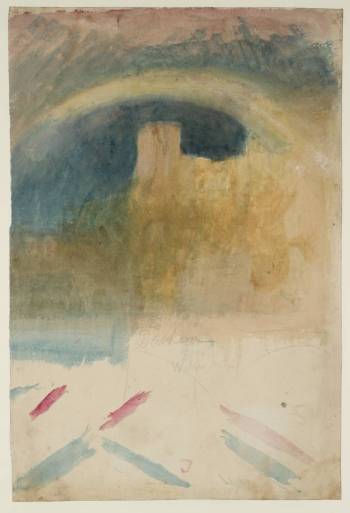
J.M.W. Turner, Durham Cathedral with a Rainbow, ca.1817, graphite and watercolour on paper, 55 × 37 cm (London: Tate, D25247).
We invite proposals for 15-minute papers or presentations to contribute to a day of informal and investigative discussion. Topics of interest include, but are not restricted to
• Environment and conservation
• Abolition, reform, and intervention
• Originality and innovation
• Scientific enquiry, speculation, and new worlds
• Practices of collecting, curation, and display
• Performance: players, theatres, audiences
• Composition: music, painting, poetry, prose fiction, architecture, design
• Ancient pasts: theories and artefacts
• Cultures of belief
• Depletion and rediscovery (buildings, communities, habitats, traditions)
• International and intercultural connections; connections across languages and traditions
• Conversation and exchange (social, professional, and discursive networks, philosophical and historical societies, bookshops, print cultures)
The region under discussion comprises the historic counties of northern England: County Durham, the North Riding of Yorkshire, Northumberland, Cumberland, and Westmorland. Of particular interest, because especially under-researched, is present-day County Durham and the areas immediately bordering it, but we welcome work on all relevant locales and communities. Of the many individuals active in the intellectual and creative cultures of the period, some were permanently settled in the northern counties, while others were here for shorter periods, often under-researched relative to the wider body of scholarship on their work. They are all of significance to our discussion, as are, also equally, the natural and constructed environments of the northern English counties—private and public buildings, landscapes and treescapes, theatres and observatories. All these environments helped shape the formation and development of ideas and many are now lost or under-regarded.
This is a free, in-person symposium, open to researchers across disciplines, with papers and roundtables and an emphasis on discussion and exchange. Teas, coffees, and a light lunch will be provided. There will be at least one online-only follow-up session later in 2023. We invite 300-word proposals for 15-minute papers or presentations. Please submit your proposal via this form by 14 July 2023.
If you cannot attend but are interested in receiving information about the Research Strand and follow-up sessions, you can use the above link to register your interest. We shall respond to all proposal submissions no later than 28 July, after which time further details and the registration link will be made available.










 Enfilade
leave a comment