Exhibition | Ingenious Women, 16th to 18th Centuries

Angelika Kauffmann, Clio, Muse of History, detail, ca. 1770–75 (Augsburg: Schaezlerpalais–Deutsche Barockgalerie; photo by Andreas Brücklmair).
◊ ◊ ◊ ◊ ◊
Opening this fall at the the Bucerius Kunst Forum:
Ingenious Women: Women Artists and Their Companions
Geniale Frauen: Künstlerinnen und ihre Weggefährten
Bucerius Kunst Forum, Hamburg, 14 October 2023 — 28 January 2024
Kunstmuseum Basel, 2 March — 30 June 2024
With the exhibition Ingenious Women: Women Artists and Their Companions, the Bucerius Kunst Forum traces the careers of outstanding women artists (Künstlerinnen) from the sixteenth to the eighteenth century. For the first time, the family context in which the women artists pursued their careers is addressed and made visible through juxtaposition with works by their fathers, brothers, husbands, and fellow painters. Today often forgotten, female artists of their time were able to achieve extraordinary success in a wide variety of family constellations: they became court painters, teachers, entrepreneurs, and even publishers and were awarded the highest honours.
 The exhibition presents around 140 works by 26 women artists, including Sofonisba Anguissola, Judith Leyster, Marietta Robusti (Tintoretto’s daughter), and Angelika Kauffmann. Masterful portraits, still lifes, and historical scenes in painting, along with drawings and prints from across Europe, ranging from the Renaissance and Baroque periods to early Neoclassicism, will be brought together in Hamburg. For the first time, works by women artists will be juxtaposed with those of their male colleagues in such a pointed way that both formal and stylistic similarities and differences will come to the fore.
In the early modern period it was not altogether impossible for women to pursue a career as an artist, but it was definitely outside the norm and therefore always subject to special challenges. Anyone wishing to practice a freelance profession had to join a guild, but some regions denied membership to women, and in others it entailed considerable hurdles and costs. A conspicuous number of women artists of this period came from or married into artistic families. They worked for their fathers, brothers, and husbands, and often in secret. At the royal courts of Europe, the situation was different: with an open mind to artistic achievement—regardless of origin or gender—women were able to work openly as artists at court. Women such as Lavinia Fontana, Anna Dorothea Therbusch, and Rachel Ruysch asserted themselves against social norms, capturing the attention and earned the esteem of their contemporaries. The fact that they fell into oblivion is also due to the history of art scholarship, in which a male gaze dominated until the advanced twentieth century.
The exhibition shows the unique careers of these pioneering women artists and offers new insights into their lives and work, as well as thought-impulses on contemporary issues such as equality and the reconciliation of work and family.
Bodo Brinkmann and Katrin Dyballa, eds., with contributions by Beiträge von B. Brinkmann, K. Dyballa, S. Engel, A. Mensger, R. Müller, S. Salomon, A. Tacke, S. Pisot, I. Wenderholm, and S. Werthemann, Geniale Frauen: Künstlerinnen und ihre Weggefährten (Munich: Hirmer Verlag, 2023), 300 pages, ISBN: 978-3777442365, €45.
Exhibition | Out of the Shadows: Women Artists
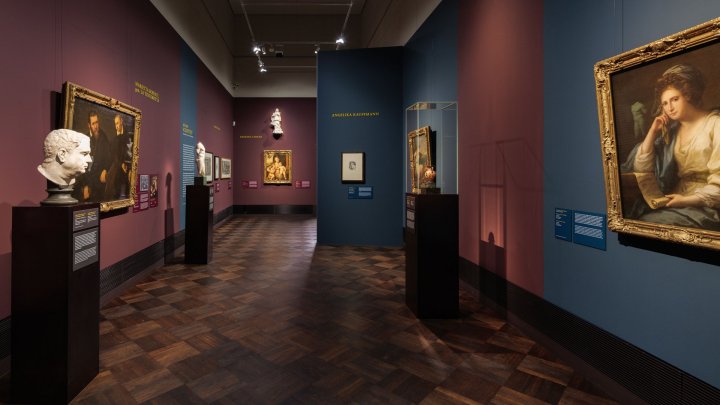
Installation view, Out of the Shadows: Women Artists from the 16th to the 18th Century, Gemäldegalerie Alte Meister at Dresden’s Zwinger, 2023.
◊ ◊ ◊ ◊ ◊
This installation on view at the Zwinger closes in a few weeks:
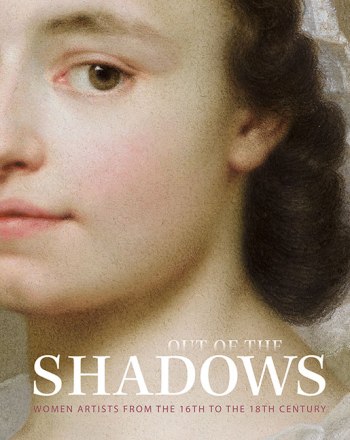
Out of the Shadows: Women Artists from the 16th to the 18th Century
Aus dem Schatten: Künstlerinnen vom 16. bis zum 18. Jahrhundert
Gemäldegalerie Alte Meister, Zwinger, Dresden, 12 May — 20 August 2023
With this cabinet exhibition, the Gemäldegalerie Alte Meister turns its attention to women artists (Künstlerinnen) from the 16th to the 18th century, who for a long time have been overshadowed by the ‘Great Masters’ of art history. With their works represented in the collection, they are a minority, and to this day their names are far less familiar than those of their male counterparts. This is not due to inability, but to a structural discrimination that is perpetuated in art historiography.
 Women generally were not allowed formal academic training nor drawing from live (nude) models. Only a few women were lucky enough to grow up and be promoted in an artistic environment, so that institutional and social structures did not necessarily hinder their advancement. In many cases, they were the daughters of artists trained in their father’s workshop.
The cosmopolite Angelika Kauffmann (1741–1807) achieved widespread recognition in her lifetime and is also represented here with five works. In a time when only men were seen as true artists and women were credited, at most, with talent but never genius, the painter managed to assert herself by also being a shrewd strategist and self-promotor. She produced numerous history paintings with references to antiquity in which women take the leading roles.
Lavinia Fontana (1552–1614) was one of the first women of the modern period to work as an independent artist. She painted numerous portraits and history paintings of mythological and biblical themes, some of them in large format. The devotional painting in Dresden, The Holy Family, is an early work by the Bolognese artist which, after undergoing restoration, will be included in the show in mid-August.
This concentrated presentation also features copperplate engravings by Diana Scultori from the holdings of the Kupferstich-Kabinett as well as paintings and prints by other noteworthy women artists such as Elisabetta Sirani, Barbara Longhi, Rachel Ruysch, Maria van Oosterwijck, and Theresa Concordia Mengs.
Stephan Koja and Iris Yvonne Wagner, Out of the Shadows: Women Artists from the 16th to the 18th Century (Dresden: Staatliche Kunstsammlungen Dresden, 2023), 144 pages, ISBN: 978-3954987559 (German edition) / ISBN: 978-3954987696 (English edition), €34.










 Enfilade
leave a comment