The Magazine of the Decorative Arts Trust, Summer 2023
The Decorative Arts Trust has shared select articles from the summer issue of their member magazine as online articles for all to enjoy. The following pieces are relevant to the eighteenth century:
The Magazine of the Decorative Arts Trust, Summer 2023

The magazine cover features Ickworth Hall, a site which Decorative Arts Trust members visited during a recent study trip to East Anglia.
• Matthew A. Thurlow, “Hervey Silver at Ickworth” Link»
• Debbie Miller, “Privies, Puzzles, and Pots: The Archaeology of Philadelphia Ceramics” Link»
• Jorge F. Rivas Pérez, “The Material World of the Spanish Colonial Estrado” Link»
• Foong Ping, “Chronicles of a Global East: Seattle Art Museum Exhibition Examines Silk Roads and Maritime Routes” Link»
• William Keyse Rudolph, “Luxury and Passion: Inventing French Porcelain at the Nelson-Atkins Museum of Art” Link»
• Bethany McGlyn, “Completing the Picture: New Research into Craft, Slavery, and Servitude in Early Lancaster” Link»
• Susan Eberhard, “Chinese Metalwork and English Restoration Silver in the ‘Chinese Taste’” Link»
The print Magazine of the Decorative Arts Trust is mailed to Trust members twice per year. Memberships start at $50, with $25 student memberships.
Exhibition | Luxury and Passion: Inventing French Porcelain
Now on view at The Nelson-Atkins:
Luxury and Passion: Inventing French Porcelain
The Nelson-Atkins Museum of Art, Kansas City, 13 August 2022 — 12 August 2024
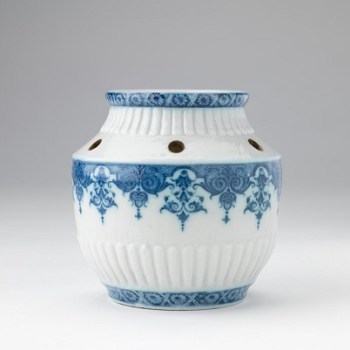
Designed by Louis Poterat, made by Louis Poterat Manufactory (Rouen, France, 1690–1696), potpourri jar, ca. 1690–96, soft-paste porcelain with underglaze enamel decoration, 12.4 × 11.4 cm (Kansas City, Missouri: The Nelson-Atkins Museum of Art, 2021.10).
Luxury and Passion celebrates the debut of a new acquisition, one of the earliest pieces of soft-paste porcelain made in France in the late 17th century. A potpourri jar, one of the handful of experimental pieces made by the Poterat Manufactory in Rouen, France, is one of only about a dozen surviving works by this brief-lived company, and only the second example in a US museum–only four exist in museums worldwide. The new acquisition gives us the opportunity to feature almost the entire collection of the museum’s important 18th-century French porcelain holdings. In this focus installation, the Nelson-Atkins explores how France launched itself into the domestic porcelain industry in the 17th and 18th centuries. This beautiful, durable type of ceramic was the focus of intense competition among European superpowers, all who raced to discover how to make this ‘white gold’ for themselves, after falling in love with imported Asian wares.
New Book | Brittle Beauty
Published by Paul Holberton and distributed by The University of Chicago Press:
Andreina d’Angeliano, Claudia Lehner-Jobst, Errol Manners, Rosalind Savill, Selma Schwartz, and Jeffrey Munger, Brittle Beauty: Reflections on 18th-Century European Porcelain (London: Ad Ilissvm, 2023), 560 pages, ISBN: 978-1912168293, £90 / $110.
 Brittle Beauty presents a superlative private collection of European porcelain—radical, rare, and in many cases unique pieces assembled over thirty years. Lavishly illustrated and insightfully researched, the book showcases eighty vessels and sculptures and includes accounts of their patrons and former owners, many as eccentric as the works themselves.
One striking attribute of porcelain is its reflective glaze. Mirror-like in a wider sense, Brittle Beauty: Reflections on 18th-Century European Porcelain examines the context in which this porcelain was created—including cultural, political, topographical, and ceremonial aspects. It also looks at related materials such as silver, textiles, and glass.
The 18th century was the golden age of porcelain in Europe, which had previously been dependent on precious imports from the Far East. The discovery of the formula for hard-paste porcelain in Dresden in 1709 inspired the establishment of manufactories throughout the Continent. However, its popularity was not purely commercial: porcelain—with its meld of art and science, beauty and intellect, East and West—became a symbol of Enlightenment culture for every princely court. Oriental motifs and European forms were synthesised with deceptive subtlety; later, creations of pure fantasy emerged, often based on travellers’ accounts of exotic lands. Familiar Occidental themes such as nature, hunting, or archaeology were paralleled by ironic narratives of love and vanity. Porcelain, with its fragile allure, is uniquely expressive of the human comedy, yet its destiny has often been brutal and tragic. This book features essays from several eminent scholars. It also showcases a wealth of stunning imagery from Sylvain Deleu, who expertly photographed the pieces, many for the first time.
Andreina d’Agliano art historian and curator, is a specialist in porcelain from Turin and Florence and has published various private and public collections.
Claudia Lehner-Jobst is an art historian specializing in European decorative arts, notably du Paquier porcelain, and Director of the Augarten Porcelain Museum, Vienna.
Errol Manners, FSA is a dealer in antique ceramics based in London and the former Chair of The French Porcelain Society and of the Ceramics Vetting Committee at TEFAF (Maastricht) and Masterpiece (London).
Dame Rosalind Savill, DBE, FBA, FSA, worked at the Victoria and Albert Museum and at the Wallace Collection (where she was Director from 1992 until 2011), and has published widely on Sèvres porcelain.
Selma Schwartz, an independent scholar, was Deputy Keeper and Curator of Porcelain at the Rothschild Collection, Waddesdon Manor for over 25 years.
Jeffrey Munger is a former curator in the Department of European Sculpture and Decorative Arts at the Metropolitan Museum of Art, New York.










 Enfilade
2 comments