New Book | My Dark Room
From The University of Chicago Press:
For 30% off US orders, visit http://www.press.uchicago.edu and enter code MDR30 at checkout (expires 31 December 2023). For 30% off UK and European orders, call +44 (0) 1243 843291 or email chicago.csd@wiley.com and redeem with promo code MDR30 (expires 7 September 2023).
Julie Park, My Dark Room: Spaces of the Inner Self in Eighteenth-Century England (Chicago: The University of Chicago Press, 2023), 344 pages, ISBN: 978-0226824758 (cloth), $105 / ISBN: 978-0226824765 (paper), $35. Also available as a PDF.
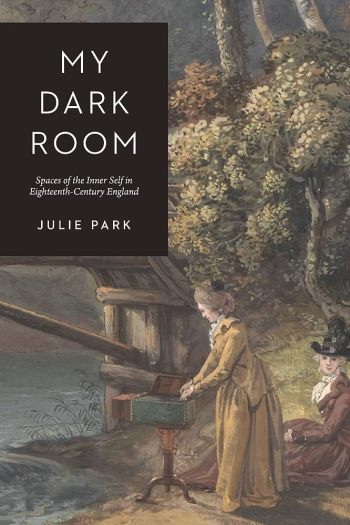 Examines spaces of inner life in eighteenth-century England to shed new light on interiority in literature and visual and material culture.
In what kinds of spaces do we become most aware of the thoughts in our own heads? In My Dark Room, Julie Park explores places of solitude and enclosure that gave eighteenth-century subjects closer access to their inner worlds: grottos, writing closets, landscape follies, and the camera obscura, that beguiling ‘dark room’ inside which the outside world in all its motion and color is projected. The camera obscura and its dreamlike projections within it served as a paradigm for the everyday spaces, whether in built environments or in imaginative writing, that generated the fleeting states of interiority eighteenth-century subjects were compelled to experience and inhabit.
My Dark Room illuminates the spatial and physical dimensions of inner life in the long eighteenth century by synthesizing material analyses of diverse media, from optical devices and landscape architecture to women’s intimate dress, with close readings of literary texts not traditionally considered together, among them Andrew Marvell’s country house poem Upon Appleton House, Margaret Cavendish’s experimental epistolary work Sociable Letters, Alexander Pope’s heroic verse epistle Eloisa to Abelard, and Samuel Richardson’s novel Pamela. Park also analyzes letters and diaries, architectural plans, prints, drawings, paintings, and more, drawing our attention to the lively interactions between spaces and psyches in private environments. Park’s innovative method of ‘spatial formalism’ reveals how physical settings enable psychic interiors to achieve vitality in lives both real and imagined.
Julie Park is Paterno Family Librarian for Literature and professor of English at the Pennsylvania State University. She is the author of The Self and It: Novel Objects in Eighteenth-Century England and coeditor of Organic Supplements: Bodies and Things of the Natural World, 1580–1790.
c o n t e n t s
Introduction
1 Country House: Making Storylines at Nun Appleton
2 Closet: Margaret Cavendish’s Writing Worlds
3 Grotto: Design and Projection in Alexander Pope’s Garden
4 Pocket: Pamela’s Mobile Settings and Spatial Forms
5 Folly: Fictions of Gothic Space in Eighteenth-Century Landscapes
Epilogue
Acknowledgments
Notes
Bibliography
Index
◊ ◊ ◊ ◊ ◊
Note (added 8 August) — The posting was updated to include the discount code.










 Enfilade
leave a comment