Yale Launches LUX to Search Collections
As announced earlier this summer, from Yale News:
Mike Cummings, “17 Million Reasons to Love ‘LUX,’ Yale’s New Collections Search Tool,” Yale News (1 June 2023). Yale introduces LUX, a groundbreaking custom search tool for exploring the university’s unparalleled holdings of artistic, cultural, and scientific objects.
Yale University’s museums, libraries, and archives contain vast troves of cultural and scientific heritage that fire curiosity and fuel research worldwide. Now there’s a simple new way to make astonishing connections among millions of objects.
Starting today, anyone can explore the university’s unparalleled holdings online through LUX: Yale Collections Discovery—a groundbreaking discovery and research platform that provides single-point access to more than 17 million items, including defining specimens of dinosaur fossils, illuminated medieval manuscripts, paintings by Vincent van Gogh and J. M. W. Turner, and the archives of Langston Hughes, Gertrude Stein, and other renowned literary figures.
Free and easy to use, the platform—a powerful kind of database that maps relationships—helps users find clear pathways through the collections and uncover links between objects that might otherwise seem unconnected, such as a fish fossil and an 18th-century sketch of a young woman. Previously there was no easy way to search multiple collections at once or discern associations among the objects within them.
Developed by Yale over the past five years, LUX encompasses the collections of the Yale Center for British Art (YCBA), the Yale University Art Gallery, the Yale Peabody Museum, and Yale University Library, which includes the Beinecke Rare Book and Manuscript Library, the Lewis Walpole Library, and specialized collections devoted to the arts, music, film, history of medicine, and religion. The Mellon Foundation, the nation’s largest funder of the arts and humanities, funded key aspects of the project and was instrumental in its completion. . . .
Ayesha Ramachandran, associate professor of comparative literature in Yale’s Faculty of Arts and Sciences, has experimented with LUX, and calls it a “terrific tool” for teaching and conducting research.
“I was struck by the way LUX is constructed to be a tool of exploration and not just a database,” Ramachandran said. “It is extremely intuitive and conceptually organized to allow you to drill down to learn more about the object of your search.”
Call for Papers | 2024 Wallace Seminars in the History of Collecting
From the Call for Papers:
Seminars in the History of Collecting, 2024
The Wallace Collection, London, last Monday of the Month
Proposals due by 1 September 2023
The seminar series was established as part of the Wallace Collection’s commitment to the research and study of the history of collections and collecting, especially in the 18th and 19th centuries in Paris and London. We are keen to encourage contributions covering all aspects of the history of collecting, including:
• Formation and dispersal of collections
• Dealers, auctioneers, and the art market
• Collectors
• Museums
• Inventory work
• Research resources
The seminars, which are normally held on the last Monday of every month during the calendar year, excluding August and December, act as a forum for the presentation and discussion of new research into the history of collecting. Seminars are open to curators, academics, historians, archivists, and all those with an interest in the subject. Papers should generally be 45–60 minutes long. Seminars take place between 5.30 and 7.00pm. The seminars will take place jointly at the Wallace Collection and Bonhams, and online.
If interested, please send a short text (500 words), a brief CV, and indicate any months when you would not be available to speak, by Friday 1 September 2023. Please note: if your paper is accepted, you will need to send us your paper’s title (maximum 90 characters with spaces), a 200-word abstract, a 50-word bio, and one image with its caption for promotional purposes. For more information and to submit a proposal, please contact: History.OfCollecting@wallacecollection.org
Please note that we are able to contribute up to the following sums towards speakers’ travelling expenses on submission of receipts:
• Speakers within the UK – £100
• Speakers from Continental Europe – £180
• Speakers from outside Europe – £300
The series is supported by Bonhams.
Laure Marest Named Curator of Ancient Coins at Harvard Art Museums
From the press release (4 August 2023) . . .
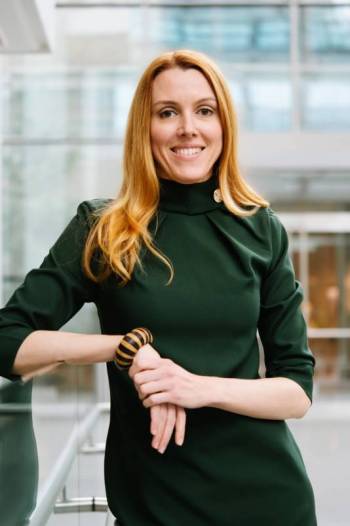
Laure Marest’s research interests include ancient Greek art, especially coins, engraved gems, and Hellenistic portraits, as well as the reception of antiquity in the 18th and 19th centuries. Photo by Mike Ritter.
Martha Tedeschi, the Elizabeth and John Moors Cabot Director of the Harvard Art Museums, today announced the appointment of Laure Marest as the new Damarete Associate Curator of Ancient Coins—one of the few numismatic positions based at a U.S. university museum. Marest will lead the charge in rethinking the presentation of the museums’ sizable collection of ancient Greek, Roman, Byzantine, and other coins, as well as related objects, and in proposing fresh perspectives for the field through programs and publishing. She will begin her new role at Harvard on 18 September 2023.
Marest is currently the Cornelius and Emily Vermeule Associate Curator of Greek and Roman Art at the Museum of Fine Arts, Boston, where she was previously assistant curator from 2017 to 2022. While at the MFA, she co-curated The Marlborough Gem (2023) and worked with colleagues to renovate and install five new permanent collection galleries featuring the art of ancient Greece, Rome, and the Byzantine Empire, which opened in December 2021. Marest was the lead curator for the Gods and Goddesses Gallery, a major display of large-scale sculptures of ancient Greek and Roman deities—including the MFA’s monumental Juno—and more intimate objects used for religious rituals. She also is author of a forthcoming publication on the collection of ancient Greek and Roman engraved gems at the MFA.
In her role at the Harvard Art Museums, Marest will join the Division of Asian and Mediterranean Art and oversee the museums’ numismatic collection. Working with colleagues across the museums and the Harvard campus, as well as with community stakeholders, she will participate in a museum-wide rethinking and reframing of the museums’ permanent collections galleries and contribute to exhibitions and publications. She will research the current numismatic holdings and make acquisitions to diversify the collection. She will also work closely with students and faculty to continue to expand use of the collection in undergraduate and graduate teaching across disciplines; she will mentor students and curatorial fellows, training and nurturing the next generation in her field.
“We are delighted to welcome Laure to the Harvard Art Museums,” said Tedeschi. “Harvard students and our public audiences have long been fascinated with ancient coins, which feature prominently in our collection galleries. Laure’s expertise across different media and her wide-ranging interests and passion for inclusive storytelling will further expand our efforts to connect visitors to the peoples and cultures of the ancient Mediterranean and Middle East.”
“I am excited to join the Harvard community and to work closely with colleagues across the museums and faculty to animate the numismatic collection and rethink the permanent displays,” said Marest. “And it is a great honor to succeed Carmen Arnold-Biucchi, a grande dame in the field, in this position, which itself was named after Damarete, an exemplary female ruler of Syracuse whose deeds were praised in antiquity.”
Marest has previously held teaching positions at the University of California, Berkeley, and California State University, Northridge, as well as curatorial assistant and intern positions in the Department of Antiquities at the J. Paul Getty Museum, Los Angeles. At the Getty, she assisted with several exhibitions, including Modern Antiquity: Picasso, De Chirico, Léger and Picabia in the Presence of the Antique (2011–12), The Art of Ancient Greek Theater (2010–11), Collector’s Choice: J. Paul Getty and His Antiquities (2009–10), and Carvers and Collectors: The Lasting Allure of Ancient Gems (2009).
Marest received her PhD at the University of California, Berkeley, and holds degrees from California State University, Northridge, and the Sorbonne, Paris. She has participated in excavations in Albania and Italy and was previously involved as a researcher and photographer for the Pompeii Artifact Life History Project and as a gem specialist and photographer for the Pompeii Archaeological Research Project: Porta Stabia. Her research interests include ancient Greek art, especially coins, engraved gems, and portraiture of the Hellenistic period, as well as the reception of antiquity in the 18th and 19th centuries. She has presented at numerous conferences throughout the United States and has published in the American Journal of Numismatics and contributed to Hellenistic Sealings & Archives: Proceedings of The Edfu Connection, an International Conference (2021) for the Studies in Classical Archaeology series, and to Proceedings of the XV International Numismatic Congress (2017).
Comprising over 20,000 coins, the numismatic collection of the Harvard Art Museums is comprehensive and ideally suited for teaching. Greek, Roman, and Byzantine coins from c. 630 BCE to 1453 CE form the core of the collection, but it also features examples of (west) Asian, Islamic, western medieval, and later coins. Thanks to the long-term loan of the Arthur Stone Dewing Collection, the museums’ holdings of Greek coinage are particularly strong and include the world’s largest collection of Syracusan decadrachms. The coin collection has grown steadily through bequests, gifts, and purchases over the last 125 years. Among these, the Thomas Whittemore bequest of Byzantine coins is especially notable. The bequest of Frederick M. Watkins contains Greek and Roman coins of exceptional quality. The 2005 acquisition of the collection of Margarete Bieber, the 2008 acquisition of the Zvi Griliches Collection, and the transfer of the Alice Corinne McDaniel Collection from Harvard University’s Department of the Classics have significantly enriched the holdings of ancient Greek, Roman, and Jewish coins.










 Enfilade
leave a comment