Call for Applications | Making Her Mark: Exhibition Study Day

From the Call for Applications:
Making Her Mark: Exhibition Study Day
Baltimore Museum of Art, 23 October 2023
Applications due by 6 September 2023
The Baltimore Museum of Art and the Art Gallery of Ontario are delighted to be co-organizing the exhibition Making Her Mark: A History of Women Artists in Europe, 1400–1800, scheduled to run from 1 October 2023 to 7 January 2024 in Baltimore and from 30 March until 1 July of 2024 in Toronto. Curated by Andaleeb Badiee Banta, BMA Senior Curator of Prints, Drawings & Photographs, and Alexa Greist, AGO Associate Curator and R. Fraser Elliott Chair, Prints & Drawings, this exhibition presents a feminist revision of early modern European art. An invitational study day will be held in the exhibition galleries at the BMA, where scholars and the exhibition curators will facilitate discussions around the themes and objects on display. Advanced graduate students and early career professionals from diverse humanistic disciplines are invited to apply to participate. Up to 10 selected participants will receive a $250 travel stipend, made possible by a generous grant from the Kress Foundation, to offset travel costs.
As the first North American exhibition in over forty years to stage such an expansive woman artist-centered approach to Renaissance, Baroque, and 18th-century European art, Making Her Mark will be unique in its presentation of a wide range of materials, media, and scale, foregrounding quality works made by women, many of whom remain largely unfamiliar to general and specialist audiences. Exemplary works by well-known artistic ‘heroines’ such as Sofonisba Anguissola, Lavinia Fontana, Artemisia Gentileschi, Judith Leyster, Luisa Roldán, Rosalba Carriera, and Rachel Ruysch will join exceptional products of women-led workshops, female artisanal collectives, and talented amateurs who operated outside of the male-dominated professional arena. Expanding beyond the traditional focus on the ‘major arts’ of large-scale painting and sculpture, Making Her Mark aims to be a bold corrective to the historical assumption that women artists and makers of this period were rare and relatively untalented. This presentation will consider the entire European continent and seeks to subvert the typical monographic format, identifying it as an inherently sexist critical apparatus that encouraged the classification of women artists as anomalous.
The exhibition’s scope is purposefully broad, both temporally and geographically, in order to allow for differences in individual social circumstances, power dynamics, and cultural context, and to address the careers of women artists who had transnational reputations and relationships. Bringing together such varied objects will present them through a wider lens, one that includes creative production by female practitioners who did not or could not subscribe to male-determined criteria for what constituted important or legitimate art. Thematic groupings on the themes of power, faith, interiority, scientific documentation, empire, professional pathways, and entrepreneurship guide visitors through a wide variety of media exploring women’s contributions to the early history of botany, zoology, and epistemology; book arts; religious and history subjects; print culture; textile production; ceramics; wax modeling; metalwork; and courtly and private portraiture. A diverse presentation of works brilliantly illuminates the fact that women were involved with all manner of artistic production and contributed to nearly every aspect of early modern visual culture, even if their names were not recorded for posterity.
We invite applications from advanced graduate students as well as early career scholars who are no more than five years out from degree conferral. The ideal applicant will be engaged with the study of early modern women and materiality. We welcome applications from scholars working in disciplines outside of art history. In order to minimize the cost of attendance, we are pleased to offer accepted applicants free entrance to the exhibition and a $250 travel stipend, generously provided by the Kress Foundation.
To be considered for participation and the travel grant, please submit a one-page CV. Additionally, please provide a brief summary (not to exceed 250 words) of your interest and how this experience in the exhibition will benefit your current work. Application materials should be sent to Theresa Kutasz Christensen at TChristensen@artbma.org. We cannot consider applications received after Wednesday, September 6th. Selected applicants will be notified of their acceptance by September 22nd.
Exhibition | Ingenious Women, 16th to 18th Centuries

Angelika Kauffmann, Clio, Muse of History, detail, ca. 1770–75 (Augsburg: Schaezlerpalais–Deutsche Barockgalerie; photo by Andreas Brücklmair).
◊ ◊ ◊ ◊ ◊
Opening this fall at the the Bucerius Kunst Forum:
Ingenious Women: Women Artists and Their Companions
Geniale Frauen: Künstlerinnen und ihre Weggefährten
Bucerius Kunst Forum, Hamburg, 14 October 2023 — 28 January 2024
Kunstmuseum Basel, 2 March — 30 June 2024
With the exhibition Ingenious Women: Women Artists and Their Companions, the Bucerius Kunst Forum traces the careers of outstanding women artists (Künstlerinnen) from the sixteenth to the eighteenth century. For the first time, the family context in which the women artists pursued their careers is addressed and made visible through juxtaposition with works by their fathers, brothers, husbands, and fellow painters. Today often forgotten, female artists of their time were able to achieve extraordinary success in a wide variety of family constellations: they became court painters, teachers, entrepreneurs, and even publishers and were awarded the highest honours.
 The exhibition presents around 140 works by 26 women artists, including Sofonisba Anguissola, Judith Leyster, Marietta Robusti (Tintoretto’s daughter), and Angelika Kauffmann. Masterful portraits, still lifes, and historical scenes in painting, along with drawings and prints from across Europe, ranging from the Renaissance and Baroque periods to early Neoclassicism, will be brought together in Hamburg. For the first time, works by women artists will be juxtaposed with those of their male colleagues in such a pointed way that both formal and stylistic similarities and differences will come to the fore.
In the early modern period it was not altogether impossible for women to pursue a career as an artist, but it was definitely outside the norm and therefore always subject to special challenges. Anyone wishing to practice a freelance profession had to join a guild, but some regions denied membership to women, and in others it entailed considerable hurdles and costs. A conspicuous number of women artists of this period came from or married into artistic families. They worked for their fathers, brothers, and husbands, and often in secret. At the royal courts of Europe, the situation was different: with an open mind to artistic achievement—regardless of origin or gender—women were able to work openly as artists at court. Women such as Lavinia Fontana, Anna Dorothea Therbusch, and Rachel Ruysch asserted themselves against social norms, capturing the attention and earned the esteem of their contemporaries. The fact that they fell into oblivion is also due to the history of art scholarship, in which a male gaze dominated until the advanced twentieth century.
The exhibition shows the unique careers of these pioneering women artists and offers new insights into their lives and work, as well as thought-impulses on contemporary issues such as equality and the reconciliation of work and family.
Bodo Brinkmann and Katrin Dyballa, eds., with contributions by Beiträge von B. Brinkmann, K. Dyballa, S. Engel, A. Mensger, R. Müller, S. Salomon, A. Tacke, S. Pisot, I. Wenderholm, and S. Werthemann, Geniale Frauen: Künstlerinnen und ihre Weggefährten (Munich: Hirmer Verlag, 2023), 300 pages, ISBN: 978-3777442365, €45.
Exhibition | Out of the Shadows: Women Artists
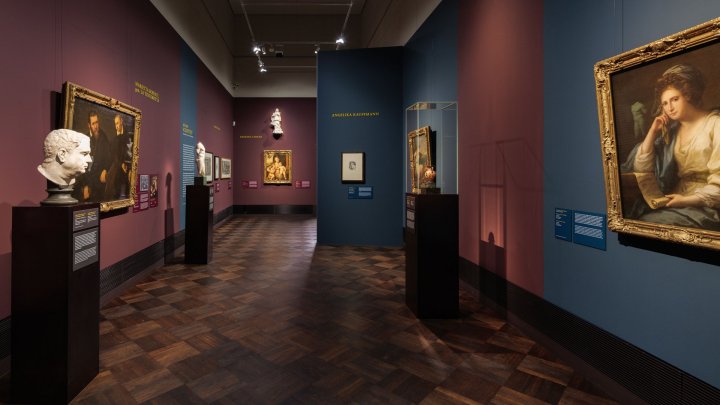
Installation view, Out of the Shadows: Women Artists from the 16th to the 18th Century, Gemäldegalerie Alte Meister at Dresden’s Zwinger, 2023.
◊ ◊ ◊ ◊ ◊
This installation on view at the Zwinger closes in a few weeks:
Out of the Shadows: Women Artists from the 16th to the 18th Century
Aus dem Schatten: Künstlerinnen vom 16. bis zum 18. Jahrhundert
Gemäldegalerie Alte Meister, Zwinger, Dresden, 12 May — 20 August 2023
With this cabinet exhibition, the Gemäldegalerie Alte Meister turns its attention to women artists (Künstlerinnen) from the 16th to the 18th century, who for a long time have been overshadowed by the ‘Great Masters’ of art history. With their works represented in the collection, they are a minority, and to this day their names are far less familiar than those of their male counterparts. This is not due to inability, but to a structural discrimination that is perpetuated in art historiography.
 Women generally were not allowed formal academic training nor drawing from live (nude) models. Only a few women were lucky enough to grow up and be promoted in an artistic environment, so that institutional and social structures did not necessarily hinder their advancement. In many cases, they were the daughters of artists trained in their father’s workshop.
The cosmopolite Angelika Kauffmann (1741–1807) achieved widespread recognition in her lifetime and is also represented here with five works. In a time when only men were seen as true artists and women were credited, at most, with talent but never genius, the painter managed to assert herself by also being a shrewd strategist and self-promotor. She produced numerous history paintings with references to antiquity in which women take the leading roles.
Lavinia Fontana (1552–1614) was one of the first women of the modern period to work as an independent artist. She painted numerous portraits and history paintings of mythological and biblical themes, some of them in large format. The devotional painting in Dresden, The Holy Family, is an early work by the Bolognese artist which, after undergoing restoration, will be included in the show in mid-August.
This concentrated presentation also features copperplate engravings by Diana Scultori from the holdings of the Kupferstich-Kabinett as well as paintings and prints by other noteworthy women artists such as Elisabetta Sirani, Barbara Longhi, Rachel Ruysch, Maria van Oosterwijck, and Theresa Concordia Mengs.
Stephan Koja and Iris Yvonne Wagner, Out of the Shadows: Women Artists from the 16th to the 18th Century (Dresden: Staatliche Kunstsammlungen Dresden, 2023), 144 pages, ISBN: 978-3954987559 (German edition) / ISBN: 978-3954987696 (English edition), €34.
Call for Essays | The Material History of the Visually Altered Book

Extra-illustrated copy of Johann Amos Comenius, Orbis Sensualium Pictus, translated by Charles Hoole, 12th edition, (London, 1777) in Bodleian Library, Vet.A6.e.2518.
◊ ◊ ◊ ◊ ◊
Extra Extra: The Material History of the Visually Altered Book
A collection of essays edited by Julie Park and Adam Smyth
Proposals due by 31 August 2023
Julie Park and Adam Smyth invite proposals for essays to be included in an edited collection on the long history of the extra-illustrated book. Extra-illustration had a vital flowering in late-eighteenth and nineteenth-century culture, but what are the earlier roots of this practice in medieval and early modern cultures and what are the legacies today? The editors welcome proposals by contributors from different backgrounds, career stages, disciplines, and fields (art historians, book historians, book artists, book sellers, curators and librarians, media studies scholars, and more) to consider the methods, materials, forms, and consequences of extra-illustration as a transhistorical medium and activity. Long before and well after Richard Bull’s pivotal act of reconstructing James Granger’s Biographical History of England (1769) by affixing engraved prints to illustrate its textual body, book readers and makers have added images to pre-existing works of writing, fundamentally altering their physical design and composition, and destabilizing categories of book, art and object in doing so. How might we consider, for instance, medieval books, continually modified by their owners with added images and text, or the contemporary artist’s book, frequently an alteration of a previously printed book object through added visual elements, as forms of extra-illustration?
How might we think of extra-illustration in terms of a series of tensions: between amplification (the book extrapolated) and destruction (the book blown up); between the classificatory logic of James Granger and chaos; between order and flux; between the iconophilic and the iconoclastic. Is extra-illustration an erotic, libidinal process? Is it a respectable activity for a quiet drawing room, or is it, in Holbrook Jackson’s words, “a singularly perverted idea”? What is the extra-illustrated volume’s relationship to the codex: tribute, or parody? What is the politics of extra-illustration? Is extra-illustration connected to retreat and consolation, or is it driven by a grasping, colonial ambition? Is it a radical upending of ideas of order and convention, or is it an assertion of hierarchy? How do we read—or how did readers read—these combinatory texts? And are there extra-illustrators who occupy a particularly important place in this tradition—figures like Charlotte and Alexander Sutherland, perhaps, or Richard Bull, or John Kitto?
Please submit proposals of 175–250 words, with a brief (one-page) CV, to Julie Park (jvp6261@psu.edu) and Adam Smyth (adam.smyth@ell.ox.ac.uk) by 31 August 2023.
The Burlington Magazine, June 2023
The eighteenth century in the June issue of The Burlington (with apologies for being so slow to post, –CH) . . .
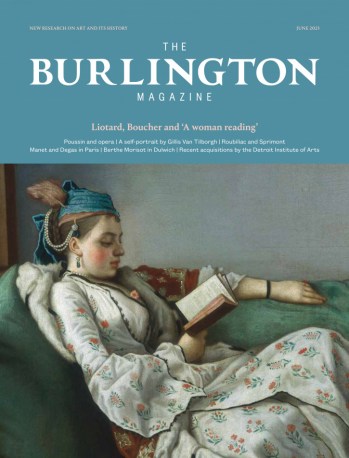
The Burlington Magazine 165 (June 2023)
 e d i t o r i a l
• “The Future of the RIBA Drawings Collection,” p. 583.
a r t i c l e s
• Tessa Murdoch, “Roubiliac and Sprimont: A Friendship Revisited,” pp. 600–11.
Recent research into the circles of Huguenot artists and craftsmen working in London in the mid-eighteenth century has provided new evidence about the friendship and working relationship between the sculptor Louis-François Roubiliac and the goldsmith Nicholas Sprimont. This lends weight to the belief that Roubiliac provided small models for casting in silver and bronze as well as for the porcelain manufactory co-founded by Sprimont in Chelsea in 1745.
• Perrin Stein, “Liotard and Boucher: A Question of Precedence,” pp. 612–19.
There has been much debate about whether Liotard or Boucher invented the motif of a woman in Turkish costume reading a book while reclining on a sofa, which appears in both their work in the 1740s. New evidence that resolves the question highlights the very different ways these two artists constructed exoticism.
• Ann Gunn, “Titian’s Perseus and Andromeda: A Missing Link in the Chain of Provenance,” pp. 620–22.
• Simon Spier and Judith Phillips, “Joséphine Bowes’s Gift to Napoleon III: Antoine-Jean Gros’s Napoleon Distributing the Cross of the Legion of Honour to Artists during His Visit to the Salon of 1808,” pp. 626–29.
r e v i e w s
• Alexandra Gajewski, “The New Museum in the Bibliothèque Nationale, Paris,” pp. 630–37.
When in 1995–98 the books of the Bibliothèque nationale, Paris, were moved to their monumental new home in the west of the city, the library’s historic collections of antiquities, coins, medals, and other precious objects remained in the original complex of buildings in central Paris where they had been shown since the eighteenth century. Their reinstallation in the library’s newly restored museum rooms was opened last year.
• Kirstin Kennedy, Review of the exhibition Treasures from Faraway: Medieval and Renaissance Objects from The Schroder Collection (Strawberry Hill, 2023), pp. 641–43.
• Aileen Dawson, Review of the exhibition English Delftware (Bristol Museum and Art Gallery (from February 2023), pp. 652–54.
• Belinda Thomson, Review of the exhibition Berthe Morisot: Shaping Impressionism (Dulwich Picture Gallery, 2023), pp. 654–57. [In Paris, the show is entitled Berthe Morisot et l’art du XVIIIe siècle: Watteau, Boucher, Fragonard, Perronneau]
• J. V. G. Mallet, Review of Lilli Hollein, Rainald Franz, and Timothy Wilson, eds., Tin-Glaze and Image Culture: The MAK Maiolica Collection in its Wider Context (Arnoldsche Art Publishers, 2022), pp. 660–62.
• Clare Hornsby, Review of Andrew Robinson, Piranesi: Earliest Drawings / I primi disegni (Artemide Edizioni, 2022), pp. 666–67.
• G. A. Bremner, Review of Gauvin Alexander Bailey, The Architecture of Empire: France in India and Southeast Asia, 1664–1962 (McGill-Queen’s University Press, 2022), pp. 667–68
o b i t u a r y
• Peter Hecht, Obituary for Ger Luijten (1956–2022), pp. 675–76.
s u p p l e m e n t
• Recent Acquisitions (2016–22) of European Works of Art at the Detroit Institute of Arts










 Enfilade
leave a comment