The Met | Look Again: European Paintings 1300–1800

Details of European paintings in The Met Collection.
◊ ◊ ◊ ◊ ◊
After a five-year infrastructure project to replace the skylights, The Met’s newly installed galleries of European paintings will open to the public on Monday. For the 18th century, some significant changes have been made to the French, Italian, and British galleries, addressing issues of race, gender, class, and colonialism. A good time to revisit old friends, formulate fresh questions, and discover new favorites! –CH
From The Met:
Look Again: European Paintings 1300–1800
The Metropolitan Museum of Art, New York, opening 20 November 2023
The reopened galleries dedicated to European Paintings from 1300 to 1800 highlight fresh narratives and dialogues among more than 700 works of art from the Museum’s world-famous holdings. The newly reconfigured galleries—which include recently acquired paintings and prestigious loans, as well as select sculptures and decorative art—will showcase the interconnectedness of cultures, materials, and moments across The Met collection.
The chronologically arranged galleries will feature longstanding strengths of the collection—such as masterpieces by Jan van Eyck, Caravaggio, and Poussin; the most extensive collection of 17th-century Dutch art in the western hemisphere; and the finest holdings of El Greco and Goya outside Spain—while also giving renewed attention to women artists, exploring Europe’s complex relationships with New Spain and the Viceroyalty of Peru, and looking more deeply into histories of class, gender, race, and religion.
The reopening of the suite of 45 galleries at the top of the Great Hall staircase (galleries 600–644) follows a five-year project to replace the skylights. This monumental infrastructure project improves the quality of light and enhances the viewing experience for a new look at this renowned collection.
Major support for Look Again: European Paintings 1300–1800 is provided by Candace K. and Frederick W. Beinecke.
Conference | Fischer von Erlach and His Contemporaries
From ArtHist.net:
Court Architects in Europe, ca. 1700: Johann Bernhard Fischer von Erlach and His Contemporaries
Theatermuseum im Palais Lobkowitz, Vienna, 30 November — 2 December 2023
Registration due by 27 November 2023
Scholarly research has described Johann Bernhard Fischer von Erlach (1656–1723) early on as an outstanding artistic personality and has endeavored to contour his built, drawn, and printed oeuvre, which can safely be described by his own word as ungemein (‘extraordinary’). Even if scholars have increasingly been concerned with integrating Fischer into the architectural culture of his time, it has rightly and repeatedly been emphasized that the question of his international profile still requires a broader perspective that takes into account the relationship to his contemporary ‘colleagues’ as well as structural questions. In this sense, the conference aims to examine Fischer’s activities in a broader European context by means of selected thematic fields, thus attempting to sharpen his profile. Registration requested to irina.morze@wienmuseum.at by 27 November.
Organizers
• Institute for Habsburg and Balkan Studies (IHB) der Österreichischen Akademie der Wissenschaften
• Wien Museum
• Institut für Kunstgeschichte der Universität Münster
Concept
Herbert Karner, Jens Niebaum, Andreas Nierhaus
t h u r s d a y , 3 0 n o v e m b e r 2 0 2 3
13.00 Welcome and Introduction
13.30 Section 1 | Architects of Great Courts: Conditions, Scope, Hierarchies
• Anna Mader-Kratky — Fischer von Erlach als kaiserlicher Oberbauinspektor und die institutionellen Rahmenbedingungen des Wiener Hofbauamtes
• Simon Thurley — Sir Christopher Wren and His Contemporaries at Court: British Royal Architects and Architecture, 1660–1714
• Benjamin Ringot — Jules Hardouin-Mansart, from Architect to Administrator: Becoming Louis XIV’s Superintendent of Royal Buildings
• Martin Olin — Architect, Courtier, Police Minister: Nicodemus Tessin the Younger in the Service of Royal Absolutism
• Konrad Ottenheym — Jacob Roman, Hofarchitekt der Oranier um 1700
17.30 Discussion
f r i d a y , 1 d e c e m b e r 2 0 2 3
9.00 Section 2 | Drawing and Prints: Media of Visualisation, Transfer, and Knowledge Production
• Werner Oechslin — „…das Auge zu ergötzen, und denen Künstlern zu Erfindungen Anlass zu geben…“: Fischer von Erlachs Zeichnungen für die Historische Architektur
• Jasenka Gudelj — Fischer von Erlach’s Dalmatian Connection: Drawing the Diocletian Palace in Split
• Elisabeth Kieven — Fischer von Erlach und Juvarra: Zeichnungen im Vergleich
• Kristina Deutsch — Jean Marot und die druckgraphische Architekturdarstellung zur Zeit Ludwigs XIV. in Frankreich
12.00 Lunch Break
13.30 Section 2 | Drawing and Prints, continued
• Jonas Nordin — The People beyond the Mountains: Erik Dahlbergh’s Images of Swedish Architecture and Topography
• Peter H. Jahn — „Inventées … par Mathieu Daniel Pöppelmann Premier Architecte de Sa Majesté“ – das Dresdner Zwingerstichwerk von 1729 als publizistische Statusbekundung eines Hofbaumeisters
14.40 Discussion
16.15 Section 3 | Paths to Architecture: Court Architects and Their Education around 1700
• Anna-Victoria Bognár — Das akademische Studium der Architektur in der Frühen Neuzeit. Zur Entwicklung von Studienzahlen, Studienorten und Inhalten
• Giuseppe Bonaccorso — The Roman Training of Johann Bernhard and Joseph Emanuel Fischer von Erlach between Carlo Fontana and Emissaries from European Courts
• Alexandre Gady — Becoming Jules Hardouin-Mansart, the Sun King’s First Architect
s a t u r d a y , 2 d e c e m b e r 2 0 2 3
9.00 Section 3 | Paths to Architecture, continued
• Kristoffer Neville — Nicodemus Tessin’s Autobiography
• Matthew Walker — Christopher Wren: From Science to Service
• Tommaso Manfredi — Studying Architecture in Rome between the 17th and the 18th Centuries: From Fischer von Erlach to Juvarra
• Giuseppe Dardanello — Practicing with Goldsmithing, Perspective Views, Stage Design: Filippo Juvarra Shaping His Own Visual Design Culture
• Freek Schmidt — Renewing Court Architecture in a Republic: The Professional Advancement of Pieter de Swart
13.00 Discussion
Call for Papers | Many Lives: Picture Frames in Context
From the AGO:
Many Lives: Picture Frames in Context
Art Gallery of Ontario, Toronto, 2–3 May 2024
Proposals due by 15 December 2023
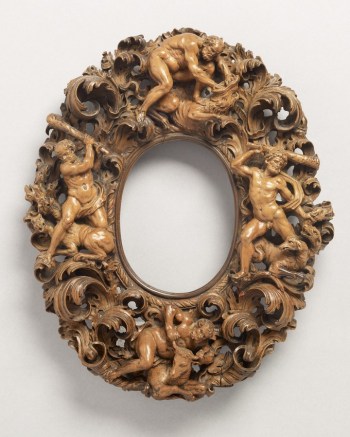
Frame with Four Labours of Hercules: Hercules and the Nemean Lion, the Cerberus, the Cretan Bull, and the Ceryneian Hind, ca. 1700–25, boxwood, 21.5 × 18 × 2.5 cm (Toronto: AGO, The Thomson Collection at the Art Gallery of Ontario, 29347).
The Art Gallery of Ontario (AGO) invites submissions from conservators, curators, graduate students, and independent researchers for a two-day conference on the history and conservation of picture frames. The conference will take place at the AGO on Thursday, 2 May, and Friday, 3 May 2024.
This conference is co-organized by the museum’s curatorial and conservation departments to promote inter- and multi-disciplinary dialogue. The AGO is home to an important collection of historic frames, and a project is currently underway at AGO to catalogue and conserve this collection to make the collection more accessible for study and use. In light of this project, the symposium aims to present current research that contextualizes frames in their many incarnations, including research on frame makers, framing traditions, frames’ afterlives, frame collections, pairings of frames to paintings, artists’ frames, the commercial history of framing, and related topics. Keynote lectures will be delivered by Lynn Roberts, acclaimed frame historian and publisher of The Frame Blog, and Hubert Baija, recently-retired longtime conservator of frames at the Rijksmuseum.
Applicants are requested to send a current CV and a 300-word abstract outlining the topic of a 20-minute paper to Julia.campbell-such@ago.ca by 15 December 2023.
Conference registration, accommodation in Toronto, and some meals will be covered for speakers. Further funding is available for travel for students and unaffiliated researchers. Special funding for one early-career scholar has been generously provided by the Decorative Arts Trust. Please indicate in your email with CV and abstract if you would like to apply for this funding.
London Art Week to Include Symposium on Conservation
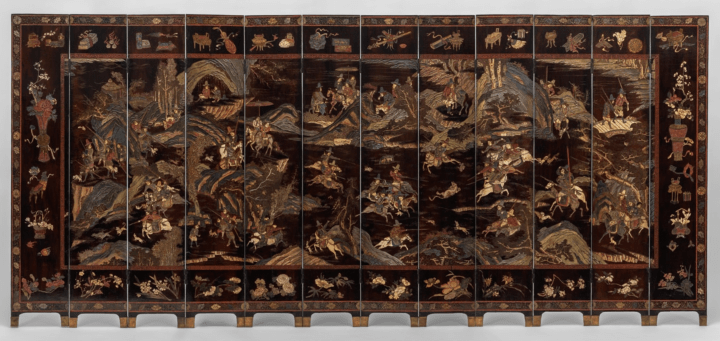
12-paneled Kangxi lacquer screen with a Dutch hunting scene, Kangxi period (1662–1722), carved, incised, and lacquered wood, painted, with brass fittings, 119 × 266 cm (Amir Mohtashemi). This is one of a rare group of about nine known lacquered screens of the period depicting Dutchmen; related examples are in the National Museum of Denmark, the Rijksmuseum, and the Museum of Fine Arts, Boston.
◊ ◊ ◊ ◊ ◊
From the press release for the Winter 2023 edition of LAW:
London Art Week, Winter 2023
1–8 December 2023
A busy eight days in early December will see the capital’s leading auction houses and fine art galleries from around the UK and Europe taking part in the Winter 2023 edition of London Art Week from Friday, 1 to Friday, 8 December. Exhibitions and sales will take place online and in galleries across central London, revealing important and exciting works. From Renaissance and Old Master rarities to Modern and Contemporary paintings, drawings, and sculpture, and encompassing exceptional works of art and craftsmanship, including, rare furniture, books, and manuscripts, this year’s Winter edition of London Art Week offers the best selection of the finest art on the market.
LAW Symposium | The Art of Conservation: Preservation, Restoration, and Framing
National Portrait Gallery, London, 5 December 2023
The 2023 LAW Symposium The Art of Conservation: Preservation, Restoration, and Framing takes place on Tuesday, 5 December at the recently reopened National Portrait Gallery. In partnership with The Burlington Magazine, there will be three panels of talks with leading curators, conservators, and LAW experts. These will investigate such topics as: how study informs conservation treatment; exciting moments from the history of conservation, including important contributions from women, based on the panellists’ articles in The Burlington Magazine’s new publication The Art of Conservation co-published with Paul Holberton (pre-launch on the day); and historic picture frames and their changing fashions, 27 years after the UK’s first exhibition devoted to picture frames was held at the National Portrait Gallery.
Lynn Roberts and Paul Mitchell, authors of Frameworks, Form, Function & Ornament and A History of European Picture Frames, who were closely involved with that exhibition, will be joined by conservators from the National Gallery and National Portrait Gallery. Tickets for the symposium are £20.
More information about London Art Week, its exhibitions, and other programming can be found in the full press release and at the LAW website.
Exhibition | The Regency in Paris, 1715–1723
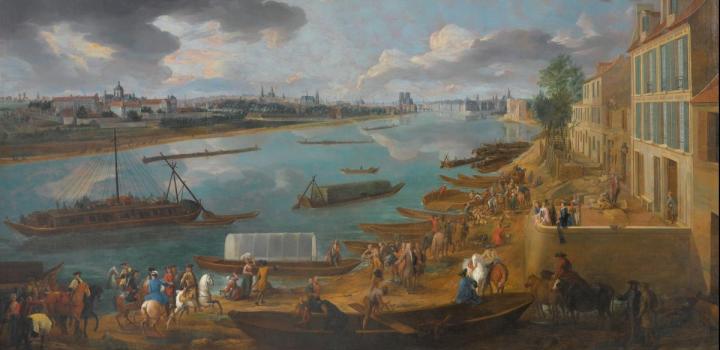
Pierre Denis Martin, View of Paris from the Quai de la Rapée toward la Salpêtrière, l’île Saint-Louis, and l’île de la Cité, 1716, oil on canvas, 170 × 315 cm (Paris: Louvre / Musee Carnavalet)
◊ ◊ ◊ ◊ ◊
Now on view at the Musée Carnavalet:
The Régence in Paris, 1715–1723: The Dawn of the Enlightenment
Musée Carnavalet, Paris, 20 October 2023 — 25 February 2024
Curated by Valérie Guillaume, with José de Los Llanos and Ulysse Jardat
The Musée Carnavalet – Histoire de Paris presents an exhibition on the Regency, a forgotten period in history, marking the return of the King and of political, economic, and cultural life to Paris.
Louis XIV died in Versailles on 1 September 1715, leaving behind a nation in debt and a five-year-old child too young to rule, Louis XV, as his heir. On 2 September, the Duke Philippe d’Orléans (1674–1723), nephew of the late King, took on the role of Regent of France. This exhibition takes place as part of the tricentennial commemoration of the Regent’s death.
In 1715, the court, the government, and all the administrations moved back to Paris, the second city in Europe, whose population then increased significantly. Thus, the city, and notably the Palais-Royal, the Regent’s residence, became the heart of all political life. A period of intense cultural effervescence ensued, giving rise to a world of philosophical, economic, and artistic innovations. Voltaire, Marivaux, Montesquieu, Law, and Watteau are some the most well-known figures of the time. With the invention of paper money and the bankruptcy of 1720, these years of economic and financial frenzy were interspersed with significant twists and turns. Under the Régence emerged a newfound freedom of criticism, which would become known as the spirit of the Enlightenment.
The exhibition’s thematic structure highlights the innovations of the period in order to illustrate the breadth of their historical significance. Over 200 works from public and private collections—paintings, sculptures, prints, items of decor, and pieces of furniture—help us explore this period of history, accounting for the mutations of society at a time when Paris was becoming the cultural capital of France in a permanent way.
Curators
• Valérie Guillaume, director of the Musée Carnavalet – Histoire de Paris
• José de Los Llanos, head curator, in charge of the Graphic Arts Department and the Maquettes Department
• Ulysse Jardat, curator, head of the Decor, Furniture, and Decorative Arts Department
La Régence à Paris (1715–1723): L’aube des Lumières (Paris: Paris-Musées, 2023), 224 pages, ISBN: 978-2759605705, €39.
Study Day | Spectacle and Representation during the Régence
From the Carnavalet:
Spectacle et représentation royale durant la Régence, 1715–1723
Orangerie du musée Carnavalet, Paris, 16 November 2023
 Dans le cadre des manifestations organisées autour de l’exposition La Régence à Paris (1715–1723): L’aube des lumières, le Centre de musique baroque de Versailles et le musée Carnavalet – Histoire de Paris proposent une journée d’études pluridisciplinaire sur les divertissements du jeune Louis XV. Cette journée réunit historiens, historiens de l’art, historiens de la danse et musicologues pour une journée d’études pluridisciplinaire autour des trois ballets dansés devant toute la cour par le jeune Louis XV aux Tuileries en 1720 et 1721 (L’Inconnu, Les Folies de Cardenio, Les Éléments), peu de temps avant sa majorité, son sacre et donc sa prise de souveraineté. S’inscrivant à la fois dans la lignée des grands divertissements royaux du Grand Siècle, mais dans des inspirations et une esthétique plus modernes, annonciatrices des Lumières, ces spectacles royaux ont participé à la construction de l’image publique du jeune souverain. Au-delà des aspects musicaux, littéraires, chorégraphiques et esthétiques, ces spectacles de cour, seront ainsi envisagés au travers de la question, transversale, de la représentation du pouvoir royal durant la Régence.
Réservation recommandée, jcharbey@cmbv.com.
m o d e r a t e u r s
Alexandre Dupilet
Petra Dotlačilová (Stockholm University, CMBV-CESR)
Thomas Leconte (CMBV-CESR)
i n t e r v e n a n t s
• José de Los Llanos (Conservateur en chef, responsable du Cabinet des Arts graphiques et du département des Maquettes, Musée Carnavalet – Histoire de Paris) et Ulysse Jardat (Conservateur du patrimoine, responsable du département des Décors, Mobilier et Arts décoratifs, Musée Carnavalet – Histoire de Paris), commissariat scientifique de l’exposition La Régence à Paris (1715–1723): L’aube des Lumières
• Laurent Lemarchand (Université de Rouen, GHRis) — Louis XV et Philippe d’Orléans : l’Union sacrée
• Vivien Richard (Musée du Louvre) — Les Tuileries : résidence du jeune Louis XV, 1715–1722
• Thomas Leconte (CMBV-CESR) — Le roi en sa capitale, 1715–1722 : l’image de la majesté à travers le cérémonial royal et le maillage urbain
• Pascale Mormiche (CY Cergy Paris Université) — Louis XV aimait-il danser ?
• Nathanaël Eskenazy (Université Paul-Valéry-Montpellier III, IRCL) — Convaincre, persuader, exhorter : repenser le discours encomiastique et la célébration de la figure royale dans les trois ballets dansés par Louis XV
• Barbara Nestola (CMBV-CESR) — Réunir pour mieux régner ? Fusion et collaboration entre troupes de cour et de ville pour la représentation des ballets dansés par Louis XV, 1720–1721
• Petra Dotlačilová (Stockholm University, CMBV-CESR) — Terpsichore durant la Régence : entre la tradition de cour et la danse théâtrale
• Mickaël Bouffard (Sorbonne Université, Théâtre Molière Sorbonne, CELLF) — Les habits des ballets de Louis XV : goût nouveau ou recyclage de vieilles idées ?
Call for Papers | From the Low Countries to Sweden, 1400–1800
From ArtHist.net:
Art on Demand: Objects, Knowledge, and Ideas from the Low Countries in Sweden, 1400–1800
RKD – Netherlands Institute for Art History, The Hague, 8 May 2024
Proposals due by 20 December 2023
The risks and challenges of migration are of compelling interest today. Over the past thirty years, research on the migration of early modern artists and on cultural exchange between the Low Countries and Sweden has advanced steadily, and addressed many themes. The Dutch and Flemish artists’ communities in Stockholm, and the careers of individual artists at the Swedish court, in the service of the Swedish nobility or Dutch industrial entrepreneurs in particular, have received fresh attention, as has the history of the collecting of Netherlandish art in Sweden.
On 8 May 2024, a symposium at the RKD – Netherlands Institute for Art History will mark the launch of the heavily annotated and illustrated digital English language version of Horst Gerson’s chapter on ‘Sweden’ from his Ausbreitung und Nachwirkung der holländischen Malerei des 17. Jahrhunderts of 1942 (The Dispersal and Legacy of Dutch 17th-Century Painting). For historians of Dutch 17th-century painting, in 1942, Gerson’s study of the integration of Dutch art in Sweden was largely uncharted territory, although there were Swedish studies in the field. The launch of the translated and annotated version of Gerson’s text marks the perfect occasion to discuss, contextualize, and rethink his original ideas in the light of present and developing knowledge.
The organizers welcome unpublished contributions on a broad range of topics relating to Dutch and Flemish artists, artisans, and art production in Sweden and its then major territories. These include: painting, drawing, graphic arts, tapestry, jewellery, sculpture and architecture, collecting and the art market, the looting of Dutch and Flemish art during the Thirty Years’ War, as well as the contribution of Dutch and Flemish migrants to many forms of material culture.
Papers will be 20 minutes long, and might address the following themes and questions:
• Fresh approaches to the careers of practitioners from the Low Countries at the Swedish court, in the service of the Swedish nobility, Dutch entrepreneurs and in urban centres (including monographic studies)
• How did those interconnected fields function as hubs of cross-cultural exchange between individuals, and of production?
• Less-studied works by Dutch and Flemish artists and artisans who were active in Sweden between 1400 and 1800
• What were the workshop practices and techniques employed by Dutch and Flemish artists and artisans in Sweden, and how did these interact with local artistic traditions and impact on technical and art literature?
• What were the social networks and professional relationships that linked and supported Netherlandish and Swedish makers, art dealers and collectors?
• What was the market for Dutch and Flemish artistic goods in Sweden, and how did it develop over time?
Please submit a preliminary title, an abstract (maximum of 300 words), and a short CV to Rieke van Leeuwen (leeuwen@rkd.nl) before 20 December 2023. Speakers will be notified by 15 January 2024. Selected presentations will be considered for publication. Please contact the organizers with any questions concerning the conference and this call for papers.
Academic Committee
Alex Alsemgeest (Rijksmuseum, Amsterdam), Quentin Buvelot (Mauritshuis, The Hague), Angela Jager (RKD, The Hague), Rieke van Leeuwen (RKD, The Hague), Martin Olin (Nationalmuseum, Stockholm), and Juliette Roding (independent, previously Leiden University)
New Book | Interiors in the Age of Enlightenment
From Bloomsbury:
Stacey Sloboda, ed., Interiors in the Age of Enlightenment: A Cultural History (London: Bloomsbury Visual Arts, 2023), 248 pages, ISBN: 978-1350408029, $120.
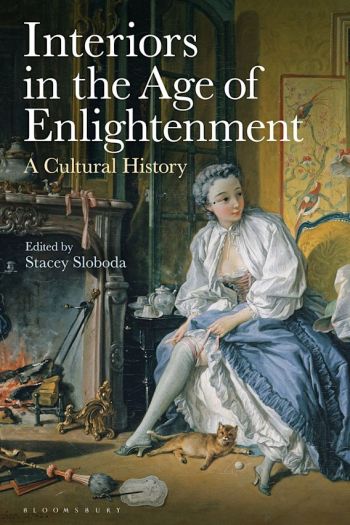 Interiors in the Age of Enlightenment provides a comprehensive and interdisciplinary overview of the cultural history of interior design and interior spaces from 1700 to 1850. Considering the interior as material, social, and cultural artefact, this volume moves beyond conventional descriptive accounts of changing styles and interior design fashions, to explore in depth the effect on the interior of the materials, processes, aesthetic philosophies, and cultural attitudes of the age. From the Palace of Versailles to Virginia coffeehouses, and from chinoiserie bathhouses to the trading exchanges of the West Indies, the chapters in this book examine a wide range of themes including technological advancements, public spaces, gender and sexuality, and global movements in interior designs and decorations. Drawing together contributions from leading scholars, this volume provides the most authoritative and comprehensive survey of the history of interiors and interior architecture in the long eighteenth century.
Stacey Sloboda is Paul H. Tucker Professor of Art at the University of Massachusetts Boston.
c o n t e n t s
Preface
Introduction: The Interior in the Age of Enlightenment — Stacey Sloboda
1 Beauty: Cultural Aesthetics in the Enlightenment Interior — Anne Nellis Richter
2 Technology: Cultural Transfer, Imitation, and Improvement of Materials and Surfaces of the Interior — Noémie Étienne
3 Designers, Professions, Trades: Conceiving and Making the Interior — Conor Lucey
4 Global Movements: Exoticism and Hybridity in the Globalized Interior — Vanessa Alayrac-Fielding
5 Private Spaces: Performing the Home — Mimi Hellman
6 Public Spaces: Staging Ritual and Shaping Identity — Laurel O. Peterson
7 Gender and Sexuality: The Desire of Decor — Michael Yonan
8 The Interior in the Arts: Literary and Visual Representations — Karen Lipsedge and Melinda McCurdy
Bibliography
Index
Conference | The Scottish Interior
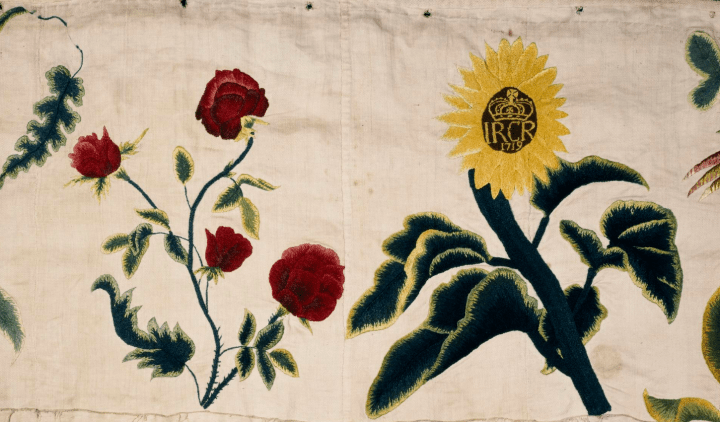
Embroidered valance celebrating the marriage of James Francis Stuart and Clementina Sobieska, 1719 (Edinburgh: National Museum of Scotland, A.1988.263 C). Part of a set of two crewel work wall hangings and four valances of white linen embroidered in coloured wool with a ‘Tree of Life’ pattern. This valance is embroidered with the cypher ‘IRCR / 1719’ under a crown within a sunflower, for ‘Jacobus Rex Clementina Regina’, referring to the marriage of James Francis Stuart and Clementina Sobieska.
◊ ◊ ◊ ◊ ◊
From the National Museum of Scotland:
The Scottish Interior
National Museum of Scotland, Edinburgh, 1 December 2023
A one-day conference on aspects of the Scottish interior from the 16th century to the present.
Thirty years on from the publication of Ian Gow’s defining book The Scottish Interior, this conference brings together specialists from a range of backgrounds to discuss questions of Scottishness—or lack thereof—in Scottish interiors from the 16th century to the present. Exploring a range of themes from the Renaissance to the Arts and Crafts movement via ‘Balmoralisation’, and with an interdisciplinary approach looking at patronage, collecting, architecture, and design, this event will appeal to anyone interested in Scottish history, design, and identity. The event is free, but booking is essential. Lunch and refreshments will be provided.

Armchair designed by Robert Adam for Sir Lawrence Dundas and made in Thomas Chippendale’s workshop, 1765 (Edinburgh: National Museum of Scotland, K.2002.9).
p r o g r a m m e
9.00 Arrival
9.30 First Panel
• Helen Wyld — Introduction
• Sally Rush — The Renaissance Interior in Scotland
• Michael Pearce — North-Britons: Interiors for an Anglicised Scottish Aristocracy
10.50 Tea
11.20 Second Panel
• Ian Gow — The Scottish Interior
• Stephen Jackson — The Role of Antique Furniture in the Scottish Interior
• Annette Carruthers — The Arts and Crafts Interior in Scotland
12.40 Lunch
13.50 Third Panel
• Emma Baillie — Messages in Plaster: The Work of Thomas Clayton at Blair Castle
• Calum Robertson — The Scottish Armoury
• Godfrey Evans — Hamilton Palace: The Projection of Exceptional Connoisseurship and Exalted Status by the Premier Peers of Scotland
15.10 Tea
15.40 Fourth Panel
• Mary Miers — Romantic Retreats
• Mhairi Maxwell, James Wylie, and Jonathan Faiers — Balmoralisation
16.20 Round table discussion with all speakers
New Book | A Cultural History of the Home
The 6 volumes appeared in 2020; the stand-alone volume on the Enlightenment became available in 2022 (see below); another option will appear in 2024.
Amanda Flather (anthology editor), A Cultural History of the Home, volumes 1–6 (London: Bloomsbury Academic, 2020), ISBN: 978-1472584410, $610.
 A Cultural History of the Home provides a comprehensive survey of the domestic space from ancient times to the present. Spanning 2800 years, the six volumes explore how different cultures and societies have established, developed and used the home. It reveals a great deal about how people have lived day-to-day in a range of regions and epochs by providing a historical focus on the location in which they will have spent much of their time: the domestic space.
1 Antiquity, 800 BCE–800 CE
2 Medieval Age, 800–1450
3 Renaissance, 1450–1648
4 Age of Enlightenment, 1648–1815
5 Age of Empire, 1815–1920
6 Modern Age, 1920–Present
Each volume discusses the same themes in its chapters:
• The Meaning of the Home
• Family and Household
• The House
• Furniture and Furnishings
• Home and Work
• Gender and Home
• Hospitality and Home
• Religion and Home
This structure offers readers a broad overview of a period within each volume or the opportunity to follow a theme through history by reading the relevant chapter across volumes.
Amanda Flather is Lecturer in the Department of History at the University of Essex. She is the author of Gender and Space in Early Modern England (2006).
◊ ◊ ◊ ◊ ◊
Clive Edwards, ed., A Cultural History of the Home in the Age of Enlightenment (London: Bloomsbury Academic, 2022), 264 pages, ISBN: 978-1472584250, $110. The paperback edition will be available in 2024.
 During the period of the Enlightenment, the word ‘home’ could refer to a specific and defined physical living space, the location of domestic life, and a concept related to ideas of roots, origins, and retreat. The transformations that the Enlightenment encouraged created the circumstances for the concept of home to change and develop in the following three ways. First to influence homemaking were the literary and cultural manifestations that included issues around attitudes to education, social order and disorder, sensibility, and sexuality. Secondly, were the roles of visual and material culture of the home that demonstrated themselves through print, portraiture, literature, objects and products, and dress and fashion. Thirdly, were the industrial and sociological aspects that included concepts of luxury, progress, trade and technology, consumption, domesticity, and the notions of public and private spaces within a home. The chapters in this volume therefore discuss and reflect upon issues relating to the home through a range of approaches. Enlightenment homes are examined in terms of signification and meaning; the persons who inhabited them; the physical buildings and their furniture and furnishings; the work undertaken within them; the differing roles of men and women; the nature of hospitality, and the important role of religion in the home. Taken together they give a valuable overview of the manners, customs, and operation of the Enlightenment home.
Clive Edwards is Emeritus Professor of Design History at Loughborough University. He is editor of The Bloomsbury Encyclopedia of Design (2015) and author of Turning Houses into Homes: A History of the Retailing and Consumption of Domestic Furnishings (2017), The Twentieth Century Interiors Sourcebook (2013), Interior Design: A Critical Introduction (2010), How to Read Pattern: A Crash Course in Textile Design (2009), Encyclopedia of Furnishing Textiles, Soft Furnishings and Floor Coverings (2007), British Furniture: 1600–2000 (2006), and Encyclopedia of Furniture Materials, Trades, and Techniques (2001).
c o n t e n t s
1 The Meaning of Home — Karen Lipsedge
2 Family and Household —Helen Metcalfe
3 The House — Stephen Hague
4 Furniture and Furnishings — Clive Edwards
5 Home and Work — Leonie Hannan
6 Gender and Home — Ruth Larsen
7 Hospitality and Home — Woodruff Smith
8 Religion and the Home — Matthew Neal










 Enfilade
leave a comment