New Book | Novels, Needleworks, and Empire
Part of the Lewis Walpole Series in Eighteenth-Century Culture and History, from Yale UP:
Chloe Wigston Smith, Novels, Needleworks, and Empire: Material Entanglements in the Eighteenth-Century Atlantic World (New Haven: Yale University Press, 2024), 312 pages, ISBN: 978-0300270785, $65.
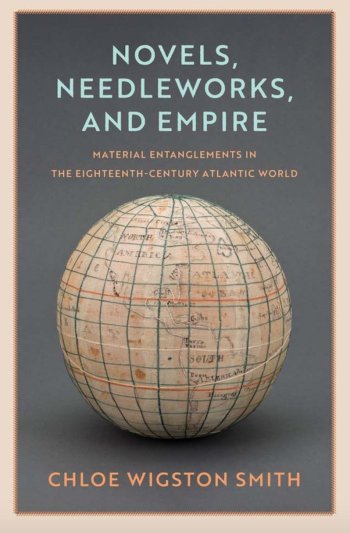 The first sustained study of the vibrant links between domestic craft and British colonialism
In the eighteenth century, women’s contributions to empire took fewer official forms than those collected in state archives. Their traces were recorded in material ways, through the ink they applied to paper or the artifacts they created with muslin, silk threads, feathers, and shells. Handiwork, such as sewing, knitting, embroidery, and other crafts, formed a familiar presence in the lives and learning of girls and women across social classes, and it was deeply connected to colonialism.
Chloe Wigston Smith follows the material and visual images of the Atlantic world that found their way into the hands of women and girls in Britain and early America—in the objects they made, the books they held, the stories they read—and in doing so adjusted and altered the form and content of print and material culture. A range of artifacts made by women, including makers of color, brought the global into conversation with domestic crafts and consequently placed images of empire and colonialism within arm’s reach. Together, fiction and handicrafts offer new evidence of women’s material contributions to the home’s place within the global eighteenth century, revealing the rich and complex connections between the global and the domestic.
Chloe Wigston Smith is professor of eighteenth-century literature at the University of York, where she teaches in the Department of English and the Centre for Eighteenth Century Studies. She is the author of Women, Work, and Clothes in the Eighteenth-Century Novel.
c o n t e n t s
List of Illustrations
Introduction: Entangled Forms
1 Making the Four Corners of the Globe, Oroonoko, and Euphemia
2 Small Marks in Thread: Samplers, Moll Flanders, and Material Expression
3 Global Domestic Objects: Embroidered Maps, Lydia, and The Female American
4 Pins, Needles, and Wampum in Mary Rowlandson and Hobomok
5 Companionship in Black Attendant Needlework, The History of Sir George Ellison, and The Woman of Colour
Coda: Material Entanglements, Then and Now
Notes
Acknowledgments
Index










 Enfilade
leave a comment