Exhibition | Kaendler’s Meissen Porcelain Figures
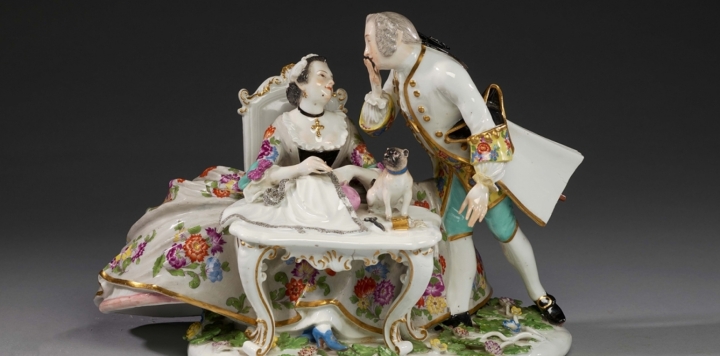
This summer at the Wawel Royal Castle:
Magnificence of Rococo: Kaendler’s Meissen Porcelain Figures
Wspaniałość rokoka: Miśnieńskie figurki porcelanowe Johanna Joachima Kaendlera
Wawel Royal Castle, National Art Collection, Kraków, 23 May — 29 September 2024
At the age of 25, Johann Joachim Kaendler (1706–1775) was appointed court sculptor by Augustus the Strong (r. 1694–1733). In the same year he joined the Meissen porcelain manufactory as a modeller, to which he remained loyal throughout his life. Kaendler’s name is closely associated with the golden age of the Meissen manufactory in the 18th century, where, he demonstrated his artistic and technical talent in creating numerous porcelain sculptures, which are still highly valued as collectors’ items today. At the same time they are still part of the manufactory’s repertoire.
 The choice of themes in Kaendler’s works reflects the courtly life of the period, which ranged from the late Baroque through the Rococo to the emerging Classicism. Until the end of the Saxon-Polish joint reign in 1763, the nobility and the court were almost the only clients of the manufactory, before the emerging middle classes finally discovered porcelain for themselves. Accordingly, Kaendler’s early works are oriented towards the preferences and fashions of the court. Hunting and theatre—especially the popular Commedia dell’arte—played a central role here, as did the Masonic Order, which was replaced by the Order of the Pug after the papal ban of 1738.
In 1736, for the first time Kaendler created one of the highly esteemed crinoline groups, which often depicted men and women in everyday court life, also in an amorous context. They were named after the ladies’ flared skirts, which were given their shape by a framework of fishbone. Alongside love adventures, the pastoral idyll, the simple life, was one of the secret longings of the nobility. This trend found its most famous manifestation in the Hameau of the French Queen Marie Antoinette (1755–1793) in Versailles. Kaendler served this fad with figures from the people, craftsmen, peasants and, last but not least, the ‘Cris de Paris’ (Cries of Paris), which embody various professions.
Increasing world trade and travel reports from distant countries stimulated people’s curiosity at that time. Exotic depictions of all kinds were in vogue. Artists and craftsmen endeavoured to satisfy the wishes of their customers with ever new subjects, which, however, were often far removed from reality—and few could verify it anyway. Kaendler devoted himself to the subject in his own way. He modelled figures in the national costumes of various peoples as well as animals that were foreign to Central Europeans at the time, such as elephants, lions and dromedaries, to name but a few. The chinoiseries had long since developed into a fashion in their own right. Kaendler did not limit himself to shaping individual figures in their characteristic costumes and physiognomy, but also created family scenes with a unique charm.
Kaendler’s surviving notes from the 1740s prove his productivity. The surviving porcelain sculptures bear witness to his creativity, his genius. Thus, within a few years, a world of his own was created in porcelain, which was enjoyed by the society of the time. Even if tastes have changed since then, Kaendler still proves to be a gifted artist when we take a closer look.
The exhibition jointly organised by the Röbbig Gallery and Wawel Royal Castle will present, for the first time in Poland, a magnificent group of figures by Johann Joachim Kaendler from European private collections. The exhibition will be an excellent pendant to the Wawel collection of Meissen porcelain, which centres around stately objects that create illustrate how the manufactory worked to elevate the prestige of the Wettin court. Wawel Hill was the seat of Polish kings from 1025, and coronations took place here, including that of Augustus II the Strony and his son Augustus III. The figurines presented by the Röbbig Gallery served the more private needs of porcelain lovers all over the world and continue to do so today. Together, the two collections will provide an opulent picture of life in the palaces and residences of the mid-eighteenth century.
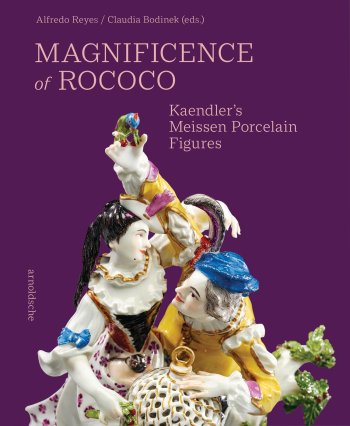
Alfredo Reyes and Claudia Bodinek, eds., Magnificence of Rococo: Kaendler’s Meissen Porcelain Figures (Stuttgart: Arnoldsche, 2024), 400 pages, ISBN: 978-3897907072, $135.
Online Talks | San Francisco Ceramic Circle
Upcoming talks from the San Francisco Ceramic Circle:
Membership to the San Francisco Ceramic Circle includes seven in-person and/or virtual lectures per year, a summer social, and our annual ‘Pot Night’, which occurs in September and combines an annual business meeting with a social time to share current acquisitions and ceramic information with fellow members. The membership fee for 2024/2025 is $35. For general questions, please write to sfceramiccircle@gmail.com.
The Art of German Stoneware: Meanings and Mysteries
Jack Hinton (Henry P. McIlhenny Curator of European Decorative Arts and Sculpture, Philadelphia Museum of Art)
Zoom, Sunday, 17 March 2024, 11am (PST)
All Walks of Life: Meissen Porcelain Figures of the 18th Century
Vanessa Sigalas (Associate Curator of Collections Research, Wadsworth Atheneum)
Zoom, Sunday, 14 April 2024, 11am (PST)
American Ceramic Circle Research Grants
From ArtHist.net:
American Ceramic Circle Research Grants
Applications due by 2 April 2024
To encourage new scholarship in the field of ceramics, the American Ceramic Circle (ACC) annually underwrites grants for up to $5,000 to individuals to help offset costs associated with original research. Grant applications, which are reviewed by the Grants and Scholarship Committee, are due the second Friday of April. Grants are not intended for projects involving commercial profit, including publication subventions. Successful applicants are required to submit the results of their completed research to the ACC in the form of a paper, which may be published in the ACC Journal. Grantees may also be invited to speak at the annual ACC symposium. Please send completed application including a coversheet and proposal as PDF to: ACC Grants and Scholarship Chair at accgrants@gmail.com using this form.
1 Coversheet
• Name
• Address
• Telephone
• Email
• Institutional Affiliation
• List of Publications — please attach copy of one, especially if related to proposed topic.
• References — please ask references familiar with your project to send letters of recommendation directly to accgrants@gmail.com as PDFs.
2 Proposal
Please prepare an attachment to the cover sheet with the following sections:
• Project title
• Brief project summary (100 words max)
• Significance of topic (500 words max)
• List of primary sources consulted (if project is historic in nature)
• Project description: plans for the project, reasons, how it will be accomplished, and describe the qualifications of individuals involved in project (500 words max)
• Research plan
• Timeline, including estimated date of completion
• Collections, archives, institutions, etc. to be visited
• Proposed budget, with estimated expenditures
• Total amount requested from ACC
The American Ceramic Circle was founded in 1970 as a non-profit educational organization committed to the study and appreciation of ceramics. Its purpose is to promote scholarship and research in the history, use, and preservation of ceramics of all kinds, periods, and origins. The current active membership is composed of ceramics enthusiasts from many walks of life, including museum professionals, collectors, institutions, auction house professionals, and dealers in ceramics. Member interest is focused on post-Medieval pottery and porcelain of Europe, Asian ceramics of all periods, and ceramics made, used, or owned in North America.










 Enfilade
leave a comment