Decorative Arts Trust Prize for Excellence and Innovation
From The Decorative Arts Trust:
Decorative Arts Trust Prize for Excellence and Innovation, $100,000
Application due by 30 June 2024
To further the Decorative Arts Trust’s mission to foster appreciation and study of the arts, the Trust established this $100,000 Prize for Excellence and Innovation. The Prize funds outstanding projects that advance the public’s appreciation of decorative art, fine art, architecture, or landscape. The Prize is awarded to a non-profit organization in the United States or abroad for a scholarly endeavor, such as museum exhibitions, print and digital publications, and online databases. The Trust’s selection committee aims to recognize impactful and original projects that advance scholarship in the field while reaching a broad audience.
Visit the Trust’s website for details and application instructions.
Call for Papers | The Expert’s Eye
From the Call for Papers, which includes the Spanish version:
El ojo experto: Método, límites y la disciplina de la Historia del Arte
The Expert’s Eye: Method, Limitations, and the Practice of Art History
Museo Arqueológico Nacional, Madrid, 24–25 October 2024
Organized by Pilar Diez del Corral Corredoira and David Ojeda Nogales
Proposals due by 15 June 2024
 The work of the art historian revolves around the art object, and the need to tailor one’s methodology to that object gives the discipline its variety and richness. Yet paradoxically, to stress that art works are the centre of art history feels almost transgressive at a time when basic questions of identification and dating are increasingly deemphasized in training new generations of scholars and curators. Perhaps as a result, recent years have seen a proliferation of news about masterpieces that have gone unnoticed until some expert (typically from the art market rather than the university or the museum) has recognized the hand of a leading artist. Among Old Master paintings, it is common knowledge that Caravaggio final canvas, an Ecce Homo, almost left Spain after having been confused with a lesser work. The numerous Rembrandts that have emerged in recent years, as well as the complex case of Leonardo’s Salvator Mundi or the dubious Goyas that regularly appear, seem to confirm a decline in traditional expertise.
The new art history, by contrast, has shown itself perfectly capable of conducting research without having to study or even look at the art object. Without discrediting the results, which are sometimes more characteristic of departments of history or anthropology, the ease with which art-historical fact is blurred can be surprising. Over the last fifty years, the notable decrease in studies that examine the most fundamental problems of dating and authorship has raised questions about the usefulness of prevailing methodologies, leading to extreme cases in which a trained or expert eye is considered unnecessary, or at least insufficient, to deal with objects lacking documentary or other external proof of origin, creator, or date. By contrast, having an educated eye implies knowing the difference between a Roman bust from the first century AD and a modern copy, between discovering the hand of Leonardo and detecting an excellent falsification. Not all reattributed works will be first rate, but by returning anonymous or misidentified objects held in the depths of the world’s museums and collections to their rightful place, the astute art historian helps reconstruct the story of their creators.
In light of these trends, this conference aims to interrogate and challenge the abandonment of visual, material, and historical expertise among art historians. Key questions include:
• When, where, and why have works of art lost their place the centre of art history? Has this been uniform across the discipline, or does it vary by field?
• How have conservators, collectors, and academics fostered or resisted a repudiation of material knowledge of the art work?
• What forms does the ‘expert eye’ take across media and art forms, including drawing, sculpture, painting, ceramics, metalwork, etc.?
• Is an emphasis on attribution essential or dispensable? What are its limits and limitations, and how does it apply to different times, places, and artistic media?
• Can older notions of ‘connoisseurship’ be reconciled with developments in technical art history? How do ever-expanding methods of scientific testing challenge or enhance the ‘expert eye’?
• How can art history ensure that it is not limited to the study of objects that have a documentary trail?
• (How) can we aspire to a holistic history of art that links questions of dating, authorship, condition, and authenticity to the broader contextual and interpretive issues that have dominated recent scholarship?
Our intention in this conference is to gather experts from different areas of art history to wrestle with these questions. We welcome historical and methodological reflections as well as object-based case studies that engage the issues outlines above. We invite you to send your proposal with a short CV (no more than 10–15 lines) before 15 June 2024. If you have any questions or suggestions, please don’t hesitate to contact us. We will be delighted to help. The conference will take place in Madrid, in-person, at the Museo Arqueológico Nacional. It is our intention to publish a selection of papers, in an anthology, by a publisher with peer-review.
Technical coordination
• Marta I. Sánchez Vasco, misanchezvasco@gmail.com
Scientific coordination
• Pilar Diez del Corral Corredoira, diezdelcorral@geo.uned.es
• David Ojeda Nogales, dojeda@geo.uned.es
Scientific committee
• Amaya Alzaga Ruiz (UNED)
• Jeffrey L. Collins (Bard Graduate Center, Nueva York)
• Ana Diéguez Rodríguez (Instituto Moll)
• Pilar Diez del Corral Corredoira (UNED)
• David Ojeda Nogales (UNED)
• Markus Trunk (Universität Trier)
Lecture | Tim Clayton on Gillray and the Limits of Free Speech
This Thursday at Yale:
Tim Clayton | The Limits of Free Speech: Gillray, the Royals, and Censorship
Yale University, New Haven, 9 May 2024, 3.30pm
Organized by the Lewis Walpole Library
 Lecture and a panel discussion with contemporary British cartoonists Martin Rowson and Steve Bell
For a decade between 1785 and 1795 George III and Queen Charlotte were the most prominent faces in Gillray’s satire, and the scandalous love lives of their children added piquancy to a print culture that was distinctly libertine in tone. But the license of printsellers provoked a backlash from the conservative wing of the establishment, especially after the French Revolution, and in late 1795 it became illegal to caricature the King. It is often claimed that caricaturists were immune to legal action, but some printsellers were punished and many prints were altered, suppressed or destroyed at this time. This talk will address some of the liberties that caricaturists took and some of the penalties they came to face as they tested the extent of the freedom of the press—a burning issue then that remains highly relevant today.
The lecture will be followed by a panel discussion between Tim Clayton and contemporary British cartoonists Martin Rowson and Steve Bell.
More information is available here»
Study Day | Collecting through the Ages
From The Wallace Collection and the conference programme:
The Wallace Collection is thrilled to announce the relaunch of the History of Collecting as Collecting Past and Present. This new series will take the format of biannual, themed study days, which will include fascinating talks from leading specialists, exploring collecting through the ages. Exclusive interviews with modern-day collectors will also feature, revealing tantalising glimpses into how exceptional objects are brought together. These will be followed by drinks receptions that will act as unique forums for discussion. For those further afield or unable to make it to the museum, the talks can be watched online. And if you are interested in taking part as a speaker at future events, calls for papers will be shared throughout the year.

Bishan Singh, The Court of Maharaja Ranjit Singh (1780–1839), Amritsar or Lahore, 1863–64
(Toor Collection)
◊ ◊ ◊ ◊ ◊
Collecting through the Ages
Online and in-person, The Wallace Collection, London, 5 July 2024
The Wallace Collection and the outstanding artworks it contains were brought together through the 18th and 19th centuries by an extraordinary family of collectors—the marquesses of Hertford and Sir Richard and Lady Wallace. Delve into the history of collecting across the ages at our first Collecting Past and Present event. You’ll hear from leading academics and specialists on a variety of subjects, from the collecting of Shakespearean relics to the houses of Calouste Gulbenkian. Also join us for a conversation with a leading modern-day collector of Sikh, Indian and Islamic art, Davinder Toor, who will offer exclusive insights into his passions and inspirations.
Registration is available here»
p r o g r a m m e
10.15 Welcome
10.30 Verena Suchy — Women as Collectors of 18th-Century Cabinets
In the theory and history of collecting, women collectors have often been absent. Examples of noble women from different German principalities, however, indicate that in the 18th century it was common—if not necessary—for aristocratic women to assemble collections of jewellery, decorative art, and precious objects. Examining these collections with Dr Suchy will shine a light on the collecting practices of women and their political and representative functions.
11.15 Refreshments
11.45 Kirsten Tambling — Shakespearean Relics in the Royal Collection
1816 was the tercentenary of Shakespeare’s death, and, in this year, George, Prince Regent, ordered seven toothpick cases fashioned from ‘Shakespere’s Tree’. He was thus inserting the monarchy into a buoyant contemporary trade in Shakespearean ‘relics’. Focusing on the 18th and 19th centuries, Dr Tambling will investigate Shakespearean relics in the Royal Collection and the significance of royals collecting
Shakespeare.
12.45 Peter Humfrey — Amabel, Countess de Grey, as Collector and Curator in Post-Orléans London
Diarist, practising artist, and commentator on the political events of her time, Amabel was also a well-informed collector, both of Old Masters arriving on the London art market in the wake of the French Revolution, and of the work of her younger contemporaries. Further, she was heir to a distinguished collection of paintings from her family and was active in documenting and rehanging it. Professor Humfrey will take a closer look at this fascinating character.
13.30 Q&A
13.45 Lunch break
14.45 Barbara Bryant — Stephen T. Gooden and the Marketing of Edward Burne-Jones’s Legend of St George and the Dragon Series
In 1894, a series of seven paintings by Burne-Jones came to auction at Christie’s. Dr Bryant will consider the protracted attempts by various dealers to sell the series in the 1890s until the successful sale by the relatively new gallery owner Stephen T. Gooden. Gooden’s achievement will give an insight into how art
dealers of this period marketed the modern masters.
15.45 Vera Mariz — The Making of a House for Calouste Gulbenkian’s Art Collection
Dr Mariz will explore the various residences that housed Calouste Gulbenkian’s art collection, with a primary emphasis on 51 Avenue d’Iéna. While the acquisition process of the latter mirrors that of acquiring artworks, Gulbenkian’s satisfaction remains uncertain. Newly discovered materials and innovative approaches offer fresh interpretations of the hôtel Gulbenkian, which will be presented as an intimate testament to Gulbenkian’s essence as an art collector.
16.30 In Conversation with Davinder Toor
Two centuries ago, Punjab’s Sikh ruling elite lavishly patronised artists and craftsmen to enhance the splendour of their empire. By the mid-19th century, the Sikh empire had met its demise at the hands of the East India Company. Over the following century and a half, Sikh artefacts were dispersed across the globe. Some ended up in British institutional collections, while others were bought and sold by collectors. With Curatorial Assistant Alexander Collins, Davinder will discuss how he has pursued his passion as a collector to create a lasting legacy to the empire of the Sikhs.
17.15 Q&A
17.30 Drinks reception
Exhibition | Ranjit Singh: Sikh, Warrior, King
Now on view at The Wallace Collection:
Ranjit Singh: Sikh, Warrior, King
The Wallace Collection, London, 10 April — 20 October 2024
Explore the life of the great Sikh leader Ranjit Singh (1780–1839) in this major exhibition
 With an unwavering sense of destiny, Ranjit Singh conquered the Punjab, an area that today encompasses Pakistan, following a period of anarchy caused by decades of Afghan invasions. By the early 19th century, he emerged as the undisputed Maharaja, establishing the influential Sikh Empire. Ranjit Singh’s leadership led to a golden age marked by thriving trade, flourishing arts, and a formidable army. Discover his story through nearly 100 stunning artworks, including jewellery and weaponry from the Sikh Empire drawn from major private and public collections. The exhibition also features historic objects from his court, courtiers, and family, including items owned by the Maharaja and the most famous of his 30 wives, Maharani Jind Kaur. Ranjit Singh: Sikh, Warrior, King is a unique opportunity to see our remarkable collection of Sikh arms and armour alongside other Sikh artworks for the first time.
From Bloomsbury Press:
Davinder Toor, Ranjit Singh: Sikh, Warrior, King (London: Philip Wilson Publishers, 2024), 144 pages, ISBN: 978-1781301265, £20 / $30.
This book, published to coincide with the exhibition at the Wallace Collection, features historic artworks, jewellery, and weaponry from Ranjit Singh’s court, courtiers, and family members. Also highlighted are objects intimately connected with his son, Maharaja Duleep Singh—the deposed boy-king turned country squire who was a favourite of Queen Victoria and father of the prominent suffragette Princess Sophia Duleep Singh. Richly illustrated, this catalogue also reveals the achievements of Ranjit Singh’s European and American officials. Acknowledging Ranjit Singh’s remarkable feat of holding back the threat of a British invasion for four decades, these ‘Firangis’ would nickname their esteemed Sikh sovereign ‘The Napoleon of the East’.
Davinder Toor is a leading figure among a new generation of Sikh, Indian, and Islamic art collectors. He has acted as a consultant to major private collectors, auction houses and institutions such as the British Museum, the Victoria and Albert Museum, and the Wallace Collection. He currently lectures on the ‘Arts of the Royal Sikh Courts’ and ‘Sikh Painting and Manuscripts’ for the V&A’s prestigious Arts of Asia course. Both he and objects from the Toor Collection of Sikh Art were featured on the BBC’s Lost Treasures of the Sikh Kingdom (2014) and The Stolen Maharajah: Britain’s Indian Royal (2018) documentaries. The Toor Collection, comprising more than 1,500 works, acts as a lasting legacy to the empire of the Sikhs.
c o n t e n t s
Maps
Foreword
Preface
Prelude to Power — Davinder Toor
Masters of War — Davinder Toor
The Lahore Durbar — Davinder Toor
Firangis — William Dalrymple
Legacies — Davinder Toor
Notes
Bibliography
Image credits
Online Course | Sâqib Bâburî on Ranjit Singh
An example of the programming offered in conjunction with exhibition Ranjit Singh: Sikh, Warrior, King, now on view at The Wallace Collection:
Sâqib Bâburî | Life Stories: Ranjit Singh (1780–1839)
Online, Wednesdays 8, 15, and 22 May 2024, 18.00–20.00 BST (and recorded)
In the 18th century, the once powerful Timurid (Mughal) Empire retreated from the wealthy region of the Punjab, now divided between India and Pakistan. Unstable and continually plundered by invasions from Afghanistan, peace and prosperity was eventually restored to the region through local resistance and the enigmatic leadership of Ranjit Singh. Over three sessions, we’ll examine Ranjit Singh’s rise to power and the multifaceted reasons for the stability and duration of his almost four-decade reign—regarded as a highpoint in an otherwise violently unstable century. The course will be taught through Zoom Webinar. Each course session duration is 120 minutes, including a five-minute break and time for Q&A with the tutor. Tickets are for all dates (£60 / £57). Ticket holders will be emailed the Zoom link, Webinar ID, and Passcode 24 hours in advance of the first course session, which should be retained for accessing all three sessions of the course. The course will also be recorded. Within 48 hours of each course session, ticket holders will be emailed a link to view the recording, which will be available for two weeks only.
Sâqib Bâburî is a Content Specialist Archivist with the Qatar Foundation Partnership, based at the British Library, where he was formerly the Curator for Urdu Collections and Curator for Persian Manuscripts. His research interests include the history and art history of Persianate South Asia, palaeography and manuscript cultures, ornament and design, arms and armour, regalia, and culinary cultures. Dr Bâburî has worked among other institutions with the Royal Collection Trust, Victoria and Albert Museum, the Universities of Oxford, Cambridge, Oldenburg, Göttingen, Singapore, King’s College London, Warburg Institute, SOAS University of London, and the Austrian Academy of Sciences.
Session One | Ranjit Singh, an Origin Story
We’ll begin our course by tracing the rise of Ranjit Singh’s ancestors through the Persian account, Tazkirat al-umarāʾ (Remembrance of the Nobles) written by his contemporary Colonel James Skinner (1778–1841). We’ll also examine the significance of militant resistance to the Timurid Empire and Afghan invaders in Ranjit Singh’s journey to rule over a cosmopolitan kingdom, termed the Khalsa State, centred on Lahore.
Session Two | Between War and Peace
In our second session we’ll explore the tensions between Ranjit Singh’s private life and public duties, focusing on his early years as a free-spirited prince taking pleasure in military exercises and avoiding bookish learning. Looking at his household, consorts, and offspring, we’ll also chart the significant developments that shaped the course of his career as an administrator, patron, and military leader. We’ll look closely at architecture, paintings, manuscripts, documents, and arms and armour to understand the aesthetic and thematic range of Ranjit Singh’s patronage.
Session Three | European Encounters
In our final session we’ll consider Ranjit Singh’s role in promoting transregional and international commercial and diplomatic relations. Once holding an antagonistic attitude towards the Timurid Empire, we’ll understand his efforts to renew connections across India, as well as West and Central Asia. Finally, we’ll look at how Ranjit Singh’s later relations with Britain, Russia, and France anticipated future disputes over the Afghanistan-Punjab corridor, leading to the collapse of the Khalsa State within a few years of his demise.
New Book | Liberty, Equality, Fashion
From Norton:
Anne Higonnet, Liberty, Equality, Fashion: The Women Who Styled the French Revolution (New York: Norton, 2024), 304 pages, ISBN: 978-0393867954, $35.
 Three women led a fashion revolution and turned themselves into international style celebrities.
Joséphine Bonaparte, future Empress of France; Térézia Tallien, the most beautiful woman in Europe; and Juliette Récamier, muse of intellectuals, had nothing left to lose. After surviving incarceration and forced incestuous marriage during the worst violence of the French Revolution of 1789, they dared sartorial revolt. Together, Joséphine and Térézia shed the underwear cages and massive, rigid garments that women had been obliged to wear for centuries. They slipped into light, mobile dresses, cropped their hair short, wrapped themselves in shawls, and championed the handbag. Juliette made the new style stand for individual liberty. The erotic audacity of these fashion revolutionaries conquered Europe, starting with Napoleon. Everywhere a fashion magazine could reach, women imitated the news coming from Paris. It was the fastest and most total change in clothing history. Two centuries ahead of its time, it was rolled back after only a decade by misogynist rumors of obscene extravagance. New evidence allows the real fashion revolution to be told. This is a story for our time: of a revolution that demanded universal human rights, of self-creation, of women empowering each other, and of transcendent glamor.
Anne Higonnet is professor of art history at Barnard College, Columbia University, where she teaches a course called ‘Clothing’. She has received many awards, including Guggenheim and Harvard Radcliffe Institute fellowships.
Conference | Captivity: Assembling Nature’s Histories
From the Center for 17th- and 18th-Century Studies at UCLA:
Captivity: Assembling Nature’s Histories
William Andrews Clark Memorial Library, Los Angeles, 17 May 2024
Conference organized by Anna Chen, Rebecca Fenning Marschall, and Bronwen Wilson
The early modern period was a hothouse for the study of physical things in the natural world, and for the collection and assembly of them in human-made physical spaces. In other periods, botanical samples were preserved by diarists in their journals, such as Poems and Riddles written by Mary Woodyeare Tibbits (ca. 1764–1840), and Pressed specimens of butterflies and moths (1905), compiled by Yasushi Nawa (1857–1926), which are both in the Clark Library’s collections. Nawa’s lepidochromic book showcases the technique of ‘printing butterflies’, or fixing the scales of their wings onto paper. Specimens of all sorts were admired for their variegated colors, curated in collections, and assembled into books. Birds were captured in aviaries for their sounds, or killed and prepared as specimens for display, study, and scientific descriptions. Plants were transported across oceans in terraria, and contained in plots and glasshouses.
Libraries were deeply implicated in these historical pursuits of the collection and classification of the contents of the natural world, as are modern libraries that now grapple with whether and how to preserve the nature that enters their collections. The interior-exterior division of libraries is a highly regulated boundary. Libraries strive tirelessly to seal the building envelope against the environmental conditions of the outdoors, as fluctuating temperature and humidity levels, mold spores, insects, rodents and natural disasters all threaten damage to their holdings. Libraries also capture books about nature on their shelves, as flora and fauna cohabitate on their grounds. At the Clark Library, Cooper hawks nest, feral cats roam, and roots of trees probe the ground in search of water. What might we learn from these efforts to capture and to conserve nature, coupled with its potential to decompose or to invade environments?
The conference is free to attend with advance registration and will be held in-person at the Clark Library and livestreamed on the Center’s YouTube Channel. No registration is required to watch the livestream. In-person registration will close on Monday, May 13 at 5.00pm. Seating is limited at the Clark Library; walk-in registrants are welcome as space permits.
p r o g r a m
9.15 Introduction — Anna Chen, Rebecca Fenning Marschall, and Bronwen Wilson (UCLA)
9.30 Panel 1 | Flight and Containment
Moderator: Rebecca Fenning Marschall (UCLA)
• Cynthia Fang (UCLA) — Containing Sound, Exhibiting Images: An Aviary at the European Palace Complex in Qing China
• V. E. Mandrij (University of Konstanz / University of Amsterdam) — The Lepidochromy Technique: Capturing Colors of Butterflies and Moths in Books and Paintings
• Jennifer Martinez Wormser (Ella Strong Denison Library, Scripps College) — One Hundred Years Later: Ellen Browning Scripps and William Leon Dawson’s Birds of California (1923)
11.00 Coffee break
11:30 Panel 2 | Accretions
Moderator: Anna Chen (UCLA)
• Tori Champion (University of St. Andrews) — Material Afterlives: The Shell Craze in 18th-Century France and the Forgotten Mollusc
• Joy Zhu (UCLA) — Misinterpreting Fossil Evidence: On the Discovery of ’Dragon Fossils‘ in China, 1915–30
• Andrew Weymouth (University of Idaho) — Humanizing Nature Research History with Static Web Design
1.00 Lunch, with a display of Clark Library materials in the North Book Room
2.30 Panel 3 | Unruly Collections
Moderator: Rebecca Fenning Marschall (UCLA)
• David Jones (Northwestern University) — In However Low Degree: Reframing the Role of Silverfish in Louis Fleckenstein’s Photography
• Ashley Cataldo (American Antiquarian Society) — From Weeding to Reseeding: Removing (and Restoring) Botanicals in Library Collections
• Deirdre Madeleine Smith (University of Pittsburgh and Carnegie Museum of Natural History) — Whither ‘Papered Leps’: On Accidental Human Archives at the Carnegie Museum of Natural History
4.00 Coffee break
4.30 Panel 4 | Assembling
Moderator: Bronwen Wilson (UCLA)
• Lindsay Wells (Independent Scholar) — Portrait of a Colonial Botanist: Joseph Dalton Hooker and the Visual Politics of Plant Science
• Frederico Câmara (Independent Scholar) — Views of Paradise: A Photographic Atlas of the Artificial Environments of Zoological Gardens and Aquariums in Oceania
Upcoming Events from The Georgian Group
Upcoming events from the The Georgian Group:
Hampshire Visit: Stratfield Saye House
Tuesday, 7 May 2024
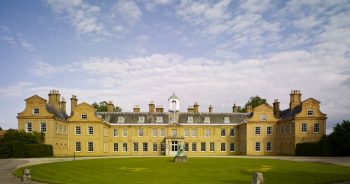
Stratfield Saye House
In the heart of the English countryside on the Hampshire/Berkshire border, you’ll find the elegant, but intimate, Stratfield Saye House, home to the Dukes of Wellington since 1818. After the Battle of Waterloo the First Duke of Wellington, or the Great Duke as he was universally known, was regarded as the saviour of his country and of Europe. A grateful nation voted a substantial sum of money to enable him to buy a house and an estate worthy of a great national hero. After considering many far grander properties, he chose Stratfield Saye. Stratfield Saye House does not compare in either size or grandeur with the other great ducal houses, and it was the Great Duke’s intention to build a huge palace in the northeast corner of the park, but fortunately the money was not available. He therefore set about making his home convenient and comfortable and, as a very practical man, he was well satisfied with the results. The House today is lived in by the 9th Duke of Wellington and his family. Whilst the Great Duke’s wonderful collection of pictures are at Apsley House, which was given to the nation by the 7th Duke in 1947, Stratfield Saye House contains a fascinating collection of paintings and furniture purchased by the Great Duke with many mementos of his occupation of his modest country home. This visit is for Georgian Group members only, and participants must make their own arrangements for transport. Refreshments and lunch are included (£50).
Sue Berry | Builders as Architects and Their Significant Influence in Town and Country: The Morris and Wild Families of Sussex, 1720–1840
Online, 7 May 2024, 6.30pm
Arthur and John Morris played an important role in the development of Coombe, Firle, and Glynde Places in Sussex and worked on houses in Lewes. They dealt directly with clients even when there was an architect. Amon and Amon Henry Wilds worked mainly in two towns, Amon Henry shifting from builder to architect. He made a big impact on Brighton, designing houses, projects, churches, and chapels. There must have been many more local entrepreneurs like these, and we need to know more about them. The Wilds moved to Brighton and undertook speculative development as well as worked for clients. The Morris family did not, as Lewes did not offer the same opportunities. £5 members / £7 non-members.
Steven Brindle | The Greek Revival in England
In-person, The Georgian Group, Fitzroy Square, London, 6.30pm
In the 1750s a debate unfolded in Rome as to which was superior: Greek or Roman art? Despite the publication of volume 1 of Stuart and Revett’s Antiquities of Athens (1762), British architects and clients instinctively took their inspiration from Roman art for another generation or more. Steven Brindle considers the development of the Greek style in England, from its tentative and experimental mid-Georgian beginnings, to its sudden triumph in the Regency age, its establishment as the ‘public style’ in the 1810s and 20s, its relationship to the mainstream neoclassicism of the late-Georgian age, its decline—and its somewhat different course in Scotland. £15 members / £18 non-members.










 Enfilade
leave a comment