Symposium | Portraiture in a Trans-Asian Context
From ArtHist.net:
Making the Subject of Portraiture in a Trans-Asian Context, ca. 1000–Present Day
SOAS University of London, 5–7 December 2024
Registration due by 22 November 2024
Portraits have commonly been understood as naturalistic likenesses of human beings, centred on the face. The work of scholars such as Jean Borgatti, Richard Brilliant (1990), and Joanna Woodall (1997) opened the field in conceptualising portraiture as a truly multi-local genre, foregrounding the relational and performative processes of portraiture. This conference addresses the performative function of portraiture in constructing subjectivities in Asian contexts, in order to reveal important cultural, social, religious, and philosophical ideas key to understanding particular societies and cultures within Asia and its diasporas.
The symposium focuses on the portraiture of Asia with two specific purposes in mind. First, to decentre studies of Asian portraiture from Eurocentric conceptions of subjecthood and thus to expand the field of portraiture studies; second, to foreground the connections, transfers and tensions articulated by portraiture within trans-Asian contexts. The focus on Asia should not be read as exclusionary, but rather as the intent to initiate a dialogue with existing research on the portraiture of other regions such as Africa and Europe. Thirty-five years after Borgatti, Brilliant and Woodall’s contributions to the field of portraiture studies, the symposium Making the Subject of Portraiture in a Trans-Asian Context ca. 1000-Present Day proposes to take stock of a changing field by contributing the scholarship of art, cultural and literary history in the trans-Asian context.
Registration links are at the event page (participants will need to register individually for each day). Please direct inquiries to Conan Cheong (656531@soas.ac.uk) and Mariana Zegianini (mz15@soas.ac.uk) of the Department of the History of Art and Archaeology, at SOAS University of London.
t h u r s d a y , 5 d e c e m b e r
17.15 Doors open at Wolfson Lecture Theatre, Senate House
17.30 Welcome by Charlotte Horlyck (Head of the School of Arts, SOAS University of London)
17.45 Let’s Change the Subject: Joanna Woodall (The Courtauld Institute of Art)
18.00 Panel 1 | Portraiture and Technology
Chair: Ashley Thompson (SOAS University of London
• Margaret Hillenbrand (University of Oxford) — Read Your Mind: Facial Recognition Technology and Contemporary Chinese Portraiture
• Xinrui Zhang (The Courtauld Institute of Art) — Maskbook: Selfhood and Portraits of Chinese Artists and Environmental Activists
• Wiebke Leister (Royal College of Art and Ashley Thorpe, Royal Holloway) — A Hannya Manifesto: Performative Photographic Portraiture as Contemporary Demon Meta-Noh Play to Construct Feminist Frameworks for Interpretation
19.30 Evening Drinks
f r i d a y , 6 d e c e m b e r
13.15 Doors open at S312, Paul Webley Wing, Senate House
13.30 Panel 2 | Portraying Femininity
Chair: Henning von Mirbach (The Courtauld Institute of Art)
• Wen-chien Cheng, Royal Ontario Museum (Online) — Genre Crossing: The Fluidity of Female Portraits in Late Imperial China
• Doreen Mueller (Leiden University) — Becoming Ōtagaki Rengetsu: Misrepresenting a Buddhist Nun
• Amanda (Xiao) Ju (University College London) — From the Personal to the General: Xing Danwen’s Photographic Diaries
• Bahar Gürsel (Middle East Technical University, Online) — Studio Portraits of Female Domestic Workers in Late 19th- and Early 20th-Century Java and Singapore
15.15 Coffee Break
15.45 Panel 3 | The Diasporic / Displaced Subject
Chair: Marcus Gilroy-Ware (SOAS University of London)
• Nicole-Ann Lobo (Princeton University) — Self-Portraits of Francis Newton Souza in Bombay & London, 1949–61
• Jung Joon Lee (Rhode Island School of Design) — Surface Reading: Oksun Kim’s Berlin Portraits and the Aesthetics of Inscrutability
• Yingbai Fu (SOAS University of London) — Dressing Like a Princess: The Old-fashioned Horse-hoof Cuffs in the Portrait of Der Ling (c. 1885–1944) for American Eyes
• Haely Chang (Hood Museum of Art, Dartmouth College) — A Portrait of Public Self: Reading Na Hyesŏk’s Self-Portrait through Vernacular Photo Albums
17.30 Coffee Break
18.00 Panel 4 | Altered Masculinities
Chair: Richard Hylton (SOAS University of London)
• Giorgio Strafella (Palacký University Olomouc, Czech Republic) — The Experimental and Intellectual Roots of Shen Jingdong’s Hero and Hundred Family Names Portraits
• Amanda Wangwright (University of South Carolina, Online) — Seeing the Truth in Uncut Jade: Modernist Naturism, Traditional Ideals, and Timeless Truths in Portrait of Xu Langxi
• Michele Matteini (New York University, Online) — The Underbelly of Qing Portraiture: Flaccid Skin, Defective Bodies, and Old Age in the Qianlong Era
s a t u r d a y , 7 d e c e m b e r
9.15 Doors open at DLT Lecture Theatre, Ground Floor, Main Building
9.30 Panel 5 | Image-Text Relationships
Chair: Malcolm McNeill (SOAS University of London)
• Yiyang Gao (University of Oxford, Online) — Intertextual Subjectivity at the Qing Court: Portraiture in Wanguo laicho tu and Tributary Dramas Revisited
• Mengxuan Sui (Tsinghua University Art Museum, Online) — The Portraiture of Female Literati: A Study on Qu Bingyun (1767–1810) and Her Peers
• Nicholas L. Chan (The Chinese University of Hong Kong, Online) — A 1979 Calendar: Portraits of Figures from the Dream of the Red Chamber
11.00 Panel 6 | The Performing Subject
Chair: Natasha Morris (SOAS University of London)
• Junyao He (The Courtauld Institute of Art) — Emperor or Bodhisattva? The Qianlong Emperor as Bodhisattva Manjushri in the collection of the Potala Palace, Lhasa, Revisited
• Conan Cheong (SOAS University of London) — Memorialising Monastic Subjectivity: Photographs and Wax Figures of Buddhist Monks in Luang Prabang, Lao PDR
• Ziyi Shao (SOAS University of London) — The Origins and Image Translation of the Three Horizontal Paintings of Tsongkhapa’s Life Stories in Fanhualou
12.30 Lunch Break
13.30 Panel 7 | Testing the Boundaries
Chair: Stephen Whiteman (The Courtauld Institute of Art)
• Leslie V. Wallace (Coastal Carolina University) — White General and Other Portraits of Gyrfalcons at the Court of the Qianlong Emperor (r. 1795–1796)
• Natasha Morris (SOAS University of London) — ‘Opening the Face of Isfahan’: Portraiture in 17th-Century Persian Painting
• Chang Tan (Penn State University) — Living Matter: Portraiture in Zhuang Hui’s “Nature Photography”
15.00 Closing Remarks (Conan Cheong and Mariana Zegianini)
Symposium | Apprentices and Networks of Learning, 1650–1950
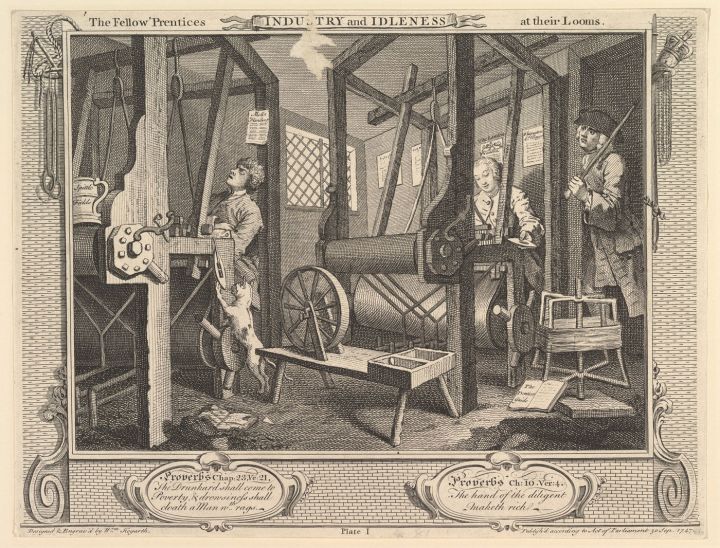
William Hogarth, Industry and Idleness, Plate I: The Fellow ‘Prentices at Their Looms, October 1747, etching and engraving
(Houston: Sarah Campbell Blaffer Foundation)
◊ ◊ ◊ ◊ ◊
This Saturday at the MFAH:
Skillful Hands: Apprentices and Networks of Learning, 1650–1950
Online and in-person, Museum of Fine Arts Houston, 9 November 2024
Established in 2014, the biennial Rienzi symposium focuses on topics inspired by the decorative arts, with papers presented by emerging scholars.
The 2024 symposium, Skillful Hands: Apprentices and Networks of Learning 1650–1950, explores the networks of learning available—and unavailable—to diverse groups of people, examining how access to training and materials through apprenticeships shaped craft traditions. Selected participants present their research on Saturday, 9 November 2024, on the MFAH main campus in Lynn Wyatt Theater, located in the Kinder Building. Entrance is included with Museum admission. The event is live streamed and can be accessed here.
Before the late 19th century, apprenticeships regulated by European craft guilds were the primary means of training in craft trades. These apprenticeships offered a valuable alternative to traditional education but often excluded women, immigrants, Indigenous and enslaved peoples, and children from low-income families. With the onset of the Industrial Revolution, informal apprenticeships emerged to adapt to new innovations and technologies. Outside traditional European models, skills were acquired through forced migration, local environments, and informal training in various colonial regions. These diverse experiences contributed to a network of skilled craftspeople, both anonymous and renowned.
p r o g r a m
11.15 Welcome — Christine Gervais (the Fredricka Crain Director, Rienzi)
11.20 Keynote
Making Time: Competition and Collaboration in Early Modern European Artisanal Networks — Lauren R. Cannady (Assistant Professor of Humanities, University of Houston–Clear Lake)
12:05 Session 1
• Tactile Nomenclature: Transgenerational Transmission of Silk Weaving Knowledge in Early Modern Iran —
Nader Sayadi (Visiting Assistant Professor, University of Rochester)
• Es Artisanes Du Roi: The Public Prohibition and Private Protection of Women’s Artisanal Knowledge in the Paris of Louis XIV, 1661–1715 — Jordan Hallmark (PhD student, Harvard University)
1.00 Lunch break
1.40 Session 2
• The Racial Afterlife of Revolutionary Goldsmithing and Absent Apprenticeships from Haiti to Bordeaux — Benet Ge (Williams College)
• ‘Perfect’ Imitations: Learning in The Spanish Colonial Philippines — Lalaine Little (Director, Pauly Friedman Art Gallery, Misericordia University)
2.35 Break
2.50 Session 3
• Haitian Cabinetmaking Community in New Orleans: The Apprentices of Jean Rouseau and Dutreuil Barjon — Lydia Blackmore (Decorative Arts Curator, Historic New Orleans Collection)
• Passing on Knowledge: Learning the Upholsterer’s Trade in the 19th Century — Justine Lécuyer (Sorbonne Université, Paris)
Call for Papers | Artists’ International Social Networks, 1750–1914
From ArtHist.net:
(Re)searching Connections: Artists’ International Social Networks, 1750–1914
Academia Belgica, Rome, 30 September — 1 October 2025
Proposals due by 15 February 2025
 Musea Brugge and the Academia Belgica are pleased to announce the conference (Re)searching Connections: Artists’ International Social Networks, 1750–1914, to be held at the Academia Belgica in Rome on 30 September and 1 October 2025. This two-day conference will examine the formation and function of artists’ transnational social networks, while also exploring new research possibilities enabled by digital methodologies. Embracing a broad chronological and geographical scope, we invite insights spanning the long nineteenth century and various contexts worldwide. We are excited to confirm two esteemed keynote speakers: France Nerlich (Musée d’Orsay) and Giovanna Ceserani (Stanford University).
Possible topics for consideration include, but are not limited to:
• The impact of artists’ networks on educational and professional development, with a focus on artistic training abroad, intergenerational exchanges, mentorship, patronage, and/or the role of academies and other institutions.
• The complex interplay of identity and community in artists’ networks, which can encompass émigré artists, artist’s colonies, the influence of gender, social class and family ties, the physical spaces of sociability, and interpersonal dynamics such as collaboration, competition, emulation, and a sense of belonging.
• Processes of artistic exchange and adaptation in artist’s networks, whether influenced by cross-cultural interaction or by historical shifts and events such as the rise of nationalistic ideologies, regime change, warfare, and colonialism.
• The representation and documentation of artist’s networks, with attention to contemporary artworks, visual media, and written historical source material, as well as the digital approaches that enable the visualization and analysis of social networks today.
Please visit our website for the conference details, including the full Call for Papers and the submission form. We invite proposals for 20-minute papers in English or French. If presenting in French, please provide accompanying materials in English. Please fill out the submission form on our website by 15 February 2025 (notification of acceptance expected to arrive by the end of March 2025). Proposals should include a single PDF file with the following components:
• A 100-word biography of the author
• A 300-word abstract
• 1 or 2 relevant images (e.g. artworks, archival documents, data visualization)
Proposals will be evaluated based on relevance, clarity, novelty, and contribution to the field. We seek papers that reflect critically on the source material and methodologies employed. For more information, please contact Marie Vandeghinste at marie.vandeghinste@brugge.be.










 Enfilade
leave a comment