Netherlands Yearbook for History of Art | Women, 1500–1950
The latest issue of NKJ:
Elizabeth Alice Honig, Judith Noorman, and Thijs Weststeijn, eds., Women: Female Roles in Art and Society of the Netherlands, 1500–1950, Netherlands Yearbook for History of Art / Nederlands Kunsthistorisch Jaarboek 74 (2024), ISBN: 978-9004710740, $162.
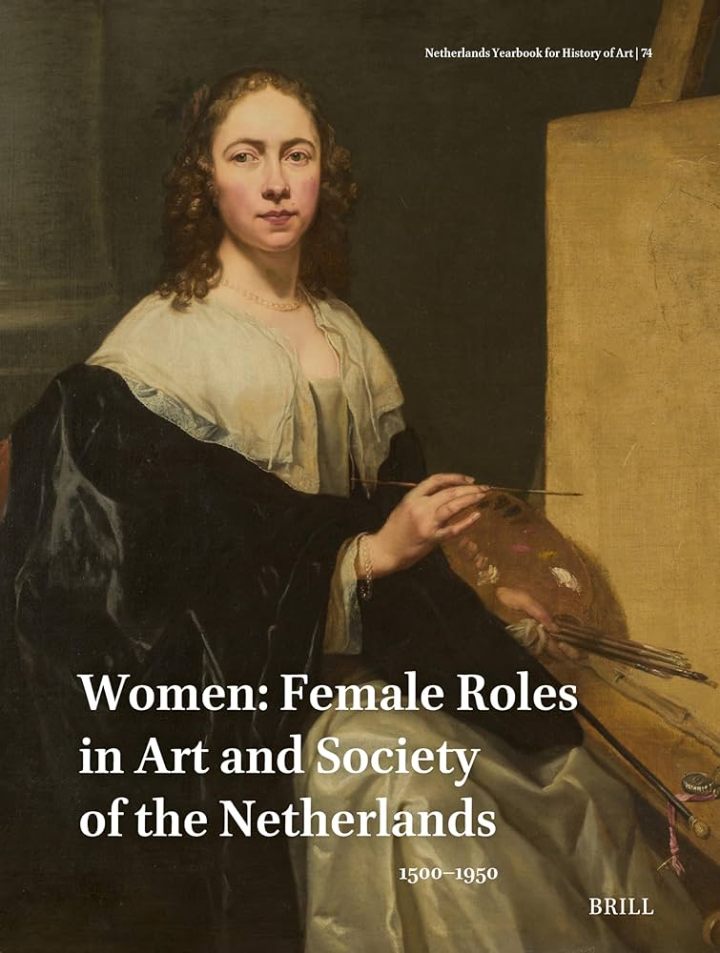 Long overdue in the history of the Netherlands Yearbook for History of Art, this volume foregrounds women as creators, patrons, buyers, and agents of change in the arts of the Low Countries. Venturing beyond the participation of ‘exceptional’ individuals, chapters investigate how women produced paintings, sculptures, scientific illustrations, and tapestries as well as their role in architectural patronage and personalized art collections. Teasing out a variety of socio-economic, legal, institutional, and art-theoretical dimensions of female agency, the volume highlights the role of visual culture in women’s lived experience and self-representation, asking to what extent women challenged, subverted, or confirmed societal norms in the Netherlands.
Elizabeth Alice Honig is Professor of Northern European Art at the University of Maryland, and Professor Emerita at the University of California, Berkeley. She works on Dutch, Flemish, and British art.
Judith Noorman is Associate Professor in Early Modern Art History at the University of Amsterdam. From 2021 to 2026, she is Principal Investigator of The Female Impact, a research project funded by the Dutch Research Council (NWO).
Thijs Weststeijn is Professor of Art History before 1800 at Utrecht University, where he chairs the research project The Dutch Global Age (2023–2028).
c o n t e n t s
• Introduction
• Dynamic Partnership: The Work of Married Women in Dutch Seventeenth-Century Artists’ Households — Marleen Puyenbroek
• The Sculptor and the Sculptress: Gendering Sculpture Production in the Early Modern Low Countries —Elizabeth Rice Mattison
• The Images and the Interventions of Adriana Perez in the Rockox Collection — Kendra Grimmett
• Household Heroines: Maria van Nesse’s Memory-Book and the Interplay between the Art Market and Household Consumption — Judith Noorman
• Weaving a Business: Clara de Hont’s (1664–1751) Tapestry Workshop in Amsterdam — Rudy Jos Beerens
• Situational Awareness and Practices of Exchange in the Art of Johanna Helena Herolt and Alida Withoos — Catherine Powell-Warren
• Cultivating a Female Presence in the Early Eighteenth-Century Learned Community: The Printed Portraits of Maria de Wilde (1682–1729) — Lieke van Deinsen
• Unmarried, Married, Widowed, and Dead: Female Patrons of Architecture in Amsterdam (1680–1800) —Pieter Vlaardingerbroek
• Caretaker of a Collection: The Case of Jo van Bilderbeek-Lamaison — Bert-Jaap Koops
• We Could Hardly Refuse Them: Alida Pott and the Women of De Ploeg, 1918–1931 — Anneke de Vries
New Book | Campaspe Talks Back
From Brepols:
Lieke van Deinsen, Bert Schepers, Marjan Sterckx, Hans Vlieghe, and Bert Watteeuw, eds., Campaspe Talks Back: Women Who Made a Difference in Early Modern Art (Turnhout: Brepols: 2024), 436 pages, ISBN: 978-2503613055, €125.
 With forty-three contributions this book pays homage to Katlijne Van der Stighelen, who has shown exceptional range in her own contributions to the history of art in the Southern Netherlands and beyond. With monographs on Peter Paul Rubens and Anthony van Dyck, she has considerably expanded scholarship on canonical artists. Yet early on, a catalogue raisonné of the portraits of the lesser-known Cornelis de Vos revealed that Van der Stighelen was not one to preserve the status quo but to challenge it. Mindful of protagonists and their historiographical pull, she has consistently rehabilitated artists relegated to the background, in some cases by single-handedly saving them from total oblivion and—remarkable feat—having them added to the canon.
Portraiture, supposedly a sijd-wegh der consten, was paved into a central avenue of inquiry in Van der Stighelen’s work. Her approach to the genre made it into a pathway for the introduction of women artists. What was a sijd-wegh became a zij-weg. From seminal publications on Anna-Maria van Schurman to revelatory exhibitions on Michaelina Wautier, Van der Stighelen’s particular brand of feminism has impacted scholarship as deeply as it has touched the museum-going public.
Women and portraiture are the core themes of the essays assembled in this book. The resulting group portrait is crowded and rambunctious and reflects the varied subject matter that has attracted Van der Stighelen’s professional attention. It also paints a partial portrait of the community of scholars that she has so generously fostered. In trying to summarize the motivations of authors to contribute to this volume or the gratitude of generations of art historians trained by her, it is best to quote the title of the first exhibition on women artists in Belgium and The Netherlands, which Van der Stighelen curated in 1999: Elck zijn waerom.
Lieke van Deinsen is assistant research professor Dutch literature at KU Leuven.
Bert Schepers is senior editor of the Corpus Rubenianum Ludwig Burchard.
Marjan Sterckx is associate professor in the histories of art and interior design 1750–1950 at Ghent University.
Hans Vlieghe is emeritus professor history of early modern art at Leuven University.
Bert Watteeuw is director of the Antwerp Rubenshuis.
c o n t e n t s
Introduction
Campaspe, Apelles, and Alexander the Great
• Hans Vlieghe — Katlijne: Portrait of an Art Historian
I | Sitters & Subjects
• Barbara Baert — Cutting the Gaze: Salome in Andrea Solario’s Oeuvre, c. 1465–1524
• Nils Büttner — Rubens, the Capaio Ladies, and Their Niece
• Hans Cools — Why Margaret of Parma Should Make It to the Next Version of the Flemish Canon
• Liesbeth De Belie — Concerning Orbs and the Value of a Destroyed Portrait
• Guy Delmarcel — The Virtuous Women of the Bible: A Series of Baroque Tapestries from Bruges and Their Mysteries
• Gerlinde Gruber — Brave (if Brazen) Women: Spartans, not Amazons, by Otto van Veen (1556–1629)
• Karen Hearn — Portrait of a Poisoner? An Early Seventeenth-Century British Female Portrait Reconsidered
• Fiona Healy — Sacred History Imitating Real Life: How a Curious Portrayal of the Birth of the Virgin Reflects Childbirth Practices in the Early Modern Period
• Koenraad Jonckheere — Rubens’s Verwe: Head Studies and Complexion
• Elizabeth McGrath — The Girls in Rubens’s Allegory of Peace
• Hubert Meeus — Judith’s Maid
• Bert Schepers — Lifting the Veil on Justus van Egmont (1602–1674): On Cleopatra Approaching Alexandria and Some Other Newly Identified Designs for Tapestries
• Lieke van Deinsen — The Voiceless Virgin and the Speaking Likeness: Anna Maria van Schurman’s Portrait as a Labadist
• Hans Vlieghe — Portrait of a Young Woman in Triplicate: On a ‘Rubensian’ Head Study
II | Artists & Artisans
• Rudy Jos Beerens — Unravelling the Story of Jannetje Laurensd. Wouters (c. 1640–1722), Tapitsierster
• Ralph Dekoninck — Pausias and Glycera by Rubens and Beert: Amorous Emulation and/or Mimetic Rivalry
• Kirsten Derks — Leaving Her Mark: Michaelina Wautier’s Signing Practice
• Inez De Prekel — Female Artists and Artisans in the Antwerp Guild of St Luke, 1629–1719
• Ad Leerintveld — Constantijn Huygens and Louise Hollandine, Princess of the Palatinate, or How High a Highness Could Rise in the Arts
• Fred G. Meijer — All in the Family: A Previously Unrecorded Landscape Painter: Catrina Tieling, 1670-?
• Judith Noorman — ‘Elck heeft sijn eijgen pop’: Dollmaker Drawings by Leonart Bramer and Dolls as Indicators of Class and Identity
• Anna Orlando — Sofonisba and van Dyck: A Matter of Style
• Marjan Sterckx — Talent and Sentiment: A Portrait of the Artist Marie-Anne Collot (1748–1821) as a Young Woman
• Jan Van der Stock — Women Who Stood Their Ground in the Guild of St Luke at the Beginning of Antwerp’s ‘Golden Age’, 1453–1552
• Francisca van Vloten — From ‘Russian Rembrandt’ to ‘Baronin’ and ‘Nonna’: Marianne von Werefkin (1860–1938), Evolution and Appreciation
• Wendy Wiertz — Craft, Gender, and Humanitarian Aid: The Representation of Belgian Lacemakers in the Era of World War I
• Beatrijs Wolters van der Wey — Catharina Pepyn, Rising Star
III | Partners & Patrons
• Rudi Ekkart and Claire van den Donk — In the Lead: Another Look at the Role of Women in Seventeenth-Century Family Portraits
• Valerie Herremans — Arte et Marte: Countess Maria-Anna Mulert-van den Tympel and Ian-Christiaen Hansche’s Pioneering Stucco Ceilings in Horst Castle (1655)
• Corina Kleinert — Hidden in the Footnotes: The Collection of Anna-Isabella van den Berghe, 1677–1754
Hannelore Magnus, ‘Periculum in Mora’: Frans Langhemans the Younger (1661–c.1720) and the Scandalous Elopement of Maria Cecilia de Wille
• Volker Manuth and Marieke de Winkel — The Marital Misfortunes and Messy Divorce of a Mennonite Woman: Catharina Hoogsaet
• Sarah Joan Moran — Court Beguinage Mistresses as Art Curators
• Erik Muls — Isabella and Catharina Ondermarck: Spiritual Daughters on a Mission
• Eric Jan Sluijter — Rembrandt’s Saskia Laughing (1633): The Affect and Effect of Reciprocal Love
• Bert Timmermans — Art Patronage in an Unequal Playing Field: Women’s Convents during the Building Boom of the Antwerp ‘Invasion Conventuelle’
• Ben van Beneden — A Flemish Shepherd for Amalia? Some Thoughts on a Newly Discovered Painting by Thomas Willeboirts Bosschaert
• Carla van de Puttelaar — Marriage in Painting: Painterly Collaborations between Juriaan Pool and Rachel Ruysch and a Newly Discovered Portrait of a Girl
• Martine van Elk — ‘The Name Gives Lustre’: Anna Maria van Schurman’s Glass Engravings
• Bert Watteeuw and Klara Alen —Dealing with Helena
• Jeremy Wood — In the Shadow of the ‘Proud Duke’? Elizabeth Percy, Duchess of Somerset (1667–1722), as Patron
• Lara Yeager-Crasselt — Painting Margherita: Louis Cousin and Flemish Portraiture in Seventeenth-Century Italy
• Leen Huet — Epilogue: Reading between the Lines, Reading between the Brushstrokes – Two letters
Bibliography of Katlijne Van der Stighelen — Compiled by Lies De Strooper and Koen Brosens










leave a comment