Exhibition | Sketching Splendor: American Natural History, 1750–1850
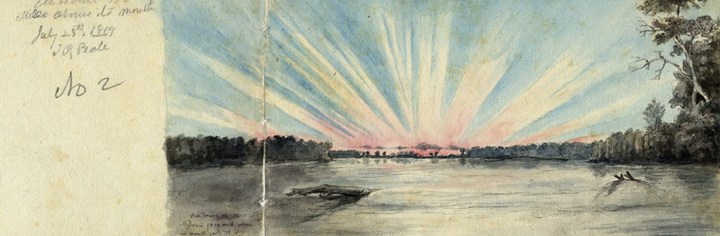
Titian Ramsay Peale, Sunset on Missouri, July 1819
(Philadelphia: American Philosophical Society, NH121 TRP, MSS.B.P31.15d)
◊ ◊ ◊ ◊ ◊
Now on view at the American Philosophical Society Museum:
Sketching Splendor: American Natural History, 1750–1850
American Philosophical Society Museum, Philadelphia, 12 April — 29 December 2024
Sketching Splendor: American Natural History, 1750–1850 explores how William Bartram, Titian Ramsay Peale, and John James Audubon made sense of nature’s complexities through their writings, drawings, and watercolors. It highlights their approaches to capturing the natural world during a time of rapid intellectual, social, and political change.
 Bartram, Peale, and Audubon relied on natural knowledge established by European, Euro-American, and Native American experts while balancing changing ideas of how reason and emotion impacted science. As both artists and naturalists, they freely expressed their ideas using science, art, and literature. Through a potent mix of scientific ideas, shifting worldviews, and professional freedom, their works embodied both experimentation and certainty. However, their interpretation of the natural world has also raised questions of national importance. Their world was not just one of intellectual excitement, but one of systematic injustice and a complex national history become visible as we peel back the layers. Sketching Splendor draws on the APS’s extensive holdings. Highlights of the exhibition include William Bartram’s map of the Alachua Savanna, Benjamin Henry Latrobe’s Rattlesnake Skeleton, Titian Ramsay Peale’s watercolors from the Long Expedition, and one volume of John James Audubon’s original Birds of America.
Anna Majeski and Michelle Craig McDonald, Sketching Splendor: American Natural History, 1750–1850 (Philadelphia: University of Pennsylvania Press, 2024), 112 pages, ISBN: 978-1606180402, $30.
Anna Majeski received a PhD in art history from the Institute of Fine Arts, New York University in 2022, where she completed a doctoral dissertation on a remarkable series of astrological fresco cycles completed in Padua between 1300 and 1440. Her research focuses on the intersections of art and science, image and knowledge in the early modern world, and has been supported by pre- and postdoctoral fellowships from the American Academy in Rome and the Harvard Center for Renaissance Studies, Villa I Tatti. She joined the American Philosophical Society, Library & Museum, as Mellon Foundation Postdoctoral Natural History Exhibition Research Fellow in October 2022.
Michelle Craig McDonald is the Librarian/Director of the Library and Museum at the American Philosophical Society, founded in 1743 and the oldest learned society in North America. The APS has more than 14 million pages of manuscripts and 300,000 printed volumes, with particular strengths in early American history, the history of science, and Native American and Indigenous cultures. McDonald earned her PhD in history from the University of Michigan where she focused on business relationships and consumer behavior between North America and the Caribbean during the 18th and 19th centuries. She is the co-author of Public Drinking in the Early Modern World: Voices from the Tavern (Pickering & Chatto/Routledge Press, 2011), and her current monograph, Coffee Nation: How One Commodity Transformed the Early United States, will be published by the University of Pennsylvania Press in spring 2025.
IDEAL Internship Grants from Decorative Arts Trust

Family Room at Filoli, Woodside California
(Photo by Jeff Bartee)
◊ ◊ ◊ ◊ ◊
From the press release (28 October 2024) . . .
The Decorative Arts Trust is pleased to announce the six institutions that received IDEAL Internship Grants for 2025: the Asheville Art Museum in Asheville, North Carolina; Bard Graduate Center in New York City; The Clay Studio in Philadelphia; Filoli in Woodside, California; the High Museum of Art in Atlanta; and the Liberty Hall Historic Site in Frankfort, Kentucky.
The IDEAL Internship Grants program was established in 2020 to create opportunities for undergraduate students of color through collaborations that create meaningful introductions to the museum field and introduce new perspectives and voices to curatorial practice. Since its founding, the program has supported 16 interns.
Once the Asheville Art Museum reopens following the damage brought by Hurricane Helene, the curatorial department will host two undergraduate interns to assist with the development and educational programming for two upcoming exhibitions.
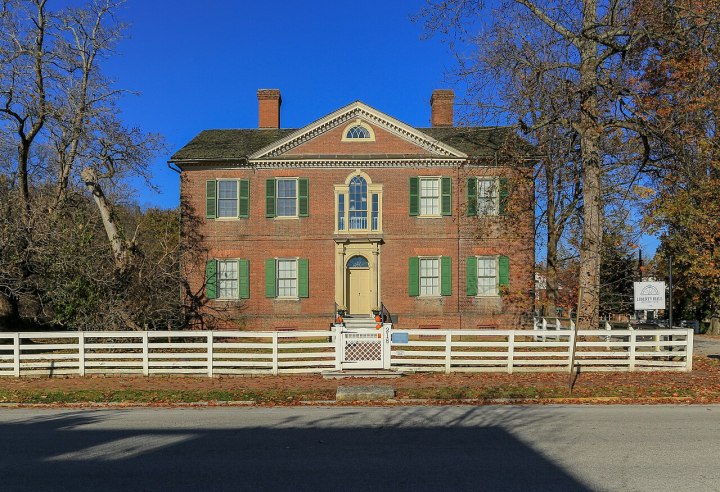
Liberty Hall, Frankfort, Kentucky, built in 1796 (Photo by Christopher Riley, Wikimedia Commons, November 2018).
Bard Graduate Center will create an internship within their Marketing, Communications, and Design department, specifically for Pratt Institute’s Undergraduate Communications Design program. The intern will work closely with staff on exhibition design, catalog production, and institutional branding.
The Clay Studio, in Philadelphia, will hire an intern who will gain valuable experience working with both physical and digital archival systems, the documentation of artworks, and exhibition planning and implementation.
Filoli, a Georgian Revival estate turned museum in Woodside, California, will host a Collections Intern to gain tangible and meaningful experience in preservation, cataloging, photography, and database management.
As the High Museum of Art in Atlanta approaches its centennial anniversary in 2026, the curatorial team will welcome an intern to assist with the reinstallation of American art galleries and conduct research on objects in the permanent collection.
Liberty Hall Historic Site in Frankfort, Kentucky, will host an intern to study the Black experience at two houses owned by the prominent Brown family, specifically regarding the buildings’ construction, urban enslavement, emancipation, and Reconstruction.
For updates about applying for these internship opportunities, visit the institutions’ websites and follow them on social media. The IDEAL Internship Program is part of the Decorative Arts Trust’s Emerging Scholars Program. For upcoming grant application deadlines, visit decorativeartstrust.org or email thetrust@decorativeartstrust.org.










 Enfilade
leave a comment