Call for Papers | French Sacred Sculpture, 1700–1850
From ArtHist.net, which includes the German version:
Productive Crisis: French Sacred Sculpture on the Threshold of Modernity, 1700–1850
Produktive Krise: Französische Sakralskulptur an der Schwelle zur Moderne, 1700–1850
Martin-Luther-Universität Halle-Wittenberg, Halle, 27–29 November 2025
Organized by Julie Laval and Angelika Marinovic
Proposals due by 31 January 2025
With the start of the 18th century, Parisian churches emerged as a testing ground for new sculptural concepts. Critical discourses on religion, institutions, and art—increasingly conducted in public forums such as Salons, literary magazines, and other editorial formats—demanded updated artistic approaches. There is no doubt that the French Revolution, with its tendencies toward secularisation, marked a significant turning point with regard to the modernisation programmes within the church. Nevertheless, sculptural concepts in the first half of the 19th century up to the end of French monarchy continued to be characterised by the search of convincing and authentic solutions in response to the crisis of the sacred space, while still considering the political and institutional continuity of royal and ecclesiastical patrons.
As part of the DFG-funded project Sculpture and the Sacred: Sculptural Reconceptions of Religious Spaces of Visuality in Paris during the Transition to the Modern Period (1700 to circa 1850), this conference will be held at the IZEA in Halle (Saale) from November 27 to 29, 2025. It focuses on innovations in previously underrated French religious sculpture from the Siècle des Lumières to the end of the French monarchy. The focus is on religious spaces of visuality fundamentally shaped by sculpture, not only in Paris but also beyond. In addition to French religious sculpture—with a particular emphasis on its liturgical and architectural context—this conference will also consider possible correlations with secular sculpture and comparable themes in sculptural production in neighbouring European countries.
Proposals may consider, but are not limited to, the topics suggested below. Submissions offering further perspectives are explicitly encouraged.
• Significance of social and cultural upheavals arising throughout the Siècle des Lumières—especially during the French Revolution and the July Revolution of 1830—as well as the reconsolidation measures of the Restoration for (French) religious sculpture
• Political intentionality in the conception of religious sculptural ensembles, e.g. as an expression of continuity and in response to social change
• Reassessment of the relationship between religious sculpture and an increasingly ‘enlightened’ and self-aware audience, e.g. new didactic expectations regarding religious sculpture as well as a re-evaluation of sculptural illusion as reflected in contemporary magazines and other publications
• Post-Tridentine liturgical reforms during the Siècle des Lumières and the debate on the renewal of Christian art and architecture as articulated by, among others, François-René de Chateaubriand and Charles de Montalembert as impetus for sculptural invention
• Relevance of aesthetic demands shaped by Neoclassical ideals and formulated in art theoretical writings and Salon critiques (such as the ‘beau idéal’ coined by Quatremère de Quincy or the rejection of realistic detail) for religious sculpture
• Influence of the redefinition of religious sculpture on secular sculptural practices
• Artistic innovation in religious sculpture in neighbouring European countries
The conference languages are German, English, and French. Travel and accommodation expenses will be fully covered by the German Research Foundation (DFG). A conference volume is planned for 2026. Please submit an abstract (up to 500 words) for a 20-minute presentation along with a brief biographical note by 31 January 2025, to sakralskulptur@kunstgesch.uni-halle.de. Question are also welcome.
Head of the DFG-funded project Productive Crisis: French Sacred Sculpture on the Threshold of Modernity, 1700–1850: Prof. Dr. Wiebke Windorf (Martin-Luther-Universität Halle-Wittenberg).
Conference development and coordination:
Julie Laval M.A. (Martin-Luther-Universität Halle-Wittenberg)
Dr. Angelika Marinovic (Martin-Luther-Universität Halle-Wittenberg)
Conference | The Secularization of Religious Assets
From ArtHist.net and the Centre André-Chastel:
The Secularization of Religious Assets in Enlightenment Europe: Urban Development, Architecture, and Art Works
La sécularisation des établissements religieux dans l’Europe des lumières: Ville, architecture et œuvres d’art
Institut National d’Histoire de l’Art, Paris, 27 November 2024
Organized by Ronan Bouttier, Gernot Mayer, and Raluca Muresan
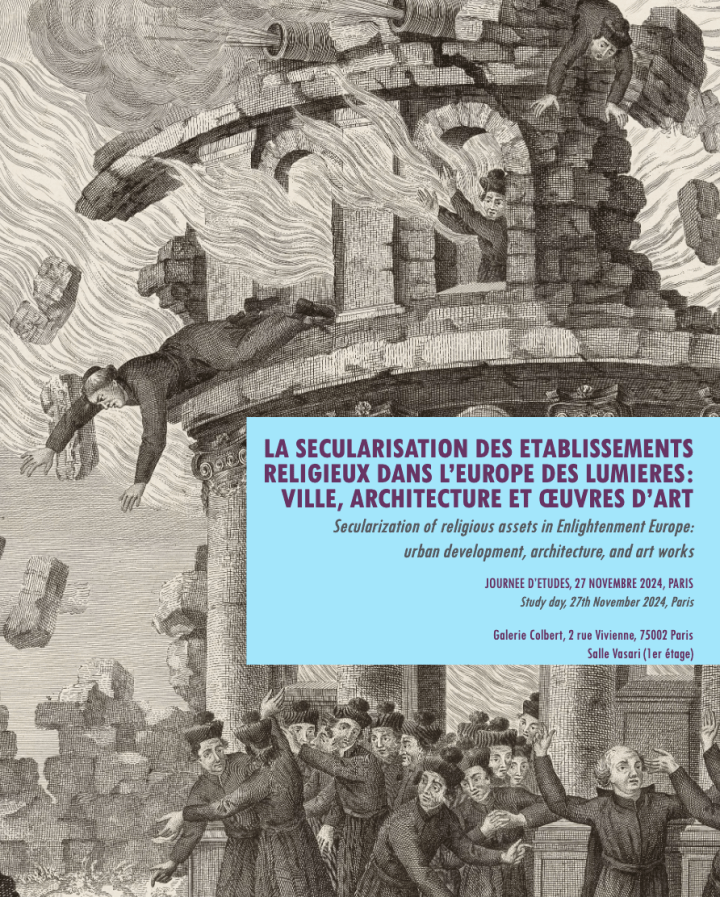 The suppression of the Society of Jesus in 1773 marks the last step of the Order’s progressive dissolution initiated fifteen years earlier, in Europe and in its colonies. This act of suppression was the culmination of a broader secularisation movement concerning religious congregations across Europe, from the 1760s to the French Revolution. In most cases, the State intended to take over the management of properties belonging to religious congregations described as useless for the common interest. Whether driven by reformatory or by economic interests, all acts of suppression and secularisation had the same consequences: a large number of movable assets and real property, estates and art works were either reallocated to other religious congregations or put on sale, when not confiscated altogether.
p r o g r a m m e
9.00 Welcome of participants
9.15 Welcoming address
9.30 Introduction by the organizers
10.00 Confiscation Procedures
Chair: Raluca Muresan (Sorbonne Université, Paris)
• Paola Benussi (Archivio di Stato, Venise), La sécularisation des patrimoines ecclésiastiques dans les régions « d‘outre-mer » de la République de Venise
• Raffaele Marronne (Scuola Normale Superiore, Pise), ‘Volle entrare per tutte le sagrestie’: The Dispersion of the Artistic Heritage of the Lay Confraternities of Siena following the Leopoldine Suppressions (1785)
• Etienne Couriol (LARHRA, Université Lyon 3), Ce que dit la presse périodique lyonnaise et bordelaise de la vente des biens des Jésuites
11.30 Pause
12.00 Sécularisation et développement urbain / Secularization and Urban Development
Chair: Ronan Bouttier (Université Paris 1 Panthéon-Sorbonne)
• Richard Biegel (Université Charles, Prague), Les transformations des édifices sacrés de Prague au siècle des Lumières et leurs conséquences urbaines
• Pierre Coffy (Univ. Paris 1 Panthéon-Sorbonne/Univ. Statale di Milano), Préparer le terrain pour l’essor de la «ville moderne»: Suppression et réemploi des biens religieux dans le Milan des Habsbourg d’Autriche
13.00 Lunch break
14.30 Sécularisations, remplois et dispersions / Secularization, Reuse, and Dispersal
Chair: Gernot Mayer (Université de Vienne)
• Alberto Garin (Universidad Francisco Marroquín, Guatemala), Le couvent des Jésuites de la Antigua Guatemala
• Katia Martignago (Università degli Studi di Napoli Federico II, Naples), The Venetian Jesuits’ Convent after 1773
• Sylvia Stegbauer (Belvedere Research Center, Vienne), Architectural Properties of the Marian Congregations in Transition
• Márta Velladics (Université Eötvös Loránd, Budapest), Success or Failure? The Utilisation of the Abolished Monasteries in Hungary between 1782 and 1802
17.00 Final Discussion
• Emilie d‘Orgeix (Ecole Pratique des Hautes Etudes, Paris)
• Jean-Philippe Garric (Université Paris 1 Panthéon-Sorbonne)
• Olga Medvedkova (CNRS, Centre André Chastel, Paris)
18.00 Thanks from the organizers
Organizers
• Ronan Bouttier, Université Paris 1 Panthéon-Sorbonne
• Gernot Mayer, Universität Wien, Vienne
• Raluca Muresan, Sorbonne Université, Paris
Scientific Committee
• Jean-Philippe Garric, Université Paris 1 Panthéon-Sorbonne
• Richard Kurdiovsky, Österreichische Akademie der Wissenschaften, Vienne
• Olga Medvedkova, CNRS, Centre André Chastel, Paris
• Émilie d’Orgeix, Ecole Pratique des Hautes Etudes, Paris
Image: Extinction de la Société des Jésuites, detail, 1773, engraving, 58 × 39 cm (Wien Museum, Inv. 21288).
New Book | Every Valley
From Penguin Random House:
Charles King, Every Valley: The Desperate Lives and Troubled Times That Made Handel’s Messiah (New York: Doubledy, 2024), 352 pages, ISBN: 978-0385548267, $32.
 George Frideric Handel’s Messiah is arguably the greatest piece of participatory art ever created. Adored by millions, it is performed each year by renowned choirs and orchestras, as well as by audiences singing along with the words on their cell phones. But this work of triumphant joy was born in a worried age. Britain in the early Enlightenment was a place of astonishing creativity but also the seat of an empire mired in war, enslavement, and conflicts over everything from the legitimacy of government to the meaning of truth. Against this turbulent background, prize-winning author Charles King has crafted a cinematic drama of the troubled lives that shaped a masterpiece of hope. Every Valley presents a depressive dissenter stirred to action by an ancient prophecy; an actress plagued by an abusive husband and public scorn; an Atlantic sea captain and penniless philanthropist; and an African Muslim man held captive in the American colonies and hatching a dangerous plan for getting back home. At center stage is Handel himself, composer to kings but, at midlife, in ill health and straining to keep an audience’s attention. Set amid royal intrigue, theater scandals, and political conspiracy, Every Valley is entertaining, inspiring, unforgettable.
Charles King is the author of eight books, most recently Gods of the Upper Air, a New York Times bestseller, a finalist for the National Book Critics Circle award, and winner of the Francis Parkman Prize. His Odessa won a National Jewish Book Award. He is a professor of international affairs and government at Georgetown University.










 Enfilade
leave a comment