Exhibition | Sculpture and Colour in the Spanish Golden Age

Luisa Roldán, known as La Roldana, The First Steps of Jesus, ca. 1692–1706, polychrome terracota
(Museo de Guadalajara)
◊ ◊ ◊ ◊ ◊
From the press release for the exhibition:
Hand in Hand: Sculpture and Colour in the Spanish Golden Age
Darse la mano: Escultura y color en el Siglo de Oro
Museo Nacional del Prado, Madrid, 19 November — 2 March 2025
Curated by Manuel Arias Martínez
When praising the wood sculpture of Christ of Forgiveness, carved by Manuel Pereira and polychromed by Francisco Camilo, the writer on art Antonio Palomino (1655–1726) concluded with the following opinion: “Thus painting and sculpture, hand in hand, create a prodigious spectacle.” The unique importance achieved by the synthesis of volume and colour in sculpture of the early modern period can be explained only by the role it played as an instrument of persuasion.
 From the Graeco-Roman world onwards, sculptural representation was seen as a necessity. Divinity was present through its corporeal, protective, and healing image, which became more lifelike when covered with colour, an essential attribute of life in contrast to the inanimate pallor of death. In the words of the Benedictine monk Gregorio de Argaiz in 1677: “Each figure, no matter how perfect it may be in sculpture, is a corpse; what gives it life, soul, and spirit is the brush, which represents the affections of the soul. Sculpture forms the tangible and palpable man […], but painting gives him life.”
Religious sculpture existed in a context of supernatural connotations from the time of its execution. It was thus associated with miracles and divine interventions, with angelic workshops, and with craftsmen who had to be in a morally acceptable state in order to undertake a task that went beyond a mere artistic exercise, given that what was created was ultimately an imitation of the divine.
The exhibition now presented at the Museo Nacional del Prado offers an analysis of the phenomenon and success of polychrome sculpture, which filled churches and convents in the 17th century and played a key role as a support for preaching. The close and ideal collaboration between sculptors and painters is revealing with regard to the esteem in which colour was held, not merely as a superficial finish to the work but rather an essential element without which it could not be considered finished. Colour also made a decisive contribution to emphasising the dramatic values of these sculptures, both those made for altarpieces and for processional images. Theatrical gesturalism, together with the sumptuous nature of the clothing—whether sculpted, glued fabric, or real textiles—transformed these sculptures into dramatic objects filled with meaning.
Finally, the exhibition looks at other examples of the interrelationship between the arts in relation to polychrome sculpture, from the prints that helped disseminate the most popular devotional images to the Veils of the Passion [painted altarcloths of devotional images] which simulated altarpieces, and paintings that made use of striking illusionism to faithfully reproduce the sculptural images on their respective altars.
More information is available here»
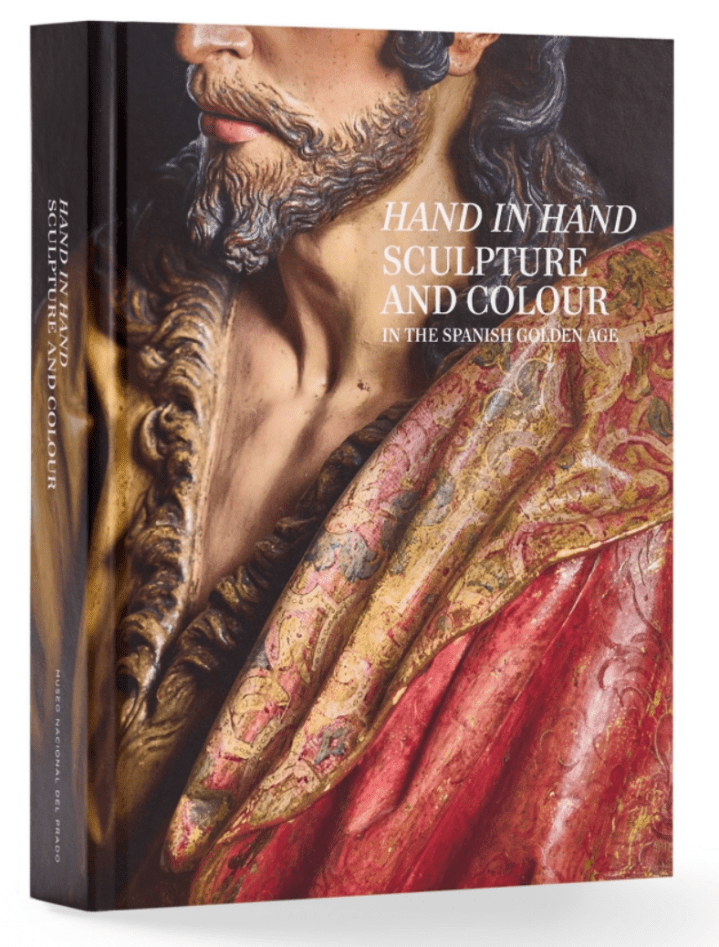
Manuel Arias Martínez, Hand in Hand: Sculpture and Colour in the Spanish Golden Age (Madrid: Museo Nacional del Prado, 2024), 424 pages, ISBN: 978-8484806288 (English edition) / ISBN: 978-848480-6271 (Spanish edition) €37.










 Enfilade
leave a comment