New Book | Taste and the Antique
From Brepols:
Adriano Aymonino, Eloisa Dodero, Nicholas Penny, and Francis Haskell, Taste and the Antique: The Lure of Classical Sculpture, 1500–1900, revised and amplified edition (Turnhout: Harvey Miller / Brepols, 2024), 3 volumes, approximately 1684 pages, ISBN: 978-1909400252, €395.
 Indispensable for historians of taste and for art historians concerned with the debt owed by artists from the Renaissance onwards to the art of ancient Greece and Rome, as well as for students and collectors of the many surviving copies of the sculptures discussed.
For several hundred years, until about 1900, a limited number of antique sculptures were as much admired as are the Mona Lisa, Botticelli’s Birth of Venus or Michelangelo’s David today. They were reproduced in marble, bronze, and lead, as plaster casts in academies and art schools, as porcelain figurines for chimneypieces and as cameos for bracelets and snuffboxes. They were celebrated by poets from Du Bellay and Marino to Byron and D’Annunzio, and memorably evoked by novelists as diverse as Marcel Proust and Nathaniel Hawthorne, George Eliot and Charles Dickens. Copies of some of these statues can be seen at Pavlosk and Madrid, at Stourhead, Charlottenburg, Malibu and Versailles, and in countless gardens, houses, and museums throughout the world.
How and when did these particular sculptures achieve such a special status? Who were the collectors, restorers, dealers, artists, dilettanti, scholars and archaeologists who created their reputations? Under what names (often wildly fanciful) did they first become famous? How were they interpreted, and how and when and why did their glamour begin to wane? These are some of the problems that are confronted in Taste and the Antique.
 Taste and the Antique has become a classic of art history since its original publication in 1981. Now expanded into three volumes, this revised and amplified edition significantly updates the information based on new research undertaken in the last several decades, as well as expanding examples of the reception and influence of these works by artists and collectors from the Renaissance through to contemporary art.
When Taste and the Antique was published in 1981, Francis Haskell (1928–2000) was established as one of the most influential historians of art, not only in the English-speaking world but throughout Europe, chiefly on account of his first book, Patrons and Painters (1963), a highly original account of Baroque art in Italy. Since his appointment as professor of art history in Oxford in 1967, he had turned his attention from Italy in the seventeenth and eighteenth centuries to France in the eighteenth and nineteenth, and had begun his investigations of collecting, historiography, and the role of the museum and of the art critic, eventually published as Rediscoveries in Art (1976) and Past and Present in Art and Taste (1987). Taste and the Antique identified the models for art education and criticism during the four centuries with which Haskell was chiefly preoccupied, providing a series of individual case studies for the works upon which orthodox taste was founded. The book had a central place in his oeuvre, prompting preoccupations which persist in the last book that he published in his lifetime, History and Its Images (1993), as well as in The Emphemeral Museum, published posthumously in 2000.
 When he began to work with Francis Haskell on Taste and the Antique, Nicholas Penny was teaching art history at the University of Manchester. His first book, Church Monuments in Romantic England (1977), had attracted Haskell’s attention and subsequently they discovered and developed many mutual interests. Penny went on to occupy curational positions in the Ashmolean Museum in Oxford, the National Gallery in London, and the National Gallery of Art in Washington, D.C. From 2008 to 2015 he was director of the National Gallery. He is now a visiting professor at the National Academy of Fine Art in Hangzhou. Among his other books are Raphael (1983), written with the late Roger Jones, and The Materials of Sculpture (1993), as well as catalogues of the sculpture in the Ashmolean Museum (3 volumes, 1992) and of the sixteenth-century Italian paintings in the National Gallery (2004, 2008, 2016). He is currently cataloguing the Italian paintings in the Norton Simon Museum in Pasadena, of which one volume was published in 2021 and the other, written with Imogen Tedbury, is approaching completion.
Adriano Aymonino is the director of the MA in Art Market, Provenance and History of Collecting at the University of Buckingham. He is the author of Paper Palaces (2013); Drawn from the Antique: Artists and the Classical Ideal (with Anne Varick Lauder, 2015); and, most recently, Enlightened Eclecticism. The Grand Design of the 1st Duke and Duchess of Northumberland (2021), winner of the 2022 William MB Berger Prize.
Eloisa Dodero is archaeological curator at the Capitoline Museums in Rome. She is the author of Il Tesoro di Antichità. Winckelmann e il Museo Capitolino nella Roma del Settecento (with Claudio Parisi Presicce, 2017); Ancient Marbles in Naples in the Eighteenth Century (2019); and co-author, with Amanda Claridge, of The Paper Museum of Cassiano dal Pozzo. Sarcophagi and other Reliefs (four volumes, 2022) and, within the same series, of Statues and Busts (2023).
c o n t e n t s
Volume I | Text
A revised and amplified version of the 1981 edition. Fifteen chapters trace in narrative form, with the support of a wide variety of plates, the rise and decline of this highly important episode in the history of taste. These chapters are followed by catalogue entries for 95 of the most celebrated sculptures, all of them illustrated, which provide information on when and where they were discovered, changes of ownership and nomenclature, as well as a record of varying critical fortunes designed to complement the more general discussion in the earlier chapters.
Preface to the Revised and Amplified Edition
An Updated Note on the Presentation of the Essay and Catalogue
Introduction
1 ‘A New Rome’
2 The Public and Private Collections of Rome
3 Plaster Casts and Prints
4 Control and Codification
5 Casts and Copies in Seventeenth-Century Courts
6 ‘Tout ce qu’il y a de beau en Italie’
7 Erudite Interests
8 Florence: The Impact of the Tribuna
9 Museums in Eighteenth-Century Rome
10 The New Importance of Naples
11 The Proliferation of Casts and Copies
12 New Fashions in the Copying of Antiquities
13 Reinterpretations of Antiquity
14 The Last Dispersals
15 Epilogue
Notes to the Text
Updated Bibliography
Catalogue
Appendix
Bibliography
Index
Volume II | Originals
Contains especially commissioned new photography of over 90 statues catalogued in Volume I.
Volume III |Replicas and Adaptations
Devoted to a visual survey of the full range of replicas and adaptations of the works catalogued and illustrated in the previous volumes.
Study Day | The Face in Public Sculpture
From ArtHist.net:
L’intime face au public: Le visage dans la sculpture publique des XVIIIe et XIXe siècle en France et dans la sphère germanique
INHA Paris, 25–26 November 2024
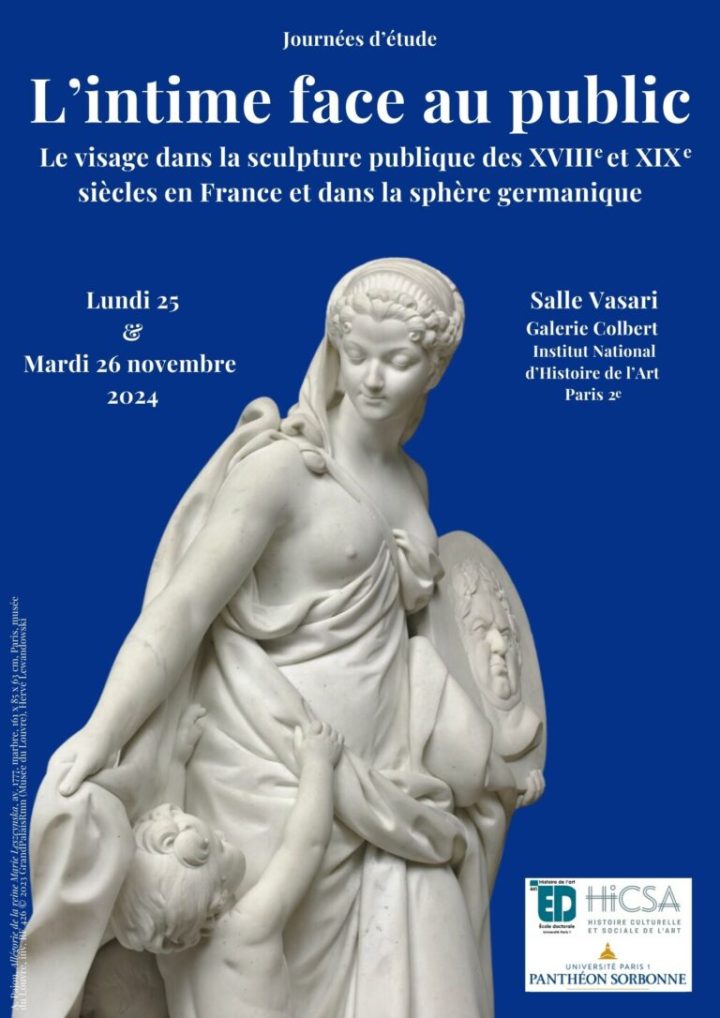 Cette journée d’étude dédiée à la sculpture souhaite s’intéresser à un élément en particulier : le visage. Partie essentielle de la figure sculptée, le visage a ce double rôle de permettre l’identification et l’expression. Cette double responsabilité est davantage mise en évidence au cours des XVIIIe et XIXe siècles, avec l’essor des portraits et de l’intérêt porté à l’intériorité, et plus largement à l’intime. Cette manifestation souhaite mettre en parallèle cette notion d’intimité avec celle du public, qui lui est souvent opposée. La sculpture étant l’art par excellence de l’espace public, l’objectif est de confronter le visage qui relève de l’intime, avec les impératifs liés à la sculpture publique. Ce sujet est d’autant plus pertinent que les statues présentes dans l’espace public ont été sujettes à un décorum en constante évolution tout au long du XIXe siècle.
Le type statuaire de prédilection était et reste le portrait, en buste ou bien en pied. Honneur pour une personne, outil de propagande, image officielle, le visage sculptural compte de nombreuses fonctions qui se dessinent au XVIIIe siècle et se précisent au XIXe siècle, avec le déplacement d’une fonction religieuse et royale de la sculpture à une fonction civique. Oscillant entre idéalisation et ressemblance, la figuration du visage dans le médium sculptural est un concept questionnable dans les XVIIIe et XIXe siècles franco-allemands. Outre les similitudes dans leurs ascendants artistiques et textuels, ces deux étendues géographiques nous permettront d’interroger les circulations artistiques qui ont eu lieu, et surtout d’analyser comment les évolutions politiques, qui ont touchées tant la France que la sphère germanique, ont conduit à une affirmation nationale qui s’incarne dans la sculpture publique. Cette journée d’étude vise ainsi à questionner la représentation du visage dans la statuaire publique franco-germanique du XVIIIe et XIXe siècle, à analyser ses théories, ses pratiques, ses techniques, ses possibles typologies et la perception qu’en a le spectateur.
l u n d i , 2 5 n o v e m b r e
14.00 Accueil des participants
14.30 Introduction générale — Justine Cardoletti, Sarah Touboul-Oppenheimer, Émilie Ginestet
14.45 Conférence d’ouverture / Opening Lecture
• Animated Features: Making Public Faces Private — Malcolm Baker (Distinguished professor of the History of Art, University of California, Riverside)
15.30 Session 1 | Visage du vivant, visage du mort / The Face of the Living, the Face of the Dead
Chair: Guilhem Scherf (Conservateur général du patrimoine au département des Sculptures, musée du Louvre)
• La statuaire publique franco-germanique : Objet de transmission de l’intime et Sujet altruiste ou quand le visage inerte devient une table de conversion des affects qui Comptent pour les siècles et les siècles — Bruno Bouchard (Professeur, Université du Québec à Rimouski)
• Jean-Baptiste Carpeaux : un instantané en pierre — Francis Mickus (Doctorant en Histoire, Université Paris 1 Panthéon-Sorbonne)
• Le visage du mort : portrait intime, portrait public — Eric Sergent (Maître de conférences en histoire de l’art et du patrimoine, Université de Haute-Alsace)
• L’intime et l’obscène. Moulages anthropologiques et masques mortuaires au XIXe siècle — Martial Guédron (Professeur d’Histoire de l’art moderne, Université de Strasbourg)
m a r d i , 2 6 n o v e m b e r
9.00 Accueil des participants / Greeting participants
9.30 Session 2 | Le visage d’un statut : l’illustre et le populaire / The Face of a Status: The Illustrious and the Popular
Présidence : Émilie Ginestet (Doctorante en Histoire de l’art moderne, Université Toulouse –Jean Jaurès), Sarah Touboul-Oppenheimer (Doctorante en Histoire de l’art, Université Paris 1 Panthéon-Sorbonne)
• Intimes fragments : la fonte du Louis XV de Bouchardon, gestation et reliques d’un monument parisien —Ulysse Jardat (Conservateur du patrimoine, responsable du département Décors, mobilier et arts décoratifs, Musée Carnavalet-Histoire de Paris)
• Goethe par David d’Angers. Production collective d’une persona — Gregor Wedekind (Professeur d’Histoire de l’art moderne et contemporain, Johannes Gutenberg-Universität Mainz)
• Christian Daniel Rauch à Halle : début, puissance d’action et vulnérabilité du monument — Wiebke Windorf (Professeur d’Histoire de l’art moderne, Martin-Luther-Universität Halle-Wittenberg)
• Visages du quotidien : la sculpture de genre dans les monuments publics au XIXe siècle — Michaël Vottero (Docteur en histoire de l’art habilité à diriger des recherches et Conservateur en chef du patrimoine, conservateur des monuments historiques, DRAC Bourgogne-Franche-Comté)
14.00 Session 3 | Expression du visage, expression du monument / Facial Expression, Expression of the Monument
Présidence : Émilie Roffidal (chargée de recherche HDR CNRS Framespa-UMR 5136)
• From the Fontaine de Grenelle to the Laiterie at Rambouillet: The Theme of the Distracted Head in Mid-to-Late 18th-Century French Sculpture — Tomas Macsotay (Professeur d’Histoire de l’art moderne, Universitat Pompeu Fabra)
• De face ou de profil ? L’orientation de la tête dans les monuments publics aux rois de France à l’époque moderne — Étienne Jollet (Professeur d’Histoire de l’art moderne, Université Paris 1 Panthéon-Sorbonne)
• Élever une figure chartraine au XIXe siècle — Maéva Bouderlique (Doctorante en Histoire de l’art contemporain, Nantes Université)
• Le Gavarni de Denys Puech : le monument comme image-récit biographique — Marie-Lise Poirier (Doctorante en Histoire de l’art, Université du Québec à Montréal)
16.30 Session 4 | Du privé au public : enjeux du Beau et de l’identification dans le buste / From Private to Public: Issues of the Beautiful and Identification in Busts
Présidence : Justine Cardoletti (Doctorante en Histoire de l’art moderne, Université Paris 1 Panthéon-Sorbonne)
• La figure antique et la notion du Beau au XVIIIe siècle : évolution et transformation du goût dans l’espace nobiliaire — Hector Chapron (Doctorant en Histoire de l’art moderne, Sorbonne Université)
• Gaetano Merchi (1747–1823). Itinéraires européens du portrait sculpté entre pratique publique et privée — Gaia Mazzacane (Doctorante en Histoire de l’art, École Normale Supérieure de Pise)
17.15 Conclusion des journées — Justine Cardoletti, Émilie Ginestet, Sarah Touboul-Oppenheimer
17.30 Cocktail de clôture
Exhibition | Sculpture and Colour in the Spanish Golden Age

Luisa Roldán, known as La Roldana, The First Steps of Jesus, ca. 1692–1706, polychrome terracota
(Museo de Guadalajara)
◊ ◊ ◊ ◊ ◊
From the press release for the exhibition:
Hand in Hand: Sculpture and Colour in the Spanish Golden Age
Darse la mano: Escultura y color en el Siglo de Oro
Museo Nacional del Prado, Madrid, 19 November — 2 March 2025
Curated by Manuel Arias Martínez
When praising the wood sculpture of Christ of Forgiveness, carved by Manuel Pereira and polychromed by Francisco Camilo, the writer on art Antonio Palomino (1655–1726) concluded with the following opinion: “Thus painting and sculpture, hand in hand, create a prodigious spectacle.” The unique importance achieved by the synthesis of volume and colour in sculpture of the early modern period can be explained only by the role it played as an instrument of persuasion.
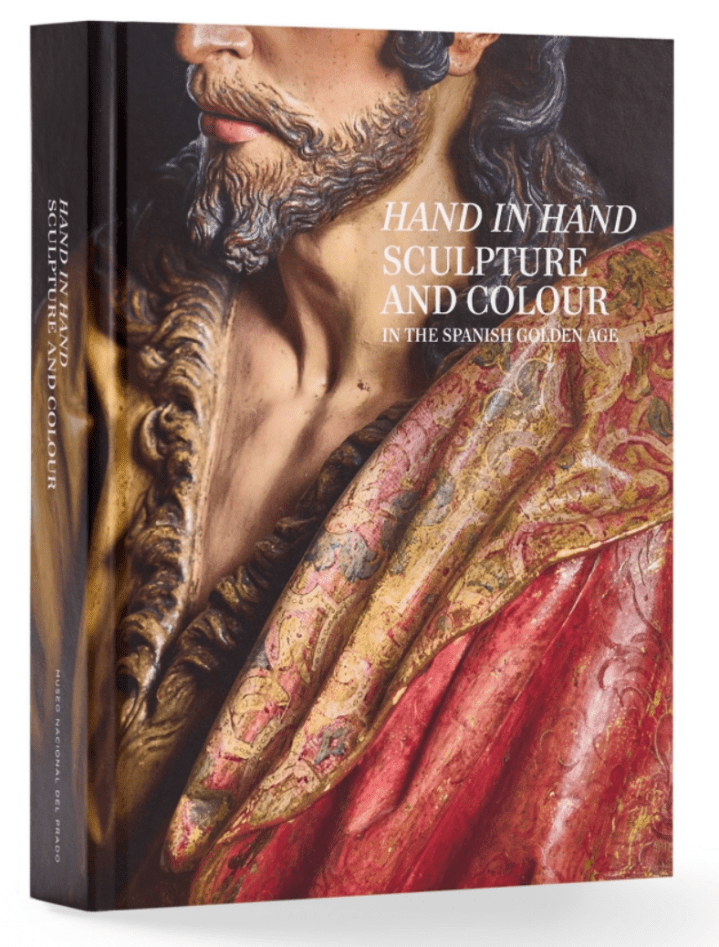 From the Graeco-Roman world onwards, sculptural representation was seen as a necessity. Divinity was present through its corporeal, protective, and healing image, which became more lifelike when covered with colour, an essential attribute of life in contrast to the inanimate pallor of death. In the words of the Benedictine monk Gregorio de Argaiz in 1677: “Each figure, no matter how perfect it may be in sculpture, is a corpse; what gives it life, soul, and spirit is the brush, which represents the affections of the soul. Sculpture forms the tangible and palpable man […], but painting gives him life.”
Religious sculpture existed in a context of supernatural connotations from the time of its execution. It was thus associated with miracles and divine interventions, with angelic workshops, and with craftsmen who had to be in a morally acceptable state in order to undertake a task that went beyond a mere artistic exercise, given that what was created was ultimately an imitation of the divine.
The exhibition now presented at the Museo Nacional del Prado offers an analysis of the phenomenon and success of polychrome sculpture, which filled churches and convents in the 17th century and played a key role as a support for preaching. The close and ideal collaboration between sculptors and painters is revealing with regard to the esteem in which colour was held, not merely as a superficial finish to the work but rather an essential element without which it could not be considered finished. Colour also made a decisive contribution to emphasising the dramatic values of these sculptures, both those made for altarpieces and for processional images. Theatrical gesturalism, together with the sumptuous nature of the clothing—whether sculpted, glued fabric, or real textiles—transformed these sculptures into dramatic objects filled with meaning.
Finally, the exhibition looks at other examples of the interrelationship between the arts in relation to polychrome sculpture, from the prints that helped disseminate the most popular devotional images to the Veils of the Passion [painted altarcloths of devotional images] which simulated altarpieces, and paintings that made use of striking illusionism to faithfully reproduce the sculptural images on their respective altars.
More information is available here»
Manuel Arias Martínez, Hand in Hand: Sculpture and Colour in the Spanish Golden Age (Madrid: Museo Nacional del Prado, 2024), 424 pages, ISBN: 978-8484806288 (English edition) / ISBN: 978-848480-6271 (Spanish edition) €37.
Call for Papers | French Sacred Sculpture, 1700–1850
From ArtHist.net, which includes the German version:
Productive Crisis: French Sacred Sculpture on the Threshold of Modernity, 1700–1850
Produktive Krise: Französische Sakralskulptur an der Schwelle zur Moderne, 1700–1850
Martin-Luther-Universität Halle-Wittenberg, Halle, 27–29 November 2025
Organized by Julie Laval and Angelika Marinovic
Proposals due by 31 January 2025
With the start of the 18th century, Parisian churches emerged as a testing ground for new sculptural concepts. Critical discourses on religion, institutions, and art—increasingly conducted in public forums such as Salons, literary magazines, and other editorial formats—demanded updated artistic approaches. There is no doubt that the French Revolution, with its tendencies toward secularisation, marked a significant turning point with regard to the modernisation programmes within the church. Nevertheless, sculptural concepts in the first half of the 19th century up to the end of French monarchy continued to be characterised by the search of convincing and authentic solutions in response to the crisis of the sacred space, while still considering the political and institutional continuity of royal and ecclesiastical patrons.
As part of the DFG-funded project Sculpture and the Sacred: Sculptural Reconceptions of Religious Spaces of Visuality in Paris during the Transition to the Modern Period (1700 to circa 1850), this conference will be held at the IZEA in Halle (Saale) from November 27 to 29, 2025. It focuses on innovations in previously underrated French religious sculpture from the Siècle des Lumières to the end of the French monarchy. The focus is on religious spaces of visuality fundamentally shaped by sculpture, not only in Paris but also beyond. In addition to French religious sculpture—with a particular emphasis on its liturgical and architectural context—this conference will also consider possible correlations with secular sculpture and comparable themes in sculptural production in neighbouring European countries.
Proposals may consider, but are not limited to, the topics suggested below. Submissions offering further perspectives are explicitly encouraged.
• Significance of social and cultural upheavals arising throughout the Siècle des Lumières—especially during the French Revolution and the July Revolution of 1830—as well as the reconsolidation measures of the Restoration for (French) religious sculpture
• Political intentionality in the conception of religious sculptural ensembles, e.g. as an expression of continuity and in response to social change
• Reassessment of the relationship between religious sculpture and an increasingly ‘enlightened’ and self-aware audience, e.g. new didactic expectations regarding religious sculpture as well as a re-evaluation of sculptural illusion as reflected in contemporary magazines and other publications
• Post-Tridentine liturgical reforms during the Siècle des Lumières and the debate on the renewal of Christian art and architecture as articulated by, among others, François-René de Chateaubriand and Charles de Montalembert as impetus for sculptural invention
• Relevance of aesthetic demands shaped by Neoclassical ideals and formulated in art theoretical writings and Salon critiques (such as the ‘beau idéal’ coined by Quatremère de Quincy or the rejection of realistic detail) for religious sculpture
• Influence of the redefinition of religious sculpture on secular sculptural practices
• Artistic innovation in religious sculpture in neighbouring European countries
The conference languages are German, English, and French. Travel and accommodation expenses will be fully covered by the German Research Foundation (DFG). A conference volume is planned for 2026. Please submit an abstract (up to 500 words) for a 20-minute presentation along with a brief biographical note by 31 January 2025, to sakralskulptur@kunstgesch.uni-halle.de. Question are also welcome.
Head of the DFG-funded project Productive Crisis: French Sacred Sculpture on the Threshold of Modernity, 1700–1850: Prof. Dr. Wiebke Windorf (Martin-Luther-Universität Halle-Wittenberg).
Conference development and coordination:
Julie Laval M.A. (Martin-Luther-Universität Halle-Wittenberg)
Dr. Angelika Marinovic (Martin-Luther-Universität Halle-Wittenberg)
Conference | The Secularization of Religious Assets
From ArtHist.net and the Centre André-Chastel:
The Secularization of Religious Assets in Enlightenment Europe: Urban Development, Architecture, and Art Works
La sécularisation des établissements religieux dans l’Europe des lumières: Ville, architecture et œuvres d’art
Institut National d’Histoire de l’Art, Paris, 27 November 2024
Organized by Ronan Bouttier, Gernot Mayer, and Raluca Muresan
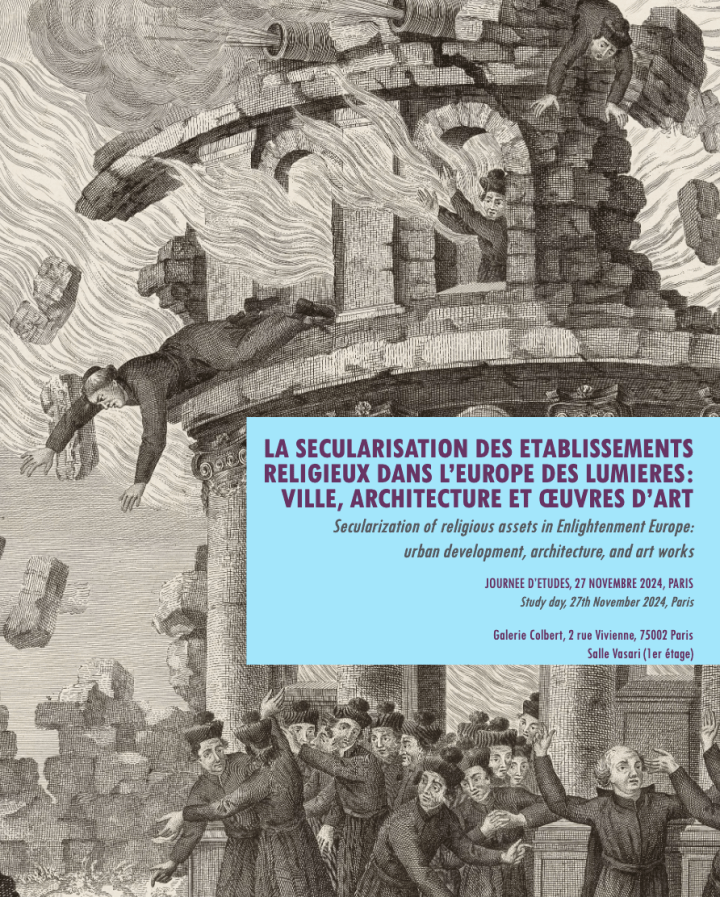 The suppression of the Society of Jesus in 1773 marks the last step of the Order’s progressive dissolution initiated fifteen years earlier, in Europe and in its colonies. This act of suppression was the culmination of a broader secularisation movement concerning religious congregations across Europe, from the 1760s to the French Revolution. In most cases, the State intended to take over the management of properties belonging to religious congregations described as useless for the common interest. Whether driven by reformatory or by economic interests, all acts of suppression and secularisation had the same consequences: a large number of movable assets and real property, estates and art works were either reallocated to other religious congregations or put on sale, when not confiscated altogether.
p r o g r a m m e
9.00 Welcome of participants
9.15 Welcoming address
9.30 Introduction by the organizers
10.00 Confiscation Procedures
Chair: Raluca Muresan (Sorbonne Université, Paris)
• Paola Benussi (Archivio di Stato, Venise), La sécularisation des patrimoines ecclésiastiques dans les régions « d‘outre-mer » de la République de Venise
• Raffaele Marronne (Scuola Normale Superiore, Pise), ‘Volle entrare per tutte le sagrestie’: The Dispersion of the Artistic Heritage of the Lay Confraternities of Siena following the Leopoldine Suppressions (1785)
• Etienne Couriol (LARHRA, Université Lyon 3), Ce que dit la presse périodique lyonnaise et bordelaise de la vente des biens des Jésuites
11.30 Pause
12.00 Sécularisation et développement urbain / Secularization and Urban Development
Chair: Ronan Bouttier (Université Paris 1 Panthéon-Sorbonne)
• Richard Biegel (Université Charles, Prague), Les transformations des édifices sacrés de Prague au siècle des Lumières et leurs conséquences urbaines
• Pierre Coffy (Univ. Paris 1 Panthéon-Sorbonne/Univ. Statale di Milano), Préparer le terrain pour l’essor de la «ville moderne»: Suppression et réemploi des biens religieux dans le Milan des Habsbourg d’Autriche
13.00 Lunch break
14.30 Sécularisations, remplois et dispersions / Secularization, Reuse, and Dispersal
Chair: Gernot Mayer (Université de Vienne)
• Alberto Garin (Universidad Francisco Marroquín, Guatemala), Le couvent des Jésuites de la Antigua Guatemala
• Katia Martignago (Università degli Studi di Napoli Federico II, Naples), The Venetian Jesuits’ Convent after 1773
• Sylvia Stegbauer (Belvedere Research Center, Vienne), Architectural Properties of the Marian Congregations in Transition
• Márta Velladics (Université Eötvös Loránd, Budapest), Success or Failure? The Utilisation of the Abolished Monasteries in Hungary between 1782 and 1802
17.00 Final Discussion
• Emilie d‘Orgeix (Ecole Pratique des Hautes Etudes, Paris)
• Jean-Philippe Garric (Université Paris 1 Panthéon-Sorbonne)
• Olga Medvedkova (CNRS, Centre André Chastel, Paris)
18.00 Thanks from the organizers
Organizers
• Ronan Bouttier, Université Paris 1 Panthéon-Sorbonne
• Gernot Mayer, Universität Wien, Vienne
• Raluca Muresan, Sorbonne Université, Paris
Scientific Committee
• Jean-Philippe Garric, Université Paris 1 Panthéon-Sorbonne
• Richard Kurdiovsky, Österreichische Akademie der Wissenschaften, Vienne
• Olga Medvedkova, CNRS, Centre André Chastel, Paris
• Émilie d’Orgeix, Ecole Pratique des Hautes Etudes, Paris
Image: Extinction de la Société des Jésuites, detail, 1773, engraving, 58 × 39 cm (Wien Museum, Inv. 21288).
New Book | Every Valley
From Penguin Random House:
Charles King, Every Valley: The Desperate Lives and Troubled Times That Made Handel’s Messiah (New York: Doubledy, 2024), 352 pages, ISBN: 978-0385548267, $32.
 George Frideric Handel’s Messiah is arguably the greatest piece of participatory art ever created. Adored by millions, it is performed each year by renowned choirs and orchestras, as well as by audiences singing along with the words on their cell phones. But this work of triumphant joy was born in a worried age. Britain in the early Enlightenment was a place of astonishing creativity but also the seat of an empire mired in war, enslavement, and conflicts over everything from the legitimacy of government to the meaning of truth. Against this turbulent background, prize-winning author Charles King has crafted a cinematic drama of the troubled lives that shaped a masterpiece of hope. Every Valley presents a depressive dissenter stirred to action by an ancient prophecy; an actress plagued by an abusive husband and public scorn; an Atlantic sea captain and penniless philanthropist; and an African Muslim man held captive in the American colonies and hatching a dangerous plan for getting back home. At center stage is Handel himself, composer to kings but, at midlife, in ill health and straining to keep an audience’s attention. Set amid royal intrigue, theater scandals, and political conspiracy, Every Valley is entertaining, inspiring, unforgettable.
Charles King is the author of eight books, most recently Gods of the Upper Air, a New York Times bestseller, a finalist for the National Book Critics Circle award, and winner of the Francis Parkman Prize. His Odessa won a National Jewish Book Award. He is a professor of international affairs and government at Georgetown University.
Call for Papers | Disabilities and American Art Histories
From the Call for Papers:
Disabilities and American Art Histories
Commentaries for American Art, 2026
Organized by Laurel Daen and Jennifer Van Horn
Manuscripts (1500–2000 words) due by 1 April 2025
American Art, the peer-reviewed journal co-published by the Smithsonian American Art Museum and the University of Chicago Press, seeks to publish papers that explore the intersections of disability studies and the histories of American art, architecture, and design. What perspectives, insights, and forms of redress does disability studies bring to American art history? Where does disability surface in American art and visual culture, and where do absences persist? How has art enacted ableism, spurred practices that challenge and move beyond exclusion and oppression, or combined divergent tendencies in complicated and generative ways? What are the responsibilities of art historians to advance disability justice in their scholarship, teaching, and museum practice? How do the histories of American art change when new ways of making or experiencing art are included?
We invite essays that center disability in American art history in compelling and innovative ways. We encourage authors to foreground critical disability studies methodologies and conceptualize disability broadly, recognizing that the meanings and terminologies of disability can vary across disciplines, experiences, identities, and histories. We welcome essays about how disability has been represented, conceptualized, and constructed via visual and material practices; how individual artists as well as communities, including those that reject the identity of disability, have defined themselves alongside and beyond changing understandings of abled-ness. We encourage authors to approach disability intersectionally and to center the histories of understudied peoples. We also invite reflection on how the discipline of American art and practices of extractive looking have perpetuated ableism.
Collectively these commentaries aim to reveal the centrality of disability and disability studies to our understanding of American art history, considering how such approaches can advance multiple fields and contribute to anti-ableist future practices. Please submit manuscripts of 1,500 to 2,000 words (including notes) with 3–5 images, to AmericanArtJournal@si.edu by 1 April 2025. We invite submissions from authors in and beyond art history, including crip studies, Deaf studies, design history, disability history, disability studies, Mad studies, material culture studies, the history of the body, the history of the senses, the history of technology, medical humanities, and visual culture/practices of looking.
The journal’s guidelines on originality, quality, and submission format apply; visit journals.uchicago.edu/journals/amart/instruct for details. Pre-submission inquiries may be directed to organizers Laurel Daen, University of Notre Dame, and Jennifer Van Horn, University of Delaware, at ldaen@nd.edu and jvanhorn@udel.edu. American Art will facilitate fully anonymized peer reviews and final decisions. Accepted manuscripts will be workshopped, rigorously edited, and published in American Art in 2026.
Exhibition | Sketching Splendor: American Natural History, 1750–1850
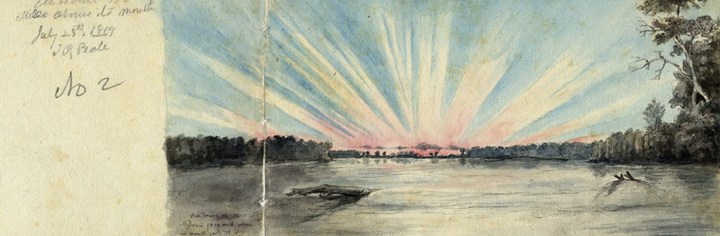
Titian Ramsay Peale, Sunset on Missouri, July 1819
(Philadelphia: American Philosophical Society, NH121 TRP, MSS.B.P31.15d)
◊ ◊ ◊ ◊ ◊
Now on view at the American Philosophical Society Museum:
Sketching Splendor: American Natural History, 1750–1850
American Philosophical Society Museum, Philadelphia, 12 April — 29 December 2024
Sketching Splendor: American Natural History, 1750–1850 explores how William Bartram, Titian Ramsay Peale, and John James Audubon made sense of nature’s complexities through their writings, drawings, and watercolors. It highlights their approaches to capturing the natural world during a time of rapid intellectual, social, and political change.
 Bartram, Peale, and Audubon relied on natural knowledge established by European, Euro-American, and Native American experts while balancing changing ideas of how reason and emotion impacted science. As both artists and naturalists, they freely expressed their ideas using science, art, and literature. Through a potent mix of scientific ideas, shifting worldviews, and professional freedom, their works embodied both experimentation and certainty. However, their interpretation of the natural world has also raised questions of national importance. Their world was not just one of intellectual excitement, but one of systematic injustice and a complex national history become visible as we peel back the layers. Sketching Splendor draws on the APS’s extensive holdings. Highlights of the exhibition include William Bartram’s map of the Alachua Savanna, Benjamin Henry Latrobe’s Rattlesnake Skeleton, Titian Ramsay Peale’s watercolors from the Long Expedition, and one volume of John James Audubon’s original Birds of America.
Anna Majeski and Michelle Craig McDonald, Sketching Splendor: American Natural History, 1750–1850 (Philadelphia: University of Pennsylvania Press, 2024), 112 pages, ISBN: 978-1606180402, $30.
Anna Majeski received a PhD in art history from the Institute of Fine Arts, New York University in 2022, where she completed a doctoral dissertation on a remarkable series of astrological fresco cycles completed in Padua between 1300 and 1440. Her research focuses on the intersections of art and science, image and knowledge in the early modern world, and has been supported by pre- and postdoctoral fellowships from the American Academy in Rome and the Harvard Center for Renaissance Studies, Villa I Tatti. She joined the American Philosophical Society, Library & Museum, as Mellon Foundation Postdoctoral Natural History Exhibition Research Fellow in October 2022.
Michelle Craig McDonald is the Librarian/Director of the Library and Museum at the American Philosophical Society, founded in 1743 and the oldest learned society in North America. The APS has more than 14 million pages of manuscripts and 300,000 printed volumes, with particular strengths in early American history, the history of science, and Native American and Indigenous cultures. McDonald earned her PhD in history from the University of Michigan where she focused on business relationships and consumer behavior between North America and the Caribbean during the 18th and 19th centuries. She is the co-author of Public Drinking in the Early Modern World: Voices from the Tavern (Pickering & Chatto/Routledge Press, 2011), and her current monograph, Coffee Nation: How One Commodity Transformed the Early United States, will be published by the University of Pennsylvania Press in spring 2025.
IDEAL Internship Grants from Decorative Arts Trust

Family Room at Filoli, Woodside California
(Photo by Jeff Bartee)
◊ ◊ ◊ ◊ ◊
From the press release (28 October 2024) . . .
The Decorative Arts Trust is pleased to announce the six institutions that received IDEAL Internship Grants for 2025: the Asheville Art Museum in Asheville, North Carolina; Bard Graduate Center in New York City; The Clay Studio in Philadelphia; Filoli in Woodside, California; the High Museum of Art in Atlanta; and the Liberty Hall Historic Site in Frankfort, Kentucky.
The IDEAL Internship Grants program was established in 2020 to create opportunities for undergraduate students of color through collaborations that create meaningful introductions to the museum field and introduce new perspectives and voices to curatorial practice. Since its founding, the program has supported 16 interns.
Once the Asheville Art Museum reopens following the damage brought by Hurricane Helene, the curatorial department will host two undergraduate interns to assist with the development and educational programming for two upcoming exhibitions.
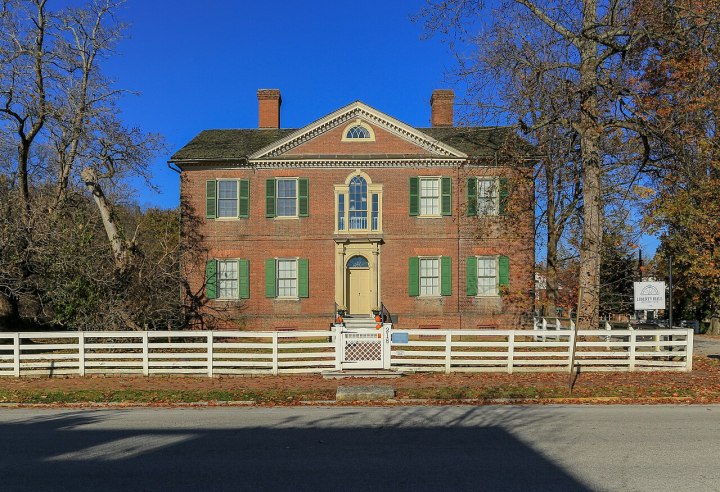
Liberty Hall, Frankfort, Kentucky, built in 1796 (Photo by Christopher Riley, Wikimedia Commons, November 2018).
Bard Graduate Center will create an internship within their Marketing, Communications, and Design department, specifically for Pratt Institute’s Undergraduate Communications Design program. The intern will work closely with staff on exhibition design, catalog production, and institutional branding.
The Clay Studio, in Philadelphia, will hire an intern who will gain valuable experience working with both physical and digital archival systems, the documentation of artworks, and exhibition planning and implementation.
Filoli, a Georgian Revival estate turned museum in Woodside, California, will host a Collections Intern to gain tangible and meaningful experience in preservation, cataloging, photography, and database management.
As the High Museum of Art in Atlanta approaches its centennial anniversary in 2026, the curatorial team will welcome an intern to assist with the reinstallation of American art galleries and conduct research on objects in the permanent collection.
Liberty Hall Historic Site in Frankfort, Kentucky, will host an intern to study the Black experience at two houses owned by the prominent Brown family, specifically regarding the buildings’ construction, urban enslavement, emancipation, and Reconstruction.
For updates about applying for these internship opportunities, visit the institutions’ websites and follow them on social media. The IDEAL Internship Program is part of the Decorative Arts Trust’s Emerging Scholars Program. For upcoming grant application deadlines, visit decorativeartstrust.org or email thetrust@decorativeartstrust.org.
Exhibition | Buckland and Palladio: A Legacy of Design

Hammond-Harwood House in Annapolis, Maryland, designed by William Buckland in 1774. Buckland was inspired by Palladio’s Villa Pisani, Montagnana, as published in The Four Books of Architecture.
◊ ◊ ◊ ◊ ◊
Now on view:
Buckland and Palladio: A Legacy of Design
Hammond-Harwood House Museum, Annapolis, Maryland, 1 April — 30 December 2024
When William Buckland designed the Hammond-Harwood House in 1774, he was inspired by the designs of 16th-century Italian architect Andrea Palladio. The Hammond-Harwood House celebrates its 250th anniversary with an exhibition of early documents, paintings, and artifacts that provide context for Matthias Hammond’s house—including Buckland’s indenture papers and a drawing by Thomas Jefferson.
When the Hammond-Harwood House was designed for Matthias Hammond in 1774, Annapolis was in its Golden Age. There were 14 major houses either already built or underway for the politically active leaders of the Revolution: John Brice, Charles Carroll of Carrollton, William Paca, John Ridout, and Upton Scott. Hammond, a wealthy 25-year-old tobacco planter and delegate to the Maryland General Assembly, had a handsome inheritance and a keen business sense to purchase four acres in Annapolis to build his own “town house.”
Hammond hired the joiner, carpenter, and architect William Buckland to design his city home. Buckland had been indentured to George Mason since his arrival in Virginia in 1755 to complete Mason’s plantation home, Gunston Hall. Buckland left Mason with high recommendations and bought a farm in Virginia, set up a workshop, and worked on other estates, including Mount Airy, the Tayloe family plantation.
Buckland moved to Annapolis most likely at the urging of Tayloe’s son-in-law Edward Lloyd. Lloyd, a wealthy merchant and planter, had purchased a half-finished brick house in Annapolis begun by Samuel Chase, now known as the Chase-Lloyd House. Buckland agreed to complete its construction and devise the impressive interior that showcased his skill inspired by the designs of the 16th-century Italian architect Andrea Palladio (1508–1580).
Palladio was an Italian Renaissance architect who was influenced by Greek and Roman architecture and is considered to be, even today, one of the most influential figures in the history of architecture. His treatise, I quattro libri dell’architettura (The Four Books of Architecture), was first printed in Italian in 1570, followed by several reprints and a full English version published in London by Giacomo Leoni in 1715–1720.
In Buckland’s design for Hammond’s city house, he adapted the plans of the Villa Pisani at Montagnana from Palladio’s Four Books. The five-part plan house, composed of a central block with wings on each side and connected by a passage, was well-suited to the tastes and climates of the southern colonies. By 1760, the manor houses of the Chesapeake and Tidewater plantation owners were primarily of the five-part Palladian plan—essentially a Palladian country villa.
Although Buckland is thought to have designed many interiors in Virginia and Maryland, including Tulip Hill, Whitehall, and Ringgold House, little documentation exists. The Hammond-Harwood House is the only known commission for a full building design and attests to Buckland’s knowledge of English Palladianism and the current fashion in decoration.










 Enfilade
leave a comment