New Book | The Gardens of Venice
From Marsilio Arte:
Toto Bergamo Rossi and Marco Bay, with photographs by Marco Valmarana, The Gardens of Venice (Venice: Marsilio Arte, 2024), 296 pages, ISBN: 979-1254631973, €65 / $70.
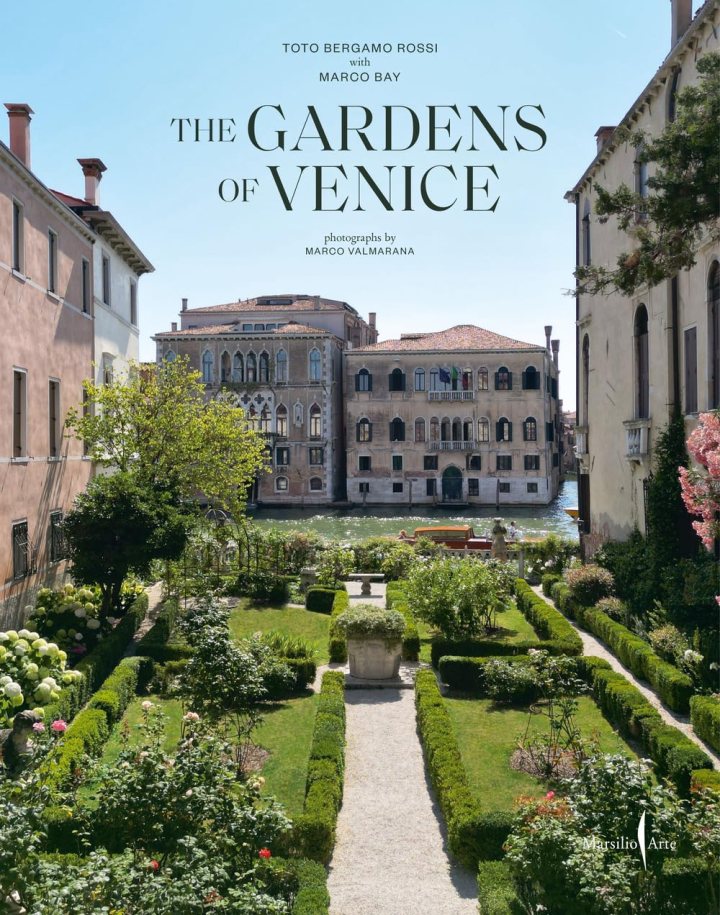
A lush look into Venice’s verdant gardens, photographed in every season of the year.
Turquoise lagoons and crystalline canals, criss-crossed by romantic bridges and traversed by singing gondoliers on their gondolas: water is considered by many to be Venice’s most enchanting feature. Yet on the little land that constitutes this ancient city, secret and sumptuous gardens lie waiting to cast their captivating spell. This lushly illustrated volume takes readers inside Venice’s most undiscovered and most exclusive green spaces across the city. The gardens of the palazzi that overlook the Grand Canal, along with the more vernacular ones of the lagoon islands, are captured throughout the seasons: the flowering in spring, the opulence of summer, the colors of fall and the frost of winter. Photographer Marco Valmarana’s exquisite images evoke a sense of wanderlust enough to inspire even the most jaded traveler. To walk the reader through the legacy of these special spaces, author Toto Bergamo Rossi recounts the evolution and history of the Venetian garden alongside a glossary of commonly used plants. The Gardens of Venice also includes a special foreword by designer Diane von Furstenberg.
Toto Bergamo Rossi, formerly a specialist in the conservation of stone materials, has restored a number of important monuments in Italy. Since 2010 he has served as the director of Venetian Heritage. He is the author of Inside Venice (Rizzoli, 2016) and Venice and Its Doges (Rizzoli, 2023).
New Book | Blue Guide: Venice, 10th Edition
The tenth edition for Venice appeared last year. While I’ve always thought of Blue Guides as reliably informative, this updated edition is also engaging, fun to read, and handsomely designed. If you’ve not tried a Blue Guide recently, it’s worth another look. –CH
Alta Macadam, Blue Guide Venice: Tenth Edition (London: Somerset Books, 2024), 495 pages, ISBN: 978-1905131945, $25.
 Full color throughout, with photographs, diagrams, site plans, and detailed maps.
The 10th edition of this accessible, detailed guide to Venice is an essential handbook for any traveler who wants to fully understand the existence and future challenges of this unique and extraordinary city, as well as its history, art, architecture, cuisine, and culture.
Completely updated, this new edition is in full colour, with photographs, plans, and illustrations, as well as detailed and accurate maps of the labyrinthine streets and canals. There is also a section of practical tips, ideas on food and wine, and how to navigate the transportation system. The depth of information and quality of research make this book the very best guide for the independent cultural traveler, as well as for all students of art history, architecture, and Italian culture. Ideal as an on-site guide or as a desk resource.
Art historian Alta Macadam lives in Fiesole, on the hillside above Florence.
New Book | The Venetian Façade
From ORO Editions:
Michael Dennis, The Venetian Façade (South Bend: Notre Dame School of Architecture / ORO Editions, 2024), 160 pages, ISBN: 978-1961856356, $40.

There are no books that focus on the unique artistic characteristics of the Venetian facade and its potential relevance to contemporary architectural and urban issues, as this book intends.
This book is about architecture. It is not about history, although a bit of history is necessary to set the context. It is not about theory, although, again, a bit is necessary to connect the facade with urbanism. It is also not about structure and technology. And, most definitely, it is not about the plan. All of these topics are well-covered elsewhere. This book is about the facade. It explores the art and typology of the Venetian facade, not only as a high point of architectural literacy and achievement, but as a potentially useful contemporary stimulant.
Michael Dennis is the principal of Michael Dennis & Associates in Boston, and Professor of Architecture Emeritus at MIT. 1986 Thomas Jefferson Professor of Architecture, University of Virginia; 1988 Eero Saarinen Professor of Architecture, Yale University; 2006 Charles Moore Professor of Architecture, University of Michigan.
New Book | Canaletto and Guardi: Views of Venice
Published by Scala and distributed by Rizzoli:
Lelia Packer and Charles Beddington, Canaletto and Guardi: Views of Venice at the Wallace Collection (Milan: Scala, 2024), 192 pages, ISBN: 978-1785513206, £25 / $30.

A celebration of the beauty of Venice that Wallace Collection’s paintings convey and an enjoyable and informative complement to viewing the paintings in the flesh. Among the renowned Old Master paintings at the Wallace Collection in London is an important group of 27 eighteenth-century views of Venice, known as vedute, by Canaletto and his followers, including Francesco Guardi. They hang together in a dedicated gallery known as the Canaletto Room, but the majority had not been cleaned since the nineteenth century and their original beauty was obscured by multiple layers of discoloured varnish.
The paintings have now been restored, following a recent multi-year conservation and research project, and this book presents them in their renewed splendour. It features essays and commentaries by Charles Beddington, the global expert on vedute, and by Wallace Collection curator Lelia Packer, which provide fresh insights into the artists’ creative processes, the dating of pictures and their authorship. Canaletto and Guardi is a gorgeous celebration of the beauty of Venice that these paintings convey.
Lelia Packer is the curator of Dutch, Italian, Spanish, German, and pre-1600 paintings at the Wallace Collection.
Charles Beddington is an independent scholar and art dealer based in London.
◊ ◊ ◊ ◊ ◊
More information on the conservation and research project is available here»
New Book | Women Artists and Artisans in Venice
From Amsterdam UP:
Tracy Cooper, ed., Women Artists and Artisans in Venice and the Veneto, 1400–1750: Uncovering the Female Presence (Amsterdam: Amsterdam University Press, 2024), 292 pages, ISBN: 978-9048559718, €141.
 This book of essays highlights the lives, careers, and works of art of women artists and artisans in Venice and its territories from the fourteenth to the eighteenth centuries. The collection represents the first fruits of an ongoing research program launched by Save Venice, Inc., Women Artists of Venice, directed by Professor Tracy Cooper of Temple University, in conjunction with a conservation program, led by Melissa Conn, Director of Save Venice, Inc. Inspired by a growing body of research that has resurrected female artists and artisans in Florence and Bologna during the last decade, the Save Venice project seeks to recover the history of women artists and artisans born or active in the Venetian republic in the early modern period. Topics include their contemporary reception—or historical silence—and current scholarship positioning them as individuals and as an underrepresented category in the history of art and cultural heritage.
Tracy E. Cooper is Professor of Art History at Temple University and on the Board of Directors of Save Venice, Inc., where she is director of the Women Artists in Venice research program. She is best known for Palladio’s Venice: Architecture and Society in a Renaissance Republic (Yale, 2006), winner of the Phyllis Goodhart Gordan Prize from the Renaissance Society of America.
c o n t e n t s
List of Illustrations
Introduction — Tracy Cooper, Temple University
1 La Serenissima in Context: Women Artists in Venice and Beyond — Babette Bohn, Texas Christian University
2 The Taiapiera in Fourteenth-Century Venice: What’s in a Name? — Louise Bourdua, University of Warwick
3 In Search of Marietta Tintoretta — Robert Echols, Independent Scholar, and Frederick Ilchman, Museum of Fine Arts Boston
4 The ‘Vite’ of Women Artists in Venice (Sixteenth to Eighteeth Century) — Antonis Digalakis, University of Crete
5 Artists and Artisans in the Account Books of Marino Grimani, Patrician and Doge of Venice (Late Sixteenth–Early Seventeenth Centuries) — Maria Adank, Università degli Studi di Verona
6 Chiara Varotari (1584/1585–after 1663) — Diana Gisolfi, Pratt Institute
7 Artemisia Gentileschi in Venice: Facts and Suppositions — Davide Gasparotto, J Paul Getty Museum
8 Giovanna Garzoni and Venetian Witchcraft: Still Lifes as Natural Enchantments — Sheila Barker, Medici Archive Project and University of Pennsylvania
9 Caterina Tarabotti Unveiled — Georgios Markou, University of Cambridge
10 Shining a Light on Giulia Lama’s Painting Practice in the San Marziale Four Evangelists — Cleo Nisse, Columbia University
11 Rosalba Carriera Unframed — Xavier Salomon, The Frick Collection
General Bibliography
Archival Abbreviations
Works Cited
Index
Netherlands Yearbook for History of Art | Women, 1500–1950
The latest issue of NKJ:
Elizabeth Alice Honig, Judith Noorman, and Thijs Weststeijn, eds., Women: Female Roles in Art and Society of the Netherlands, 1500–1950, Netherlands Yearbook for History of Art / Nederlands Kunsthistorisch Jaarboek 74 (2024), ISBN: 978-9004710740, $162.
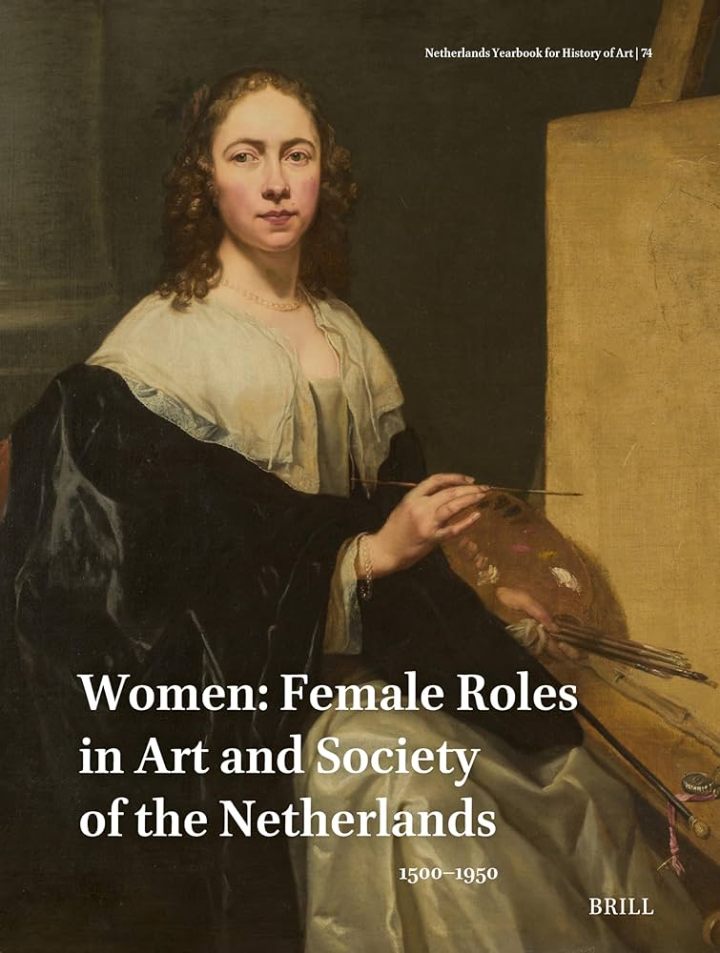 Long overdue in the history of the Netherlands Yearbook for History of Art, this volume foregrounds women as creators, patrons, buyers, and agents of change in the arts of the Low Countries. Venturing beyond the participation of ‘exceptional’ individuals, chapters investigate how women produced paintings, sculptures, scientific illustrations, and tapestries as well as their role in architectural patronage and personalized art collections. Teasing out a variety of socio-economic, legal, institutional, and art-theoretical dimensions of female agency, the volume highlights the role of visual culture in women’s lived experience and self-representation, asking to what extent women challenged, subverted, or confirmed societal norms in the Netherlands.
Elizabeth Alice Honig is Professor of Northern European Art at the University of Maryland, and Professor Emerita at the University of California, Berkeley. She works on Dutch, Flemish, and British art.
Judith Noorman is Associate Professor in Early Modern Art History at the University of Amsterdam. From 2021 to 2026, she is Principal Investigator of The Female Impact, a research project funded by the Dutch Research Council (NWO).
Thijs Weststeijn is Professor of Art History before 1800 at Utrecht University, where he chairs the research project The Dutch Global Age (2023–2028).
c o n t e n t s
• Introduction
• Dynamic Partnership: The Work of Married Women in Dutch Seventeenth-Century Artists’ Households — Marleen Puyenbroek
• The Sculptor and the Sculptress: Gendering Sculpture Production in the Early Modern Low Countries —Elizabeth Rice Mattison
• The Images and the Interventions of Adriana Perez in the Rockox Collection — Kendra Grimmett
• Household Heroines: Maria van Nesse’s Memory-Book and the Interplay between the Art Market and Household Consumption — Judith Noorman
• Weaving a Business: Clara de Hont’s (1664–1751) Tapestry Workshop in Amsterdam — Rudy Jos Beerens
• Situational Awareness and Practices of Exchange in the Art of Johanna Helena Herolt and Alida Withoos — Catherine Powell-Warren
• Cultivating a Female Presence in the Early Eighteenth-Century Learned Community: The Printed Portraits of Maria de Wilde (1682–1729) — Lieke van Deinsen
• Unmarried, Married, Widowed, and Dead: Female Patrons of Architecture in Amsterdam (1680–1800) —Pieter Vlaardingerbroek
• Caretaker of a Collection: The Case of Jo van Bilderbeek-Lamaison — Bert-Jaap Koops
• We Could Hardly Refuse Them: Alida Pott and the Women of De Ploeg, 1918–1931 — Anneke de Vries
New Book | Campaspe Talks Back
From Brepols:
Lieke van Deinsen, Bert Schepers, Marjan Sterckx, Hans Vlieghe, and Bert Watteeuw, eds., Campaspe Talks Back: Women Who Made a Difference in Early Modern Art (Turnhout: Brepols: 2024), 436 pages, ISBN: 978-2503613055, €125.
 With forty-three contributions this book pays homage to Katlijne Van der Stighelen, who has shown exceptional range in her own contributions to the history of art in the Southern Netherlands and beyond. With monographs on Peter Paul Rubens and Anthony van Dyck, she has considerably expanded scholarship on canonical artists. Yet early on, a catalogue raisonné of the portraits of the lesser-known Cornelis de Vos revealed that Van der Stighelen was not one to preserve the status quo but to challenge it. Mindful of protagonists and their historiographical pull, she has consistently rehabilitated artists relegated to the background, in some cases by single-handedly saving them from total oblivion and—remarkable feat—having them added to the canon.
Portraiture, supposedly a sijd-wegh der consten, was paved into a central avenue of inquiry in Van der Stighelen’s work. Her approach to the genre made it into a pathway for the introduction of women artists. What was a sijd-wegh became a zij-weg. From seminal publications on Anna-Maria van Schurman to revelatory exhibitions on Michaelina Wautier, Van der Stighelen’s particular brand of feminism has impacted scholarship as deeply as it has touched the museum-going public.
Women and portraiture are the core themes of the essays assembled in this book. The resulting group portrait is crowded and rambunctious and reflects the varied subject matter that has attracted Van der Stighelen’s professional attention. It also paints a partial portrait of the community of scholars that she has so generously fostered. In trying to summarize the motivations of authors to contribute to this volume or the gratitude of generations of art historians trained by her, it is best to quote the title of the first exhibition on women artists in Belgium and The Netherlands, which Van der Stighelen curated in 1999: Elck zijn waerom.
Lieke van Deinsen is assistant research professor Dutch literature at KU Leuven.
Bert Schepers is senior editor of the Corpus Rubenianum Ludwig Burchard.
Marjan Sterckx is associate professor in the histories of art and interior design 1750–1950 at Ghent University.
Hans Vlieghe is emeritus professor history of early modern art at Leuven University.
Bert Watteeuw is director of the Antwerp Rubenshuis.
c o n t e n t s
Introduction
Campaspe, Apelles, and Alexander the Great
• Hans Vlieghe — Katlijne: Portrait of an Art Historian
I | Sitters & Subjects
• Barbara Baert — Cutting the Gaze: Salome in Andrea Solario’s Oeuvre, c. 1465–1524
• Nils Büttner — Rubens, the Capaio Ladies, and Their Niece
• Hans Cools — Why Margaret of Parma Should Make It to the Next Version of the Flemish Canon
• Liesbeth De Belie — Concerning Orbs and the Value of a Destroyed Portrait
• Guy Delmarcel — The Virtuous Women of the Bible: A Series of Baroque Tapestries from Bruges and Their Mysteries
• Gerlinde Gruber — Brave (if Brazen) Women: Spartans, not Amazons, by Otto van Veen (1556–1629)
• Karen Hearn — Portrait of a Poisoner? An Early Seventeenth-Century British Female Portrait Reconsidered
• Fiona Healy — Sacred History Imitating Real Life: How a Curious Portrayal of the Birth of the Virgin Reflects Childbirth Practices in the Early Modern Period
• Koenraad Jonckheere — Rubens’s Verwe: Head Studies and Complexion
• Elizabeth McGrath — The Girls in Rubens’s Allegory of Peace
• Hubert Meeus — Judith’s Maid
• Bert Schepers — Lifting the Veil on Justus van Egmont (1602–1674): On Cleopatra Approaching Alexandria and Some Other Newly Identified Designs for Tapestries
• Lieke van Deinsen — The Voiceless Virgin and the Speaking Likeness: Anna Maria van Schurman’s Portrait as a Labadist
• Hans Vlieghe — Portrait of a Young Woman in Triplicate: On a ‘Rubensian’ Head Study
II | Artists & Artisans
• Rudy Jos Beerens — Unravelling the Story of Jannetje Laurensd. Wouters (c. 1640–1722), Tapitsierster
• Ralph Dekoninck — Pausias and Glycera by Rubens and Beert: Amorous Emulation and/or Mimetic Rivalry
• Kirsten Derks — Leaving Her Mark: Michaelina Wautier’s Signing Practice
• Inez De Prekel — Female Artists and Artisans in the Antwerp Guild of St Luke, 1629–1719
• Ad Leerintveld — Constantijn Huygens and Louise Hollandine, Princess of the Palatinate, or How High a Highness Could Rise in the Arts
• Fred G. Meijer — All in the Family: A Previously Unrecorded Landscape Painter: Catrina Tieling, 1670-?
• Judith Noorman — ‘Elck heeft sijn eijgen pop’: Dollmaker Drawings by Leonart Bramer and Dolls as Indicators of Class and Identity
• Anna Orlando — Sofonisba and van Dyck: A Matter of Style
• Marjan Sterckx — Talent and Sentiment: A Portrait of the Artist Marie-Anne Collot (1748–1821) as a Young Woman
• Jan Van der Stock — Women Who Stood Their Ground in the Guild of St Luke at the Beginning of Antwerp’s ‘Golden Age’, 1453–1552
• Francisca van Vloten — From ‘Russian Rembrandt’ to ‘Baronin’ and ‘Nonna’: Marianne von Werefkin (1860–1938), Evolution and Appreciation
• Wendy Wiertz — Craft, Gender, and Humanitarian Aid: The Representation of Belgian Lacemakers in the Era of World War I
• Beatrijs Wolters van der Wey — Catharina Pepyn, Rising Star
III | Partners & Patrons
• Rudi Ekkart and Claire van den Donk — In the Lead: Another Look at the Role of Women in Seventeenth-Century Family Portraits
• Valerie Herremans — Arte et Marte: Countess Maria-Anna Mulert-van den Tympel and Ian-Christiaen Hansche’s Pioneering Stucco Ceilings in Horst Castle (1655)
• Corina Kleinert — Hidden in the Footnotes: The Collection of Anna-Isabella van den Berghe, 1677–1754
Hannelore Magnus, ‘Periculum in Mora’: Frans Langhemans the Younger (1661–c.1720) and the Scandalous Elopement of Maria Cecilia de Wille
• Volker Manuth and Marieke de Winkel — The Marital Misfortunes and Messy Divorce of a Mennonite Woman: Catharina Hoogsaet
• Sarah Joan Moran — Court Beguinage Mistresses as Art Curators
• Erik Muls — Isabella and Catharina Ondermarck: Spiritual Daughters on a Mission
• Eric Jan Sluijter — Rembrandt’s Saskia Laughing (1633): The Affect and Effect of Reciprocal Love
• Bert Timmermans — Art Patronage in an Unequal Playing Field: Women’s Convents during the Building Boom of the Antwerp ‘Invasion Conventuelle’
• Ben van Beneden — A Flemish Shepherd for Amalia? Some Thoughts on a Newly Discovered Painting by Thomas Willeboirts Bosschaert
• Carla van de Puttelaar — Marriage in Painting: Painterly Collaborations between Juriaan Pool and Rachel Ruysch and a Newly Discovered Portrait of a Girl
• Martine van Elk — ‘The Name Gives Lustre’: Anna Maria van Schurman’s Glass Engravings
• Bert Watteeuw and Klara Alen —Dealing with Helena
• Jeremy Wood — In the Shadow of the ‘Proud Duke’? Elizabeth Percy, Duchess of Somerset (1667–1722), as Patron
• Lara Yeager-Crasselt — Painting Margherita: Louis Cousin and Flemish Portraiture in Seventeenth-Century Italy
• Leen Huet — Epilogue: Reading between the Lines, Reading between the Brushstrokes – Two letters
Bibliography of Katlijne Van der Stighelen — Compiled by Lies De Strooper and Koen Brosens
Research Lunch | Jessie Park and Catherine Roach, Naming Rights
Later this month at the Mellon Centre:
Jessie Park and Catherine Roach | Naming Rights: Sir Joshua Reynolds, Sitters of Colour, and the Limits of Knowledge
Paul Mellon Centre, London, 29 November 2024, 1pm
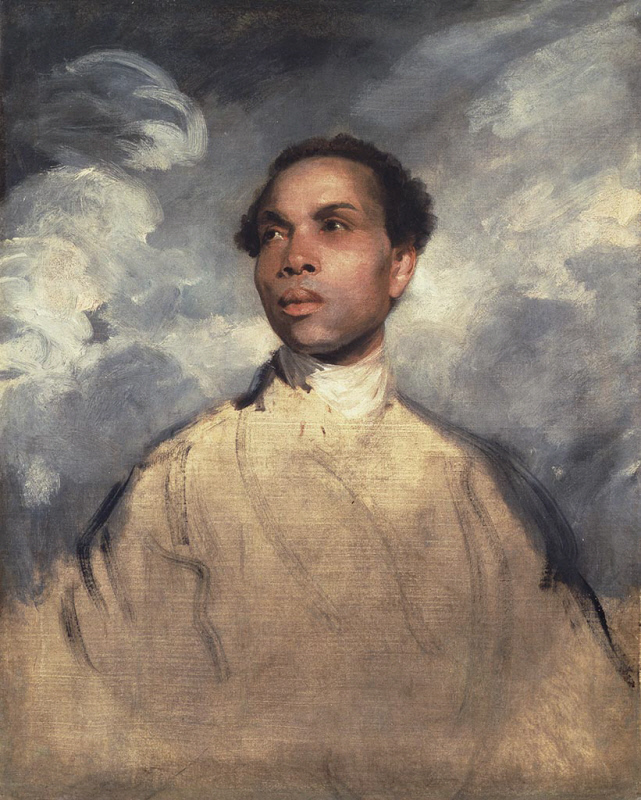
Joshua Reynolds, Portrait of a Man, perhaps Francis Barber, ca. 1770, oil on canvas, 79 × 64 cm (Private Collection).
Recent interest in recovering historical images of people of colour by Europeans raises important methodological questions. How can we address the potentials and limits of the traditional art historical toolkit in investigating this type of work? And how can we acknowledge that which may never be known?
This paper focuses on two pictures by Sir Joshua Reynolds that made their public debut together, hanging as pendants in the Reynolds retrospective at the British Institution in 1813. Each poses a different type of scholarly quandary: one subject has no name; the other, too many. One canvas represents an unidentified Black Briton. In the absence of secure historical data, the subject has been variously attributed: a servant of the artist; Francis Barber, heir to the writer Samuel Johnson; or even George Washington’s cook. Recent discoveries by researchers at the London Metropolitan Archives raise the tantalising possibility that Reynolds’s servant was named John Shropshire. But it remains an object in search of a name, a subject in search of a biography. In contrast, the second canvas represents a securely identified subject, the Polynesian traveller now known as Mai, who bore many names over his lifetime. He came to fame in Britain as ‘Omai’ or ‘Omiah’, a British misunderstanding of a Tahitian honorific that he reportedly bestowed on himself. Rather than presenting definitive answers, this paper explores how to navigate the limits of historical knowledge in the quest to name pictures and their subjects correctly.
Book tickets here»
Jessie Park is the Nina and Lee Griggs Assistant Curator of European Art at the Yale University Art Gallery. She specialises in early modern Netherlandish art, with a secondary area of expertise in the visual and material culture of global exchange from the late sixteenth to the early nineteenth century. She served as the Rousseau Curatorial Fellow in European Art at the Harvard Art Museums and held curatorial positions at the J. Paul Getty Museum in Los Angeles and the Huntington in San Marino, California. Her scholarship has appeared in The Art Bulletin and in an edited volume, Charles V, Prince Philip and the Politics of Succession: Festivities in Mons and Hainault, 1549.
Catherine Roach is an associate professor of art history at Virginia Commonwealth University, specialising in the art and exhibitions of eighteenth- and nineteenth-century Britain. Her scholarship has appeared in Art History, British Art Studies, and the American Art Journal, among others. She has been awarded fellowships by the Huntington Library and the National Humanities Center to support work on her second book, The Shadow Museum: A History of the British Institution, 1805–1867.
At Christie’s | Largillièrre’s Portrait of a Woman
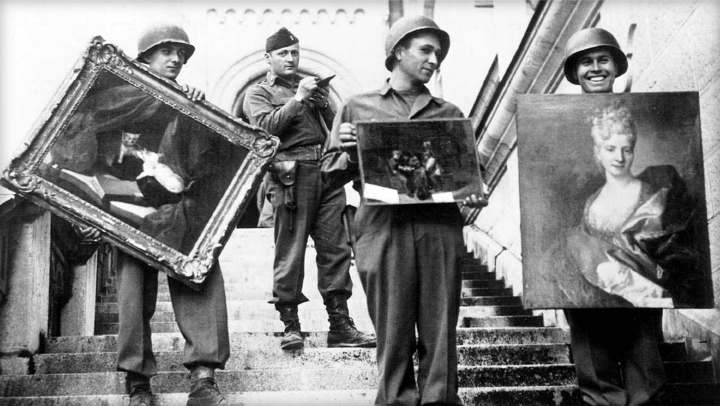
The leader of the Monuments Men, Capt. James Rorimer, and three soldiers after the rescue of artworks from Neuschwanstein Castle.
◊ ◊ ◊ ◊ ◊
As noted last month by Nina Siegal in The New York Times:
Nina Siegal, “For Sale: A Painting the Monuments Men Rescued from the Nazis,” The New York Times (25 October 2024). The portrait by a French court painter is one of three displayed in a photo that came to depict the efforts of a U.S. Army unit that tracked legions of looted art.
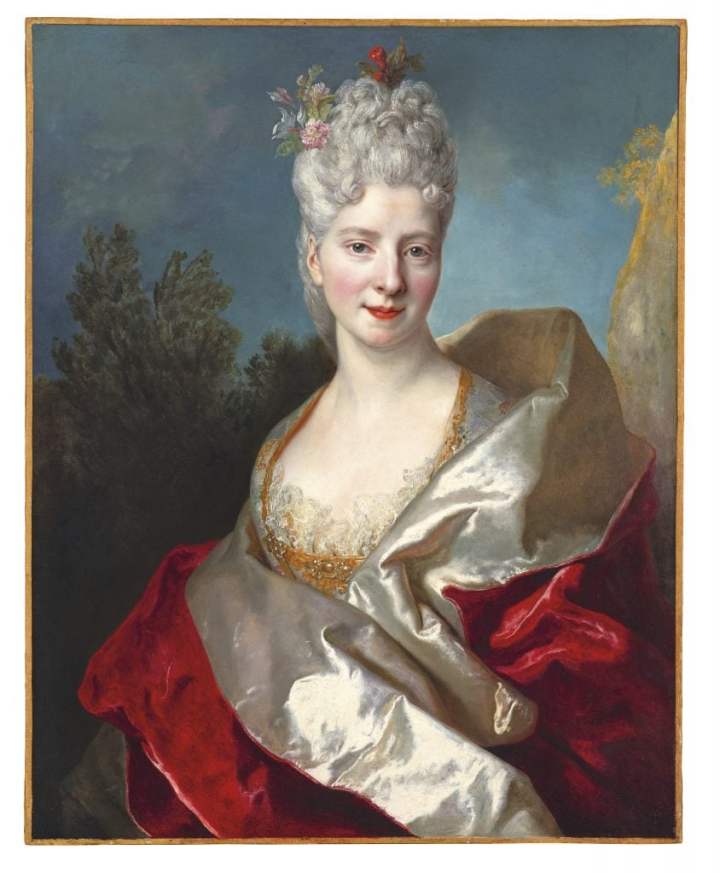
Nicolas de Largillièrre (1656-1746), Portrait of a Woman Half-Length, oil on canvas, 81 × 65 cm. To be sold at Christie’s Paris, 21 November 2024 (Sale #23018, Lot 27), estimate: €50,000–80,000.
It appears, memorably, in a snapshot taken in May 1945 of American soldiers on the steps of Neuschwanstein Castle in Bavaria—a painted portrait of a woman in a shimmering gown with porcelain skin and curly silver hair. The portrait and two other old master paintings are held by American soldiers in combat fatigues who have just liberated them from a Nazi storehouse of looted art.
The G.I.s were helping the Monuments Men, a special U.S. Army unit that tracked down millions of works of art stolen by the Germans during World War II. The image became a resonant depiction of the unit’s role in undoing Nazi evil and restoring part of European heritage to its rightful place.
Now the portrait, by the French court painter Nicolas de Largillièrre from the era of Louis XIV, is to be auctioned next month at Christie’s. . .
The full article is available here»
Note (added 22 November 2024) — The portrait sold for €529,200 (ten times more than its low estimate).
Symposium | Portraiture in a Trans-Asian Context
From ArtHist.net:
Making the Subject of Portraiture in a Trans-Asian Context, ca. 1000–Present Day
SOAS University of London, 5–7 December 2024
Registration due by 22 November 2024
Portraits have commonly been understood as naturalistic likenesses of human beings, centred on the face. The work of scholars such as Jean Borgatti, Richard Brilliant (1990), and Joanna Woodall (1997) opened the field in conceptualising portraiture as a truly multi-local genre, foregrounding the relational and performative processes of portraiture. This conference addresses the performative function of portraiture in constructing subjectivities in Asian contexts, in order to reveal important cultural, social, religious, and philosophical ideas key to understanding particular societies and cultures within Asia and its diasporas.
The symposium focuses on the portraiture of Asia with two specific purposes in mind. First, to decentre studies of Asian portraiture from Eurocentric conceptions of subjecthood and thus to expand the field of portraiture studies; second, to foreground the connections, transfers and tensions articulated by portraiture within trans-Asian contexts. The focus on Asia should not be read as exclusionary, but rather as the intent to initiate a dialogue with existing research on the portraiture of other regions such as Africa and Europe. Thirty-five years after Borgatti, Brilliant and Woodall’s contributions to the field of portraiture studies, the symposium Making the Subject of Portraiture in a Trans-Asian Context ca. 1000-Present Day proposes to take stock of a changing field by contributing the scholarship of art, cultural and literary history in the trans-Asian context.
Registration links are at the event page (participants will need to register individually for each day). Please direct inquiries to Conan Cheong (656531@soas.ac.uk) and Mariana Zegianini (mz15@soas.ac.uk) of the Department of the History of Art and Archaeology, at SOAS University of London.
t h u r s d a y , 5 d e c e m b e r
17.15 Doors open at Wolfson Lecture Theatre, Senate House
17.30 Welcome by Charlotte Horlyck (Head of the School of Arts, SOAS University of London)
17.45 Let’s Change the Subject: Joanna Woodall (The Courtauld Institute of Art)
18.00 Panel 1 | Portraiture and Technology
Chair: Ashley Thompson (SOAS University of London
• Margaret Hillenbrand (University of Oxford) — Read Your Mind: Facial Recognition Technology and Contemporary Chinese Portraiture
• Xinrui Zhang (The Courtauld Institute of Art) — Maskbook: Selfhood and Portraits of Chinese Artists and Environmental Activists
• Wiebke Leister (Royal College of Art and Ashley Thorpe, Royal Holloway) — A Hannya Manifesto: Performative Photographic Portraiture as Contemporary Demon Meta-Noh Play to Construct Feminist Frameworks for Interpretation
19.30 Evening Drinks
f r i d a y , 6 d e c e m b e r
13.15 Doors open at S312, Paul Webley Wing, Senate House
13.30 Panel 2 | Portraying Femininity
Chair: Henning von Mirbach (The Courtauld Institute of Art)
• Wen-chien Cheng, Royal Ontario Museum (Online) — Genre Crossing: The Fluidity of Female Portraits in Late Imperial China
• Doreen Mueller (Leiden University) — Becoming Ōtagaki Rengetsu: Misrepresenting a Buddhist Nun
• Amanda (Xiao) Ju (University College London) — From the Personal to the General: Xing Danwen’s Photographic Diaries
• Bahar Gürsel (Middle East Technical University, Online) — Studio Portraits of Female Domestic Workers in Late 19th- and Early 20th-Century Java and Singapore
15.15 Coffee Break
15.45 Panel 3 | The Diasporic / Displaced Subject
Chair: Marcus Gilroy-Ware (SOAS University of London)
• Nicole-Ann Lobo (Princeton University) — Self-Portraits of Francis Newton Souza in Bombay & London, 1949–61
• Jung Joon Lee (Rhode Island School of Design) — Surface Reading: Oksun Kim’s Berlin Portraits and the Aesthetics of Inscrutability
• Yingbai Fu (SOAS University of London) — Dressing Like a Princess: The Old-fashioned Horse-hoof Cuffs in the Portrait of Der Ling (c. 1885–1944) for American Eyes
• Haely Chang (Hood Museum of Art, Dartmouth College) — A Portrait of Public Self: Reading Na Hyesŏk’s Self-Portrait through Vernacular Photo Albums
17.30 Coffee Break
18.00 Panel 4 | Altered Masculinities
Chair: Richard Hylton (SOAS University of London)
• Giorgio Strafella (Palacký University Olomouc, Czech Republic) — The Experimental and Intellectual Roots of Shen Jingdong’s Hero and Hundred Family Names Portraits
• Amanda Wangwright (University of South Carolina, Online) — Seeing the Truth in Uncut Jade: Modernist Naturism, Traditional Ideals, and Timeless Truths in Portrait of Xu Langxi
• Michele Matteini (New York University, Online) — The Underbelly of Qing Portraiture: Flaccid Skin, Defective Bodies, and Old Age in the Qianlong Era
s a t u r d a y , 7 d e c e m b e r
9.15 Doors open at DLT Lecture Theatre, Ground Floor, Main Building
9.30 Panel 5 | Image-Text Relationships
Chair: Malcolm McNeill (SOAS University of London)
• Yiyang Gao (University of Oxford, Online) — Intertextual Subjectivity at the Qing Court: Portraiture in Wanguo laicho tu and Tributary Dramas Revisited
• Mengxuan Sui (Tsinghua University Art Museum, Online) — The Portraiture of Female Literati: A Study on Qu Bingyun (1767–1810) and Her Peers
• Nicholas L. Chan (The Chinese University of Hong Kong, Online) — A 1979 Calendar: Portraits of Figures from the Dream of the Red Chamber
11.00 Panel 6 | The Performing Subject
Chair: Natasha Morris (SOAS University of London)
• Junyao He (The Courtauld Institute of Art) — Emperor or Bodhisattva? The Qianlong Emperor as Bodhisattva Manjushri in the collection of the Potala Palace, Lhasa, Revisited
• Conan Cheong (SOAS University of London) — Memorialising Monastic Subjectivity: Photographs and Wax Figures of Buddhist Monks in Luang Prabang, Lao PDR
• Ziyi Shao (SOAS University of London) — The Origins and Image Translation of the Three Horizontal Paintings of Tsongkhapa’s Life Stories in Fanhualou
12.30 Lunch Break
13.30 Panel 7 | Testing the Boundaries
Chair: Stephen Whiteman (The Courtauld Institute of Art)
• Leslie V. Wallace (Coastal Carolina University) — White General and Other Portraits of Gyrfalcons at the Court of the Qianlong Emperor (r. 1795–1796)
• Natasha Morris (SOAS University of London) — ‘Opening the Face of Isfahan’: Portraiture in 17th-Century Persian Painting
• Chang Tan (Penn State University) — Living Matter: Portraiture in Zhuang Hui’s “Nature Photography”
15.00 Closing Remarks (Conan Cheong and Mariana Zegianini)










 Enfilade
leave a comment