Symposium | Apprentices and Networks of Learning, 1650–1950
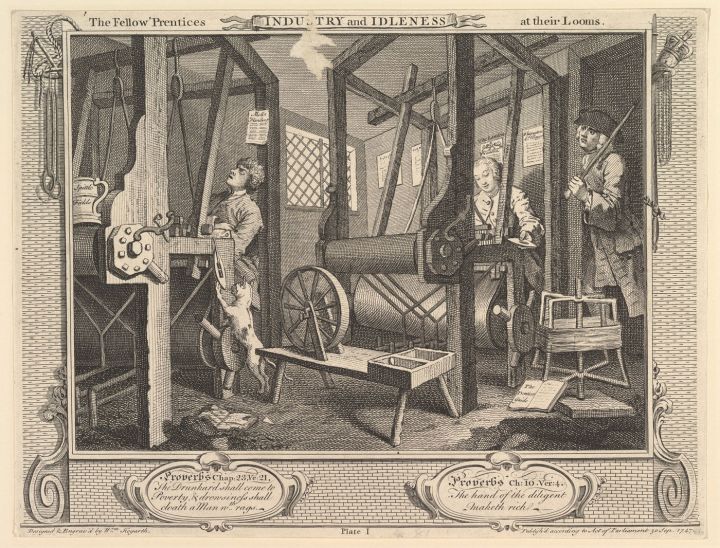
William Hogarth, Industry and Idleness, Plate I: The Fellow ‘Prentices at Their Looms, October 1747, etching and engraving
(Houston: Sarah Campbell Blaffer Foundation)
◊ ◊ ◊ ◊ ◊
This Saturday at the MFAH:
Skillful Hands: Apprentices and Networks of Learning, 1650–1950
Online and in-person, Museum of Fine Arts Houston, 9 November 2024
Established in 2014, the biennial Rienzi symposium focuses on topics inspired by the decorative arts, with papers presented by emerging scholars.
The 2024 symposium, Skillful Hands: Apprentices and Networks of Learning 1650–1950, explores the networks of learning available—and unavailable—to diverse groups of people, examining how access to training and materials through apprenticeships shaped craft traditions. Selected participants present their research on Saturday, 9 November 2024, on the MFAH main campus in Lynn Wyatt Theater, located in the Kinder Building. Entrance is included with Museum admission. The event is live streamed and can be accessed here.
Before the late 19th century, apprenticeships regulated by European craft guilds were the primary means of training in craft trades. These apprenticeships offered a valuable alternative to traditional education but often excluded women, immigrants, Indigenous and enslaved peoples, and children from low-income families. With the onset of the Industrial Revolution, informal apprenticeships emerged to adapt to new innovations and technologies. Outside traditional European models, skills were acquired through forced migration, local environments, and informal training in various colonial regions. These diverse experiences contributed to a network of skilled craftspeople, both anonymous and renowned.
p r o g r a m
11.15 Welcome — Christine Gervais (the Fredricka Crain Director, Rienzi)
11.20 Keynote
Making Time: Competition and Collaboration in Early Modern European Artisanal Networks — Lauren R. Cannady (Assistant Professor of Humanities, University of Houston–Clear Lake)
12:05 Session 1
• Tactile Nomenclature: Transgenerational Transmission of Silk Weaving Knowledge in Early Modern Iran —
Nader Sayadi (Visiting Assistant Professor, University of Rochester)
• Es Artisanes Du Roi: The Public Prohibition and Private Protection of Women’s Artisanal Knowledge in the Paris of Louis XIV, 1661–1715 — Jordan Hallmark (PhD student, Harvard University)
1.00 Lunch break
1.40 Session 2
• The Racial Afterlife of Revolutionary Goldsmithing and Absent Apprenticeships from Haiti to Bordeaux — Benet Ge (Williams College)
• ‘Perfect’ Imitations: Learning in The Spanish Colonial Philippines — Lalaine Little (Director, Pauly Friedman Art Gallery, Misericordia University)
2.35 Break
2.50 Session 3
• Haitian Cabinetmaking Community in New Orleans: The Apprentices of Jean Rouseau and Dutreuil Barjon — Lydia Blackmore (Decorative Arts Curator, Historic New Orleans Collection)
• Passing on Knowledge: Learning the Upholsterer’s Trade in the 19th Century — Justine Lécuyer (Sorbonne Université, Paris)
Call for Papers | Artists’ International Social Networks, 1750–1914
From ArtHist.net:
(Re)searching Connections: Artists’ International Social Networks, 1750–1914
Academia Belgica, Rome, 30 September — 1 October 2025
Proposals due by 15 February 2025
 Musea Brugge and the Academia Belgica are pleased to announce the conference (Re)searching Connections: Artists’ International Social Networks, 1750–1914, to be held at the Academia Belgica in Rome on 30 September and 1 October 2025. This two-day conference will examine the formation and function of artists’ transnational social networks, while also exploring new research possibilities enabled by digital methodologies. Embracing a broad chronological and geographical scope, we invite insights spanning the long nineteenth century and various contexts worldwide. We are excited to confirm two esteemed keynote speakers: France Nerlich (Musée d’Orsay) and Giovanna Ceserani (Stanford University).
Possible topics for consideration include, but are not limited to:
• The impact of artists’ networks on educational and professional development, with a focus on artistic training abroad, intergenerational exchanges, mentorship, patronage, and/or the role of academies and other institutions.
• The complex interplay of identity and community in artists’ networks, which can encompass émigré artists, artist’s colonies, the influence of gender, social class and family ties, the physical spaces of sociability, and interpersonal dynamics such as collaboration, competition, emulation, and a sense of belonging.
• Processes of artistic exchange and adaptation in artist’s networks, whether influenced by cross-cultural interaction or by historical shifts and events such as the rise of nationalistic ideologies, regime change, warfare, and colonialism.
• The representation and documentation of artist’s networks, with attention to contemporary artworks, visual media, and written historical source material, as well as the digital approaches that enable the visualization and analysis of social networks today.
Please visit our website for the conference details, including the full Call for Papers and the submission form. We invite proposals for 20-minute papers in English or French. If presenting in French, please provide accompanying materials in English. Please fill out the submission form on our website by 15 February 2025 (notification of acceptance expected to arrive by the end of March 2025). Proposals should include a single PDF file with the following components:
• A 100-word biography of the author
• A 300-word abstract
• 1 or 2 relevant images (e.g. artworks, archival documents, data visualization)
Proposals will be evaluated based on relevance, clarity, novelty, and contribution to the field. We seek papers that reflect critically on the source material and methodologies employed. For more information, please contact Marie Vandeghinste at marie.vandeghinste@brugge.be.
Conference | The Art of Mourning, 1750–1850
From ArtHist.net:
The Art of Mourning: Emotion and Restraint in the Visual Arts, 1750–1850
Die Kunst des Trauerns. Gezügelte Gefühle in den Bildkünsten, 1750–1850
Martin von Wagner Museum der Universität Würzburg, 5–6 December 2024
 In a much-discussed essay of 1986, Yve-Alain Bois identified “The Task of Mourning” as a characteristic feature of painting in the advanced twentieth century. However, this emotionally charged purpose had already been ubiquitous in many forms of artistic expression in the decades around 1800, before being eclipsed by the more materialistic art movements from the middle of the nineteenth century. Prior to that, images of mourning occur with overriding frequency, to such an extent that they lend themselves for questioning the very polarity of neo-classicism and romanticism.
From ca. 1750, mournful motifs and sentiments are conspicuously present in virtually all genres within the visual arts. Art historical research has addressed this phenomenon mainly by asking for the impact of secularization and dissolving iconographic norms (e.g., Werner Busch, Das sentimentalische Bild, 1993). In fact, mourning as existential subject matter is isolated, sometimes devoid of moralistic or theological linkage, for the first time during the so-called ‘saddle period’. In tombs designed by Antonio Canova, old and new motifs of figural grief are constantly played through; John Flaxman fills one sheet after the other with sorrowful processions; within the paper architecture of Étienne-Louis Boullée, mourning and the sublime are connected through the void of cenotaphs; the school of David chooses, in a rather obsessive manner, scenes informed with teariness; large numbers of mourning figures populate the works of the Düsseldorf School. In painting as in sculpture, let alone the graphic arts, grief and sorrow are everywhere; military commanders, politicians, artists, popes are bemoaned, just as family members, suicides and persons sentenced to death. Lost honor or lost homeland, even the flow of time, are occasions of mourning.
These new ways of depicting grief feature a clear distinction from Baroque pathetic formula. The contrary stance compared to everything before is experienced in the most immediate manner—but how to grasp it conceptually? For sure, images of mourning are hallmarked by emotional control; thus we can understand them as an inversion of heightened expression and pathos. Why, then, is there a desire for pictures of painful yet patiently endured loss just in the age of enlightenment and its aftermath, i. e. in a period that is characterized by faith in progress like none before it? For what reason these pictures were considered particularly appropriate for transformations of Christian imagery? Is there a deeper connection between the new visual dimension of mourning and changed gender-specific attributions? Can we establish a causality between the withdrawal of mourners into themselves on one side, and neo-classicist reductionism on the other? What are the effects of the expanded canon of antiquities, operated by contemporary archaeology, on the iconography of mourning? How to define the share of human science—of new anthropological concepts, early forms of psychology, or research into human emotions in terms of physical and medical scholarship—in the visualization of mourning? How to relate, in a methodically sound fashion, the boom of mourning in the visual arts with social and political upheaval?
This conference seeks to explore, on a large scale, these and other questions around the historical theme of mourning. The Art of Mourning is the first edition of the Würzburg Wellhöfer-Colloquium. Every two years, it will investigate research topics from the history of art between 1750 and 1850 from an interdisciplinary perspective.
Organisation
Michael Thimann (Georg-August-Universität Göttingen/Deutsche Gesellschaft für die Erforschung des 19. Jahrhunderts) und Damian Dombrowski (Julius-Maximilians-Universität/Martin von Wagner Museum der Universität Würzburg)
Kontakt
Martin von Wagner Museum der Universität Würzburg, mvw-museum@uni-wuerzburg.de
d o n n e r s t a g , 5 d e z e m b e r
Michael Thimann, Damian Dombrowski — Begrüßung und Einführung / Welcome and Introduction
Impulsvortrag | Keynote Lecture
• Werner Busch, FU Berlin — Die Kunst des Trauerns: Gezügelte Emotionen in den Bildkünsten, 1750–1850
Sektion 1 | Sentimentalisierte Trauer / Sentimentalised Mourning
• Cordula Grewe, Indiana University Bloomington — Seelenmalerei, oder: Wie bewahrt man seine Fassung?
• Franca Buss, Universität Hamburg — Um die Wette weinen. Johann August Nahls Grabmal für Maria Magdalena Langhans und die Sentimentalisierung des Todes
• Lisa Hecht, Philipps-Universität Marburg — Trauer oder Langeweile? Die Eleganz des ‚Nichtstuns‘ in Damenbildnissen des englischen 18. Jahrhunderts
Sektion 2 | Trauer-Orte / Places of Mourning
• Daniela Roberts, Julius-Maximilians-Universität Würzburg — Die Tugend überdauert den Schmerz: Horace Walpoles Grabmal für seine Mutter in der Westminster Abbey
• Eric Sergent, Laboratoire de recherche historique Rhône-Alpes —Mourning and Grief in French Funerary Sculpture
• Martina Sitt, Kunsthochschule Kassel — Trauer-Plätze des Klassizismus: Vielschichtige Aspekte der Gestaltung von Licht und Raum
Sektion 3 | Entgöttlichte Trauer? / Grief without Deity?
• Noémi Duperron, Université de Genève — ‘Touch(ing) with Sentiment’: Gavin Hamilton’s Grievers and Smith’s Theory of Moral Sentiments
• Maria Schabel, Julius-Maximilians-Universität Würzburg — Erneuerung religiöser Bildsprache? Fallstudien biblischer Trauerikonographie um 1800 am Beispiel zweier Werke Johann Martin von Wagners
• Lorenzo Giammattei & Antonio Soldi, Sapienza Università di Roma — Comparing Perspectives of Eternity in the Elaboration of the Mourning Theme in Painting: From Death for a Religiously Connoted Afterlife to Death as an Opportunity to Create an Ethical and Virtuous Model for the Present Time
f r e i t a g , 6 d e z e m b e r
Sektion 4 | Trauern an der Epochenschwelle / Mourning in the Age of Transition
• Damian Dombrowski, Julius-Maximilians-Universität Würzburg — ‘l’ultimo soffio di felicità in Europa’? Tiepolo’s Sense of Loss
• Isabelle Le Pape, DRAC Normandie, Rouen — From Caspar David Friedrich to Courbet’s Enterrement à Ornans: The Image of Mourning in French and German Romantic Painting
• Susanne Adina Meyer, Università di Macerata — Morire con grazia: Bilder des Trauerns im Spiegel des römischen Kunstdiskurses
Sektion 5 | Antike als Trauer-Modell / Antiquity as a Model of Mourning
• Carolin Goll, Julius-Maximilians-Universität Würzburg — Trauern in der griechischen Tragödie: Martin von Wagners Zeichnungen nach Euripides
• Johannes Myssok, Kunstakademie Düsseldorf — Canova and the Art of Mourning
• Jochen Griesbach, Julius-Maximilians-Universität Würzburg — Niobe ist überall? Zur Antikenrezeption mütterlicher Trauer in Bildern des 18. und 19. Jahrhunderts
Sektion 6 | Politisches Trauern / Political Mourning
• Tobias Kämpf, Friedrich-Alexander-Universität Erlangen — Mourning at Missolonghi: Political Artworks as Compensations for Loss
• Cigdem Özel, Universität Wien — Trauern für die Monarchie am Beispiel von Miniaturporträts Eduard Ströhlings
• Philip Schinkel, Universität Hamburg — Grenzen überschreiten: Männertränen im belgischen Nationalmythos bei Louis Gallait
Call for Papers | On the Use and Abuse of Antiquity in 18th-C. Life
From the Call for Papers:
On the Use and Abuse of Antiquity in 18th-Century Life: Classical References and Their Subversion in the Age of Enlightenment
University of Chicago John W. Boyer Center in Paris, 22–23 May 2025
Proposals due by 15 December 2024

Ingres, The Apotheosis of Homer, 1827, oil on canvas, 386 cm × 512 cm (Paris: Musée du Louvre).
It is a well-established fact, frequently analysed by literary critics, that Greek and Roman Antiquity lies at the heart of 18th-century culture. The significance attributed to ancient authors in 18th-century collèges is often acknowledged, but references to classical figures in fact permeate all forms of the literary and visual arts, whether in the light-hearted forms of Baroque and Rococo or the austere severity of Neoclassicism. Scholars have often highlighted the idealisation of ancient socio-political models, which served as counterpoints to contemporary reflections and critiques, extending from the writings of philosophers to the proclamations and imagination of Revolutionary thinkers. The classical world was imbued with an exemplary value, conceived as an alternative framework through which to contemplate and categorise a frequently problematic present, or to advocate for political, social, and aesthetic reforms. Antiquity offered ideas and images that constituted a kind of second language through which the world of the Enlightenment could be reimagined.
However, any process of re-functionalisation and re-valorisation is inevitably accompanied by subversions, instrumentalization, and alterations. For a reference to be productive and applicable to a new and changing context, it must undergo modification that renders it relevant and exploitable, allowing it to bear meanings beyond the scope of its original formulation. In all cultural domains, ancient texts were either faithfully reproduced, critically commented upon, or openly reinterpreted according to the argumentative needs of writers, who, whether intentionally or not, projected their worldview and concerns onto these works. Precisely because Antiquity functioned as a ‘second language’, its words could only serve as instruments for the description and analysis of reality to the extent that they lost their original meaning and took on new ‘semantic’ valences, enabling them to convey content more attuned to the concerns of the time.
This colloquium aims to analyse and explore these deviations, shedding light on the highly productive dialectical play that takes place between an increasingly historicist and proto-scientific reception of the ancient world (with the emergence of disciplines such as archaeology, philology, etc.) and the still very free and fertile use of classical heritage, which was often employed with little constraint to support any and all ethical, political, or aesthetic arguments. Our goal is to identify the misunderstandings or ‘subverted’ reuses of classical texts, histories, and figures. Whether these fluctuations occur in the literal but reoriented reproduction of phrases, maxims, or passages from ancient texts, or more broadly in the reception of classical models in which new symbolic potentialities are detected, we wish to delve deeper into the qualities and purposes of these transformations of ancient material, analysing their pathways and dead ends, their distortions and their reconfigurations.
Why refer to Antiquity, and with what specific objectives or purposes? How were maxims, historical or philosophical texts, and the pantheon of ancient heroes and gods reinterpreted in the Age of Enlightenment, and how were they integrated into the contemporary cultural discourse? What demands for fidelity, and what modernising distortions were imposed upon Greek and Roman treatises and literature? How did any reappropriation of ancient discourse and its imagery ultimately prove suitable for the new expressive and ideological needs of the philosophes, and how could these same images also lead to their condemnation?
Presentations, in French or English, must not exceed 30 minutes. The conference organizers will cover travel and accommodation expenses for all invited speakers. A publication of the conference proceedings is planned.
Proposals for papers, in French or English, consisting of 250–300 words, accompanied by a brief bio-bibliography including institutional affiliations, should be submitted by 15 December 2024, to glenn.roe@sorbonne-universite.fr and dario.nicolosi.92@gmail.com. Acceptance decisions will be communicated to the authors by 15 January 2025.
The Burlington Magazine, October 2024
The long 18th century in the October issue of The Burlington:
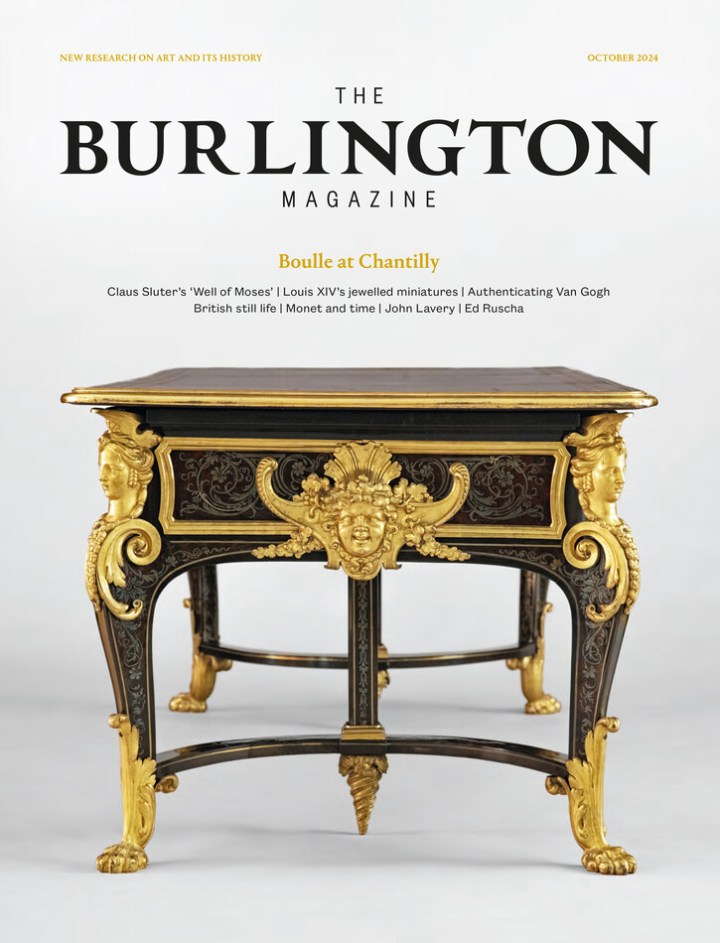
The Burlington Magazine 166 (October 2024)
 e d i t o r i a l
• “Restoring the ‘belle époque’,” pp. 995–96.
The Musee Jacquemart-André is a treasure house that graces the Haussmann boulevards in Paris and is perhaps not nearly as well-known as it should be. The recent re-opening of the museum on 6th September, following a period of closure for conservation, therefore provides a welcome opportunity to draw fresh attention to this most romantic and beguiling of collections and the elegant building that houses it.
a r t i c l e s
• Jacob Willer, “Annibale Carracci and the Forgotten Magdalene,” pp. 1028–35.
A painting the collection of the National Trust at Kedleston Hall, Derbyshire, is published here as a work of Annibale Carracci’s maturity. Related to comparable compositions which derive from it, in collections in Rome and Cambridge, it was acquired in Florence in 1758 for the 1st Baron Scarsdale.
• Samantha Happé, “Portable Diplomacy: Louis XIV’s ‘boîtes à portrait’,” pp. 1036–43.
Louix XIV’s ambitious and carefully orchestrated diplomatic programme included gifts of jewelled miniature portraits known as ‘boîtes à portrait’. Using the ‘Présents du Roi’, the circumstances around the commissioning and creation of these precious objects can be explored and a possible recipient suggested for a well-preserved example now in the Musée du Louvre, Paris.
r e v i e w s
• Alexander Collins, Review of the exhibition André Charles Boulle (Musée Condé, Château de Chantilly, 2024), pp. 1056–59.
• Claudia Tobin, Review of the exhibition The Shape of Things: Still Life in Britain (Pallant House Gallery, 2024), pp. 1067–69.
Helen Hillyard, Review of of the recently renovated galleries of the Barber Institute of Fine Arts, Birmingham, pp. 1077–79.
• Colin Thom, Review of Steven Brindle, Architecture in Britain and Ireland, 1530–1830 (Paul Mellon Centre, 2024), pp. 1080–81.
• Christopher Baker, Review of Bruce Boucher, John Soane’s Cabinet of Curiosities: Reflections on an Architect and His Collection (Yale University Press, 2024), pp. 1087–88.
o b i t u a r y
• Christopher Rowell, Obituary for Alastair David Laing (1944–2024), pp. 1094–96.
Although renowned in particular for his expertise on the art of François Boucher, Alastair Laing had very wide-ranging art historical taste and knowledge, which he shared with great generosity of spirit. He curated some important exhibitions and brought scholarly rigour to his inspired custodianship of the art collections of the National Trust.
Colloquium | Seeing Her: Where Women Wrote Architecture, 1700–1900
From the conference website:
Seeing Her: Where Women Wrote Architecture, 1700–1900
Sie Sehen: Wo Frauen Architektur Schrieben, 1700–1900
ETH Zurich Hönggerberg, 29 November 2024
 The 5th WoWA Workshop and Colloquium is entitled Seeing Her / Sie Sehen and will take place on 29 November 2024 at ETH Zurich. Featuring a private bilingual reading workshop followed by public talks in the afternoon, it brings together a diverse group of scholars in terms of seniority, period, background, and expertise.
Talks by Emma Cheatle (Sheffield), Sonja Dümpelmann (Munich), and Isabel Karremann (Zurich) will centre around specific sites ranging from maternity spaces to the literary country house and gendered landscapes. Together with the respondents, Anna-Maria Meister (Florence/Karlsruhe) and Anne Hultzsch (Zurich), speakers will complicate architectural histories of the 18th and 19th centuries with the question where women wrote architecture. Join us for the in-person colloquium: all are welcome!
Online Lecture | Charles O’Brien and Simon Bradley on Pevsner
From the Paul Mellon Centre for Studies in British Art:
Charles O’Brien and Simon Bradley | Celebrating Pevsner: Reflections on the Completion of the Buildings of England
Online, 14 November 2024, 6.00pm (London time)
The editors of the Pevsner Architectural Guides will be in conversation, reflecting on the revision of the Buildings of England series from 1983 to 2024, lately completed with the new Staffordshire volume. Simon Bradley and Charles O’Brien will consider the development and updating of the guides over forty years, the expansion of their content and the challenges both of research and writing and of maintaining the spirit and ambition of Pevsner’s original vision for the books. They will also reflect on their own contributions as authors of the new and revised editions, spanning their time with Penguin Books and Yale University Press. The event will be chaired by Jeremy Musson.
Book tickets here»
Jeremy Musson is an architectural historian; he studied at UCL and the Warburg Institute and was an assistant curator for the National Trust and architectural editor at Country Life, 1998–2007. He is the author of a number of books on the country house, including English Country House Interiors (2011) and The Drawing Room (2014), and was co-writer and presenter of BBC2’s The Curious House Guest. A heritage consultant since 2007, Jeremy has worked on projects including Hardwick Hall and St Paul’s Cathedral. He is editor of The Victorian and teaches on the building history masters course at the University of Cambridge; a senior research fellow of the Humanities Research Institute of the University of Buckingham; and a supervisor of students at New York University (NYU) in London. He is also a trustee of the Historic Houses Foundation. He was a contributing author to the revision of the Buildings of England: Sussex West with Elizabeth Williamson, Tim Hudson, and Ian Narin.
Charles O’Brien FSA is Listing and Architectural Research Director at Historic England. Until 2022 he was joint Series Editor of the Pevsner Architectural Guides. He joined the series in 1997, where he worked full time on the research, writing, and editing of the new editions. As author and co-author he has written the revised volumes London 5: East; Bedfordshire, Huntingdonshire, and Peterborough; Hampshire: South; and Surrey. He is a former Commissioner of Historic England and former Chair of their London Advisory Committee.
Simon Bradley FSA joined the Pevsner series in 1994. His own revised volumes include London 1: The City of London; London 6: Westminster; Cambridgeshire; and Oxfordshire: Oxford and the South East. He has also published on the Gothic Revival, drawing on his PhD thesis, and on railways and railway buildings including St Pancras Station (2006), The Railways: Nation, Network, and People (2015), and Bradley’s Railway Guide: A Journey Through Two Centuries of British Railway History, 1825–2025 (2024).
New Book | Chronos: Die Personifikation der Zeit
In the US, daylight saving time ends Sunday morning. New from Michael Imhof:
Angelika Eder, Chronos: Die Personifikation der Zeit und ihr Einsatz in der Kunst des 17. und 18. Jahrhunderts (Petersberg: Michael Imhof Verlag, 2024), 240 pages, ISBN: 978-3731914044, €50.
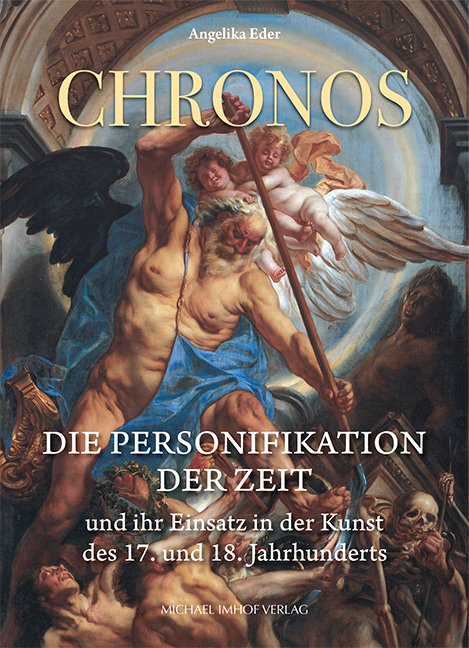 Chronos, die Personifikation der Zeit, fand in der Kunst des 17. und 18. Jahrhunderts weite Verbreitung—sei es in Tafelbildern, in Deckengemälden, in der Druckgrafik oder der Skulptur. Das weite Einsatzspektrum dieser äußerst komplexen Figur bildet den Schwerpunkt der vorliegenden Untersuchung.
Die Konfrontation mit der Erkenntnis des befristeten Lebens und der Fragilität jeder Existenz machte die Menschen im 17. und 18. Jahrhundert empfänglich für das Thema der Vergänglichkeit, das die destruktive Seite von Chronos in den Vordergrund stellt. Auf vielfältige Weise wird die Personifikation der Zeit als Zerstörerin dargestellt: von menschlichem Leben, von Liebe, von materiellen Errungenschaften. Parallel zeigen Kunstwerke die positive Seite von Chronos, bei denen sich die Zeit als Helferfigur offenbart. In der Allegorie trägt so die Zeit den Ruhm des Herrschers über dessen Tod hinaus in die Zukunft. Ebenso bewahrt Chronos die Schöpfungen der neuzeitlichen Künstler vor dem Verfall und sichert deren Andenken in ihren bleibenden Werken. Im Buch wird eine bisher fehlende Systematik entwickelt, die von der Herkunft und Genese der Zeitfigur ausgeht und anhand von ausgewählten Beispielen ihre facettenreiche Verwendung in den Blick nimmt.
Call for Papers | Objects in Early Modern Latin America
From ArtHist.net:
Objects and Everyday Life in Early Modern Latin America: Art, Crafts, and Material Culture in Light of the Encounter with European Travellers
Centre de recherche et de restauration des musées de France, Paris, 12 February 2024
Organized by Maddalena Bellavitis, Corinne Mencé-Caster, and José Manuel Santos Pérez
Proposals due by 15 November 2024
Colonial studies in recent years are increasingly bringing attention to topics that go beyond purely historical, geographical, or ethical issues. There is also a desire to focus on aspects of everyday life, on the elements that constituted moments of family routine, the rituals of cult activities, the spheres of work, like handicrafts, agriculture, and commerce, or personal affairs. In this field, research from a variety of disciplines is mixed, collaborating with each other to search for sources from which information can be drawn, and to analyse their contents in order to reconstruct contexts and narratives that can give us glimpses of the reality of that time.
This workshop intends to explore precisely this reality, and investigate the objects that were part of the private and everyday—but also public and religious—moments in the lives of the peoples of Latin America between the 16th and 18th centuries. Consideration will be given not only to items produced, constructed, and preserved in situ, but also to those that travelled to Europe with the ships that returned there, collected by travellers as curiosities or trophies. Particular attention will then be paid to objects that were derived from the encounter with European culture, through technical, practical, or aesthetic inspiration. Therefore, all proposals that deal with the world of objects, both craft and artistic, and material culture related to colonial Latin America and its encounter with Europe are welcome.
Please submit a one-page PDF with abstract for an unpublished contribution and short bio by 15 November 2024 to the following address: maddalena.bellavitis@gmail.com. Presentations will be in English, French, Spanish, or Portuguese and will last a maximum of 20 minutes. The organizers, Maddalena Bellavitis, Corinne Mencé-Caster, and José Manuel Santos Pérez, will notify the selected proposals by the end of November 2024.










 Enfilade
leave a comment