Online Talk | Vanessa Sigalas on Meissen Figures
As noted at Events in the Field:
Vanessa Sigalas | All Walks of Life: Meissen Porcelain Figures of the 18th Century
Online, Connecticut Ceramics Circle, 9 December 2024, 2pm (EST)
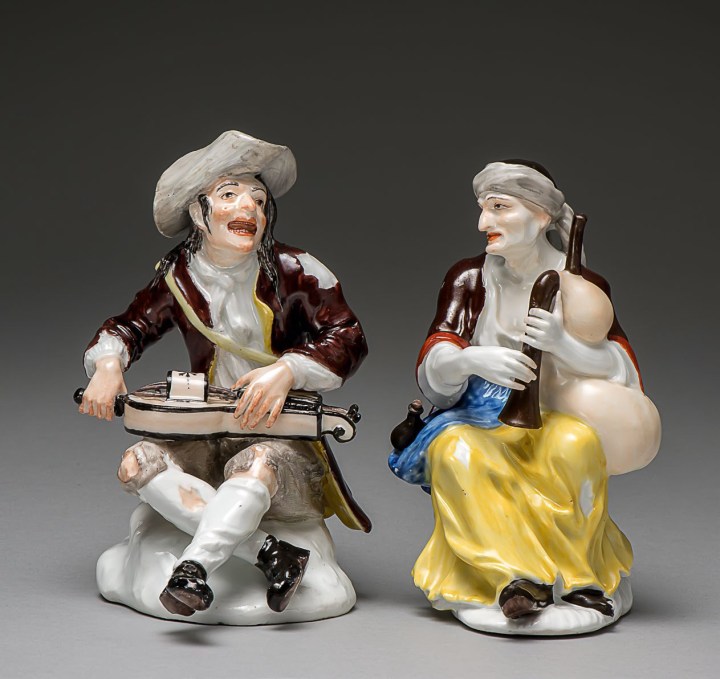
Pair of Figures of Beggar Musicians, German, Meissen Porcelain Manufactory, models by Johann Joachim Kaendler (1706–1775). Original year of modelling: ca. 1736; beggar-woman reworked later. Date of porcelain paste: both ca. 1730–65; date of decoration: both 18th century. Hard-paste porcelain. Man: Blue crossed swords mark on base; woman: no marks. Heights: man 13.4 cm; woman 13 cm. Model no. man: 918; woman: 915. Shimmerman Collection nos. MPBP_16 & 17.
Dr. Vanessa Sigalas will guide the audience through a captivating exploration of 18th-century life in Saxony, Paris, London, and St. Petersburg, using Meissen porcelain sculptures from the Alan Shimmerman Collection in Toronto, Canada, as well as the Wadsworth Atheneum’s collection in Hartford, Connecticut. Renowned master modeler Johann Joachim Kaendler, in collaboration with his fellow modelers at Meissen, portrayed glimpses of daily existence, meticulously capturing even the minutest details. From the carefully arranged trinkets of a street vendor to the intimate script of a love letter and the culinary tools of a cook preparing a hare, Kaendler’s work unveils the richness of ‘All Walks of Life’.
The Alan Shimmerman Collection, with its emphasis on groups of criers (street sellers) and artisans, offers a fresh perspective on the inception, production, and dissemination of Meissen porcelain. Dr. Sigalas’s lecture is based on her recently published collection catalogue bearing the same title, providing an immersive journey into the intricate world of 18th-century European society as depicted through these masterfully crafted sculptures.
Vanessa Sigalas holds a Dr. phil. in Art History from the Eberhard-Karls-Universität Tübingen, Germany. She joined the Wadsworth Atheneum in 2011, As an art historian, Sigalas specializes in European art from the 17th to the first half of the 20th centuries, especially 18th- and 19th-century German porcelain. One of her research interests is the connection between ivory and porcelain, particularly at the Dresden Court of Augustus the Strong (1670–1733). At the Wadsworth, she works with American and European decorative arts and sculpture from the ancient to the modern worlds, but also explores the collections of non-Western art. Despite her deep love for books and archives, Sigalas has always enjoyed the hands-on work with objects. In 2013, she assisted with the Storage Renovation and Relocation Project, and in 2015 she was part of the team to reinstall the European art collections, where she assisted the curatorial team and led the installation team of decorative arts.
She has published in a variety of journals, exhibition catalogues, and books. Her latest book, All Walks of Life: A Journey with the Alan Shimmerman Collection (2022), focuses on Meissen porcelain figures from the 18th century. She has taken on the role of editor for several publications, with her most recent work being Morgan—The Collector: Essays in Honor of Linda Roth’s 40th Anniversary at the Wadsworth Atheneum Museum of Art, co-edited with Jennifer Tonkovich. Additionally, she served as the managing editor of the American Ceramic Circle Journal from 2015 to 2023. Sigalas has curated exhibitions in Germany and the US. Her most recent exhibitions at the Wadsworth include, in conjunction with director Matthew Hargraves, Between Life & Death: Art and the Afterlife (Fall 2023), as well as the community-focused and staff-curated exhibition, Styling Identities: Hair’s Tangled Histories, which was on view until August 2024.
The Burlington Magazine, November 2024
The long 18th century in the November issue of The Burlington:
The Burlington Magazine 166 (November 2024)
e d i t o r i a l
 “The Life Cycle of Art History,” p. 1099.
Art history is withering. Art history is flourishing. Which of these statements is true? Very mixed impressions can be gathered from across the United Kingdom, where the future health and reach of the academic discipline is far from clear. Amid all this uncertainty, however, there are some inspiring developments that should be applauded.
a r t i c l e s
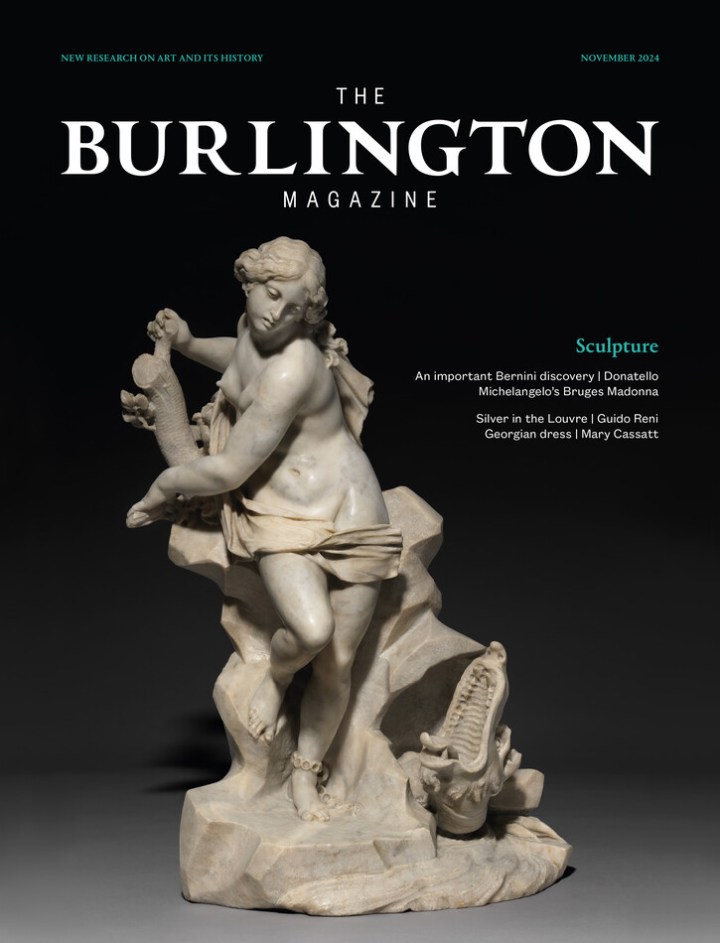
• Maichol Clemente, “‘Une pièce fort singulière’: The Rediscovery of Gian Lorenzo Bernini’s Andromeda and the Sea Monster,” pp. 1100–22.
An important early sculpture by Gian Lorenzo Bernini, Andromeda and the Sea Monster, is here attributed to him and published for the first time. It displays all the finesse and invention that characterises the work of his youth and is also notable for having been offered to Jean-Baptiste Colbert, First Minister of Louis XIV, before forming part of the collection of the Prince of Soubise [in the eighteenth century.]
r e v i e w s
• William Barcham, Review of the exhibition catalogue, Les Tiepolo: Invention et Virtuosité à Venise, edited by Hélène Gasnault with Giulia Longo and a contribution by Catherine Loisel (Beaux-Arts de Paris, 2024), pp. 1176–78.
• Erin Griffey, Review of the exhibition catalogue, Style & Society: Dressing the Georgians, by Anna Reynolds (Royal Collection Trust, 2023), pp. 1178–80.
• Philippa Glanville, Review of the catalogue of the Louvre’s silverware, Orfèvrerie de la Renaissance et des temps modernes: XVIe, XVIIe et XVIIIe siècles: La Collection du Musée du Louvre, by Michèle Bimbenet-Privat, Florian Doux, and Catherine Gougeon, with Philippe Palasi, 3 volumes (Éditions Faton, 2022), pp. 1186–87.
• Giulio Dalvit, Review of the catalogue, Galleria Borghese: Catalogo Generale I: Scultura Moderna, edited by Anna Coliva with Vittoria Brunetti (Officina Libraria, 2022), pp. 1192–93.
• Gauvin Alexander Bailey, Collective Creativity and Artistic Agency in Colonial Latin America, edited by Maya Stanfield-Mazzi and Margarita Vargas-Betancourt (University of Florida Press, 2023), pp. 1193–94.
• Charles Avery, Review of Die Bronzen des Massimiliano Soldani Benzi (1656–1740): Representationsstrategien des europäischen Adels um 1700, by Carina Weißmann (De Gruyter, 2022), p. 1195.
• Pierre Rosenberg, Review of the catalogue, French Paintings 1500–1900: National Galleries of Scotland, by Michael Clarke and Frances Fowle, 2 volumes (National Galleries of Scotland, 2023), pp. 1196–97.
Exhibition | The Art of French Wallpaper Design

Installation view of the exhibition The Art of French Wallpaper Design at the RISD Museum, November 2024.
◊ ◊ ◊ ◊ ◊
The exhibition is accompanied by an online publication:
The Art of French Wallpaper Design
RISD Museum, Providence, 16 November 2024 — 11 May 2025
The Art of French Wallpaper Design explores the vibrant, surprising designs that adorned walls in the 1700s and 1800s. Featuring more than 100 rare samples of salvaged wallpapers, borders, fragments, and design drawings, this exhibition reveals the creative process and showcases the extraordinary technical skills involved in producing these works, presenting an invaluable resource for artists and enthusiasts alike. This exhibition celebrates the vision and generosity of collectors Charles and Frances Wilson Huard, whose remarkable collection, assembled in the 1920s and ’30s, is now in the care of the RISD Museum. Accompanied by a comprehensive digital publication, The Art of French Wallpaper Design invites you to explore the remarkable innovation and craftsmanship of these historic pieces.
◊ ◊ ◊ ◊ ◊
Lyra Smith, ed., with contributions by Emily Banas, Brianna Turner, and Andrew Raftery, The Art of French Wallpaper Design (Providence: Rhode Island School of Design Museum, 2024), available online»
The vibrant designs of French papier peint (literally meaning painted paper) that adorned walls in the 1700s and 1800s were collected and donated to the museum by French artist Charles Huard and his wife, American writer Frances Wilson Huard. The Huard Collection is a rare resource due to the fragile and ephemeral nature of wallpapers. This free online publication explains the preservation methods used to take care of the wallpapers along with components made in the process, such as design drawings and woodblocks. The attentive care taken to preserve the materials made during each phase of the design process make the Huard Collection an ideal teaching collection.
Essays
• Introduction to French Wallpaper — Emily Banas
• About the Huard Collection — Emily Banas
• Conservation and the Huard Collection: Preserving the Processes of Making — Brianna Turner
• Printing Matters: Wallpaper in the Context of Printmaking — Andrew Raftery
The Collection
The RISD Museum contains one of the most significant collections of French 18th- and 19th-century wallpapers in the United States with approximately 500 wallpaper panels, borders, fragments, and design drawings. Here, you can browse the wallpapers by their collections, colors, motifs, or time periods.
The Making of Wallpaper
This video provides a guided, in-depth look at seven different wallpapers in the Huard Collection. Watch, listen, and learn about the hidden stories these wallpapers can tell us about their design, making, and use.










 Enfilade
leave a comment