New Book | Coade Stone
From Springer:
Howell Edwards and Christopher Brooke, Coade Stone: A History and Analysis (New York: Springer, 2024), 275 pages, ISBN: 978-3031714313, $110.
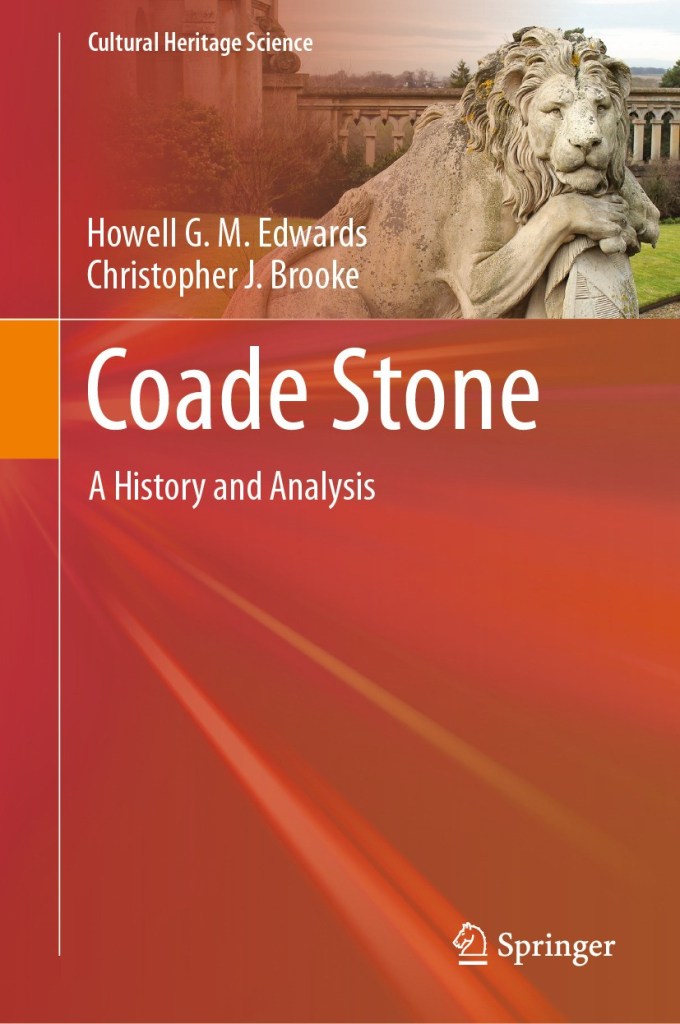 The history and nature of artificial stone for use in architecture is a subject still shrouded in myth and misconception. This book aims to lay bare those misconceptions and present a scientific and architectural account of these materials, and especially Coade Stone, the most successful of all, which found great favour during the Georgian period. Many examples of Coade Stone cast sculpture still exist and several key examples are presented in context and as case studies . Eleanor Coade’s artificial stone was so good that many observers could not distinguish it from the natural stone it replaced: the growth in replication of the neo-classical statuary and building adornment required in the late Georgian and Regency period was well satisfied by the use of Coade stone. A holistic evaluation of Coade stone artefacts is undertaken whereby the use of analytical data, historical documentation, invoices, company records, impressed marks and expert connoisseurship will establishthe attribution of Coade stone artefacts, some of which are currently in the unknown category. Several new scientific analyses are presented that demonstrate the true nature of high temperature fired ceramic Coade Stone and allow comparison with other forms of artificial stone, such as the cold cured cementitious variations, which eventually replaced it in the Victorian period.
Howell G. M. Edwards is Professor Emeritus of Molecular Spectroscopy at the University of Bradford. He read Chemistry at Jesus College in the University of Oxford and after completing his BA and BSc degrees he studied for his doctorate in Raman spectroscopy at Oxford with Dr Leonard Woodward and then became a Research Fellow at Jesus College, University of Cambridge. He joined the University of Bradford as a Lecturer in Structural and Inorganic Chemistry, becoming Head of the Department of Chemical and Forensic Sciences, and was awarded a Personal Chair in Molecular Spectroscopy in 1996. He has published over 1350 research papers in Raman spectroscopy and the characterisation of materials, along with six books on the application of this analytical technique to art, archaeology, and forensic science. He has had a lifelong interest in porcelains and the industrial archaeology, excavation, and the preservation of early porcelain manufactory sites.
Christopher J. Brooke studied for a BSc (Hons.) in Archaeological Sciences at the University of Bradford, specializing in geophysics, environmental archaeology, and palaeopathology, followed by a PhD at the University of Nottingham in the field of archaeological remote sensing for historic buildings analysis. He has worked in a wide range of organizations from central and local government, through university teaching appointments and industry, a major charity, and freelance consultancy. A Fellow of the Society of Antiquaries, a Fellow of the Royal Historical Society, an Associate Fellow of the Remote Sensing and Photogrammetry Society, and a member of many professional organizations both nationally and in the UK East Midlands, he serves on a large number of advisory boards and committees. Dr Brooke’s principal research specializations are in electromagnetic remote sensing, nondestructive archeological site survey, record photography, mathematical image processing, environmental study, spectroscopy, the history and archaeology of churches, and the recording and conservation of historic buildings. He has lectured extensively at academic institutions throughout the UK and is currently Honorary Associate Professor in Medieval History and Church Archaeology at the University of Nottingham, and Visiting Fellow in Remote Sensing at Nottingham Trent University.
c o n t e n t s
1 Introduction: Coade Artificial Stone and Its Marks
2 Factors That Influenced the Success of Coade Stone
3 Artificial Stone: The Precursors, Contemporaries, and Later Variations of Coade Stone
4 Historical Myths and Anomalies Associated with Coade Stone
5 The Mineralogy of Fired Ceramics
6 The Analysis of Coade Stone Artefacts
7 Case Studies: Coade Stone
8 Conclusions
Appendices
Glossary
Index










 Enfilade
leave a comment