New Book | Goethe, His Faustian Life
From Bloomsbury:
A. N. Wilson, Goethe, His Faustian Life: The Extraordinary Story of Modern Germany, a Troubled Genius, and the Poem that Made Our World (London: Bloomsbury Continuum, 2024), 416 pages, ISBN: 978-1472994868, $35.
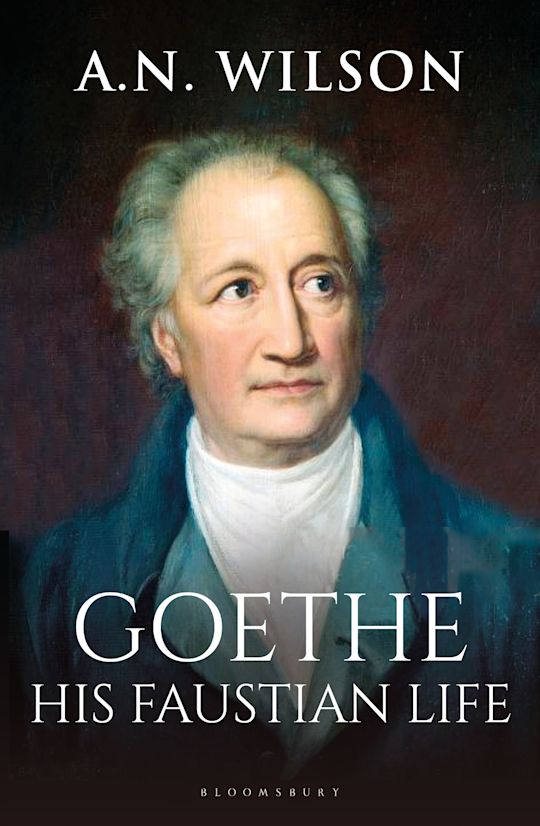 Goethe was the inventor of the psychological novel, a pioneer scientist, great man of the theatre, and a leading politician. As A. N. Wilson argues in this groundbreaking biography, it was his genius and insatiable curiosity that helped catapult the Western world into the modern era. Wilson tackles the life of Goethe with characteristic wit and verve. From his youth as a wild literary prodigy to his later years as Germany’s most respected elder statesman, Wilson hones in on Goethe’s undying obsession with the work he would spend his entire life writing—Faust. Goethe spent over 60 years writing his retelling of Faust, a strange and powerful work that absorbed all the philosophical questions of his time as well as the revolutions and empires that came and went. It is his greatest work, but as Wilson explores, it is also something much more—it is the myth of how we came to be modern.
A. N. Wilson is a Fellow of the Royal Society of Literature and holds a prominent position in the world of literature and journalism. He is a prolific and award-winning biographer and celebrated novelist, having written biographies of Tolstoy, C. S. Lewis, Milton, and Hilarire Belloc. In 2007, Wilson’s novel, Winnie and Wolf, was longlisted for the Man Booker Prize, and in 2020 The Mystery of Charles Dickens was published to great critical acclaim. He lives in North London.
New Book | A Life of Leibniz in Seven Pivotal Days
From Norton, a translation of the original German, Die beste aller möglichen Welten: Gottfried Wilhelm Leibniz in seiner Zeit, which appeared in 2022:
Michael Kempe, The Best of All Possible Worlds: A Life of Leibniz in Seven Pivotal Days, translated by Marshall Yarbrough (New York: Norton & Co., 2024), 304 pages, ISBN: 978-1324093947, $32.
 A biography of the polymath Gottfried Wilhelm Leibniz told through seven critical days spanning his life and revealing his contributions to our modern world.
Gottfried Wilhelm Leibniz (1646–1716) was the Benjamin Franklin of Europe, a ‘universal genius’ who ranged across many fields and made breakthroughs in most of them. Leibniz invented calculus (independently from Isaac Newton), conceptualized the modern computer, and developed the famous thesis that the existing world is the best that God could have created.
In The Best of All Possible Worlds, historian and Leibniz expert Michael Kempe takes us on a journey into the mind and inventions of a man whose contributions are perhaps without parallel in human history. Structured around seven crucial days in Leibniz’s life, Kempe’s account allows us to observe him in the act of thinking and creating, and gives us a deeper understanding of his broad-reaching intellectual endeavors. On 29 October 1675, we find him in Paris, diligently working from his bed amid a sea of notes, and committing the integral symbol—the basis of his calculus—to paper. On 17 April 1703, Leibniz is in Berlin, writing a letter reporting that a Jesuit priest living in China has discovered how to use Leibniz’s binary number system to decipher an ancient Chinese system of writing. One day in August 1714, Leibniz enjoys a Viennese coffee while drawing new connections among ontology and biology and mathematics. The Best of All Possible Worlds transports us to an age defined by rational optimism and a belief in progress, and will endure as one of the few authoritative accounts of Leibniz’s life available in English.
Michael Kempe is the director of the Leibniz Research Center and the Leibniz-Archiv in Hannover and teaches early modern history at the University of Konstanz.
Marshall Yarbrough is a writer, musician, and German-to-English translator. He lives in Brooklyn, New York.










 Enfilade
leave a comment