Morgan Library & Museum Fellowships
From The Morgan Library & Museum:
The Morgan Library & Museum is offering four fellowships for pre- and post-doctoral students. Applications must be submitted by 31 December 2024.
1 Drawing Institute Predoctoral Research Fellowship, 2025–26
The Morgan Drawing Institute will award one nine-month Predoctoral Research Fellowship to an advanced-level graduate student who has completed all course work and exams. The student should be currently engaged in carrying out research leading to the completion of a doctoral dissertation in the history of art, a significant component of which pertains to the history, theory, collecting, function, or interpretation of drawings. The stipend is $4000/month for 9 months, September/October 2025–May/June 2026, plus a $2000 travel allowance intended to support or subsidize a short research trip.
2 Drawing Institute Postdoctoral Research Fellowship, 2025–26
The Morgan Drawing Institute will award one nine-month Postdoctoral Research Fellowship to a scholar in the first decade of their career following the completion of the Ph.D. or equivalent advanced degree. The Postdoctoral Research Fellowship supports an independent research project, ideally working toward a clearly defined publication relating to some aspect of the history, theory, collecting, function, or interpretation of drawings. The stipend is $4850/month for 9 months, generally expected to run between September/October 2025 – May/June 2026, plus a $2000 travel allowance intended to support or subsidize a short research trip. If a fellowship is sought for a specific time (e.g. around a professor’s semester-long sabbatical), that should be clearly indicated in the application.
3 Belle da Costa Greene Curatorial Fellowships
The Morgan Library & Museum seeks applications for the Belle da Costa Greene Curatorial Fellowship, a two-year curatorial fellowship to be awarded to two promising scholars with experiences and perspectives that have not been adequately reflected in the curatorial and special collections fields. Named for the Morgan’s first director, one of the most prominent American librarians and cultural leaders of the first half of the twentieth century and a woman of African-American descent, this full-time program will equip the Fellows with a strong working knowledge of museum and special collections library operations and provides the Fellows with resources and mentorship to further a professional career in libraries, archives, or museums. The Morgan seeks candidates who are interested in working on specific projects as outlined on the museum’s website. The program will provide the Fellows with experience in a variety of core curatorial activities, such as exhibition and publications planning, research on the collection and on potential acquisitions, the creation of public programs, and donor relations. The Fellows will also have the opportunity to propose and curate an installation or small exhibition in the museum. The salary is $52,000 annually; excellent benefits. Fellows will also have a travel budget of $2000 per year for research and for activities supporting their professional development, such as attendance at a conference.
4 Shelby White & Leon Levy Fellowship in Manuscript Cataloging
The Morgan Library & Museum invites applications for the Shelby White & Leon Levy Fellowship in Manuscript Cataloging. The Fellowship is intended for new professionals who have demonstrated engagement with general cataloging or archival processing and wish to enhance their skills through intensive specialized training. This is a unique opportunity for early-career professionals to receive training and mentoring as members of the Morgan Library & Museum curatorial and cataloging staff. Starting in February 2025, the Fellowship will consist of 650 hours, and applicants will have a choice between full-time (35 hours per week) or part-time (21 hours per week) work in order to complete the 650 hours. Fellows will be assigned to work on specific groups of 19th- or 20th-century correspondence. They will be expected to research the historical and cultural context in which the letters and documents were produced, create collection and item level records in CORSAIR—the Morgan’s collections database—according to DCRM(MSS), assign accession numbers, and attend to the rehousing and conservation needs of the material. Considerations will be given to applicants’ areas of experience or expertise, such as specific language skills or subject specialization in art, literature, history, film, history of science, etc.
Williamsburg Acquires Green Frog Plate and Related Print

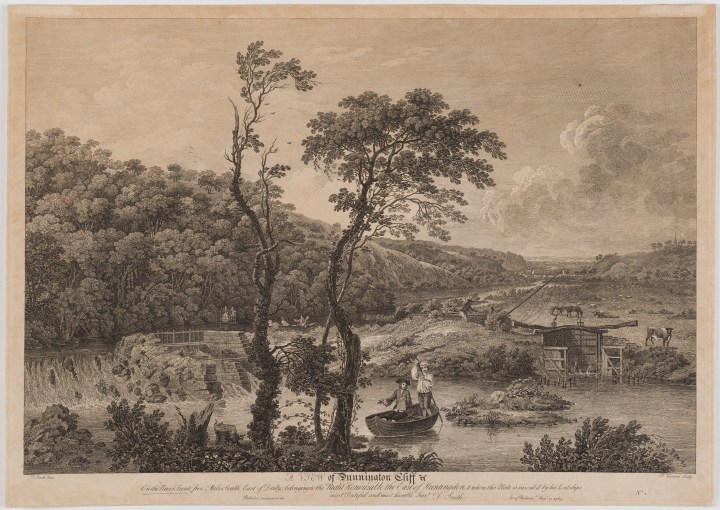
Plate, Wedgwood and Bentley, Etruria, Staffordshire (made in) and Chelsea (decorated in, 1773–74, creamware, OH: 7/8” OH 9-7/8” (Williamsburg: Museum Purchase, The Friends of Colonial Williamsburg Collections Fund, 2024-241). View of Dunnington Cliff on the River Trent, engraved by Francois Vivares after work by Thomas Smith, London, 1745, etching and line engraving on laid paper (Williamsburg: Museum Purchase, The Friends of Colonial Williamsburg Collections Fund, 2024-242).
◊ ◊ ◊ ◊ ◊
From the press release (16 December 2024) . . .
A rare pair of related 18th-century objects were recently acquired by The Colonial Williamsburg Foundation: a creamware plate, made by Josiah Wedgwood in 1773–74 as part of a service commissioned by Catherine the Great to be used at her castle, La Grenouillère or Kekerekeksinen (Frog Marsh); and a fine copy of a 1745 print engraved by François Vivares after work by Thomas Smith. The print depicts Dunnington Cliff on the River Trent in England, which is the motif seen in the center of the plate. By adding the plate to its ceramics collection, the Foundation becomes one of the few American institutions to own a surviving piece from this famous dinner service.
“Colonial Williamsburg’s collection of British-made ceramics is one of the finest in the United States,” said Ronald Hurst, the Foundation’s senior vice president and chief mission officer. “The acquisition of this plate and its printed design source brings new prominence to the collection. We are deeply grateful to the Friends of Colonial Williamsburg Collections for funding both purchases.”

Royal patronage within England and abroad helped Josiah Wedgwood secure a well-respected reputation as a manufacturer of ceramics for all levels of society. Catherine the Great of Russia was a patroness who commissioned two dinner services from his firm; the Frog Marsh service was the second. It encompassed an astounding 952 pieces, each of which was hand painted in monochrome with distinct views of England and bore a splayed frog within a shield to signify the name of the palace for which it was made. To this day, the service remains the most ambitious endeavor by a British ceramics manufacturer. It was more than a mere dinner service; it was a symbol of British diplomacy and shared with the larger world all that England could offer from ancient architectural ruins to imposing country homes in bucolic landscapes to industrial achievements, such as the view of Dunnington Cliff on River Trent shown on this plate. It also symbolizes the importance of the Baltic region in British and American trade in the 18th and early 19th centuries as well as the production of ceramics through the plate’s central image.
“This plate will be very much at home alongside other important Wedgwood-made holdings already in Colonial Williamsburg’s ceramic collection, including a prized Portland vase and a piece from the Husk service, the earlier service commissioned by Catherine the Great,” said Angelika Kuettner, Colonial Williamsburg’s curator of ceramics and glass. “This Green Frog service plate provides so many layers of interpretation for us. Other pieces from the service depicting grand houses are truly lovely, but this example allows us to talk about waterpower in the 18th century and ceramic production, not to mention Wedgwood’s industrial and entrepreneurial influence throughout the world.”
The plate’s molded rim is painted with a meandering oak leaf and acorn border interrupted by a shield enclosing a green painted splayed frog. The cavetto is painted with a neoclassical, scalloped border between concentric lines. The plate’s well is painted with a bucolic scene of a lock on a river, grazing cattle in the background, a sailing vessel on the meandering waterway, and a church spire painted faintly in the distance. The reverse bears a black enamel painted number ‘221’ and an impressed circle.
Of the pieces in the original dinner service, the majority remain in Russia today and have been there since their delivery in the 18th century. A few pieces were not sent and were divided between Wedgwood’s Etruria manufactory and Alexander Baxter, the agent for the purchase. To date, there are 26 extant pieces known that were not delivered to Catherine the Great because, as Wedgwood noted, they were either duplicates or considered by Wedgwood not up to his high standard of quality. Of those, 17 are in museum collections, only 5 of which are in American museums. This acquisition brings that number to 6 in museums in the United States; the remaining 8 pieces are still privately owned.
The view of Dunnington Cliff, located southeast of Derby, is significant as it was the site of King’s Mills, Britain’s largest water-powered manufacturing area in the mid-18th century and home to numerous mills associated with a variety of manufacturers, including flint grinding for the ceramic industry, paper making, iron forging and flour production. The representation of Dunnington Cliff on the plate comes from a 1745 print, View of Dunnington Cliff on the River Trent engraved by François Vivares after the painting on the subject by Thomas Smith. The opportunity for the Foundation to acquire both the source print with the hand-painted ceramic plate from the Frog Marsh service is significant.
“Together they tell an incredible story. Prints like this one were imported in the 18th century from England to decorate the walls of Virginia houses and also served as inspiration for an important dinner service used in a Russian Palace. Being able to show a printed design source alongside the ceramic plate helps us draw connections between mediums within the decorative arts,” said Katie McKinney, Margaret Beck Pritchard Curator of Maps & Prints
The lock at the center of the plate shows the same lock in the print. While the artists painting the plate adapted the print to the circular format, they maintained accuracy with great precision to include even the wispy clouds and a church spire seen faintly in the background.










 Enfilade
leave a comment