Exhibition | Keeping Time: Clocks by Boulle

Attributed to André-Charles Boulle, movement by Claude Martinot, Mantel clock with Father Time (detail), ca. 1726
(London: The Wallace Collection)
◊ ◊ ◊ ◊ ◊
From the press release for the exhibition (and note the study day on January 31) . . .
Keeping Time: Clocks by Boulle
The Wallace Collection, London, 27 November 2024 — 2 March 2025
Curated by Alexander Collins
For the first time, the Wallace Collection has brought together its clocks by André-Charles Boulle (1642–1732), one of history’s greatest designers and cabinetmakers, in a display that explores the art and science of timekeeping. Five exceptional timepieces tell the story of how Boulle took advantage of scientific discoveries to create unique clock designs, whose influence spread throughout the world and across the centuries.
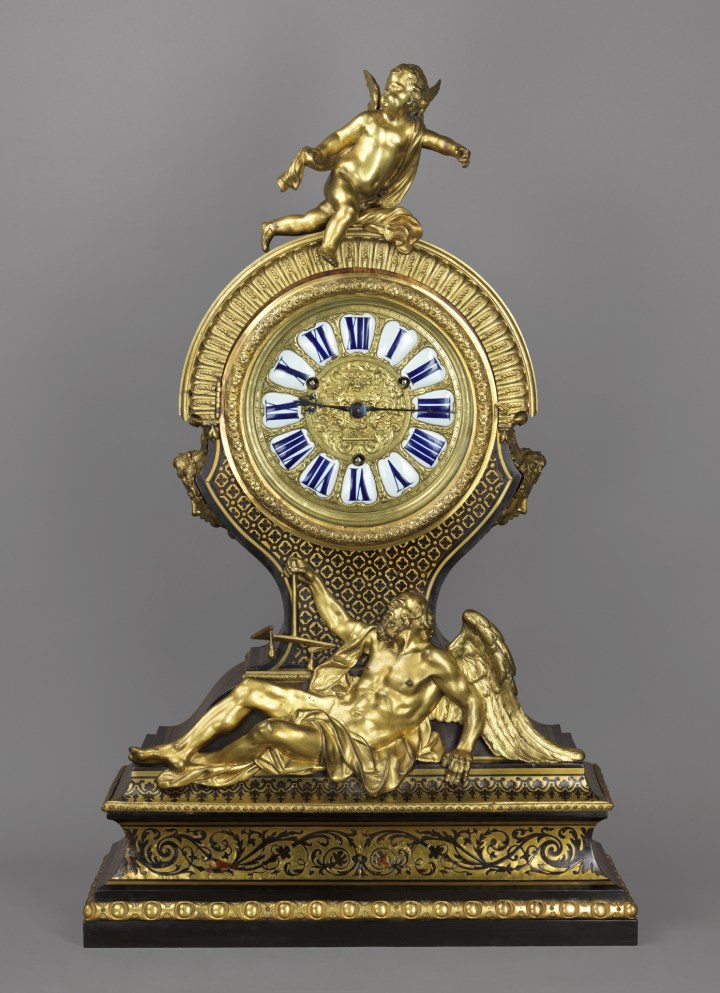
Attributed to André-Charles Boulle, movement by Claude Martinot, Mantel clock with Father Time, ca. 1726 (The Wallace Collection).
As the most famous cabinetmaker working for the court of the Sun King, Louis XIV (1638–1715), Boulle would eventually give his name to the specific style that signified the glittering spectacle of the Baroque—elaborate veneer designs incorporating turtleshell, brass, and other materials. Alongside his work as a royal furniture maker, Boulle also turned his attention to the clock, the accuracy of which had recently been revolutionised through the invention of the pendulum by Dutch scientist Christiaan Huygens (1629–1695) in 1656. As these sweeping weights called for larger clock cases, Boulle saw the opportunity to create bold and sumptuous designs.
Due to his position at court, Boulle was exempted from strict guild regulations, allowing him to work with great creative freedom. This artistic liberty was incredibly important, as the clocks not only had to demonstrate the wealth of their owners through the most luxurious materials available, but also had to show how intellectual they were. Therefore, Boulle infused his designs with narratives that chimed with scientific knowledge. Time and the natural laws of the universe are personified, for example Father Time as a bearded old man, and the Continents as figures from across the world. As well as creating innovative iconography, Boulle also reflected on the history of timekeeping by incorporating motifs such as gothic hourglasses in his clock cases.
The clocks are also products of collaboration involving the multi-disciplinary efforts of artists and craftspeople from all over 18th-century Paris. Each clock has a mechanism by a different leading clockmaker from Boulle’s time: Pierre Gaudron (died 1745), Jean Jolly (active about 1698), Claude Martinot (active about 1718), Louis Mynuël (1675–1742) and Jacques-Augustin Thuret (1669–1739). Some of these were Boulle’s neighbours in the workshops of the Louvre, as well as François Girardon (1628–1715), the king’s official sculptor, who supplied mounts of Father Time for Boulle’s clocks.
The clocks on display show the wide range of objects that Boulle turned his hand to. A monumental wardrobe from 1715 that encloses a clock, crowned with cherubs; two mantel clocks, one from around 1715 featuring Venus and Cupid, and another, from a decade later, with the figure of Father Time; as well as two extraordinary pedestal clocks.
The display opens ahead of an international conference on Boulle, to be held at the Wallace Collection in early 2025. One of the first major research events on the cabinetmaker in recent years, it will bring together specialists and conservators to consider the work of this fascinating artist, all within the same building where some of his greatest artistic achievements can be found.
Many of Boulle’s contemporaries also drew on the concept of time in their work. This will be explored in a complementary display in the museum’s Billiard Room, which is uniting two magnificent artworks: The Dance to the Music of Time (about 1634–36) by Nicolas Poussin (1594–1665), in which the Four Seasons dance to the song of Father Time, the composition of their rhythmic bodies echoing the workings of a clock movement; and The Borghese Dancers (1597–1656), where five female figures masquerade as the Hours, attendants to the goddesses of the Dawn and Moon.
Xavier Bray, Director of The Wallace Collection, says: “I am absolutely thrilled to be bringing great works of art by Boulle together for the first time. These clocks were at the cutting edge of 18th-century technology, combining exquisite artistry and mechanical expertise into a unique and innovative blend. Through Boulle’s clocks and the display, we hope visitors will be able to transport themselves into the world of Louis XIV, where luxury touched every element of the court, including something as essential and practical as timekeeping.”
Alexander Collins, Curatorial Assistant at the Wallace Collection and curator of the display, says: “Our research on these objects has revealed many unknown facets of their history, including bringing to life the multitude of artists and craftspeople who came together to make Boulle’s vision into a reality. The passage of time as a metaphor for life and death has been an important theme for artists since humanity discovered their creativity, and Boulle’s designs are important, and resonate with us today, because of this deep symbolism.”
◊ ◊ ◊ ◊ ◊
Boulle Study Day
Online and in-person, Friday, 31 January 2025
Delve into the world of baroque France and learn more about Boulle’s furniture with leading specialists, including curators and conservators from the Palace of Versailles, the Château de Chantilly, and C2RMF. You’ll explore the evolution of Boulle’s iconic designs, his materials and techniques, and his enduring legacy. This in-person event at the Wallace Collection will also be broadcast live on Zoom. Ticketholders will receive a link to a recording of the event, which will be available for two weeks. Full programme to follow: 10.00–17.00 GMT, with a drinks reception until 19.00.
Registration is available here»










 Enfilade
leave a comment