Exhibition | In Slavery’s Wake: Making Black Freedom
From the press release for the exhibition, recently covered by Jennifer Schuessler for The New York Times:
In Slavery’s Wake: Making Black Freedom in the World
National Museum of African American History and Culture, Washington DC, 13 December 2024 — 8 June 2025
Other venues will include museums in Belgium, Brazil, England, Senegal, and South Africa

The Smithsonian’s National Museum of African American History and Culture (NMAAHC) recently unveiled its first international touring exhibition, In Slavery’s Wake: Making Black Freedom in the World. Through powerful forms of artistic expressions, such as quilting, music and ironwork, the exhibition reveals healing traditions rooted in the resilience of enslaved people. Featuring more than 190 artifacts, 250 images, interactive stations, and newly commissioned artworks, In Slavery’s Wake offers a transformative space to honor these legacies of strength and creativity.
“This global exhibition is a profound journey through the African diaspora, reflecting on our shared history and envisioning a future shaped by resilience and freedom,” said Kevin Young, Andrew W. Mellon Director, Smithsonian National Museum of African American History and Culture. “It beautifully intertwines the past and present, inviting visitors to experience our heritage’s multilingual, multinational, and forward-looking spirit. This show reflects not just the impact of slavery but a celebration of the freedom-making efforts of the enslaved and abolitionists, embodying the humane and interconnected world we live in today.”
In Slavery’s Wake reckons with the impact of slavery and colonialism on present-day societies around the world and explores the often-overlooked efforts of the enslaved to force the end of slavery with legal emancipation and abolition as well as to provide a wellspring for descendants to draw upon to help create a better world for themselves and their communities through art, storytelling, music, protest, and communal healing. It delves into key questions about freedom and its expressions across six sections.
Organized by the National Museum of African American History and Culture’s Center for the Study of Global Slavery and the Ruth J. Simmons Center for the Study of Slavery and Justice at Brown University, the exhibition grew out of a decade-long collaboration between international curators, scholars, and community members who were committed to sharing stories of slavery and colonialism in public spaces. The collective worked across geographies, cultures, and languages, connecting the past and the present.
After its close in Washington, the exhibition will travel to museums in Belgium, Brazil, England, Senegal, and South Africa. Curatorial partners from each location contributed stories, objects and oral histories that reflect their local communities within this global history. It also incorporates a new collection of more than 150 oral histories filmed at each partner site, titled Unfinished Conversations. Voices from this international archive of everyday people’s memories and stories are featured throughout.
Paul Gardullo, Johanna Obenda, and Anthony Bogues, eds., with a foreword by Lonnie G. Bunch III, In Slavery’s Wake: Making Black Freedom in the World (Washington, DC: Smithsonian Books, 2024), 240 pages, ISBN: 978-1588347794, $40.
Call for Articles | Spring 2026 Issue of J18: Revolution
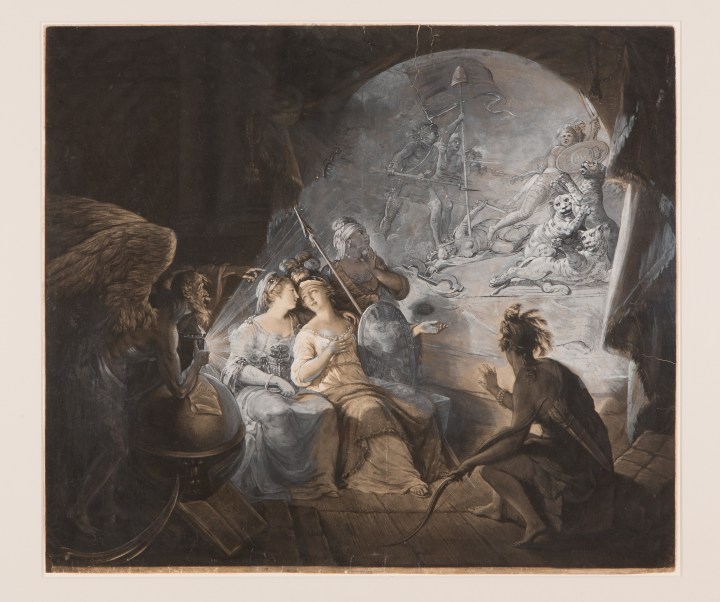
John Dixon, The Tea-Tax-Tempest (The Oracle), 1774, mezzotint with gouache, scratched proof; sheet (trimmed within plate), 52 × 59 cm
(New York: The Metropolitan Museum of Art, 83.2.2083).
◊ ◊ ◊ ◊ ◊
From the Call for Papers:
Journal18, Issue #21 (Spring 2026) — Revolution
Issue edited by Wendy Bellion and Kristel Smentek
Proposals due by 1 April 2025; finished articles will be due by 1 September 2025
July 2026 marks the 250th anniversary of the United States Declaration of Independence, a turning point in the American Revolution (1775–1783). The French Revolution (1789–1799), the Haitian Revolution (1791–1804), and the unsuccessful United Irishmen’s Rebellion (1798) followed in quick succession. For this commemorative year, this issue of Journal18 proposes to examine afresh the material and visual cultures of what historians have termed the ‘age of revolutions’.
Taking a cue from the Declaration itself—a document that interrogated the very practice (and malpractices) of representation—we invite new questions about familiar material. What images and objects, actors and artistic media, have been privileged and marginalized to date in art histories of revolution? How did visual and decorative images purporting to document the American Revolution both foreground and obfuscate the fundamental contradiction of a political freedom that depended on systems of enslavement, colonization, and Indigenous displacement?
The French revolutionary government officially promised liberty and equality for all, yet women were formally excluded from political life (while simultaneously benefiting from new measures that significantly increased their social welfare), and slavery continued until France was forced to end it, temporarily, in 1794. How were the asymmetries and inconsistencies of the French Revolution embedded or elided in its civic performances and its official and unofficial image-making campaigns, production of ephemera, and circulation of luxury goods? What about absences in the visual and material record?
How might new scholarship on the visual history of the Haitian Revolution—the most successful revolt of enslaved peoples in history—interrogate its comparative underrepresentation during the eighteenth century and within the discipline of art history, arguably contributing to what the Haitian scholar Michel-Rolph Trouillot described as its historical “silencing”? How might art history stretch beyond the Atlantic rim to consider the global contexts of the age of revolutions and the manifestations of revolution beyond Euro-America during this period?
We welcome proposals for contributions that engage these questions and related matters of revolutionary memory, violence, justice, absence, and reinvention. Submissions may take the form of full-length articles, shorter pieces focused on single objects, photo essays, interviews, or other formats.
Proposals for issue #21 Revolution are now being accepted. The deadline for proposals is 1 April 2025. To submit a proposal, send an abstract (250 words) and a brief biography to editor@journal18.org and smentek@mit.edu. Articles should not exceed 6000 words (including footnotes) and will be due for submission by 1 September 2025. For further details on submission and Journal18 house style, see Information for Authors.
Issue Editors
Wendy Bellion, University of Delaware
Kristel Smentek, MIT
New Book | Ange Laurent de La Live de Jully
From Lienart:
Marie-Laure de Rochebrune, ed., Ange Laurent de La Live de Jully (1725–1779): Un grand amateur à l’époque des Lumières (Paris: Lienart éditions, 2024), 488 pages, ISBN: 978-2359064186, €55. With contributions by Lionel Arsac, Géraldine Aubert, Colin Bailey (foreword), Vincent Bastien, Mathieu da Vinha, Patricia de Fougerolle, Mathieu Deldicque, Vincent Droguet, Alexandre Maral, Marc-André Paulin, Alexandre Pradère, Yohan Rimaud, and Xavier Salmon.
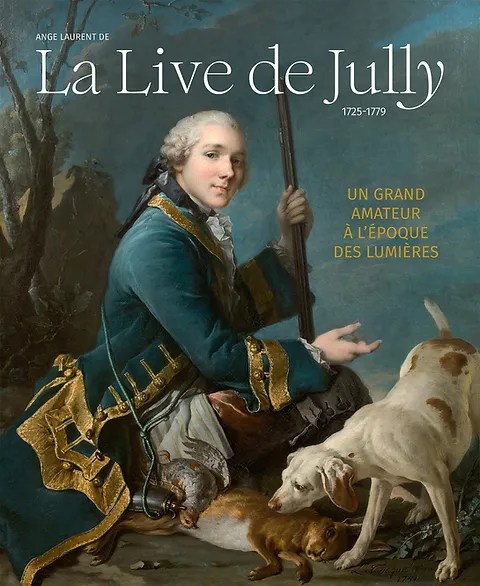 Ange Laurent de La Live de Jully (1725–1779) fut l’une des figures les plus brillantes et les plus attachantes du monde des grands amateurs français de la seconde moitié du XVIIIe siècle. Mécène et ami des artistes de son temps, collectionneur, graveur, musicien et historien, il fut élu, très jeune, membre honoraire ou associé libre de l’Académie royale de peinture et de sculpture, en raison de la qualité des collections qu’il avait réunies et aussi de ses capacités artistiques. Avec le concours des meilleurs spécialistes, cet ouvrage a pour ambition d’embrasser l’ensemble des collections de ce « dénicheur de talents » dans des domaines très divers—peintures, arts graphiques, sculptures, mobilier et objets d’art, livres, coquilles, instruments de musique—collections qui constituent autant de témoignages de son immense curiosité, de son ouverture d’esprit et de sa générosité envers les artistes. Il met également en lumière les milieux familial et intellectuel si stimulants dans lesquels il a baigné et qui expliquent, à bien des égards, la formation de son goût si raffiné et de son extrême sensibilité artistique.
Marie-Laure de Rochebrune est conservateur général au château de Versailles.
New Book | Coade Stone
From Springer:
Howell Edwards and Christopher Brooke, Coade Stone: A History and Analysis (New York: Springer, 2024), 275 pages, ISBN: 978-3031714313, $110.
 The history and nature of artificial stone for use in architecture is a subject still shrouded in myth and misconception. This book aims to lay bare those misconceptions and present a scientific and architectural account of these materials, and especially Coade Stone, the most successful of all, which found great favour during the Georgian period. Many examples of Coade Stone cast sculpture still exist and several key examples are presented in context and as case studies . Eleanor Coade’s artificial stone was so good that many observers could not distinguish it from the natural stone it replaced: the growth in replication of the neo-classical statuary and building adornment required in the late Georgian and Regency period was well satisfied by the use of Coade stone. A holistic evaluation of Coade stone artefacts is undertaken whereby the use of analytical data, historical documentation, invoices, company records, impressed marks and expert connoisseurship will establishthe attribution of Coade stone artefacts, some of which are currently in the unknown category. Several new scientific analyses are presented that demonstrate the true nature of high temperature fired ceramic Coade Stone and allow comparison with other forms of artificial stone, such as the cold cured cementitious variations, which eventually replaced it in the Victorian period.
Howell G. M. Edwards is Professor Emeritus of Molecular Spectroscopy at the University of Bradford. He read Chemistry at Jesus College in the University of Oxford and after completing his BA and BSc degrees he studied for his doctorate in Raman spectroscopy at Oxford with Dr Leonard Woodward and then became a Research Fellow at Jesus College, University of Cambridge. He joined the University of Bradford as a Lecturer in Structural and Inorganic Chemistry, becoming Head of the Department of Chemical and Forensic Sciences, and was awarded a Personal Chair in Molecular Spectroscopy in 1996. He has published over 1350 research papers in Raman spectroscopy and the characterisation of materials, along with six books on the application of this analytical technique to art, archaeology, and forensic science. He has had a lifelong interest in porcelains and the industrial archaeology, excavation, and the preservation of early porcelain manufactory sites.
Christopher J. Brooke studied for a BSc (Hons.) in Archaeological Sciences at the University of Bradford, specializing in geophysics, environmental archaeology, and palaeopathology, followed by a PhD at the University of Nottingham in the field of archaeological remote sensing for historic buildings analysis. He has worked in a wide range of organizations from central and local government, through university teaching appointments and industry, a major charity, and freelance consultancy. A Fellow of the Society of Antiquaries, a Fellow of the Royal Historical Society, an Associate Fellow of the Remote Sensing and Photogrammetry Society, and a member of many professional organizations both nationally and in the UK East Midlands, he serves on a large number of advisory boards and committees. Dr Brooke’s principal research specializations are in electromagnetic remote sensing, nondestructive archeological site survey, record photography, mathematical image processing, environmental study, spectroscopy, the history and archaeology of churches, and the recording and conservation of historic buildings. He has lectured extensively at academic institutions throughout the UK and is currently Honorary Associate Professor in Medieval History and Church Archaeology at the University of Nottingham, and Visiting Fellow in Remote Sensing at Nottingham Trent University.
c o n t e n t s
1 Introduction: Coade Artificial Stone and Its Marks
2 Factors That Influenced the Success of Coade Stone
3 Artificial Stone: The Precursors, Contemporaries, and Later Variations of Coade Stone
4 Historical Myths and Anomalies Associated with Coade Stone
5 The Mineralogy of Fired Ceramics
6 The Analysis of Coade Stone Artefacts
7 Case Studies: Coade Stone
8 Conclusions
Appendices
Glossary
Index
Exhibition | Gold and Silver Boxes in Dublin, 1662–1830

On view at Dublin Castle:
‘The Metal Stamp’d by Honest Fame’: Gold and Silver Boxes in Dublin, 1662–1830
Dublin Castle, 14 November 2024 — 31 March 2025
This exhibition is the first to present the work of the mostly forgotten artisans who worked in the small streets around Dublin Castle during the Georgian era making beautiful boxes in gold and silver for presentation to dukes, earls, and other luminaries. There are boxes made for heroes and villains alike—Edmund Burke, Henry Grattan, Luke Gardiner, Viscount Castlereagh, naval captains who fought the French, a city merchant who confronted Robert Emmet, and Henry Johnson, the victor in the bloodiest battle of 1798. The exhibition highlights the box makers’ inventiveness and ingenuity, showing the small luxuries they made for their fashionable and prosperous customers. In addition to loans from Irish collections, the exhibition brings sumptuous artefacts not seen here in centuries, such as the bejewelled gold Rathdowne box from 1823— back to Dublin from the US, UK, and continental Europe. The exhibition reveals Georgian Dublin as a vibrant place where hierarchical deference, civic politics, personal ostentation, sentimental attachment, anxieties about invasion, and rebellion all found expression in small, exquisitely made boxes.
SAAM Short-Term Fellowship for American Art History
From the SAAM:
Smithsonian American Art Museum’s Audrey Flack Short-Term Fellowship
Applications due by 11 February 2025
Applications are invited for the Smithsonian American Art Museum’s Audrey Flack Short-Term Fellowship. The application deadline is February 1. The renowned artist Audrey Flack (1931–2024) generously established this short-term award in recognition of her personal journey balancing intensive career demands with raising two daughters, one of whom has autism.
A single Audrey Flack Short-Term Fellowship will be awarded annually in support of a one-month (thirty-day) residency. Residencies must take place between 1 June 2025 and 31 May 2026, and begin on the 1st or 15th of the month. The Audrey Flack Short-Term Fellow will receive a stipend of $5,000 to support travel to and living expenses in Washington, D.C. Housing is not provided.
The Audrey Flack Short-Term Fellowship is open to predoctoral, postdoctoral, and senior scholars researching topics in American art who reside, work, or attend school outside of commuting distance from Washington, D.C. Researchers whose personal circumstances (i.e., financial constraints, employment conditions, care-giving responsibilities, or other limitations) preclude them from participating in longer-term residencies are encouraged to apply. Applicants should submit a statement of need justifying the rationale for a short-term fellowship. More information on submitting an application can be found here.
Applicants must identify a member of SAAM’s research staff to serve as the primary fellowship advisor. Projects that require access to SAAM’s collections and staff expertise are prioritized, although those that utilize other Smithsonian resources are eligible.
Preservation Long Island Receives Curatorial Internship Grant
From the press release (18 November 2024). . .
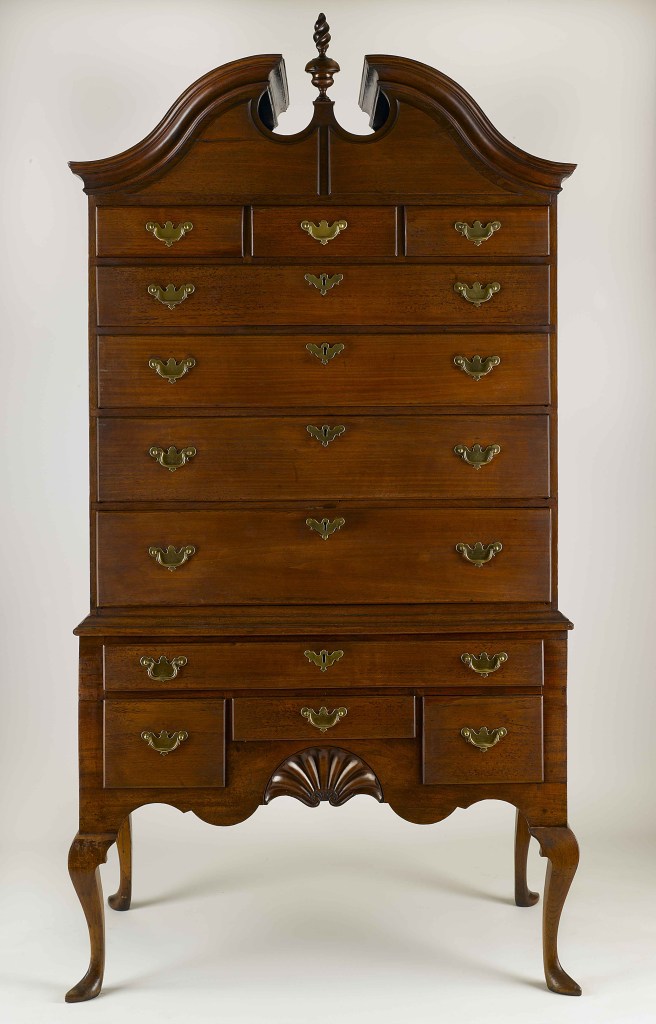
High chest of drawers, Queens County, New York, 1740–70, walnut, tulip poplar, pine (Preservation Long Island purchase, 1961.13.1).
The Decorative Arts Trust is thrilled to announce that Preservation Long Island (PLI) is the recipient of the 2025–27 Curatorial Internship Grant. Headquartered in Cold Spring Harbor, New York, PLI was founded in 1948 as the Society for the Preservation of Long Island Antiquities. PLI advances the importance of historic preservation in the region through advocacy, education, and stewardship. Their program areas include interpreting historic sites, collecting art and material culture pertaining to Long Island history, creating publications and exhibitions, and providing direct support and technical assistance to individuals and groups engaged in local preservation efforts.
In 2026, PLI will celebrate the United States Semiquincentennial as well as the 50th anniversary of their landmark furniture publication, Long Island is My Nation: The Decorative Arts and Craftsmen, 1640–1830. PLI’s Peggy N. Gerry Curatorial Fellow will collaborate with Chief Curator & Director of Collections Lauren Brincat on a series of objectives aimed at cataloging Long Island furniture in public and private collections across the region, reexamining these objects from new perspectives, and enhancing their accessibility to 21st-century researchers and the public. The Fellow will take a leading role in a new initiative building upon previous scholarship towards the creation of a collaborative Long Island furniture digital database, an exhibition, and an accompanying catalogue. Also, the Fellow will coordinate and participate in a Long Island furniture symposium in summer 2025. PLI will post the Peggy N. Gerry Curatorial Fellow position on their website at preservationlongisland.org in spring 2025. For more information about Curatorial Internship Grants, visit decorativeartstrust.org/cig.
Drayton Hall Awarded Decorative Arts Trust Funding Prize
From the press release (25 November 2024) . . .
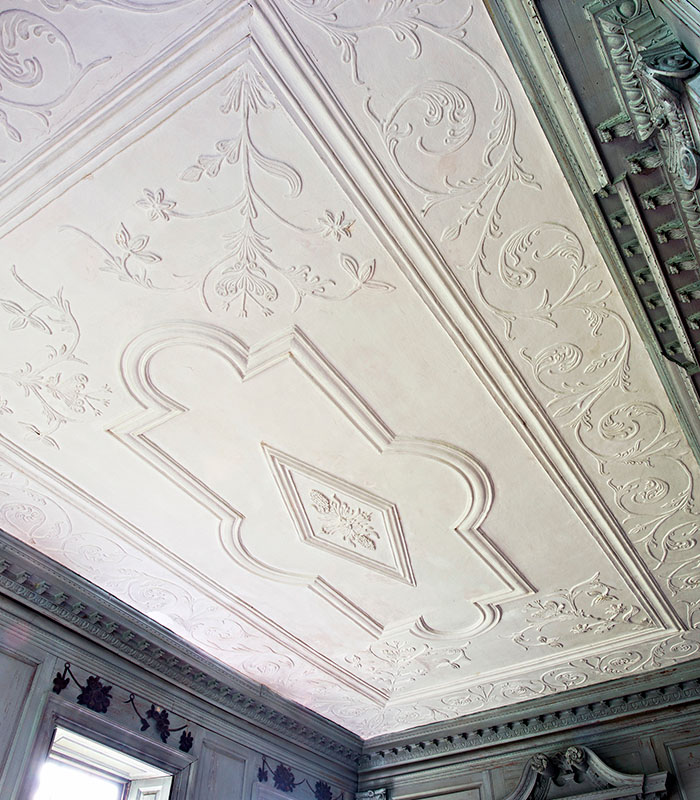
Drawing Room Ceiling, Drayton Hall (Charleston, South Carolina; photo by Willie Graham).
The Decorative Arts Trust is thrilled to announce that the 2024 Prize for Excellence and Innovation will be awarded to Drayton Hall Preservation Trust in Charleston, South Carolina, for projects to include the conservation of the plaster ceiling in the house’s Great Hall, the investigation of the plaster ceiling in the Drawing Room, and digital and in-person access to these spaces during conservation treatment and the results of the interventions. Drayton Hall, built 1738–50, is the earliest example of Palladian architecture in the United States. Surviving in relatively untouched condition, and displayed devoid of furnishings, Drayton Hall offers architectural historians the rare opportunity to study materials and designs from every period in the house’s history.
The Decorative Arts Trust Prize for Excellence and Innovation, founded in 2020, funds outstanding projects that advance the public’s appreciation of decorative art, fine art, architecture, or landscape. The Prize is awarded to a nonprofit organization in the United States for a scholarly endeavor, such as museum exhibitions, print and digital publications, conservation and preservation projects, and online databases. Past recipients include the Concord Museum; Cooper Hewitt, Smithsonian Design Museum; the Black Craftspeople Digital Archive; and Craft in America.
More information about the Prize for Excellence and Innovation is available here»
Exhibition | Painted with Silk: The Art of Early American Embroidery
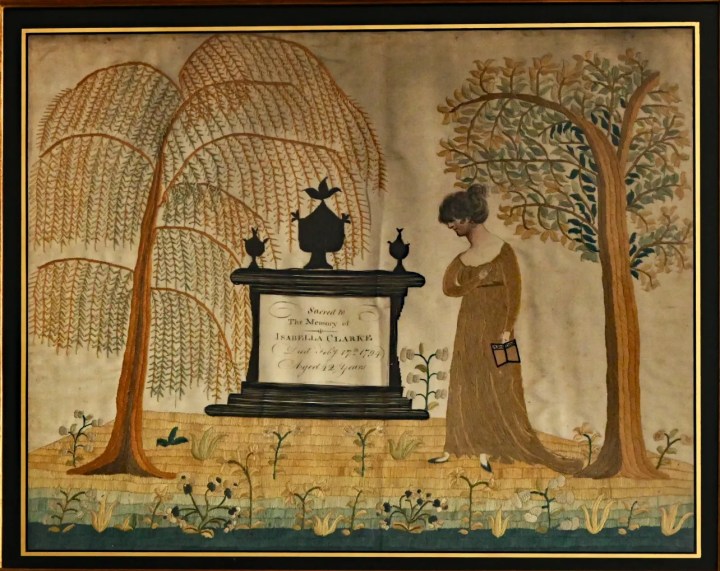
Sacred to the Memory of Isabella Clarke, Unidentified Member of the Clarke Family, Richmond, Massachusetts, ca. 1795 c
(Private Collection)
◊ ◊ ◊ ◊ ◊
From the press release for the exhibition:
Painted with Silk: The Art of Early American Embroidery
Detroit Institute of Arts, 13 December 2024 — 15 June 2025
Curated by Kenneth Myers
The Detroit Institute of Arts presents Painted with Silk: The Art of Early American Embroidery, a loan exhibition featuring a large selection of remarkably beautiful and well-preserved samplers and silk-on-silk embroideries produced by American girls and young women in the colonial and early national periods. Comprising 69 embroideries and one painting, Painted with Silk: The Art of Early American Embroidery will be on view from 13 December 2024 until 15 June 2025.
From the early 1700s until about 1830, the education of American girls from well-to-do families emphasized reading, writing, simple arithmetic, and needlework. For these girls, a finely worked embroidery worthy of being framed in their homes served as a kind of diploma. The samplers and silk-on-silk embroideries demonstrated both their mastery of an important practical skill and that they had achieved the self-discipline and refinement expected of the most privileged girls and young women in early American society. Juxtaposing historic embroideries with contemporary ones by the feminist artist Elaine Reichek, Painted with Silk draws attention to cultural assumptions and values related to gender, race, and class.
“Exhibitions at the Detroit Institute of Arts present opportunities to encourage inquiry about ourselves, our history, and our world, and this wonderful presentation is a rare chance to learn more about this important American artform” said DIA Director Salvador Salort-Pons. “The historic and contemporary embroideries displayed in the exhibition will highlight ways in which our values and assumptions are both like and unlike those of earlier Americans.”

These Are My Jewels: Having Educated Them with Care for the Service of Their Country, Catherine Langdon Wright (age 11), Susanna Rowson’s Academy, Boston, Massachusetts, 1808 (Private Collection).
Except for one painting and two early English samplers drawn from the DIA’s own collection, all the works in the show were hand-crafted by American school age girls between 1740 and about 1830. Embroidered with fine silk threads on linen, wool, or silk supports, and often framed for display, many of these embroideries became treasured family heirlooms which were passed from generation to generation. Since the early 1900s the most charming and beautiful of them have been sought out by collectors who treasured them as evidence of the skill and values of early American women. Almost all of the embroideries in Painted with Silk are on loan from private collectors eager to share their treasures with the DIA community.
The exhibition is installed in three galleries, beginning with simpler embroideries which were used to teach the alphabet and numbers, and leading to larger and more complex embroideries made with more complex stitches and paint to create more complicated pictures illustrating stories from the Hebrew and Christian Bible or contemporary literature. Many represent home as a place of safety and love. Others emphasize virtues, such as the need to obey and respect parents, teachers and other figures of authority. Some of the largest and most complicated celebrate famous women who sacrificed themselves for the good of their children or husbands.
Alongside the historic works, the exhibition presents a selection of contemporary embroideries by the acclaimed artist Elaine Reichek. Reichek originally trained as a painter but gave up the practice for embroidery—a medium historically associated with women and dismissed as a craft rather than art. Adapting the form of nineteenth-century schoolgirl samplers, Reichek developed a distinctive visual language which she uses to critique culturally dominant assumptions about society, gender, identity, and culture.
“Early American embroideries are fascinating survivors from our nation’s past,” said Kenneth John Myers, the DIA’s Byron and Dorothy Gerson Curator of American Art. “Often very beautiful, they are also inherently fragile. Silk threads can get stained, unravel, break or fade. Many surviving embroideries are in poor condition. But thanks to the generosity of several private collectors, the DIA team has been able to share an unusually large selection of very accomplished embroideries in exceptionally fine condition. And the embroideries by Reichek are fabulous.”
To complement the exhibition, the DIA will host several events, many intended for families, providing rich opportunities to learn more about American embroidery and history. Upcoming highlight events include:
Sunday, 15 December 2024
Curator Kenneth Myers will give an overview of the exhibition and discuss collecting with several of the private collectors who have lent embroideries for this show.
Wednesday, 12 February 2025, 6.30pm
Emelie Gevalt, a curator at the American Folk Art Museum in New York, will discuss the presence and absence of people of color in historic American schoolgirl embroideries.
Wednesday, 2 April 2025, 6.30pm
DIA curators Kenneth Myers and Katie Pfohl will host contemporary artist Elaine Reichek.
Call for Papers | Textiles and the Texture of Ideas in Europe, 1589–1801
From the Call for Papers:
Textiles and the Texture of Ideas in Early Modern Europe, 1589–1801: How the Craft and Its Products Interacted with Philosophy, Literature, and the Visual Arts
Procida Island (University of Naples L’Orientale), 8–14 September 2025
Proposals due by 31 January 2025
Joint project: University of Naples L’Orientale and Université de Haute-Alsace, Mulhouse. Two joint conferences will be organized:
Conference 1 | Textiles and the Texture of Ideas in Early Modern Europe, 1589–1801: How the Craft and Its Products Interacted with Philosophy, Literature, and the Visual Arts
Procida Island (University of Naples L’Orientale), 8–14 September 2025
Conference 2 | The Circulation of Textile Designs, Patterns, Skills, and Representations in Early Modern Europe
Université de Haute Alsace – Mulhouse, June 2026
The Virgin’s chemise at Chartres Cathedral (9th century), the fabrics used as support for his paintings by Luca Pignatelli (1962–) or employed by Ann Hamilton (1956–) in her installations, and textile architecture are only a few examples of how fabrics can step out of their typical function s (e.g. as daily clothing, drapery, etc.) to enter the arts and the collective imagination in rather unique ways. Evidence of textile technology dates back to the Palaeolithic (Bender Jørgensen et al., 2023); and, according to Leonardo da Vinci, it was a craft ‘second [only] to the printing of letters’ and ‘more beautiful and subtle in invention’. If artifice has traditionally aimed at producing something ‘rare’ as opposed to ‘common’ (at least until the advent of plastic according to Roland Barthes [1972: 98]), textiles are among the artifacts through which the aspiration to create rarity has been best expressed throughout the centuries. The invention of weave patterns and dyeing techniques as well as printing pattern design prove that in the production of textiles—as indeed in all crafts according to Richard Sennett—“thinking and feeling are contained within the process of making” (Sennett 2008: 7).
For these joint interdisciplinary conferences, we invite papers with a focus on the interaction between the material and the immaterial aspects of the craft of weaving, approached from various angles, in the early modern period. The aim is to explore aspects of the interactions between textile manufacturing and its products and the individual or collective imagination, intellectual life as well as the ‘world picture’ and mental representations in the early modern period. Those interactions, although sometimes acknowledged, appear to have been understudied so far. How did the immaterial life of ideas as well as the cultural context impact on the creation of fabric designs? And, vice versa, how did textile manufacturing, in either its pre-industrial or early industrial stage, impact on the personal or collective imagination? How were early modern textile artefacts, alongside the material conditions and early modern technologies of their production, perceived by contemporaries? Were they perceived as ‘symbolic capital’, in Pierre Bordieu’s acceptation (1979)? Can the study of representations, descriptions, references, or even allusions to textiles and the textile manufacture, but also of the metaphorical usage of textile-related vocabulary in various texts—from poetry to philosophical essays—or of references to the textile world in the early modern visual arts—paintings, sketches, illustrations, plates—add to our knowledge of the early modern episteme?
The dates 1589–1801 have been chosen for their significance in the progress of textile manufacturing, but papers focusing on any period of time from the beginning of the sixteenth century to the end of the eighteenth century are welcome. 1589 was the year when William Lee invented the stocking frame knitting machine in England; only a few years later, at the beginning of the 17th century in Paris, the Gobelins manufactory was established. 1801 was the year when the Jacquard loom was first introduced; Charles Babbage’s ‘difference engine’, the early calculating machine designed and partially built during the 1820s and 1830s, was inspired by the use of punched cards in the Jacquard loom (see Essinger 2004), which testifies to the potential of textile-related creativity. Could there be more, still unknown, regions of cross-fertilisation between textile manufacturing and other realms of knowledge?
We welcome interdisciplinary papers at the crossroads of, but not limited to, any ones of the following: cultural history, social history, microhistory, history of ideas or intellectual history, the history of technology, philosophy, linguistics, literary studies, material studies, visual arts studies, crafts, aesthetics, memorial studies, intermedial studies. We especially welcome papers based on archival research and adopting a microhistorical approach—recalling here Carlo Ginzburg’s statement that “the prefix ‘micro’ is related to the microscope, so to an analytic approach to history” (Carlo Ginzburg 2015). Such analytical approach we would like to extend to the study of different texts, also for a cultural analysis of the impact of the textile world on the early modern intellectual imagination. For both conferences, we therefore invite papers aiming at uncovering references to the textile world in famous and less known, or even overlooked, written texts—for example ballads, poems and emblems, plays, diaries, commonplace books, essays, philosophical texts, pamphlets and newspapers—which may be revealing of the cross-fertilisations between material and immaterial culture in the early modern period. Another space of investigation will be the visual: were there drawings, sketches or paintings representing textile manufactures and their workers as well as the manufacturing process? Were there early modern manuals or handbooks about textile production? Did they include illustrations (of the patterns, the weaving techniques, the acts and process of making fabrics)? And, if so, how much could a study of those different texts contribute to the history of early modern culture and ideas (about the human, ingenuity, nature and technology, and so on)? Could such a study be relevant in the same way as, for example, the study of plates in early modern anatomical books has proved to be? Another area of research we invite to explore is the possible connections between textiles and book-making in early modern Europe, for example the intersection between textile manufacturing and book-printing. Textile metaphors have been extensively used by philosophers and writers alike, with the textile operating at once “as language, concept and matter” (Dormor 2020: 1); they have sometimes been used by critics too, who have suggested that in early modernity “texts could be, and were, read like tapestries” (Olson 2013: 2). We also welcome papers that look at the dissemination and uses of textile vocabulary in the early modern intellectual and philosophical spheres, the collective imagination, the literary imagination as found in individual texts and that offer analyses of their implications for the history of ideas.
More specific questions may be: how did the workers of early modern textile manufactures relate to their activity and their products? In their humdrum routine work, was there any space for relating to it in imaginative and creative ways? Were they mere animalia laborantia, to adapt Hannah Arendt’s definition? Alternatively, assuming that thinking was involved at all levels of textile production—in actual manufacturing as well as in pattern designing and/or textile printing—are there traces left of that? Did early modern workers or designers in textile craftsmanship and the textile industry leave any impressions, thoughts (in the form of written notes or sketches or other) about their craft, or which may be related to it (either inspiring or being inspired by it)? Did any of the workers keep notebooks? Is there any way one could contribute further to the history of ideas ‘from below’ beginning with archival research and looking for extant traces left by those involved at different levels in textile production—the designers, the workers, the investors, the customers and the patrons? Taking inspiration from Ginzburg (1980), we ask: would something else, atypical with respect to our present knowledge of the times, emerge? With respect to the designs, patterns or prints in the weaving craft and the textile industry, would a study of possible points of contact between technical inventions and manufacturing processes, on the one hand, and the historical—global, local and even personal—moment, on the other, add to our knowledge of the wider ideas circulating in early modern Europe? Is there any such thing as a philosophy of textile technology and design? Our aim is to relate these material aspects of the craft with the imagination and the history of ideas.
Finally, in both conferences, a special section will be site-specific: around the same years in the second half of the eighteenth century, textile manufacturing flourished in the Belvedere of San Leucio in Caserta and in Mulhouse. The hunting Lodge of San Leucio became home to the silk factory by will of Ferdinand of Bourbon; the idea and choice of place for the factory started in the 1760s, after completion of the Royal Palace in Caserta. San Leucio has been a UNESCO world heritage site since 1997 and today it hosts a museum of the textile craft of the old days. The textile industry in Mulhouse began in 1747, when the first ‘indiennerie’—a cotton printing manufacture—was set up. The industry flourished to such an extent that Mulhouse became known as the ‘French Manchester’. Today the city’s Musée de l’Impression sur Etoffes (Printed Textiles Museum) bears testimony to that significant past activity. For both conferences we welcome papers on the respective local histories of textile manufacturing.
Possible topics may include but are by no means limited to:
Cultural history, social history, microhistories
• The production of textiles 1589–1801: A cultural history
• The issue of ‘authorship’ in pattern and printing designs
• Textile design and patterns in Europe
• Ends of textiles: recycling long-lasting and short-lived fabrics in early modernity Designing textiles: inventiveness and the cultural imagination in early modernity Cloth merchants and drapers’ shops in early modern Europe
• Textile workers as readers
• A cultural and/or social history of the perception of the work and its products Memoirs of textile workers 1589–1801 and object biography: fabrics, textiles, cloth Museums today and heritage tourism: the history of textiles as cultural history
The literary imagination and beyond
• Textiles, tapestries and weaving, weavers and drapers in early modern literary texts and visual arts
• Representations of early modern textiles and/or textile workers in literary texts and the visual arts
• Recurring patterns: damasquinerie, ceramic decorations, and textile decorations
• A cultural analysis of figurative patterns in tapestries
Textiles and book-making in early modern Europe
• Books and textile practical knowledge
• Intersections beween textile manifacturing and book-printing
• The woven book: early modern printing on fabric
• Disseminating the craft: early modern books about fabrics, patterns, and techniques
Special section on San Leucio and Mulhouse: the impact of the textile industry on everyday life and the collective imagination:
• What impact did the textile industry have on the collective imagination? How did the workers feel about their jobs?
• Literacy among textile workers: did they (have time to) read? What kind of books or texts, if any, did they read? Practical texts? Others? Is it possible to trace a social history of reading among textile workers? Did they read more or less than other workers?
• San Leucio and Mulhouse in the literary imagination: are there references in then- contemporary literary texts—also ballads, songs, and so on—to the Bourbon experiment in San Leucio or the Mulhouse textile industry?
• The cultural impact of the decline of the textile tradition in San Leucio and Mulhouse The memory of the textile industry in San Leucio and Mulhouse today: museums, cultural activities and outreach. Is the textile industry of the past perceived as ‘cultural capital’ today?
Please send your paper proposals in English (300 words approximately) as well as a short biography to Anna Maria Cimitile (amcimitile@unior.it) and Laurent Curelly (laurent.curelly@uha.fr) by 31 January 2025. Responses to paper proposals will be given by 15 February 2025. Details about the conference (location, registration fees, travel information, etc.) will be provided before then.
r e f e r e n c e s
Roland Barthes. Mythologies, selected and translated from the French by Annette Levers. New York: Farrar, Straus & Giroux, 1972.
Lise Bender Jørgensen, Antoinette Rast-Eicher, and Willeke Wendrich. “Earliest Evidence for Textile Technologies,” Paléorient 49.1 (2023): 213–28.
Pierre Bordieu. Distinction: A Social Critique of the Judgement of Taste (La Distinction: Critique sociale du jugement, 1979), translated by Richard Nice. Cambridge: Harvard University Press, 1984.
Catherine Dormor. A Philosophy of Textile: Between Practice and Theory. London: Bloomsbury, 2020.
James Essinger. Jacquard’s Web: How a Hand-loom Led to the Birth of the Information Age. Oxford: Oxford University Press, 2004.
Carlo Ginzburg. The Cheese and the Worms: The Cosmos of a Sixteenth-Century Miller, translated by John and Anne Tedeschi. Baltimore: The Johns Hopkins University Press, 1980.
Carlo Ginzburg. “Microhistory,” Serious Science, https://www.youtube.com/watch?v=VFh1DdXToyE, uploaded 25 June 2015, accessed 26 April 2024.
Rebecca Olson. Arras Hanging: The Textile That Determined Early Modern Literature and Drama. Newark: University of Delaware Press, 2013.
Richard Sennett. The Craftsman. New Haven: Yale University Press, 2008.










 Enfilade
leave a comment