Exhibition | The Art of Dining: Food Culture in the Islamic World
I saw the exhibition last weekend at the DIA: so many amazing objects, especially from the Middle Ages, but also plenty of 18th-century treats (with a stunning catalogue). –CH
The Art of Dining: Food Culture in the Islamic World
LACMA, Los Angeles, 17 December 2023 — 4 August 2024
Detroit Institute of Arts, 22 September 2024 — 5 January 2025
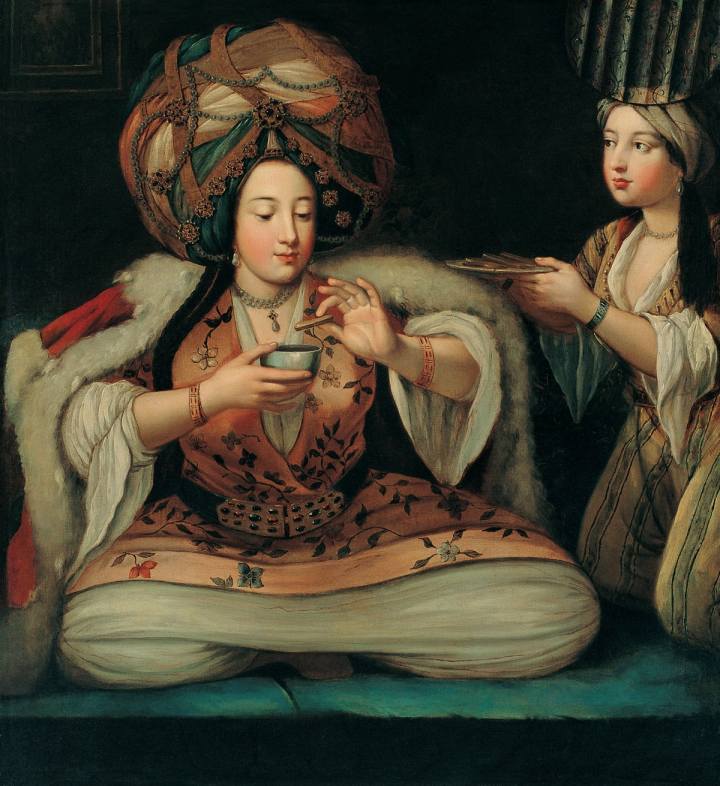
Unknown painter (French School), Enjoying Coffee, Turkey, first half of the 18th century (Istanbul: Pera Museum).
The Art of Dining brings together more than 200 works from the Middle East, Egypt, Central and South Asia, and beyond to explore connections between art and cuisine from ancient times to the present day. Paintings of elaborate feasts, sumptuous vessels for food and drink, and historical cookbooks show how culinary cultures have thrived in the Islamic world for centuries. Highlighting the relationship of these works to preparing, serving, and enjoying food, the exhibition engages multiple senses and invites us to appreciate the pleasures of sharing a meal.
Originally organized by the Los Angeles County Museum of Art (LACMA), the exhibition includes works from 30 public and private collections from across the U.S., Europe, and the Middle East, and 16 from the DIA’s collection.
Linda Komaroff, ed., Dining with the Sultan: The Fine Art of Feasting (DelMonico Books, 2023), 375 pages, ISBN: 978-1636810881, $85.
Conference | Travel Narratives and the Artistic Heritage of Dalmatia
From ArtHist.net:
Travel Narratives and the Fashioning of a Dalmatian Artistic Heritage, ca. 1675–1941
The Institute of Art History – Cvito Fisković Centre, Split, 12–14 December 2024
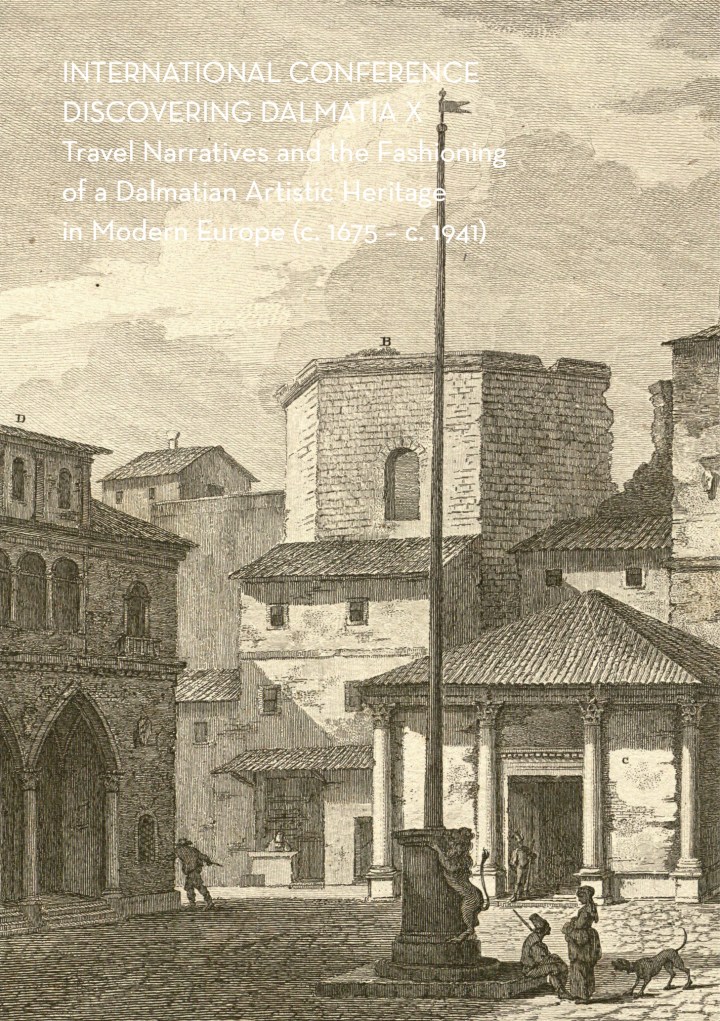 Conceived and organised as part of the Croatian Science Foundation (HRZZ) project TraveloguesDalmatia of the Institute of Art History, led by Dr Ana Šverko.
This conference brings together historians and theorists of art, architecture, urbanism, literature, anthropology, and ethnology, and other experts engaged in travel narratives. It aims to explore travel as an autonomous multidisciplinary and multimedia practice, as well as to investigate how perceptions of Dalmatia in the European imagination have been shaped through various travel narratives. These narratives span diverse genres, recording media, authorial backgrounds, and travel motivations.
t h u r s d a y , 1 2 d e c e m b e r
9.30 Introductions
• Vesna Bulić Baketić (Split City Museum)
• Ivana Vladović (Tourist Board of Split-Dalmatia County)
• Ana Šverko (Institute of Art History – Cvito Fisković Centre Split)
Conference Opening
• Renata Schellenberg: Living the Journey Twice: Travel Writing as Genre
10.30 Session 1 | Changing Perceptions of Dalmatia in Travel Narratives, 17th to the 20th Century
Moderators: Joško Belamarić and Sanja Žaja Vrbica
• Jesse Howell — Disorientation, Friction, and Anxiety in Dalmatian Travel Narratives
• Ulrike Tischler-Hofer — ‘Dalmatia Is His Majesty’s Passive Province… and Will Remain So for at Least Another 20 Years’ (1803): Mutual Perception and Rejection in Times of Transition, 1797–1815
• Mateo Bratanić — Early 20th-Century British Travel Writers in Dalmatia: The Change of Perspective
11.30 Coffee Break
12.00 Session 2 | The Evolution of Travelogues in the 18th and 19th Centuries, Part 1
Moderators: Ana Šverko and Irena Kraševac
• John Pinto — Advent’rous in the Sacred Search of Ancient Arts
• Frances Sands — Travels of the Mind: Travel Literature at Sir John Soane’s Museum
• Nataša Urošević — Dalmatian Journeys: Discovering Dalmatia on the Route of the Lloyd’s Steamers
13.30 Lunch Break
17.30 Presentation of the TraveloguesDalmatia Project
18.30 Journal Promotion — Život umjetnosti (Life of Art), Volume 113, No. 2 (2023)
f r i d a y , 1 3 d e c e m b e r
9.00 Walking Tour: Diocletian’s Palace
10.45 Introduction
11.00 Session 3 | The Evolution of Travelogues in the 18th and 19th Centuries, Part 2
Moderators: Mateo Bratanić and Mirko Sardelić
• Renata Schellenberg — Travel Reading and Travel Writing: Johann Georg Kohl’s Journey through Dalmatia (1851)
• Irena Kraševac — Arthur Rössler and Bruno Reiffenstein Discover Dalmatia on Their 1905 Journey
• Maciej Czerwiński — Competing Travel Narratives on Dalmatia: Giuseppe Modrich and Izidor Kršnjavi
12.20 Coffee Break
12.40 Session 4 | Travel Drawings: Shaping the Genre’s Definition, Part 1
Moderators: Frances Sands and Marko Špikić
• Ana Šverko — Before Spalatro: Clérisseau and Adam’s 1757 Journey from Rome to Split
• Svein Mønnesland — European Landscape Painters Discover a ‘Norwegian Fjord’, the Gulf of Kotor, 1810–1875
• Joško Belamarić — Sir John Gardner Wilkinson’s Gaze on Diocletian’s Palace
13.40 Coffee Break
14.00 Session 5 | Travel Drawings: Shaping the Genre’s Definition, Part 2
Moderators: Joško Belamarić and Ana Šverko
• Sanja Žaja Vrbica — Viennese Women Painters in the South of the Monarchy
• Elke Katharina Wittich — ‘Blue Sea and Black Mountains’: Visual Topoi in Travelogues and Guidebooks from the Mid-19th Century to the End of the First World War
• Nataša Ivanović — Genius Loci of Dalmatia in Zoran Mušič’s Oeuvre
15.30 Lunch Break
16.30 Visit to the Gallery of Fine Arts
s a t u r d a y , 1 4 d e c e m b e r
9.45 Introduction
10.00 Session 6 | Discovering Dalmatia: Identity through the Travel Narrative Lens, Part 1
Moderators: Mateo Bratanić and Elke Katharina Wittich
• Marko Špikić — Jacob Spon’s Language of Discovery of the Eastern Adriatic’s Cultural Heritage
• Frane Prpa — Maximilian de Traux and His Description of the Interior Regions of Dalmatia
• Antonia Tomić — Drniš: The Meeting Place of East and West
11.00 Coffee Break
11.20 Session 7 | Discovering Dalmatia: Identity through the Travel Narrative Lens, Part 2
Moderators: Marko Špikić and Ana Šverko
• Franciska Ćurković-Major and Boris Dundović — Professional Trip of the Society of Hungarian Engineers and Architects to Dalmatia in 1895: A Travel Account by Gyula Sándy
• Brigitta Mader — Through the Eyes of a Prehistorian: Josef Szombathy’s Photo Journeys through Dalmatia, 1898–1912
• Mirko Sardelić — Alice Lee Moqué’s Delightful Dalmatia
12.20 Discussion and Closing Remarks
13.00 Closing Reception
15.00 Visit to the Meštrović Gallery
Scientific Committee
Basile Baudez (Princeton University, Department of Art and Archaeology)
Joško Belamarić (Institute of Art History – Cvito Fisković Centre Split)
Mateo Bratanić (University of Zadar, Department of History)
Iain Gordon Brown (Honorary Fellow, National Library of Scotland)
Hrvoje Gržina (Croatian State Archives)
Katrina O’Loughlin (Brunel University London)
Cvijeta Pavlović (University of Zagreb, Faculty of Humanities and Social Sciences, Department of Comparative Literature)
Frances Sands (Sir John Soane’s Museum)
Marko Špikić (University of Zagreb, Faculty of Humanities and Social Sciences, Department of Art History)
Ana Šverko (Institute of Art History – Cvito Fisković Centre Split)
Elke Katharina Wittich (Leibniz Universität Hannover)
Organising Committee
Joško Belamarić (Institute of Art History – Cvito Fisković Centre Split)
Tomislav Bosnić (Institute of Art History – Cvito Fisković Centre Split)
Mateo Bratanić (University of Zadar, Department of History)
Ana Ćurić (Institute of Art History)
Matko Matija Marušić (Institute of Art History)
Katrina O’Loughlin (Brunel University London)
Cvijeta Pavlović (University of Zagreb, Faculty of Humanities and Social Sciences)
Ana Šverko (Institute of Art History – Cvito Fisković Centre Split)
Call for Papers | Recalling the Revolution in New England
From the Call for Papers:
Recalling the Revolution in New England
Online and in-person, Deerfield, Massachusetts, 27–28 June 2025
Proposals due by 13 January 2025
The Dublin Seminar for New England Folklife (founded in 1976) is pleased to announce the subject of its 2025 gathering, Recalling the Revolution in New England, to be held June 27–28 at Historic Deerfield. The conference keynote will be provided by Dr. Zara Anishanslin of the University of Delaware, author of the forthcoming book The Painter’s Fire: A Forgotten History of the Artists who Championed the American Revolution.
On September 11, 1765, political leaders in Boston attached a plaque to a majestic elm and named it “Liberty Tree” to honor its role in an anti-Stamp Act protest the previous month. New Englanders thus started to commemorate the events of the American Revolution even before they had any idea there would be such a revolution. Over the following centuries, people from New England shaped the national memory of that era through schoolbooks, popular poetry, civic celebrations, monuments, and more. On the 250th anniversary of the outbreak of the Revolutionary War in 1775, the Dublin Seminar for New England Folklife welcomes proposals for papers and presentations that address the broad range of ways the people of New England have looked back on the nation’s founding—and what they forgot, or chose to forget, in the process.
The annual Dublin Seminar is a meeting place where scholars of all kinds—academics, students, museum and library professionals, artisans and craftspeople, educators, preservationists, and committed avocational researchers—join in deep conversation around a focused theme in New England history, pooling their knowledge and exchanging ideas, sources, and methods in a thought-provoking forum. The 2025 seminar invites proposals for papers and presentations that illuminate how the peoples of the region have commemorated, memorialized, documented, invoked, fictionalized, and even forgotten the American Revolution through the Bicentennial period. Papers should examine events and trends in New England and adjoining regions.
The seminar encourages papers grounded in interdisciplinary approaches and original research, particularly material and visual culture, manuscripts, government and business records, the public press, oral histories, and public history practice or advocacy. Papers addressing such contemporary themes as gender dynamics, racial dimensions, and environmental aspects of Revolutionary commemoration are strongly encouraged.
Topics might include
• Efforts to recover the stories of marginalized participants in the American Revolution
• The processes of local commemoration in orations, pageants, reenactments, and more
• Recreating and depicting the American Revolution in popular fiction, theater, prints, and toys
• The collecting and preservation of Revolutionary-era artifacts and material culture
• Activating, maintaining, and interpreting historic sites, battlefields, monuments, homes, and other spaces
• The formation and activities of historical societies and heritage organizations
• Contesting the memory and meaning of the American Revolution
The seminar will convene in Deerfield, Massachusetts on June 27–28. This will be a hybrid program with both on-site and virtual registration options for attendees. The program will consist of a keynote address and approximately fifteen 20-minute presentations. Speakers will present on site at Historic Deerfield. Speakers will be expected to submit the text of their presentation at least a week before the conference. To submit a proposal, please send (as a single email attachment, in MS Word or as a PDF file, labeled LASTNAME.DubSem2025) a one-page prospectus describing the paper and the archival, material, or visual sources on which it is grounded, followed by a one-page vita or biography. Please send proposals to dublinseminar@historic-deerfield.org before noon (EST) on Monday, 13 January 2025.
Dublin Seminar presenters are expected to submit their papers (approximately 7000 words) for consideration to the Annual Proceedings of the Dublin Seminar by 14 October 2025. The scholarship proposed for presentation should be unpublished and available for inclusion in this volume to be published about eighteen months after the conference.
New Book | Goethe, His Faustian Life
From Bloomsbury:
A. N. Wilson, Goethe, His Faustian Life: The Extraordinary Story of Modern Germany, a Troubled Genius, and the Poem that Made Our World (London: Bloomsbury Continuum, 2024), 416 pages, ISBN: 978-1472994868, $35.
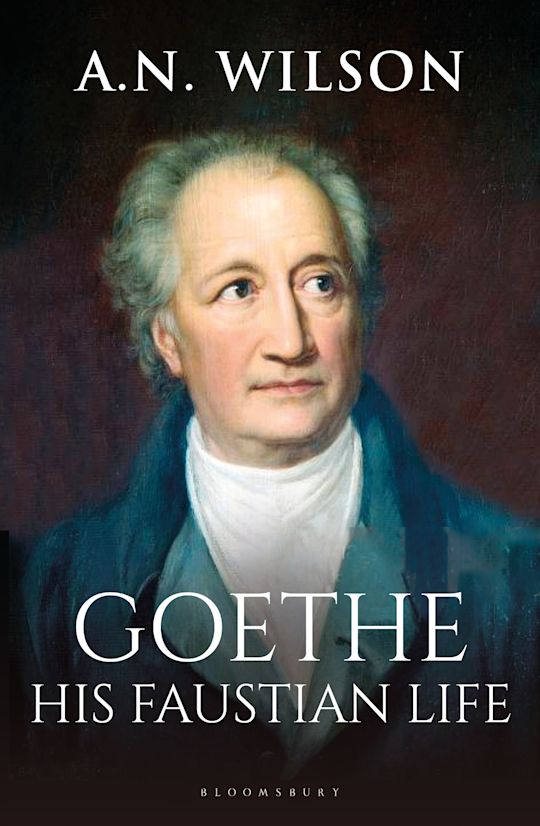 Goethe was the inventor of the psychological novel, a pioneer scientist, great man of the theatre, and a leading politician. As A. N. Wilson argues in this groundbreaking biography, it was his genius and insatiable curiosity that helped catapult the Western world into the modern era. Wilson tackles the life of Goethe with characteristic wit and verve. From his youth as a wild literary prodigy to his later years as Germany’s most respected elder statesman, Wilson hones in on Goethe’s undying obsession with the work he would spend his entire life writing—Faust. Goethe spent over 60 years writing his retelling of Faust, a strange and powerful work that absorbed all the philosophical questions of his time as well as the revolutions and empires that came and went. It is his greatest work, but as Wilson explores, it is also something much more—it is the myth of how we came to be modern.
A. N. Wilson is a Fellow of the Royal Society of Literature and holds a prominent position in the world of literature and journalism. He is a prolific and award-winning biographer and celebrated novelist, having written biographies of Tolstoy, C. S. Lewis, Milton, and Hilarire Belloc. In 2007, Wilson’s novel, Winnie and Wolf, was longlisted for the Man Booker Prize, and in 2020 The Mystery of Charles Dickens was published to great critical acclaim. He lives in North London.
New Book | A Life of Leibniz in Seven Pivotal Days
From Norton, a translation of the original German, Die beste aller möglichen Welten: Gottfried Wilhelm Leibniz in seiner Zeit, which appeared in 2022:
Michael Kempe, The Best of All Possible Worlds: A Life of Leibniz in Seven Pivotal Days, translated by Marshall Yarbrough (New York: Norton & Co., 2024), 304 pages, ISBN: 978-1324093947, $32.
 A biography of the polymath Gottfried Wilhelm Leibniz told through seven critical days spanning his life and revealing his contributions to our modern world.
Gottfried Wilhelm Leibniz (1646–1716) was the Benjamin Franklin of Europe, a ‘universal genius’ who ranged across many fields and made breakthroughs in most of them. Leibniz invented calculus (independently from Isaac Newton), conceptualized the modern computer, and developed the famous thesis that the existing world is the best that God could have created.
In The Best of All Possible Worlds, historian and Leibniz expert Michael Kempe takes us on a journey into the mind and inventions of a man whose contributions are perhaps without parallel in human history. Structured around seven crucial days in Leibniz’s life, Kempe’s account allows us to observe him in the act of thinking and creating, and gives us a deeper understanding of his broad-reaching intellectual endeavors. On 29 October 1675, we find him in Paris, diligently working from his bed amid a sea of notes, and committing the integral symbol—the basis of his calculus—to paper. On 17 April 1703, Leibniz is in Berlin, writing a letter reporting that a Jesuit priest living in China has discovered how to use Leibniz’s binary number system to decipher an ancient Chinese system of writing. One day in August 1714, Leibniz enjoys a Viennese coffee while drawing new connections among ontology and biology and mathematics. The Best of All Possible Worlds transports us to an age defined by rational optimism and a belief in progress, and will endure as one of the few authoritative accounts of Leibniz’s life available in English.
Michael Kempe is the director of the Leibniz Research Center and the Leibniz-Archiv in Hannover and teaches early modern history at the University of Konstanz.
Marshall Yarbrough is a writer, musician, and German-to-English translator. He lives in Brooklyn, New York.
New Book | John Locke’s Impact on Literature and Pictorial Art
From Krysman Press:
Joachim Möller and Bernd Krysmanski, eds., Creative Reception: John Locke’s Impact on Literature and Pictorial Art (Dinslaken: Krysman Press, 2024), 384 pages, ISBN: 978-3000555626, €30.
 The authors of this volume—all of them recognized representatives of a wide range of academic disciplines—agree that Locke’s work must have had a considerable influence both on English and German literature and the visual arts of Great Britain, especially in the eighteenth and nineteenth centuries. From the perspective of interdisciplinarity and intertextuality, the essays presented here deal with Locke as a source of ideas for Archibald Alison, John Constable, Daniel Defoe, Henry Fielding, Oliver Goldsmith, Johann Timotheus Hermes, William Hogarth, Immanuel Kant, Martin Knutzen, Gottfried Wilhelm von Leibniz, Gotthold Ephraim Lessing, George Lillo, Edward Moore, Johann Gottwerth Müller, Joshua Reynolds, Samuel Richardson, John Ruskin, Joseph Spence, Laurence Sterne, J. M. W. Turner, and Thomas Whately, among others.
Call for Papers | Emotions, Senses, and 18th-C. Art
From ArtHist.net:
The Emotions and the Senses in Eighteenth-Century Visual Art and Culture
Hogarth’s House, Chiswick (London), 6 June 2025
Proposals due by 31 January 2025
We invite scholars at all stages to submit papers for our upcoming conference, Senses and Feelings: Exploring Eighteenth-Century Visual Art, to be held on Friday, 6 June 2025 at Hogarth’s House in Chiswick.
Recent research has highlighted the nuanced understanding of emotional expression through its historical and contextual relevance. The eighteenth century has been identified by historical scholar such as Retford, Dixon, and Boddice as a critical era of change within emotional landscapes. Art theorists, importantly, have identified the nuanced role art plays in symbolising in an historical era and arousing emotions in its viewers.
We invite papers for an academic conference to mark the opening of a special exhibition on the Senses and Feelings in the Art of Hogarth. We encourage submissions that engage with these contemporary perspectives. Therefore, we welcome papers that explore topics including, but not limited to:
• The representation of emotions in painting and printmaking
• The representation of sensory practices and experience in visual culture
• The role of sensory perception in shaping artistic practices
• The intersection between the senses and the emotions in visual culture and artistic practice and expression
• Interdisciplinary approaches connecting art history and sensory studies
• The influence of societal and cultural shifts on artistic expressions of feeling or sensory experience
• The interplay between visual arts and culture and the ways social space, communities, and practices are defined or ordered by sensory or emotional practices
• The interpretation of sensory and emotional experience through visual culture in contemporary public or heritage settings
Please submit a 300-word abstract and a brief bio by 31 January 2025 to angela.platt@stmarys.ac.uk and stewart.mccain@stmarys.ac.uk. Selected papers will be presented at the conference, fostering rich discussions on how the visual arts of this pivotal era resonate with contemporary understandings of emotion and sensory experience.
Online Talk | Vanessa Sigalas on Meissen Figures
As noted at Events in the Field:
Vanessa Sigalas | All Walks of Life: Meissen Porcelain Figures of the 18th Century
Online, Connecticut Ceramics Circle, 9 December 2024, 2pm (EST)
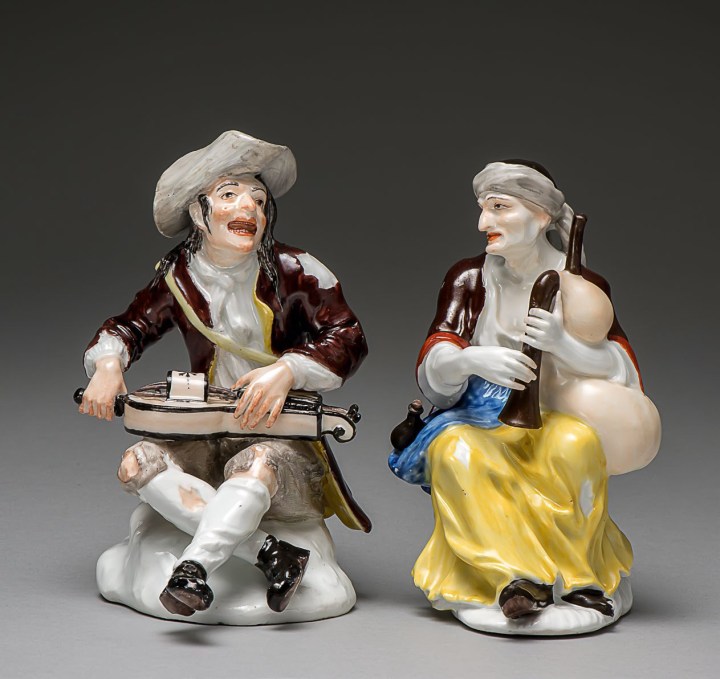
Pair of Figures of Beggar Musicians, German, Meissen Porcelain Manufactory, models by Johann Joachim Kaendler (1706–1775). Original year of modelling: ca. 1736; beggar-woman reworked later. Date of porcelain paste: both ca. 1730–65; date of decoration: both 18th century. Hard-paste porcelain. Man: Blue crossed swords mark on base; woman: no marks. Heights: man 13.4 cm; woman 13 cm. Model no. man: 918; woman: 915. Shimmerman Collection nos. MPBP_16 & 17.
Dr. Vanessa Sigalas will guide the audience through a captivating exploration of 18th-century life in Saxony, Paris, London, and St. Petersburg, using Meissen porcelain sculptures from the Alan Shimmerman Collection in Toronto, Canada, as well as the Wadsworth Atheneum’s collection in Hartford, Connecticut. Renowned master modeler Johann Joachim Kaendler, in collaboration with his fellow modelers at Meissen, portrayed glimpses of daily existence, meticulously capturing even the minutest details. From the carefully arranged trinkets of a street vendor to the intimate script of a love letter and the culinary tools of a cook preparing a hare, Kaendler’s work unveils the richness of ‘All Walks of Life’.
The Alan Shimmerman Collection, with its emphasis on groups of criers (street sellers) and artisans, offers a fresh perspective on the inception, production, and dissemination of Meissen porcelain. Dr. Sigalas’s lecture is based on her recently published collection catalogue bearing the same title, providing an immersive journey into the intricate world of 18th-century European society as depicted through these masterfully crafted sculptures.
Vanessa Sigalas holds a Dr. phil. in Art History from the Eberhard-Karls-Universität Tübingen, Germany. She joined the Wadsworth Atheneum in 2011, As an art historian, Sigalas specializes in European art from the 17th to the first half of the 20th centuries, especially 18th- and 19th-century German porcelain. One of her research interests is the connection between ivory and porcelain, particularly at the Dresden Court of Augustus the Strong (1670–1733). At the Wadsworth, she works with American and European decorative arts and sculpture from the ancient to the modern worlds, but also explores the collections of non-Western art. Despite her deep love for books and archives, Sigalas has always enjoyed the hands-on work with objects. In 2013, she assisted with the Storage Renovation and Relocation Project, and in 2015 she was part of the team to reinstall the European art collections, where she assisted the curatorial team and led the installation team of decorative arts.
She has published in a variety of journals, exhibition catalogues, and books. Her latest book, All Walks of Life: A Journey with the Alan Shimmerman Collection (2022), focuses on Meissen porcelain figures from the 18th century. She has taken on the role of editor for several publications, with her most recent work being Morgan—The Collector: Essays in Honor of Linda Roth’s 40th Anniversary at the Wadsworth Atheneum Museum of Art, co-edited with Jennifer Tonkovich. Additionally, she served as the managing editor of the American Ceramic Circle Journal from 2015 to 2023. Sigalas has curated exhibitions in Germany and the US. Her most recent exhibitions at the Wadsworth include, in conjunction with director Matthew Hargraves, Between Life & Death: Art and the Afterlife (Fall 2023), as well as the community-focused and staff-curated exhibition, Styling Identities: Hair’s Tangled Histories, which was on view until August 2024.
The Burlington Magazine, November 2024
The long 18th century in the November issue of The Burlington:
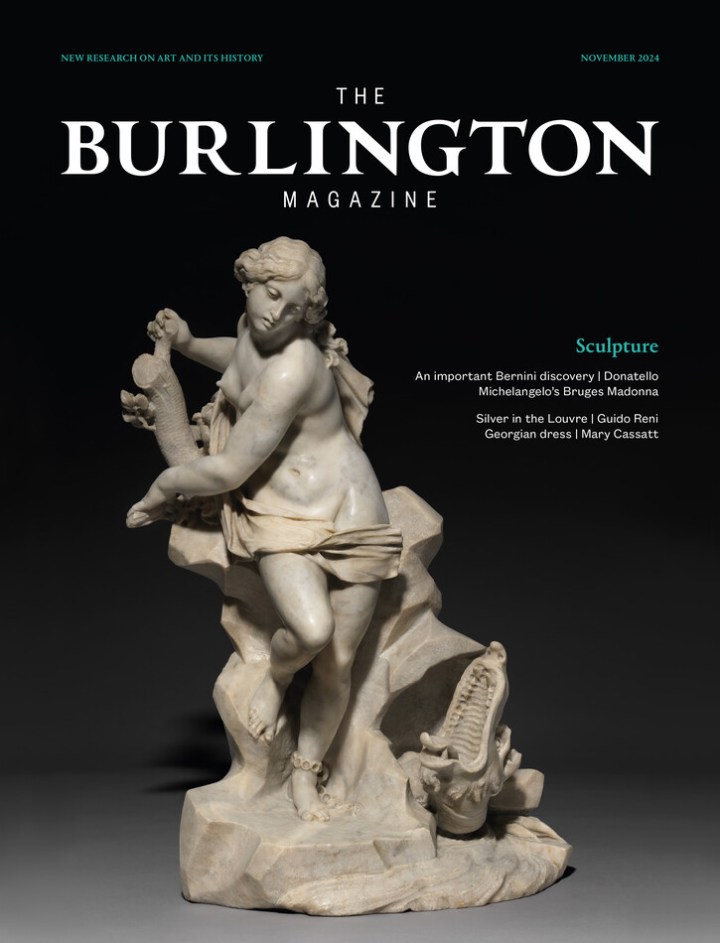
The Burlington Magazine 166 (November 2024)
e d i t o r i a l
 “The Life Cycle of Art History,” p. 1099.
Art history is withering. Art history is flourishing. Which of these statements is true? Very mixed impressions can be gathered from across the United Kingdom, where the future health and reach of the academic discipline is far from clear. Amid all this uncertainty, however, there are some inspiring developments that should be applauded.
a r t i c l e s
• Maichol Clemente, “‘Une pièce fort singulière’: The Rediscovery of Gian Lorenzo Bernini’s Andromeda and the Sea Monster,” pp. 1100–22.
An important early sculpture by Gian Lorenzo Bernini, Andromeda and the Sea Monster, is here attributed to him and published for the first time. It displays all the finesse and invention that characterises the work of his youth and is also notable for having been offered to Jean-Baptiste Colbert, First Minister of Louis XIV, before forming part of the collection of the Prince of Soubise [in the eighteenth century.]
r e v i e w s
• William Barcham, Review of the exhibition catalogue, Les Tiepolo: Invention et Virtuosité à Venise, edited by Hélène Gasnault with Giulia Longo and a contribution by Catherine Loisel (Beaux-Arts de Paris, 2024), pp. 1176–78.
• Erin Griffey, Review of the exhibition catalogue, Style & Society: Dressing the Georgians, by Anna Reynolds (Royal Collection Trust, 2023), pp. 1178–80.
• Philippa Glanville, Review of the catalogue of the Louvre’s silverware, Orfèvrerie de la Renaissance et des temps modernes: XVIe, XVIIe et XVIIIe siècles: La Collection du Musée du Louvre, by Michèle Bimbenet-Privat, Florian Doux, and Catherine Gougeon, with Philippe Palasi, 3 volumes (Éditions Faton, 2022), pp. 1186–87.
• Giulio Dalvit, Review of the catalogue, Galleria Borghese: Catalogo Generale I: Scultura Moderna, edited by Anna Coliva with Vittoria Brunetti (Officina Libraria, 2022), pp. 1192–93.
• Gauvin Alexander Bailey, Collective Creativity and Artistic Agency in Colonial Latin America, edited by Maya Stanfield-Mazzi and Margarita Vargas-Betancourt (University of Florida Press, 2023), pp. 1193–94.
• Charles Avery, Review of Die Bronzen des Massimiliano Soldani Benzi (1656–1740): Representationsstrategien des europäischen Adels um 1700, by Carina Weißmann (De Gruyter, 2022), p. 1195.
• Pierre Rosenberg, Review of the catalogue, French Paintings 1500–1900: National Galleries of Scotland, by Michael Clarke and Frances Fowle, 2 volumes (National Galleries of Scotland, 2023), pp. 1196–97.
Exhibition | The Art of French Wallpaper Design

Installation view of the exhibition The Art of French Wallpaper Design at the RISD Museum, November 2024.
◊ ◊ ◊ ◊ ◊
The exhibition is accompanied by an online publication:
The Art of French Wallpaper Design
RISD Museum, Providence, 16 November 2024 — 11 May 2025
The Art of French Wallpaper Design explores the vibrant, surprising designs that adorned walls in the 1700s and 1800s. Featuring more than 100 rare samples of salvaged wallpapers, borders, fragments, and design drawings, this exhibition reveals the creative process and showcases the extraordinary technical skills involved in producing these works, presenting an invaluable resource for artists and enthusiasts alike. This exhibition celebrates the vision and generosity of collectors Charles and Frances Wilson Huard, whose remarkable collection, assembled in the 1920s and ’30s, is now in the care of the RISD Museum. Accompanied by a comprehensive digital publication, The Art of French Wallpaper Design invites you to explore the remarkable innovation and craftsmanship of these historic pieces.
◊ ◊ ◊ ◊ ◊
Lyra Smith, ed., with contributions by Emily Banas, Brianna Turner, and Andrew Raftery, The Art of French Wallpaper Design (Providence: Rhode Island School of Design Museum, 2024), available online»
The vibrant designs of French papier peint (literally meaning painted paper) that adorned walls in the 1700s and 1800s were collected and donated to the museum by French artist Charles Huard and his wife, American writer Frances Wilson Huard. The Huard Collection is a rare resource due to the fragile and ephemeral nature of wallpapers. This free online publication explains the preservation methods used to take care of the wallpapers along with components made in the process, such as design drawings and woodblocks. The attentive care taken to preserve the materials made during each phase of the design process make the Huard Collection an ideal teaching collection.
Essays
• Introduction to French Wallpaper — Emily Banas
• About the Huard Collection — Emily Banas
• Conservation and the Huard Collection: Preserving the Processes of Making — Brianna Turner
• Printing Matters: Wallpaper in the Context of Printmaking — Andrew Raftery
The Collection
The RISD Museum contains one of the most significant collections of French 18th- and 19th-century wallpapers in the United States with approximately 500 wallpaper panels, borders, fragments, and design drawings. Here, you can browse the wallpapers by their collections, colors, motifs, or time periods.
The Making of Wallpaper
This video provides a guided, in-depth look at seven different wallpapers in the Huard Collection. Watch, listen, and learn about the hidden stories these wallpapers can tell us about their design, making, and use.










 Enfilade
leave a comment