New Book | Walking Rome’s Waters
From Yale UP:
Katherine Wentworth Rinne, Walking Rome’s Waters (New Haven: Yale University Press, 2025), 344 pages, ISBN: 978-0300276374, $35.
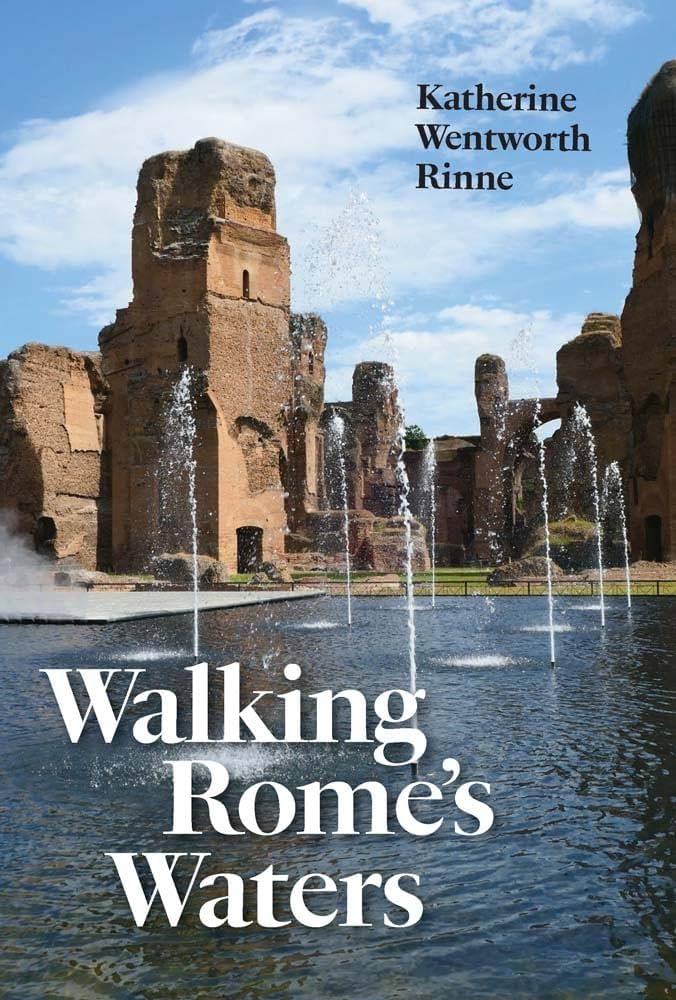 An engaging guide to the waterways of Rome and their role in shaping the city’s culture, history, and landscape
Written by a leading expert on the water infrastructure of Rome, this grand tour offers a new way to appreciate the history, geology, and character of the ancient and contemporary city. Richly illustrated itineraries wind through Rome’s streets, piazzas, and gardens, following the trail of water as it flows, propelled by gravity, through different neighborhoods. In addition to mapping thirteen walking tours, Katherine Wentworth Rinne also pulls the reader underground—where hidden springs and streams still flow—to illuminate how Rome’s complex topography has been transformed since antiquity, as well as into the sky, imaginatively flying over Rome’s villas and parks to give readers a sense of the infrastructure through an aerial view. Whether enjoyed from an armchair at home or as a companion on strolls next to aqueducts, fountains, and the Tiber River, this guidebook, filled with the author’s unique insights, brings the vibrant world of Rome’s water to life, with its eddies and whorls twisting throughout the city’s storied history.
Katherine Wentworth Rinne is a visiting scholar in the Center for Cultural Landscapes in the School of Architecture and an associate fellow at the Institute for Advanced Technology in the Humanities at the University of Virginia.
New Book | Casting a New Light

From the Museum of Fine Arts, Budapest and distributed by Unicorn Publishing:
Mirian Szőcs and Márton Tóth, eds., Casting a New Light: Plaster Casts & Cast Collections in Europe and Beyond (Budapest: Museum of Fine Arts, 2025), 178 pages, ISBN: 978-6156595232, $35.
This volume publishes the papers of the international conference Plaster Casts & Cast Collections across Europe: History and Future, held in the Museum of Fine Arts, Budapest on 24 May 2022. The conference was organised in celebration of the refurbishment of the plaster cast collection of the Museum of Fine Arts, Budapest and its exhibition in the Star Fortress in Komárom (opened in the autumn of 2021) and in the visible storage in the newly built National Museum Conservation and Storage Centre in Budapest (installed in 2022). Featuring a collection of papers, including several case studies, the volume delves into various aspects of collecting and showcasing plaster casts, an important phenomenon that shaped European and American art museums from the nineteenth century onwards. It explores international connections and influences in the establishment of cast collections while also shedding new light on the role and uses of plaster casts in the antiquity and in the era of historicism. Moreover, the volume offers valuable reflections on the intricate contexts of the contemporary reception of these collections, presenting new perspectives on their significance and future.
Miriam Szőcs is head of the Department of Sculptures at the Museum of Fine Arts, Budapest. She specializes in Renaissance and baroque bronzes. She was the curator of the new permanent exhibition of sculptures at the Museum of Fine Arts that opened in 2013. Between 2013 and 2021, she worked on the project of the refurbishment of the plaster cast collection of the Museum of Fine Arts, being the chief curator of the plaster cast exhibition at the Star Fortress in Komárom.
c o n t e n t s
• Eckart Marchand, “‘The best laid schemes’ …: The Politics of the Universal Museum and the Vicissitudes of their Plaster Cast Collections at the Turn of the Twentieth Century”
• Miriam Szőcs, “The Colleoni Monument and the Medici Tombs: Monumental Renaissance Casts in the Museum of Fine Arts in Budapest”
• Flavia Berizzi, “From Northern Italy to Hungary: Medieval and Renaissance Monumental Casts from the Museo Campi Carlo in Milan to the Museum of Fine Arts in Budapest”
• Jean-Marc Hofman, “Generation and Regeneration of the Cast Collections of the Musée de Sculpture Comparée, Paris”
• Géza Andó and Eszter Süvegh, “The Ways of the Casts: Plaster Casts of Antiquities in Budapest and Kolozsvár (today Cluj-Napoca, Romania)”
• Eszter Hajós-Baku and Beáta Szűts, “A Brief History of the Plaster Cast Collection of the Department of Graphics, Form, and Design at the Budapest University of Technology and Economics”
• Júlia Katona, “Nineteenth-Century Constructions and Monument Reconstruction in Hungary in the Context of Educational Plaster Cast Collections: A Case Study with Special Focus on the Romanesque Hall of the Museum of Fine Arts, Budapest”
• Rune Frederiksen, “The Role of Ancient Plaster Casts in Ancient Art: The Written Evidence”
• Lorenz Winkler-Horaček, “Appreciation and Rejection: Plaster Casts in the Discourse of Copy and Original, with an Excursus on the Sleeping Ariadne in the Berlin Cast Collection”
• Marjorie (Holly) Trusted, “The Making and Meaning of Plaster Casts in the Nineteenth Century: Their Future in the Twenty-First Century”










 Enfilade
leave a comment