Call for Papers | Sacred Ceramics
From the Call for Papers:
Sacred Ceramics: Devotional Images in European Porcelain
Victoria & Albert Museum, London, 30 September 2025
Organized by Matthew Martin and Rebecca Klarner
Proposals due by 30 April 2025
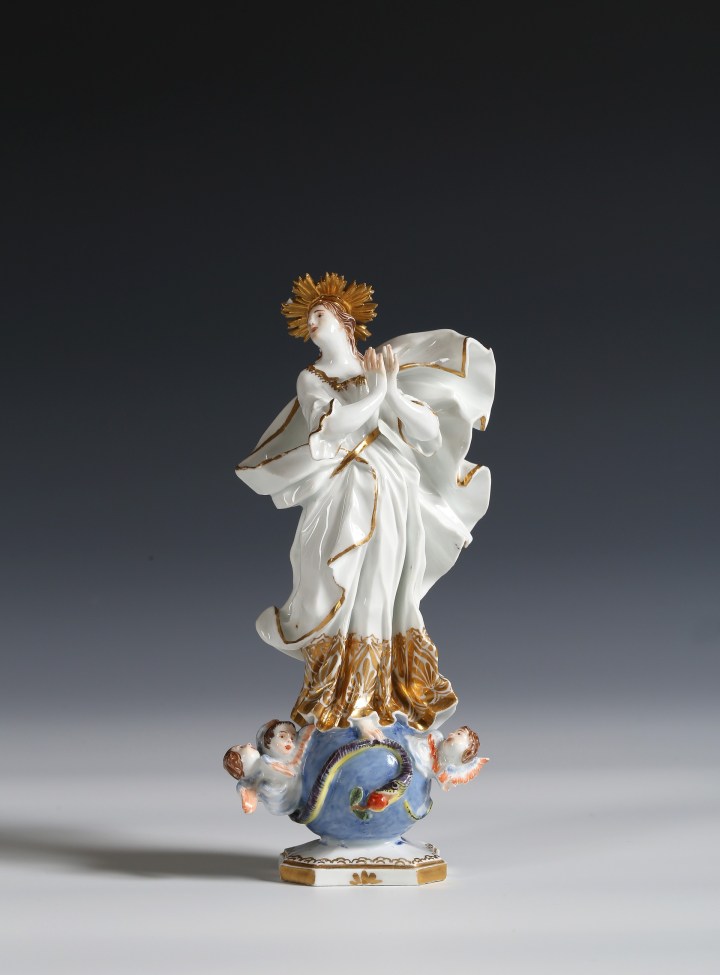
Meissen Figure of the Virgin Immaculata, probably modelled by Johann Gottlieb Kirchner, ca.1730–33 (Courtesy of E & H Manners, London).
The extensive sculptural output of Europe’s first kaolinic porcelain factory, the Saxon Meissen manufactory, has long attracted the attention of art historians. The large-scale animal sculptures executed so early in the factory’s history for the Japanese Palace, impress both for their technical ambition, and as evidence of the genius of Johann Joachim Kändler in capturing the liveliness of his animal subjects. But there is a significant area of Meissen’s sculptural output that has not to date received sustained attention: the sculptures on religious subjects produced during the reigns of Augustus II and Augustus III. Works such as Kändler’s Death of St Francis Xavier of c.1738–40 and the large Crucifixion group of 1743, represent some of the most complex sculptural works ever produced at Meissen. Yet these, and related works, have only relatively recently begun to be studied in detail (Antonin 2010; Leps 2020).
Despite this relative neglect, it is clear that Meissen’s religious sculptures played an important role in the projection of power at the Saxon Polish court. In part this was political: the conversion of Augustus II and Augustus III to Catholicism was necessary for them to be eligible for election to the crown of Poland. The marriage of Augustus III to the Catholic Maria Josepha of Austria also suggests much loftier political ambitions on the part of the Wettin electors, with the imperial crown clearly a potential prize. Signalling the Saxon court’s Catholicism was a vital political exercise and Meissen’s religious sculpture played a central role in this project (Cassidy-Geiger 2007).
But there are indications that a more complex cultural phenomenon lay behind the creation of porcelain devotional images. The pioneering work of Baxandall on limewood sculpture of the Renaissance has drawn attention to the deep significance that medium can hold in the conception and creation of devotional sculpture (Baxandall 1980). We suggest that a similar phenomenon may have been at play in the creation of porcelain religious images. The 1712 letter penned by the Jesuit Father François Xavier d’Entrecolles not only conveyed to Europe first-hand knowledge of Chinese porcelain production at Jingdezhen, it also construed access to this knowledge as a triumph of the Jesuit global mission—the successes of the Jesuits in China made the secret of kaolinic porcelain available to the Catholic princes of Europe. Porcelain’s alchemical heritage was also not without significance: success at the alchemical enterprise had always been deemed a donum dei (Principe 2013). Only with God’s blessing could the experimentalist succeed. These factors could lead to porcelain assuming a sacral character in Catholic court contexts. Devotional images in European porcelain exploited these cultural associations of the medium itself.
Of course, Meissen was not the only European porcelain factory to produce sculpture that employed counter-reformation iconography. The Doccia factory of Count Ginori—himself a natural philosophical experimentalist—was responsible for outstanding religious sculptures in a Florentine Late Baroque manner (Biancalana 2009), while Catholic court manufactories across the Holy Roman Empire—Vienna, Höchst, Fulda, Nymphenburg—produced devotional images in porcelain. Even factories in mid-eighteenth-century England—Chelsea and Derby—produced sculptures employing Catholic devotional imagery (Martin 2013). In each instance, cultural-political motives for the creation of these images can be reconstructed.
This one-day conference aims to investigate this neglected area of eighteenth-century European porcelain production. Topics for 20-minute papers to be presented at the V&A South Kensington on 30 September 2025 might include, but are not limited to:
• Who were the artists and patrons involved in these sculptures’ creation?
• What sources informed their production?
• How did these sculptures function in private and public contexts?
• What significance lay in the use of porcelain, or other ceramic mediums, to create devotional images?
To submit a paper proposal, please send an abstract of 200 words and a biography of up to 100 words to the convenors Dr Matthew Martin, University of Melbourne (mmartin1@unimelb.edu.au), and Rebecca Klarner, University of Leeds (fhrlmk@leeds.ac.uk), by 30 April 2025. Speakers will be informed of whether their proposals have been accepted by mid-May.
Display | Wedgwood and Darwin
From the V&A press release:
Wedgwood and Darwin
V&A Wedgwood Collection, Barlaston, Stoke-on-Trent, 24 February — June 2025
This display will explore the story of Josiah Wedgwood’s grandson Charles Darwin (1809–1882) and how the family link inspired Wedgwood ceramics creative output. Thirty-five historic objects from the collection will go on display alongside the acquisitions from Wedgwood’s new range inspired by Darwin’s Voyage of the Beagle. The display forms part of an ambitious new public events programme for 2025, marking ten years since the Wedgwood Collection was saved for the nation following a successful fundraising campaign spearheaded by Art Fund. Housed alongside the working Wedgwood factory at World of Wedgwood in Stoke-on-Trent, the collection celebrates the legacy of British potter and entrepreneur Josiah Wedgwood (1730–1795) and forms a unique record of over 260 years of British ceramic production, evolving tastes, changing fashions, and manufacturing innovation.
The press release marking the 10th anniversary of the V&A Wedgwood Collection is available here»
Conference | Guillaume Werniers and Tapestry-Making in 18th-C. France
From ArtHist.net:
Guillaume Werniers and Tapestry-Making in Eighteenth-Century France
Guillaume Werniers et la tapisserie dans le Nord de la France au XVIIIe siècle
Université de Lille, 1 April 2025
In 1700, Brussels-born Guillaume Werniers took over the tapestry factory founded a dozen years earlier in Lille by his father-in-law Jean de Melter. He took on local commissions (from the Etats de Flandres, churches, and convents) and specialized in tapestries depicting scenes of daily life in the manner of the Flemish painter David Teniers. These tapestries were known as ‘Tenières’ and were destined for wealthy international costumers. On the death of Werniers in 1738, his widow Catherine Ghuys took over the company until 1778, ensuring its prosperity for some forty years. This study day will bring together professionals and researchers specializing in the art of tapestry and its history (museum curators, restorers, academics, antique dealers, collectors, as well as enthusiasts) to present the latest advances in research on the subject. It will also show that tapestry occupied a place of choice in the most refined interiors during the early modern period, even though this art form is today little-known by students and the general public alike. The proceedings will be published in the Revue du Nord with the support of the Manufacture royale De Wit.
Comité scientifique
• Jan Blanc, Université de Lausanne
• Jérémie Cerman, Université d’Artois
• Anne Perrin Khelissa, Université de Toulouse
Comité d’organisation
• Pascal Bertrand, Université de Bordeaux-Montaigne
• Gaëtane Maës, Université de Lille, gaetane.maes@univ-lille.fr
• Soersha Dyon, Université de Lille
Administration
• Céline Delrue, IRHiS, ULille, celine.delrue@univ-lille.fr
p r o g r a m m e
9.30 Accueil
9.45 Ouverture — Charles Mériaux (Directeur de l’IRHiS, ULille), Soersha Dyon, Gaëtane Maës (IRHiS, ULille)
10.00 Introduction — Pascal-François Bertrand (UBordeaux Montaigne)
10.15 Context et Approche Historique de la Tapisserie Lilloise
Modérateur: Jérémie Cerman (CREHS, UArtois)
• Hélène Lobir (Musée de l’Hospice Comtesse) — La collection de tapisseries des musées de Lille
• Martine VanWelden (KULeuven, Belgique) — Contacts et comparaisons entre les centres de tapisserie de Lille et d’Audenarde
• Dominique Delgrange (Société française d’héraldique et de sigillographie) and Evrard Van Zuylen (Développeur de la base de données webaldic) — Lecture et identification des armoiries présentes dans plusieurs tapisseries de Werniers
12.00 Déjeuner
13.30 Peinture et Tapisserie
Modératrice: Juliette Singer (Palais des Beaux-Arts, Musée de l’Hospice Comtesse)
• Jean Vittet (Château de Fontainebleau) — Le peintre Arnould de Vuez (1644–1720) et la tapisserie
• Koen Brosens (KULeuven, Belgique) — Teniers, Teniers, Teniers. And Teniers. The European market for tapestries ‘à la manière de Teniers’ around 1700
• Pascal-François Bertrand (UBordeaux Montaigne) — Les Tenières de la manufacture De Melter et Werniers de Lille
15.15 Table Ronde: Autour des Attributions aux Ateliers de Lille et du Nord de La France
Modératrice: Florence Raymond (Musée de l’Hospice Comtesse)
• Guy Delmarcel (KULeuven, Belgique), les intervenants, le public
16.15 Conclusion — Gaëtane Maës (IRHiS, ULille)










 Enfilade
leave a comment