Online Talks | Tempus Fugit / Time Flies
I’m sorry to have missed the first half of the series; the last two talks take place in March and April. –CH
Tempus Fugit / Time Flies: Measuring, Perceiving, and Living Time in Early America
Online, Historic Deerfield, Sundays: 26 January, 23 February, 30 March, 27 April 2025

Tall Clock, detail, by Aaron Willard of Boston for Asa Stebbins of Deerfield, Massachusetts, ca. 1799 (Historic Deerfield).
Early New Englanders frequently invoked the passage of time in religious terms, but the ‘horological revolution’ of the seventeenth and eighteenth centuries produced technological developments in timepieces that complemented older cultural views of time. These developments went on to play an important role in the standardization of timekeeping, the rise of market economies, and industrialization. Sundials, mechanical clocks, and pocket watches were not only scientific marvels but also style-bearing objects that displayed refinement. Such objects provide suggestive windows into everyday life, especially when we broaden our sense of the many different objects and practices that marked the passage of time for diverse early Americans. This series features speakers who will address both the abstract and material nature of time found not only in clocks but also in other objects and processes central to life in early New England such as brewing, needlework, husbandry, farming, and cooking. Together the presentations will complicate our sense of what the passage of time meant for early New Englanders who had more than one way to ‘keep’ and ‘spend’ time. All lectures are free of charge and will be presented virtually via Zoom webinar. Registration required.
January 26, 2pm
Bob Frishman | Edward Duffield and Colonial American Clockmaking
Bob Frishman has professionally repaired nearly 8,000 timepieces and sold more than 1,700 vintage clocks and watches. In recent years, he has reduced his clock-repair activities and now devotes his time to research, writing, and lecturing. He has organized horology-related conferences at the Winterthur Museum, the Museum of Fine Arts Boston, the Henry Ford Museum, the Museum of the American Revolution, and the Horological Society of New York; he was also an organizer of the 2019 Time Made in Germany symposium in Nuremberg. Along with more than 100 articles and reviews, his recent book on the Philadelphia clockmaker Edward Duffield was published by the American Philosophical Society Press in 2024.
February 23, 2pm
Alexandra Macdonald | ‘Regard Not Time, but This Sign’: Recipes and Embodied Knowledge
Alexandra M. Macdonald is an historian of labour and the body with a particular interest in embodied knowledge and practices of making in the Atlantic world in the eighteenth century. As part of her research, she is interested in using period specific ingredients and methods to recreate historical craft and culinary recipes, for example indigo vats and preserved food. Alexandra has received a number of fellowships to support her research, including a fellowship from the New England Regional Fellowship Consortium which brought her to Deerfield. Most recently she was a Postdoctoral Fellow at Winterthur Museum, Garden & Library where she worked closely with conservation scientists to analyze a canvaswork embroidery made in Connecticut in the mid-eighteenth century. She is currently the Social Science and Humanities Research Council Postdoctoral Fellow at Brock University where she is working on a book length study of indigo in the Atlantic world.
March 30, 2pm
Sara Schechner | Marking Time during the American Revolutionary Period: Sundials and Clocks
Sara J. Schechner is the David P. Wheatland Curator of the Collection of Historical Scientific Instruments at Harvard University.
April 27, 2pm
Elizabeth Bacon Eager | Mastering Time: Slavery, Self-Sovereignty, and the 18th-C. Clockmaker
Elizabeth Bacon Eager is an assistant professor of art history at Southern Methodist University, where she teaches courses on early American art, architecture, and material culture. Exploring intersections between art, science, and technology of the eighteenth- and nineteenth-century Atlantic World, she is particularly interested in questions of materiality and process and fascinated by the reconstruction of historical tools and techniques. Her current research examines the material culture of time in early America, with a particular focus on objects and images produced by Black, Indigenous, and female makers. Dr. Eager’s work has been published in The Art Bulletin, Journal18, and Panorama: Journal of the Association of Historians of American Art.
Call for Papers | Women and the Household in the Book Trade
From the Call for Papers:
Women and the Household in the Early Modern Book Trade, 1550–1750
Antwerp, 5–7 November 2025
Proposals due by 31 March 2025
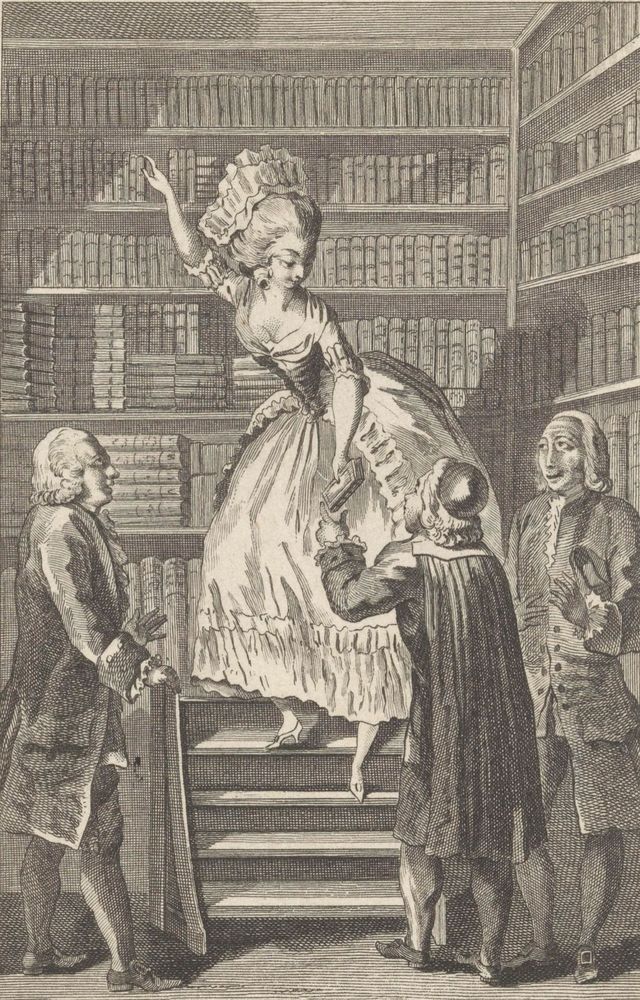
Young saleswoman in a bookstore, Paris, 1782, etching.
This two-day conference aims to share knowledge of women’s rich and varied lives and works in the period before the rapid industrialisation of book production, which changed the face of home labour for early modern women.
The growing field of feminist bibliography has been built upon a recognition that early modern books were mostly products of the interwoven sectors of domesticity and trade. Many book trade practices took place within the home, enabling the unofficial training and labour of women and children. It was only the most successful enterprises that prompted investment in bespoke buildings, prompting a public-private dialectic which was sometimes merely superficial, since many were also managed or served by female family members and domestic servants. Some women owned businesses, premises and stock; managed apprentices and shops; and held ijaza (licenses) or copyright. Many others laboured invisibly, printing and sewing volumes, engraving blocks, and making ink and paper from home.
Traditionally understood as a male-dominated domain, pioneering research of the 1990s by, for example, Helen Smith, Paula McDowell, Susan Broomhall, Mark Lehmstedt, and Leslie Howsam enabled us to reconsider the place of women in the book trade in a much more systematic way. Since then, scholars such as Sarah Werner, Saskia Limbach, Heleen Wyffels, and Rémi Jimenes have developed the field, and Kate Ozment, Cait Coker, and Michelle Levy have provided new and valuable tools for feminist bibliography in The Women in Book History Bibliography and The Women’s Print History Project. And yet, the work of recovering the history of women and their place in the book trade remains challenging and labour-intensive.
Historiography, record-keeping, and even the process of archiving have been androcentric, and the historical—and for the most part, printed—evidence that survives about women and book production predominantly concerns widows. Often, we need to look beyond the imprint and the advertisement to the material culture of book production, to the physical evidence of the codex and the personal records of journals and correspondence to identify female family members like daughters, sisters, and wives. With this turn to material cultural methodologies, the under-explored collections in museums and archives can provide a richer picture, one that is improving with new collections development practices and increased resources being allocated by heritage sites and major research libraries to women’s histories and to the recovery of marginalised figures in the History of the Book.
This conference, as a part of the FWO research project Partners in Innovation: Women Publishers as Knowledgeable Agents in the Low Countries’ Book Trade, 1550–1750, coincides with the year devoted to the many women living and working in the Officina Plantiniana in 2025 at Museum Plantin-Moretus, a UNESCO World Heritage Site, and is co-hosted with the Rubens House Museum, Antwerp. We invite participants to consider the supposed binary between home and work for women in the early modern book trade worldwide. Through this approach, we hope to share knowledge of women’s rich and varied lives and works in the period before the rapid industrialisation of book production which changed the face of home labour for early modern women. The event features a guided tour of Museum Plantin-Moretus and a show and tell of key artefacts from the collection.
We invite submissions for 20-minute papers addressing the following areas:
• Marriage and inheritance
• Networks, kinship, and patronage
• Representations of the household and women in the book trade
• Impact of women on the history of knowledge production
• Spatial and architectural perspectives
• Apprentices and apprenticing, formal and informal
• Reflections on methodologies for feminist recovery of women’s work in the book trade
• Transnational comparisons of home labour in the book trade
• Material cultural approaches to women’s book history
• Women’s work in all sectors of book production, including binding, paper making, etc.
Please send an abstract of 200 words to womenandplantin@antwerpen.be with your name, affiliation, email address, and a short bio of no more than 50 words by 31 March 2025. There will be a registration fee for presenters. Queries are welcomed.
Keynote Speakers
Susan Broomhall (Australian Catholic University) and Alicia Montoya (Radboud University)
Organising Committee
Nina Geerdink (Utrecht University), Kristof Selleslach (Museum Plantin-Moretus), Lieke van Deinsen (KU Leuven), Zanna Van Loon (Museum Plantin-Moretus), Helen Williams (Northumbria University), Patricia Stoop (University of Antwerp), and Pierre Delsaerdt (University of Antwerp)










 Enfilade
leave a comment