Exhibition | Wild Apollo’s Arrows

Josef Abel, Klopstock’s Arrival in Elysium / Klopstocks Ankunft im Elysium, 1805
(National Gallery Prague)
◊ ◊ ◊ ◊ ◊
Now on view at Vienna’s Academy of Fine Arts:
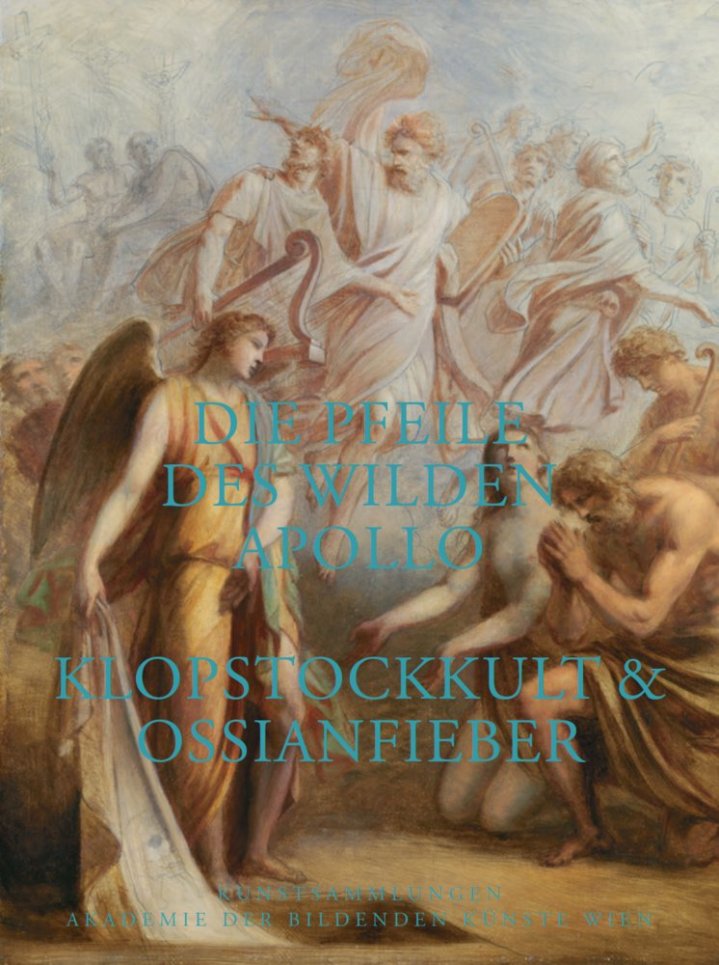
Wild Apollo’s Arrows: Klopstock Cult & Ossian Fever
Die Pfeile des wilden Apollo: Klopstockkult & Ossianfieber
Akademie der bildenden Künste Wien, 7 March — 25 May 2025
Curated by Alexander Roob
The exhibition Wild Apollo’s Arrows: Klopstock Cult & Ossian Fever presents significant artistic works that exemplify the epochal shift from the Enlightenment to the irrationalism of the Storm and Stress movement and Romanticism, exploring for the first time the immense influence of the poet Friedrich Gottlieb Klopstock (1724–1803) on the fine arts and music of his own age.
Decades before the French Revolution, the Age of Enlightenment saw a sudden outbreak of irrational sentiment, expressed in exuberant emotions, notions of spiritualistic gender switching, and a fragmented, heroic, and introspective view of art. This was the onset of an epochal shift with consequences for pictorial art: reliance on the actual appearance of things gave way to the mystical and diffuse, accompanied by a greater interest in the realm of acoustics. Nothing seems to better define this ‘acoustic turn’ than the trope of the blind prophet and lyrical poet, which functioned as a literary model for this new epoch, as seen in the figures of Homer, Ossian, and John Milton. Milton’s grand inner images were proclaimed to be the perfection of the romantic sublime, and the myth of the lost and regained paradise to which he had given literary form was associated with Mesmer’s notion of lucid dreaming. In the early 1750s, German poet Friedrich Gottlieb Klopstock positioned himself as an heir to Milton, with his pietistic epic The Messiah: A Heroic Poem, and in this he issued a challenge to the self-proclaimed English national bard William Blake.
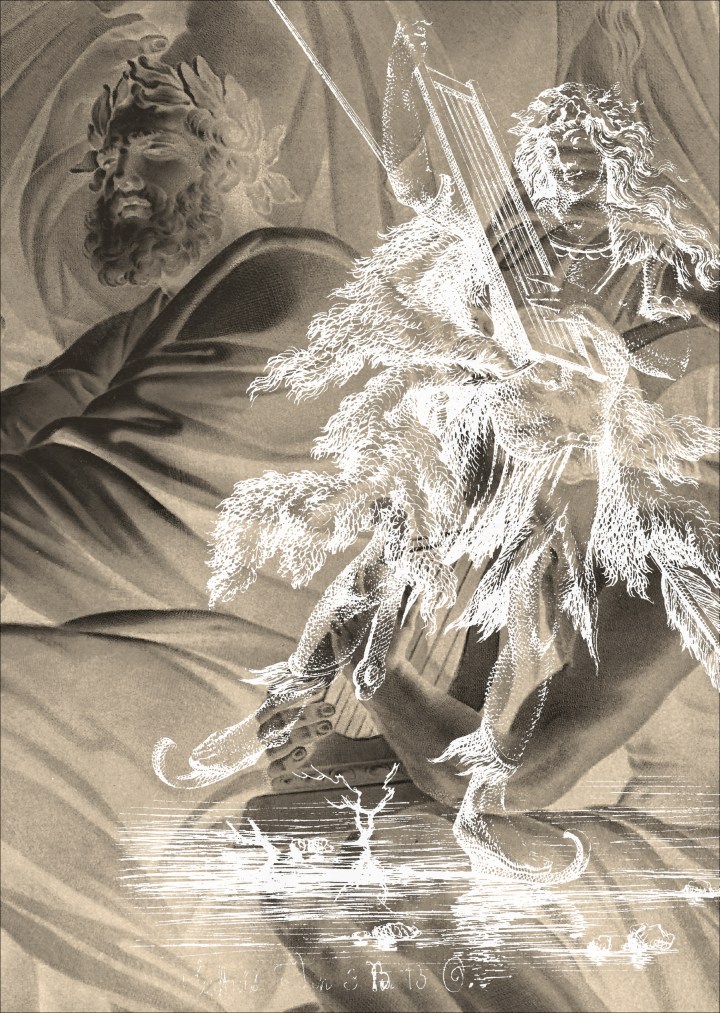
Motif combining works by Johann Peter Pichler after Heinrich Friedrich Füger, Homer Reciting, 1803 (Graphic Collection of the Academy of Fine Arts Vienna), and Carl Wilhelm Kolbe the Elder, Ice-skating Bard (‘Braga’), 1793–94 (Hamburger Kunsthalle, Kupferstichkabinett / bpk, photo by Julia Bau), design composite motif: Beton.
For cultural philosopher Johann Gottfried Herder, ‘wild Apollo’s arrows’ were the rousing sounds of an early folk movement and the Nordic dronescapes of a budding nationalist mysticism, which was all heralded in the pseudo-Celtic poem cycle Ossian. In the visions of the superstar poet Klopstock ‘wild Apollo’ appeared in a Celtic-Germanic mix, and the bard’s song and cosmic ice-dance put the world into creative turmoil. Klopstock, a keen ice-skater, who was nowhere more popular than in Austria, became a role-model for a sentimental skating trend that saw motion as a way to transcend limitations.
The exhibition presents art works that exemplify this epochal shift from the Enlightenment to the irrationalism of the Storm and Stress (Sturm und Drang) movement and Romanticism. For the first time, Klopstock‘s immense influence on the fine arts and music of his own age is explored. With interpretations of his work in art and music by Angelika Kauffmann, Heinrich Friedrich Füger, Josef Abel, and Franz Schubert, the republican poet Klopstock was surprisingly still very present in the Habsburg Empire at the time of the Napoleonic Wars. The exhibition blends works of Austrian classicism, evidence of international early romanticism, and the narcotic imagery of the Nazarenes to the accompaniment of music by Joseph Haydn, Christoph Willibald Gluck, and Franz Schubert.
Alongside works from the Paintings Gallery and numerous loans, this exhibition draws widely on works from the Academy of Fine Arts Vienna Graphic Collection. The project also integrates works by students from the Academy of Fine Arts Vienna, and it will be presented in the Exhibit Galerie and three rooms at the Paintings Gallery. A comprehensive publication with essays and illustrations will accompany the exhibition.
 With works by Josef Abel, Edmund Aigner, Johann Wilhelm Baur, Thomas Blackwell, William Blake, Filippo Caporali, Thomas Chatterton, Daniel Chodowiecki, Edward ‘Celtic’ Davies, Josef Dorffmeister, Bonaventura Emler, Heinrich Friedrich Füger, Johann Heinrich Füssli, Hendrick Goltzius, Christoph Willibald Gluck, Johann Valentin Haidt, Joseph Haydn, Anton Herzinger, William Hogarth, Bartholomäus Hübner, Anne Hunter, Archduchess Maria Clementina of Austria, Johann Evangelist Scheffer von Leonhardshoff, Friedrich John, Owen Jones, Angelika Kauffmann, John Kay, Friedrich Gottlieb Klopstock, Joseph Anton Koch, Carl Wilhelm Kolbe the Elder, Simon Petrus Klotz, Leopold Kupelwieser, Johann Caspar Lavater, Johann Friedrich Leybold, William James Linton, Johann Heinrich Lips, Johann Hieronymus Löschenkohl, Josef Löwy, James Macpherson, Charles-François-Adrien Macret, Jacob Wilhelm Mechau, Heinrich Merz, Isaac Mills, Jean-Michel Moreau, Wilhelm Müller, Friedrich Olivier, Carl Hermann Pfeiffer, Johann Peter Pichler, Albert Christoph Reindel, Johan Christian Reinhart, Ferdinand Ruscheweyh, Luigi Schiavonetti, Julius Schnorr von Carolsfeld, Ludwig Ferdinand Schnorr von Carolsfeld, Franz Schubert, Moritz von Schwind, William Bell Scott, Franz Xaver Stöber, Joseph Sutter, Johanna Dorothea Sysang, Giambattista Vico, Marianne von Watteville, Josef Wintergerst, Franz Wolf, Nikolaus Ludwig von Zinzendorf, Felice Zuliani, and others.
Works after William Blake, Asmus Jakob Carstens, Johann Nepomuk Ender, Heinrich Friedrich Füger, Bonaventura Genelli, Gerdt Hardorff, G. W. Hoffmann, William Hogarth, Angelika Kauffmann, Nicaise de Keyser, Giuseppe Longhi, Johann Friedrich Overbeck, Raffaello Santi, genannt Raffael, Bertel Thorvaldsen, Angiolo Tramontini, Richard Westall.
Contemporary works by students of the Academy such as Christian Azzouni, Ina Ebenberger, Hicran Ergen, Eginhartz Kanter, Julia Kronberger, Prima Mathawabhan, Amar Priganica, Liese Schmidt, Pia Wilma Wurzer, and Ancient Britons Team (ABK Stuttgart).
Alexander Roob, with Sabine Folie, Die Pfeile des wilden Apollo: Klopstockkult & Ossianfieber (Hamburg: Textem Verlag), 248 pages, ISBN: 978-3864853340, €32.
Conference | Painted Ceilings: France and Germany, 1600–1800

This week in Munich, as noted at ArtHist.net:
Eine Verflechtungsgeschichte der Deckenmalerei: Frankreich und Deutschland, 1600–1800
Une histoire croisée des plafonds peints: France-Allemagne, 1600–1800
Carl Friedrich von Siemens Stiftung, München, 12–14 March 2025
Registration due by 11 March 2025
Ziel der Tagung ist es, das historische, kulturelle, formale und technische Phänomen der Verbreitung von gemalten und skulptierten Deckenausstattungen im Europa des 17. und 18. Jahrhunderts zu erforschen. Deutschland und Frankreich bieten sich für dieses Unterfangen an: Die zahlreichen punktuellen und verstreuten Studien der letzten 20 Jahre sollen in einem umfangreichen Unternehmen systematisiert und mit aktuellen Fragestellungen verknüpft werden. Die Zeit ist günstig: Auf beiden Seiten des Rheins entstanden in den letzten Jahren Datenbankinitiativen und es besteht dringender Handlungsbedarf, um gemeinsame digitale Werkzeuge zu entwickeln und die Relevanz und Interoperabilität zu erhöhen.
Le projet propose d’étudier le phénomène historique, culturel, formel et technique qu’a constitué la multiplication des décors de plafonds, peints et sculptés en Europe aux XVIIe et XVIIIe siècles. Les terrains français et allemands se prêtent à cette enquête : ils ont fait l’objet de nombreuses études ponctuelles et différentes depuis 20 ans et appellent aujourd’hui une vaste entreprise de systématisation du corpus et d’enrichissement du questionnaire. Le moment est opportun : des bases de données naissent de part et d’autre du Rhin ces dernières années et il est urgent d’engager une réflexion afin d’adopter des outils numériques communs, afin de gagner en pertinence et en interopérabilité.
Gefördert von der Deutschen Forschungsgemeinschaft (DFG), der Agènce Nationale de Recherche (ANR) und der Carl Friedrich von Siemens Stiftung.
Eine Anmeldung unter ist erforderlich.
Weitere Informationen zum Projekt.
Deutsch-Französische Forschungsdatenbank.
Projektkennung Deutsche Forschungsgemeinschaft (DFG) – Projektnummer 469528261
m i t t w o c h , 1 2 m Ä r z
14.00 Begrüßung / Mot de bienvenue
14.05 Matteo Burioni (LMU) — Einführung : Vom Kulturtransfer zur Verflechtungsgeschichte / Introduction : D’une histoire des transferts à l’histoire croisée
Moderation: Christine Tauber (Zentralinstitut für Kunstgeschichte)
14.30 Hendrik Ziegler (Universität Marburg) — Die Spiegelgalerie von Versailles als deutsch-französischer Erinnerungsort / La galerie des glaces de Versailles comme lieu de mémoire franco-allemand
15.15 Diskussion
15.30 Pause
16.00 Ulrike Seeger (Universität Stuttgart/LMU) — Die Aeneasgalerie von Matthäus Günther im Neuen Schloss in Stuttgart / La galerie d’Énée de Matthäus Günther au nouveau château de Stuttgart
16.20 Matthieu Lett (Université Bourgogne Europe, IUF) — Jean Girardet (1709–1778), peintre de plafonds : perspectives croisées entre le duché de Lorraine, l’Italie et Saint-Empire romain germanique / Jean Girardet (1709–1778), Deckenmaler: Eine Verflechtungsgeschichte zwischen dem Herzogtum Lothringen, Italien und dem Heiligen Römischen Reich Deutscher Nation
16.40 Anne Ilaria Weiß (LMU) — Das Paradeappartement Augusts des Starken im Dresdner Residenzschloss. Zwischen dem Streben nach der Kaiserwürde, goût français und dynastischer Verflechtung mit Frankreich / L’appartement de parade d’Auguste le Fort dans le château de la résidence de Dresde. Entre aspiration à la dignité impériale, goût français et liens dynastiques avec la France
17.00 Diskussion
17.30 Pause
18.00 Olivier Bonfait (Université Bourgogne Europe, IUF) — Matthieu Lett (Université Bourgogne Europe, IUF), Sandra Bazin-Henry (Université Marie et Louis Pasteur), Plafond-3D outre Rhin / Plafond-3D jenseits des Rheins
18.30 Matteo Burioni (LMU), Elisabeth Mayer (LRZ) — Anne Ilaria Weiß (LMU), Appartement und Deckenmalerei in Schloss Rheinsberg / Appartement et plafond peint au château de Rheinsberg
d o n n e r s t a g , 1 3 m Ä r z
Projektpräsentation / Présentation du projet
Moderation: Hubertus Kohle (LMU)
9.00 Olivier Bonfait (Université Bourgogne Europe, IUF), Matteo Burioni (LMU), Maximilian Kristen (LMU), Matthieu Lett (Université Bourgogne Europe, IUF), Florian Zacherl (LMU) — Die Forschungsdatenbank: Metadaten zur Deckenmalerei in Frankreich und Deutschland / Le portail commun: données sur les peintures de plafond en France et en Allemagne
9.50 Diskussion
10.15 Sandra Bazin-Henry (Université Marie et Louis Pasteur) — Les plafonds français et la quadratura : réflexions autour de vestiges illusionnistes / Die französische Deckenmalerei und die Quadratura: Überlegungen zu illusionistischen Relikten
10.30 Marine Roberton (Université Bourgogne Europe) — Sous les ciels de Rennes. Typologie et hiérarchie des fonds des plafonds du parlement de Bretagne / Typologie und Hierarchie der Deckenmalerei im Parlament der Bretagne in Rennes
10.45 Theresa Baumann (LMU) — Künstlerischer Austausch in der Patronage von Henriette Adelaide von Savoyen / Échange artistique sous le patronage d’Henriette Adélaïde de Savoie
11.00 Diskussion
11.30 Pause
12.00 Cordula Mauss / Sandra Bucher-Fiuza (Bayerische Verwaltung der staatlichen Schlösser, Gärten und Seen) — Die Restaurierung des Festsaales von Schloss Ansbach / La restauration de la salle de fête du château d’Ansbach
12.20 Mona Hess (Universität Bamberg) — Die 3D-Vermessung im Festsaal von Schloss Ansbach / Le relevé 3D dans la salle de fête du château d’Ansbach
12.45 Diskussion
14.00 Führung Nymphenburg / Visite guidée de Nymphenburg
Produktion: Denken in der dritten Dimension / Les savoir-faire : penser en 3D
Moderation: Eva-Bettina Krems (Universität Münster)
15.00 Stephan Hoppe (LMU) — Wolf Caspar von Klengel und das Palais im Großen Garten in Dresden. Produktionsgeschichte als modulare Verflechtungsgeschichte / Wolf Caspar von Klengel et le Palais du Grand Jardin à Dresde. L’histoire de la production comme histoire croisée
15.45 Diskussion
16.00 Pause
16.30 Etienne Faisant (Musée du Grand Siècle) — L’architecte, le peintre et le plafond. De l’invention des plafonds en France au XVIIe siècle / Der Architekt, der Maler und die Decke. Von der Erfindung der Deckenmalerei in Frankreich im 17. Jahrhundert
16.45 Maxime Bray (Sorbonne Université) — Réceptions ‘en superficie’ des plafonds peints. Les expertises, un autre lieu des relations entre peintres et architectes au XVIIe siècle / Die ‘Oberflächen’ der Deckenmalerei. Begutachtungen, ein weiterer Schauplatz der Beziehung zwischen Maler und Architekten im 17. Jahrhundert
17.00 Turner Edwards (INHA, Université Bourgogne Europe) — Penser l’ensemble à l’écrit : sémantique des plafonds et du décor dans la première moitié du XVIIIe siècle / Das Gesamtkunstwerk schriftlich denken: Semantik der Deckenmalerei und der Dekorationssysteme in der ersten Hälfte des 18. Jahrhunderts
17.15 Diskussion
f r e i t a g , 1 4 m Ä r z
Die Bildmacht der Deckenmalerei / L’efficace de la peinture de plafond
Moderation: Léa Kuhn (Zentralinstitut für Kunstgeschichte)
9.00 Christian Quaeitzsch (Bayerische Verwaltung der staatlichen Schlösser, Gärten und Seen) — Rekonstruktion barocker Deckenmalereien in der Münchner Residenz – zwischen Aktualisierung und Musealisierung / Reconstruction des peintures de plafond baroques dans la résidence de Munich – entre actualisation et muséalisation
9.45 Diskussion
10.00 Pause
10.30 Anna Klug (Zentralinstitut für Kunstgeschichte) — François Lemoynes Deckenmalerei im Salon d’Hercule von Schloss Versailles und ihre Rezeption im 18. Jahrhundert / Le plafond peint par François Lemoyne au salon d’Hercule du château de Versailles et sa réception critique au 18e siècle
10.45 Vladimir Nestorov (Université Bourgogne Europe) — Depuis les cieux de Paris. Des plafonds parisiens comme modèles pour les provinces au XVIIe siècle / Deckenmalereien in Paris als Vorbilder für die Provinzen im 17. Jahrhundert
11.00 Markus Castor (Deutsches Forum für Kunstgeschichte, Paris) — Die Götter verlassen den Himmel. Zu den Folgen der Säkularisierungstendenzen für die Deckenmalerei des 18. Jahrhunderts / Les dieux quittent le ciel. Sur les conséquences des tendances à la sécularisation pour les peintures de plafond du 18ème siècle
11.15 Diskussion
Moderation: Thomas Kirchner (ehemaliger Direktor des Deutschen Forums für Kunstgeschichte, Paris)
13.30 Olivier Bonfait (Université Bourgogne Europe, IUF) — Premiers apports de la recherche en France sur les plafonds peints, 1600–1800 / Vorüberlegungen zu einer Erforschung der Deckenmalerei in Frankreich, 1600–1800
13.45. Matteo Burioni (LMU) — Austauschprozesse, Materialität und formale Lösungen. Die Deckenmalerei in Deutschland, 1600–1800 / Processus d’échange, matérialité et solutions formelles. La peinture de plafond en Allemagne, 1600–1800
14.30 Diskussion
15.00 Pause
15.30 Eva-Bettina Krems (Universität Münster) — Von Räumen und Menschen: Transgression und Grenze in der höfischen Architektur und Ausstattung / Des espaces et des personnes : Transgression et frontière dans l’architecture et le décor des cours européennes
16.15 Diskussion
16.45 Schlußworte / Conclusion










 Enfilade
leave a comment