Call for Papers | What Does Sculpture Do to a Garden? 17th–21st Century
From ArtHist.net, which includes the French version:
What Does a Sculpture Do to a Garden? What Does a Garden Do to a Sculpture?
Que fait une sculpture à un jardin? Que fait un jardin à une sculpture?, 17e–21e siècle
Musée Rodin, Paris, 6 June 2025
Proposals due by 31 March 2025

Edvard Munch, Le Penseur de Rodin dans le parc du Dr Max Linde à Lübeck, ca. 1907, oil on canvas, 143 × 98 cm (Paris: Musée Rodin).
Part of the 22nd edition of the Rendez-vous aux jardins taking place 6–8 June 2025 under the theme “Stone Gardens / Garden Stones,” the symposium is under the scientific direction of Emmanuelle Héran, Chief Curator and Head of Garden Collections at the Musée du Louvre. The event will be webcast live.
While closely linked since Antiquity, the relationship between sculpture and gardens was rekindled during the Renaissance. Rodin himself pondered this connection, as Paul Gsell recounts in Art: “Statues are usually placed in gardens to embellish them. For Rodin, gardens are here to adorn the statues. For him, Nature remains the supreme mistress, an infinite perfection.” And yet, works tracing the history of gardens often give little consideration to the statuary that inhabits them. Conversely, sculpture scholars rarely reflect on the unique setting of gardens, or on what a sculpture, in turn, can bring to a garden. In both fields, publications are frequently illustrated with tightly framed photographs of sculptures, isolating them as if displayed within a museum—or even entirely cut out from their surroundings. Yet, a garden is not a museum; it offers to three-dimensional works neither the neutrality of a ‘white cube’ nor even the illusion of a ‘green cube’ beneath an open sky.
Indeed, what could be more subject to change, more ephemeral, than a garden? As seasons pass, with the shifting hours of the day and the whims of the weather, the environment surrounding a sculpture is in constant flux. While there does exist a ‘museography’ for gardens—defined both as the art of displaying sculptures within them and as the composition of gardens incorporating sculpture—it has never been the subject of a comprehensive study. It is scarcely taught, neither to curators overseeing an ‘open-air sculpture museum’ nor to landscape architects and garden designers responsible for their creation and upkeep. In this regard, Louis Gevart’s dissertation broke new ground [1].
The question of meaning also arises. In royal and aristocratic parks and gardens, a sculptural ensemble may follow a coherent iconographic program, whose analysis reveals political intentions—such as the renowned Grande Commande of 1674 for Versailles. More often, however, groves and lawns host a disparate collection, whose coherence—if it ever existed—may have faded over time. The history of a collection displayed in a garden can mirror that of a museum. Yet it may also be entirely different, as the works placed in a garden are not necessarily commissioned pieces or first choices. Some may have arrived belatedly, by default, left outdoors for lack of a better option, or, when too damaged or vandalized, removed in haste.
It is thus possible that a restoration, conversion or ex nihilo creation project requires a landscape architect to address the difficult issue of sculptures. In the world of historical monuments, managing a set of statues does not always fall under the responsibility of the chief architect, but of a heritage curator. This separation of powers is worth examining: is it relevant or counterproductive? How can dialogue be established? The choice of materials, their adaptability and durability can all be considered. Site-specific works created in close collaboration with a garden can be cited, such as Giuseppe Penone and Pascal Cribier’s L’Arbre des voyelles in the Tuileries Gardens.
During the 20th century, sculpture parks and gardens—created with this intent—focused more on presenting a “living history of sculpture under construction” (Louis Gevart). Iconographic objectives may have been replaced by the production of a historical-stylistic narrative, without soliciting the help of a landscape architect. However, as the profound changes recently made to Middelheim Park in Antwerp and the recreation of entire programs at Stowe demonstrate, a return to iconographic coherence does seem to be taking place, in response to the public’s presumed expectations.
This symposium welcomes case studies of the same work in different sizes and materials, whose effect on a garden can be decisive for its composition or, on the contrary, become unremarkable. Think of copies of famous ancient sculptures—the Farnese Hercules, the Diana of Versailles—whose use, identified by Haskell and Penny in 1981 and recently revised, continues. Also welcome are examples of sculptures whose contribution to a garden does not appear to be essential, or of attempts that have proved inconclusive, or of bases that have been left empty or refilled. The crucial question remains that of the usefulness and relevance of a three-dimensional work within a garden environment. In other words, what does a sculpture do to a garden? And what does a garden do to a sculpture?
This call is addressed to art historians specializing in gardens or sculpture. It is also aimed at park and garden managers, heritage architects and landscape architects who have carried out preliminary studies or restoration work on historic gardens, so that they can share their thoughts and recent field practices, carried out in close collaboration with art historians and sculptors. It will focus on the following questions:
• What is the use of sculpture in a garden?
• Iconography: the search for coherence
• When the statue is missing / The empty base
• What materials are used in a garden?
• Landscape architects and sculptors / Site-specific works
Submissions—with a title, an abstract (1500–2000 characters), and a brief biographical note (500–1000 characters)—should be sent to colloques@musee-rodin.fr before 31 March 2025.
Research Committee
• Emmanuelle Héran, Chief Curator, Head of Garden Collections, musée du Louvre
• Amélie Simier, Chief Curator, Director, musée Rodin
• Véronique Mattiussi, Head of the Research Department, musée Rodin
• Franck Joubin, Researcher and Conference Coordinator, musée Rodin
[1] Louis Gevart, “La Sculpture et la terre. Histoire artistique et sociale du jardin de sculpture en Europe (1901–1968),” PhD thesis in art history, under the direction of Thierry Dufrêne, Université Paris Ouest La Défense, January 2017.
Exhibition | Designing the Future of The Nelson-Atkins
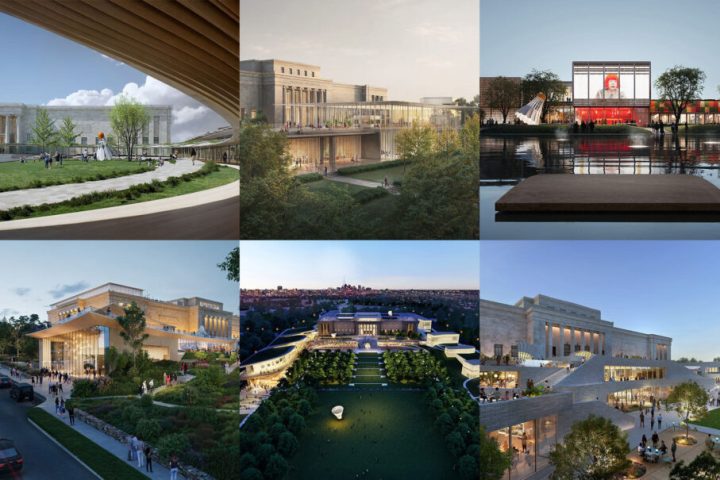
Proposals by the six finalists for The Nelson-Atkins Museum of Art, aimed at integrating the campus, the Donald J. Hall Sculpture Park, and the two existing buildings into a cohesive experience for new wider community engagement.
◊ ◊ ◊ ◊ ◊
It’s not an 18th-century story per se, but interesting to see a museum engage a strong classical facade and an iconic landscape in the 21st century. From the press release (13 March) for the exhibition, which includes an online component:
Building Belonging: Designing the Future of the Nelson-Atkins
The Nelson-Atkins Museum of Art, Kansas City, 15 March — 1 June 2025
The Nelson-Atkins Museum of Art this week revealed the concepts from six finalist teams in the competition to transform the museum with a dynamic, open, and inviting design. The expansion project’s goal is to attract new audiences by creating vibrant spaces for hosting more art, along with new immersive and interactive experiences for the community. The concepts—devised by some of the most respected designers working in museum architecture today—are now available to view in an online gallery here. They can also be seen in a free exhibition at The Nelson-Atkins Museum of Art, Building Belonging: Designing the Future of the Nelson-Atkins, until 1 June 2025. The public is invited to comment at the exhibition or through the portal available here.
The museum’s Architect Selection Committee (ASC) will meet in late spring to interview the finalists and make a recommendation to the Board of Trustees. Following ratification and the winning team’s appointment, the chosen design will be refined in close partnership with the museum and its stakeholders, including local communities. The Board of Trustees aims to broaden the conventions of the museum—which offers free general admission—so it continues evolving as a place where everyone feels they belong. The project will integrate the campus, the Donald J. Hall Sculpture Park, and the two existing buildings into a cohesive new experience. The first stage of the competition, which launched in October 2024, attracted 182 teams from 30 countries on six continents.
“These six concept designs articulate six unique visions of a new and even more dynamic Nelson-Atkins.” said Evelyn Craft Belger, Chair of the museum’s Board of Trustees and the Architect Selection Committee. “This is a thrilling moment for the museum and our community when we start to visualize an identity that will carry us through the coming decades. We encourage our community to visit the exhibition and share your thoughts—which proposal best realizes your aspirations?”
“We asked for bold, inspiring moves that also respected the existing museum campus and I’m so happy to say we’ve received them in these initial designs,’ said Julián Zugazagoitia, Director & CEO of the Nelson-Atkins, “Each is a fascinating response to a complex project brief, together they bring myriad perspectives. The teams have shone their beams of thought on our big questions: how do we synthesize our existing icons with a new proposition? How do we modernize and embrace the future but keep the best of our history? And, most of all, how do we create a museum that is transparent for all and instills a sense of belonging and well-being?”
In conjunction with this exhibition is the release of Director’s Highlights: Celebrating 90 Years of The Nelson-Atkins Museum of Art, which captures the richness and variety of the museum’s collection told through the eyes of the curators and Zugazagoitia himself. It includes about 200 works of art organized by the decade in which they entered the museum. Engaging stories, images, and colorful anecdotes accompany each work, along with historic photos and plans. The publication is available for purchase online and in the museum store.
More information about the six finalists can be found here»
• Kengo Kuma & Associates
• Renzo Piano Building Workshop
• Selldorf Architects
• Studio Gang
• Weiss/Manfredi Architecture/Landscape/Urbanism
• WHY Architecture

◊ ◊ ◊ ◊ ◊
Note (added 25 April 2025) — Weiss/Manfredi will lead the expansion, as announced in the press release:
The Nelson-Atkins Museum of Art has unanimously selected WEISS/MANFREDI Architecture/Landscape/Urbanism as the lead architect for the museum’s upcoming expansion and transformation project. Their guiding theme united the trilogy of architecture, landscape, and community as reciprocal elements that work together while maintaining the majestic south lawn view into the Donald J. Hall Sculpture Park. WEISS/MANFREDI’s concept is aligned with the museum’s goals for a dynamic, open, and inviting design that will create more spaces to present all forms of art, as well as new opportunities for immersive and creative experiences for audiences of every age. The museum’s Architect Selection Committee made the recommendation of WEISS/MANFREDI, describing the project as the best to fulfill the museum’s aspirations, and the team as sensitive to Kansas City while being engaging, smart, creative, and curious. The choice was ratified by the Board of Trustees shortly thereafter. Having selected the lead architect, the museum will now begin the months-long process of turning the concept into more specific and detailed plans to meet the long-term needs and goals of the community. . . .
The full press release is available here»










 Enfilade
leave a comment