AHRC Studentship | Netherlandish Networks: Home-making, 1565–1799
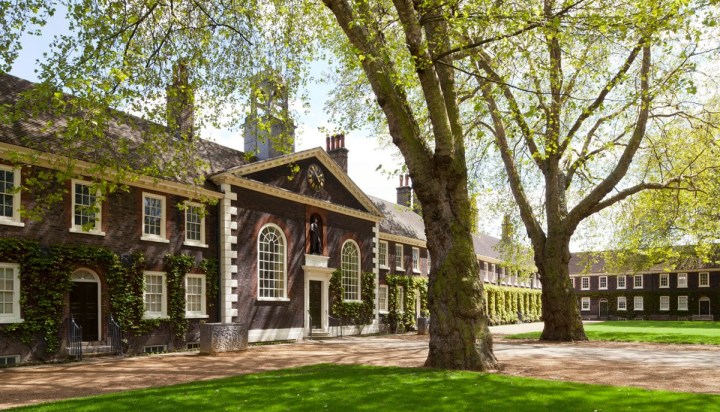
The Museum of the Home is located in almshouses, built in 1714, in Hoxton, East London.
◊ ◊ ◊ ◊ ◊
From the project description:
Netherlandish Networks:
Home-making in an Age of Emerging Global Capitalism, 1565–1799
AHRC Doctoral Studentship, Open University with the Museum of the Home and Queen Mary, University of London
Applications due by 7 April 2025
We are delighted to invite applications from students for a PhD Studentship in the Department of Art History at the Open University funded by the Arts and Humanities Research Council in partnership with the Museum of the Home (London) and the Centre for the Studies of Home at Queen Mary, University of London.
The project will explore the hidden histories behind a set of early modern objects belonging to the Museum of the Home, including a Flemish tapestry, Delftware, Chinese porcelain, japanned furniture, and items inlaid with rosewood. These diverse objects all share one quality: a relationship to the Netherlandish maritime trading networks (‘Netherlandish’ here refers to the profoundly entwined economies and cultures of what is roughly now Belgium and Holland). These Netherlandish networks spanned the globe but at their centre lay the cities of Amsterdam and Antwerp, not least because their Sephardic Jewish communities facilitated otherwise difficult trading connections between Northern Europe and the extensive Spanish and Portuguese Empires. London and the emerging British Empire relied heavily on these Netherlandish networks, especially across the sixteenth and seventeenth centuries. Crucially, these networks allowed for the circulation of religious and other refugees, merchants, skilled craftworkers, and enslaved people as well as materials like tropical hardwoods, objects like ceramics, clocks, and metalwork, and types of design that were then copied locally.
Key Research Questions
• What are the most efficient ways of mapping the many and complex journeys behind the interior fittings and furnishings that constituted home-making in early modern England as it became part of a global economy that, in turn, rested on colonialism and enslavement?
• How were early modern homes made in and through objects—so visually, spatially and materially—in relation to two overlapping immigrant communities (Sephardic Jews and Netherlanders)?
• To what extent were homes made in temporary lodgings such as boarding-houses or through public spaces such as churches or synagogues? In this process, how were objects mobilised in ritual and less formal behaviour?
• How can objects best be used to instantiate specific social histories about immigration, colonialism, and enslavement?
• What broader historical, curatorial, and art-historical methodologies may be developed from studying objects with hidden histories?
As part of the studentship, the successful candidate will be expected to spend significant periods of time with the collections at the Museum of the Home in east London. Research will also be undertaken at relevant archives across London, including the National Archives at Kew, which holds an extensive range of port books recording merchant shipping into most English ports from between 1565 and 1799.
The candidate will be co-supervised between the Open University and the Museum of the Home. Professor Clare Taylor and Dr Margit Thøfner, from the Department of Art History will supervise from the Open University, and Ailsa Hendry, Collections Manager and Lara Baclig, Community Producer, will supervise on behalf of the Museum of the Home.
Clare Taylor is a specialist in early modern interiors, material culture, and design. She has been lead supervisor for a number of Collaborative Doctoral Awards, including with the National Trust, the National Railway Museum, and the Sanderson archive. Margit Thøfner specialises in Netherlandish art, visual and material culture from the sixteenth and seventeenth centuries. Ailsa Hendry’s experience stretches across collections care and curation and she has worked on many projects exploring early modern European history. Lara Baclig specialises in community engagement and decolonial practice in collecting and displays.
More information is available here»
Call for Papers | ‘National’ Churches in Foreign Mediterranean Ports
This panel is part of the AISU conference in Palermo:
‘National’ Churches and Mediterranean Ports in the Early Modern Period
Foreign Communities Reshaping the Urban Fabric
Chiese ‘nazionali’ nei porti del Mediterraneo in età moderna (secoli XV–XVIII)
Il ruolo delle comunità forestiere nella riconfigurazione del tessuto urbano
Associazione Italiana di Storia Urbana Congress, Palermo, 10–13 September 2025
Organized by Nadia Rizzo and Carl Alexander Auf der Heyde
Proposals due by 3 May 2025
The establishment of ‘national’ mercantile groups in major Mediterranean port cities—key hubs for cross-cultural exchange—developed continuously from the Middle Ages into the early modern period (Colletta 2012). These ports became meeting places for foreign merchants who organised themselves into ‘nations’, structured associations based primarily on geographical origin, but also on shared language and religion (Petti Balbi 2001). These communities did not limit their activities to commercial spaces such as ‘fondaci’ and ‘logge’.
From at least the fifteenth century, they established meeting and worship places, often gaining patronage for chapels within existing churches. The most ambitious goal of the foreign communities, however, was the construction of a dedicated church, consecrated to their patron saint and intended primarily to meet the religious and liturgical needs of the group (Koller, Kubersky-Piredda 2015 [for national churches in Rome]). In addition to serving as a devotional landmark, the construction of a national church was a clear statement of the community’s presence, identity, and wealth, exerting a tangible and visible influence on the urban and architectural landscape of the host city.
From the mid-sixteenth century, coinciding with a wave of significant urban redevelopment, there was a marked increase in the construction of national churches independent of local religious communities. This phenomenon intensified during the seventeenth century, alongside the architectural fervour of the newly emerging Counter-Reformation orders, fostering a virtuous cycle of competition not only between nations, but also among religious congregations and national communities.
This panel seeks to explore the impact of foreign communities on the urban transformation of Mediterranean port cities between the sixteenth and eighteenth centuries, with a focus on the institution of the national church as a key reference point. We invite proposals in Italian, English, Spanish, and French that approach this topic from different perspectives and levels of analysis, including:
• Research on the settlement system of a single nation in multiple mercantile centers
• Specific studies on individual national churches
• Diachronic investigations on the settlement of a foreign group in a specific center (from chapels to national churches)
• Comparative overviews of multiple national churches in the same city
To apply, please fill out the form available at the bottom of each session presentation. The link for session 4.1 can be found here. Applicants are required to submit the paper abstract (maximum 5000 characters) and a brief biographical note. For any further information regarding the session, please contact the panel coordinators: Nadia Rizzo (Scuola Normale Superiore, nadia.rizzo@sns.it) and Carl Alexander Auf der Heyde (Università degli Studi di Palermo, carlalexander.aufderheyde@unipa.it).
The congress of the Associazione Italiana di Storia Urbana (Italian Association of Urban History / AISU International) will meet in Palermo, 10–13 September 2025. This year’s theme is The Crossroad City: Relations and Exchanges, Intersections and Crossing Points in Urban Realities.










 Enfilade
leave a comment