AHRC Studentship | Netherlandish Networks: Home-making, 1565–1799
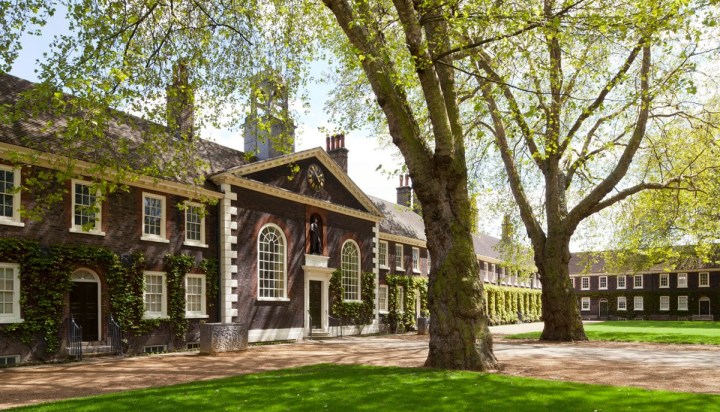
The Museum of the Home is located in almshouses, built in 1714, in Hoxton, East London.
◊ ◊ ◊ ◊ ◊
From the project description:
Netherlandish Networks:
Home-making in an Age of Emerging Global Capitalism, 1565–1799
AHRC Doctoral Studentship, Open University with the Museum of the Home and Queen Mary, University of London
Applications due by 7 April 2025
We are delighted to invite applications from students for a PhD Studentship in the Department of Art History at the Open University funded by the Arts and Humanities Research Council in partnership with the Museum of the Home (London) and the Centre for the Studies of Home at Queen Mary, University of London.
The project will explore the hidden histories behind a set of early modern objects belonging to the Museum of the Home, including a Flemish tapestry, Delftware, Chinese porcelain, japanned furniture, and items inlaid with rosewood. These diverse objects all share one quality: a relationship to the Netherlandish maritime trading networks (‘Netherlandish’ here refers to the profoundly entwined economies and cultures of what is roughly now Belgium and Holland). These Netherlandish networks spanned the globe but at their centre lay the cities of Amsterdam and Antwerp, not least because their Sephardic Jewish communities facilitated otherwise difficult trading connections between Northern Europe and the extensive Spanish and Portuguese Empires. London and the emerging British Empire relied heavily on these Netherlandish networks, especially across the sixteenth and seventeenth centuries. Crucially, these networks allowed for the circulation of religious and other refugees, merchants, skilled craftworkers, and enslaved people as well as materials like tropical hardwoods, objects like ceramics, clocks, and metalwork, and types of design that were then copied locally.
Key Research Questions
• What are the most efficient ways of mapping the many and complex journeys behind the interior fittings and furnishings that constituted home-making in early modern England as it became part of a global economy that, in turn, rested on colonialism and enslavement?
• How were early modern homes made in and through objects—so visually, spatially and materially—in relation to two overlapping immigrant communities (Sephardic Jews and Netherlanders)?
• To what extent were homes made in temporary lodgings such as boarding-houses or through public spaces such as churches or synagogues? In this process, how were objects mobilised in ritual and less formal behaviour?
• How can objects best be used to instantiate specific social histories about immigration, colonialism, and enslavement?
• What broader historical, curatorial, and art-historical methodologies may be developed from studying objects with hidden histories?
As part of the studentship, the successful candidate will be expected to spend significant periods of time with the collections at the Museum of the Home in east London. Research will also be undertaken at relevant archives across London, including the National Archives at Kew, which holds an extensive range of port books recording merchant shipping into most English ports from between 1565 and 1799.
The candidate will be co-supervised between the Open University and the Museum of the Home. Professor Clare Taylor and Dr Margit Thøfner, from the Department of Art History will supervise from the Open University, and Ailsa Hendry, Collections Manager and Lara Baclig, Community Producer, will supervise on behalf of the Museum of the Home.
Clare Taylor is a specialist in early modern interiors, material culture, and design. She has been lead supervisor for a number of Collaborative Doctoral Awards, including with the National Trust, the National Railway Museum, and the Sanderson archive. Margit Thøfner specialises in Netherlandish art, visual and material culture from the sixteenth and seventeenth centuries. Ailsa Hendry’s experience stretches across collections care and curation and she has worked on many projects exploring early modern European history. Lara Baclig specialises in community engagement and decolonial practice in collecting and displays.
More information is available here»










 Enfilade
leave a comment