Exhibition | The Declaration’s Journey

Looking to this fall, from the March 11 press release for the exhibition:
The Declaration’s Journey
Museum of the American Revolution, Philadelphia, 18 October 2025 — 3 January 2027
The Museum of the American Revolution today announces new details of its loan acquisitions for The Declaration’s Journey—a special exhibition commemorating the 250th anniversary of the adoption of the Declaration of Independence—related to female activists and suffragists in the 18th and 19th centuries who both touted the Declaration’s progressive ideals and pushed the United States to apply the its promise of equality to women.
On the night of July 4,1776, the first copies of the Declaration of Independence were published at John Dunlap’s printing office, near Second and Market Streets in Philadelphia. The news of independence spread quickly and widely both in the United States and abroad. Though women were not mentioned in the declaration issued by the Continental Congress, they contributed to its proliferation and success. Beginning with Dunlap, printers created broadsides of the Declaration, and they published the text in their newspapers. In July 1776, Mary Katharine Goddard of Baltimore was the only woman running a newspaper under her own name in the newly declared United States. She first published the Declaration in her newspaper, the Maryland Journal, and later also printed broadside copies of the Declaration, the first version to bear the names of the men who signed the revolutionary document. The Declaration’s Journey will feature a rare surviving broadside of the Declaration of Independence printed by Goddard in January 1777, on loan from Brian and Barbara Hendelson.
Throughout the 19th and early 20th centuries, activists fought for women’s rights and cited the words of the Declaration of Independence to advocate for education, temperance, abolition, and especially suffrage. In Seneca Falls, New York, in 1848, 100 men and women signed a Declaration of Sentiments that looked very similar to the Declaration of Independence, with a key difference—it affirmed that “all men and women are created equal.” At the time, women in the United States had few legal, social, and political rights compared to men. Women were not allowed to vote. Only a few state laws allowed them to own property if they got married. They had limited rights in the court system and could not serve in government positions.
Elizabeth Cady Stanton, a skilled writer and orator for the suffrage movement, wrote the Declaration of Sentiments, borrowing its title from the American Anti-Slavery Society while retaining the structure and much of the language from the United States’ Declaration. Of the 68 women who signed the Declaration of Sentiments, only one, Rhoda Palmer, lived long enough to legally vote after nationwide women’s suffrage was achieved in 1918.
The Declaration’s Journey will feature Elizabeth Cady Stanton’s desk used in her house in Tenafly, New Jersey, where she lived from 1868 until 1887. Alongside coauthors Matilda Joslyn Gage, Ida Husted Harper, and Susan B. Anthony, Stanton likely used this desk during the writing process for their History of Woman Suffrage book, which they began working on following the suffragists’ appearance at the Centennial International Exhibition in Philadelphia in 1876. At that appearance, a small group of suffragists including Stanton famously interrupted the proceedings of the Fourth of July celebration at Independence Hall to present their Declaration of Rights of the Women of the United States to Vice President Thomas Ferry. History of Woman Suffrage was later published in 1881.
Coline Jenkins, the great-great-granddaughter of Stanton, will lend the desk to the Museum for the full run of The Declaration’s Journey. Just as Stanton and her fellow activists took advantage of the attention surrounding the Centennial celebration to travel to Philadelphia and champion their cause, Jenkins said she is thrilled to have her ancestor represented through the Museum’s special exhibition celebrating the Semiquincentennial.
“The Declaration’s Journey will be the focus of the nation in 2026,” Jenkins said. “It means a lot to me and to my family to contribute this artifact at such a key time to such a key institution. It was never my family’s interest to have it stored away from the American people. Now, by its inclusion in this special exhibition, the desk can be a tool for Americans to understand where they came from and how to move forward.”
Displayed near Stanton’s desk in The Declaration’s Journey will be the earliest known printing of the Declaration of Sentiments, on loan from the Historical Society of Pennsylvania. The exhibition will also include a ballot box made from blueberry crates that was used in 1868 in a protest organized by Vineland, New Jersey, resident Portia Gage. One hundred and seventy-two local white and Black women cast illegal votes in the ballot box, which will be on loan from the Vineland Historical and Antiquarian Society.
“American women have helped to shape the legacy of the Declaration of Independence over the past 250 years,” said Matthew Skic, Senior Curator at the Museum of the American Revolution. “Stories of revolutionary women such as Mary Katherine Goddard, Elizabeth Cady Stanton, and Portia Gage remind us of the long-standing and continuing struggle to strengthen the American nation’s commitment to equality stated back in 1776.”
Structure of the exhibition:
First Travels, 1776–1783
The exhibition begins with the story of Jonas Phillips, a Jewish merchant in Philadelphia who sent a letter, written in Judeo-German to keep its contents secret, and a Dunlap broadside of the Declaration of Independence to Amsterdam in July 1776. That copy never arrived, as the ship carrying it was captured by a British warship. The letter and Dunlap broadside will be on view along with Phillips’ notes referencing the Declaration’s promise of freedom of conscience—an early example of the emerging meanings credited to the Declaration. Other objects and documents in this introductory section convey how a July 1776 reading of the Declaration led the Mi’kmac and Maliseet communities of New Brunswick and Maine to enter into the first treaty to recognize the U.S. as an independent nation; how the French celebrated the Declaration and helped to announce the U.S. as a nation of the world, available for diplomacy and alliance; and how a small minority, all abolitionists, pioneered the use of the Declaration as an egalitarian document.
A Worldwide Journey, 1780–1830
The story moves abroad to examine how international interpretations of the Declaration of Independence pressured Americans to clarify their own understanding of the founding document, especially its language about equality. The Marquis de Lafayette borrowed language of the Declaration in his “Declaration of the Rights of Man and Citizen” (1789) but clarified language about equality. The Haitian Declaration of 1804, as well as the declarations adopted in Mexico and Chile, pushed and pressured Americans into conversation and conflict over the tensions within their own Declaration’s promise.
A Divided Declaration, 1831–1898
The narrative returns to the United States, exploring the Declaration’s appropriation by abolitionists, suffragists, and Confederate secessionists. Items may include Frederick Douglass’s typescript oration from 1852, best known for the line “What to the American Slave, is your Fourth of July?” and a printing of the Seneca Falls Convention’s Declaration of Sentiments, which launched the modern women’s suffrage movement with the addition of the phrase “and women” to the Declaration’s statement that “all men” are created equal.
Examples of Native American Declarations of Sovereignty and Independence, including Mashpee and Cherokee, show ways that the Declaration’s language was re-fashioned in the 1800s by people described in the original document as “savage.”
The Declaration’s Journey, 1898–Present
In this final section, visitors will see more and more people claim the legacy of the Declaration. At the end of WWI, Czechoslovakia, Korea and six other nations adopted their versions of a declaration of independence and by the mid-1900s, the Declaration was increasingly understood as a fundamental statement of human rights and equality. Martin Luther King Jr.’s 1963 “I Have a Dream,” speech is perhaps the best-known example of this understanding of the Declaration as a far-reaching promise. Visitors will leave the exhibition with an understanding of our Declaration as part of an ongoing revolution, a continuing effort to secure fair government and individual rights for people in the United States and around the world.
The Museum is poised to play a leadership role in the upcoming 250th anniversary of the nation’s founding in 2026. As we continue to transform the nation’s relationship with its Revolutionary past by increasing awareness of the many ordinary, diverse, and little-known people who created the American nation. Through this special exhibit, digital initiatives, and educational programs, we aim to facilitate widespread conversation about the meaning of the American Declaration of Independence and its ongoing legacy.
Journal18, Fall 2024 — Craft
The latest issue of J18 (I’m sorry to be slow with this one! –CH) . . .
Journal18, Issue #18 (Fall 2024) — Craft
Issue edited by Jennifer Chuong and Sarah Grandin
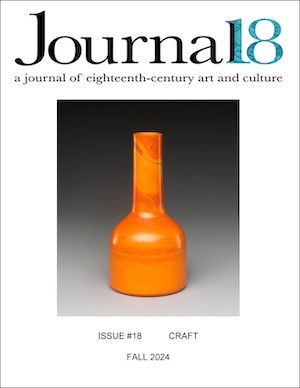 When, where, and why does craft matter? Craft, by definition, is any activity involving manual skill. But in the modern western world, the term typically implies specific kinds of activities that produce specific kinds of objects: things like baskets, lace, and lacquerware. In a culture that has historically privileged rationality and innovation, craft’s commitment to tradition, reliance on haptic knowledge, and association with marginalized subjects have rendered it the minor counterpart to more ‘serious’ forms of material production. As a subsidiary to art and industry, craft has often occupied a circumscribed role in accounts of modern art and modernity’s origins in the eighteenth century. Recently, however, craft—as a more capacious category of material production—has become a crucial term in efforts to expand and diversify the study of eighteenth-century art.
This special issue builds on recent investigations while considering how craft’s ancillary role within the Anglo-European tradition has limited its capacity to transform the field. Drawing inspiration from the absence of an art/craft divide in many cultures, we are interested in exploring craft’s potential to radically reframe, reconceptualize, and globalize the history of art.
a r t i c l e s
Elizabeth Eager — Labor, Leisure, and Lost Time in Eighteenth-Century Women’s Embroidery
Yve Chavez — Eighteenth-Century Loom and Basket Weaving at the California Missions
Hampton Smith — Insurgent Tooling and the Collective Making of Slave Revolts
Natalie E. Wright and Glenn Adamson — Encyclopædia Materia: Material Intelligence and Common Knowledge
Julie Bellemare, N. Astrid R. van Giffen, and Robert Schaut — Hot Tempered: Recreating a Lost Glass Recipe
Caroline Wigginton — Reading with Indigenous Form: Lucy Tantaquidgeon Tecomwas’s Moccasins (ca. 1767)
Ellen Siebel-Achenbach — Bookbinding in Eighteenth-Century Nuremberg: Reconstructing an Edge Plough from the Hausbücher der Nürnberger Zwölfbrüderstiftungen
All articles are available for free here, along with recent notes & queries:
r e c e n t n o t e s a n d q u e r i e s
Lytle Shaw — A Pirate Primer? Review of Stan Douglas: The Enemy of All Mankind
Sofya Dmitrieva — The Art Collection of the French Royal Academy of Painting and Sculpture: Notes on the Database
Jennifer Laffick — Lethière in Williamstown and Paris: A Transatlantic Exhibition Review
Kristina Kleutghen — Beijing to Dresden via St. Petersburg: An Early Qing Enameled Snuff Bottle in the Collection of Augustus II the Strong
Geoff Quilley — Lubaina Himid’s Naming the Money at the Entangled Pasts, 1768-now Exhibition, Royal Academy, London










 Enfilade
leave a comment