New Book | Jewish Country Houses
From Brandeis UP:
Juliet Carey and Abigail Green, eds., with photography by Hélène Binet, Jewish Country Houses (Waltham, MA: Brandeis University Press, 2024), 300 pages, ISBN: 978-1684582204, $60. Part of the Tauber Institute Series for the Study of European Jewry.
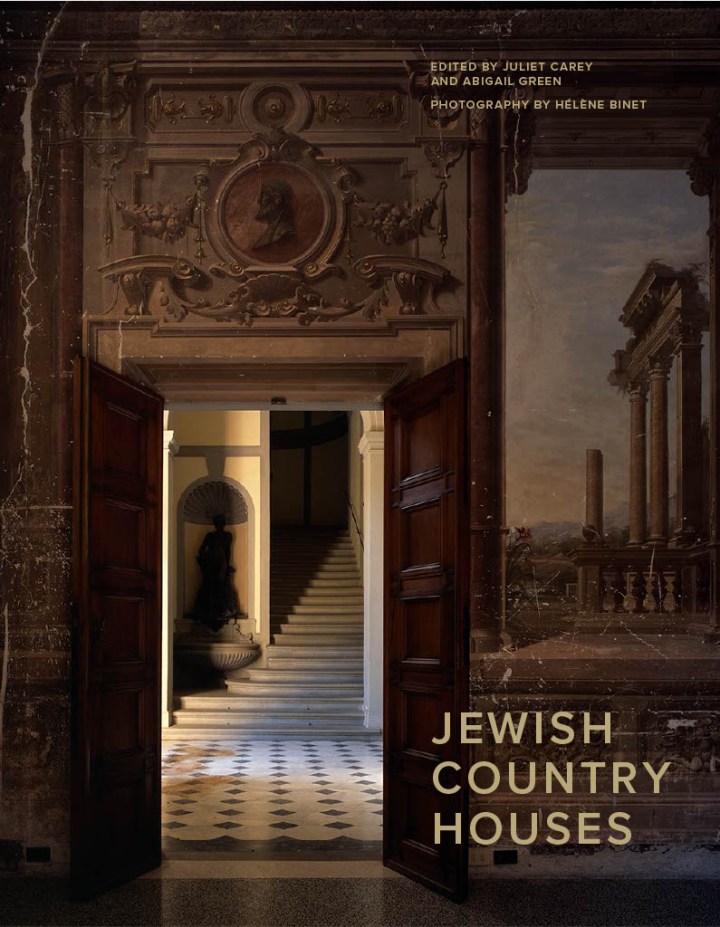 Country houses are powerful symbols of national identity, evoking the glamorous world of the landowning aristocracy. Jewish country houses—properties that were owned, built, or renewed by Jews—tell a more complex story of prejudice and integration, difference and connection. Many had spectacular art collections and gardens. Some were stages for lavish entertaining, while others inspired the European avant-garde. A few are now museums of international importance, many more are hidden treasures, and all were beloved homes that bear witness to the remarkable achievements of newly emancipated Jews across Europe—and to a dream of belonging that mostly came to a brutal end with the Holocaust. Lavishly illustrated with historical images and a new body of work by the celebrated photographer Hélène Binet, this book is the first to tell their story, from the playful historicism of the National Trust’s Waddesdon Manor in Buckinghamshire to the modernist masterpiece that is the Villa Tugendhat in the Czech city of Brno—and across the pond to the United States, where American Jews infused the European country house tradition with their own distinctive concerns and experiences. This book emerges from a four-year research project funded by the UK Arts and Humanities Research Council that aims to establish Jewish country houses as a focus for research, a site of European memory, and a significant aspect of European Jewish heritage and material culture.
Juliet Carey is senior curator at Waddesdon Manor. Abigail Green is an Oxford historian and author of the award-winning Moses Montefiore: Jewish Liberator, Imperial Hero.
◊ ◊ ◊ ◊ ◊
A conversation with the authors will take place at Yale on Monday:
Juliet Carey and Abigail Green | Jewish Country Houses
Yale University, New Haven, 24 March 2025, 4pm
Juliet Carey and Abigail Green will discuss their new book, Jewish Country Houses, which explores these remarkable houses, their architecture and collections, and the lives of the extraordinary men and women who created and transformed them. Moderated by Laurel O. Peterson, Assistant Curator of Prints and Drawings, Yale Center for British Art; the event is cosponsored by the Yale Center for British Art and Yale Jewish Studies Program.
Symposium | Turner Today

J.M.W. Turner, Inverary Pier, Loch Fyne: Morning, detail, ca. 1845, oil on canvas
(New Haven: Yale Center for British Art, Paul Mellon Collection)
◊ ◊ ◊ ◊ ◊
Upcoming at YCBA:
Turner Today
Online and in-person, Yale Center for British Art, New Haven, 9 May 2025
The dramatic landscapes of J. M. W. Turner continue to enthrall audiences across the globe, more than two centuries after the artist’s birth. Organized in conjunction with the Yale Center for British Art’s exhibition J. M. W. Turner: Romance and Reality, this symposium invites scholars and curators from Canada, the United States, and the United Kingdom to explore the multiple ways that Turner’s oeuvre speaks to our present moment, from its relationship to contemporary visual art to its role in framing conversations about climate change and resource extraction. What exciting and new possibilities exist for interpreting and sharing Turner’s work in 2025?
The symposium is free and open to the public. It will be held in the Lecture Hall at the Yale Center for British Art and will be livestreamed. Registration is recommended but not required for this event.
s c h e d u l e
10.15 Welcome and opening remarks by Martina Droth (Paul Mellon Director, YCBA)
10.30 Panel One | Transatlantic Turner: Reputation and Reception
Moderator: Tim Barringer (Paul Mellon Professor of the History of Art, Yale University)
Turner established a significant reputation in North America in his lifetime and still draws considerable attention from American museums. This panel brings together curators from the Frick Collection, J. Paul Getty Museum, and Metropolitan Museum of Art to explore Turner’s transatlantic appeal in the past and present. How has Turner been introduced to, and understood by, American audiences? What factors cemented Turner’s reputation in the United States and how does his storied reputation affect the way we present and represent his work today?
• Julian Brooks (Senior Curator and Head of the Department of Drawings, J. Paul Getty Museum)
• Alison Hokanson (Curator, Metropolitan Museum of Art)
• Aimee Ng (John Updike Curator, Frick Collection)
11.30 Break
11.45 Panel Two | Turner’s Atmospheric Topography
Chair: Lucinda Lax (Curator of Paintings and Sculpture, YCBA)
How are Turner’s paintings being reinterpreted amid current ecological crises? This panel situates Turner’s interest in particular locations, and the specifics of place, within the broader sociopolitical and environmental context of industrialization and natural resource extraction. Curators based in the United States and United Kingdom will discuss how exhibitions of Turner’s work can address contemporary environmental issues and consider how museums can put contemporary works with environmental themes in dialogue with Turner’s paintings.
• John Chu (Senior Curator of Pictures and Sculpture / Senior Curator for Midlands, National Trust)
• Lizzie Jacklin (Keeper of Art, Tyne and Wear Archives and Museums)
• Jennifer Tonkovich (Eugene and Clare Thaw Curator of Drawings and Prints, Morgan Library and Museum)
12.45 Lunch
2.00 Panel Three | Turner, Tradition, and Modern Painting
Chair: Martin Myrone (Head of Research Support and Pathways, Paul Mellon Centre for Studies in British Art, and Convenor, British Art Network)
This panel considers a paradox: Turner is often portrayed as a harbinger of late nineteenth- and early twentieth-century Impressionism and abstraction, yet he made constant and overt reference in his art to major artists of the past. How is Turner being embraced and interpreted as an artist who both self-consciously worked within a longstanding tradition and broke radically with traditional painting practices? How are curators engaging with Turner’s elusive relationship to modernity and tradition? What is Turner’s relevance to contemporary artistic practice?
• Amy Concannon (Manton Senior Curator of Historic British Art, Tate)
• Anni Pullagura (Margaret and Terry Stent Associate Curator of American Art, High Museum of Art)
• Nicholas Bell (President and CEO, Glenbow)
3.00 Closing Remarks and Reflections on J. M. W. Turner: Romance and Reality
• Lucinda Lax (Curator of Paintings and Sculpture, YCBA)
• Tim Barringer (Paul Mellon Professor of the History of Art, Yale University)










 Enfilade
leave a comment