Call for Essays | Rethinking the Material Afterlives of Animals
From ArtHist.net:
Essay Collection | Rethinking the Material Afterlives of Animals, 1500–1800
Edited by Catherine Girard and Sarah Grandin
Proposals due by 30 April 2025; final essays due February 2026
Do animals introduce a material difference to objects from the early modern period? Should scholars think differently about objects that include animal remains than they do about other materials? The editors of this volume invite essays that examine human and non-human animal relations through objects made of animal remains in the early modern period to investigate this possible difference. This era saw intensified zoological research alongside the expansion of armed trade, overland and maritime travel, and extractive industries dependent on biotic materials. These shifts shaped the ways in which animal remains were preserved, transformed, and recontextualized within artistic and economic networks. Rather than treating these materials in terms of visual encounters alone, contributors to this volume are asked to foreground the visceral and tactile engagements generated by objects crafted with materials such as fur, skin, quills, feathers, shells, ivory, and bones.
We encourage essays that stem from diverse epistemologies and that explore alternative approaches to thinking about artistic materials. How might perspectives that emphasize reciprocity and relationality, for instance, reshape art historical approaches to objects made with and from animals? How does animal presence both ‘construct and disrupt’ human culture? How are the material ‘affordances’ of biomatter—their ability to alert, lubricate, protect, join, support—preserved, distorted, or deferred in human-made objects? How do such materials maintain continuity with their former life and how are they fundamentally altered? We invite contributors to reflect on how their work can be a site of reconciliation, acknowledging both the original contexts of these materials and the contemporary responsibilities of their material, intellectual, and spiritual caretakers.
The book seeks full-length essays that examine moments of transformation in the lives of these animal materials: from the deep ecological knowledge of those who sourced these materials, to the artisans and artists who processed them, to the wearers and collectors who recontextualized them. How do the acts of sourcing, crafting, and collecting materialize particular worldviews? How do these objects navigate tensions between organic and inorganic, sentient and non-sentient entities? What are the limits of such categories?
We also invite shorter contributions that explore the specific ethical and methodological challenges that museological care and conservation raise. How does the field of conservation reckon with biotic materials’ instability and latent animacy? What are the ethical implications of working with such materials? How do artists, scholars, curators, and knowledge-keepers participate in the care of historical objects that include animal substrates?
As a whole, this volume aims to chart new methods for engaging with animal materials in the archive, interrogating how anthropocentrism and colonialism have shaped art history’s disciplinary practices and omissions. We welcome contributions from scholars in art history, visual and material culture, museum studies, and related disciplines who are interested in rethinking the material afterlives of animals from diverse cross-cultural, temporal, and methodological perspectives.
Please submit a 500-word abstract to Catherine Girard (St. Francis Xavier University, cgirard@stfx.ca) and Sarah Grandin (The Courtauld Institute of Art, Sarah.Grandin@courtauld.ac.uk) by 30 April 2025, specifying whether you are planning to write a full-length essay of up to 8000 words or a shorter contribution of up to 4000 words, including notes. Final essays will be due in February 2026.
Lecture | Jessica Riskin on Lamarck
Upcoming at Yale University:
Jessica Riskin
Professor of Insects and Worms: Jean-Baptiste Lamarck and his Life-Made World
27th Lewis Walpole Library Lecture
Yale University, New Haven, 30 April 2025, 5.30pm
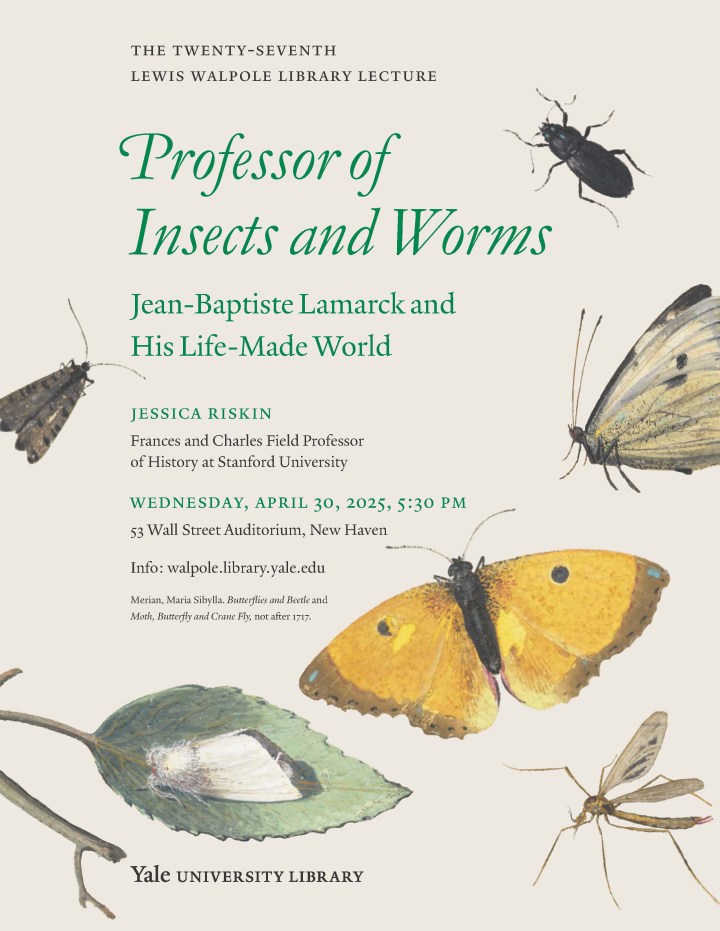 Jean-Baptiste Lamarck (1744–1829) was the Professor of Insects and Worms at the Museum of Natural History in Paris. Living through the storms of the French Revolution and Napoleonic period, he founded biology, coining the term to name a new science devoted to all and only living things, and authored the first theory of evolution. Lamarck’s science was foundational to modern biology, yet its radicalism—he usurped God’s monopoly on Creation and re-assigned it to mortal, living beings—brought him and his ideas plenty of trouble. During Lamarck’s lifetime, Napoleon and his scientific inner circle hated him and did what they could to undermine him. Charles Darwin then adopted central elements of Lamarck’s theory, but after Darwin’s death, his most influential followers re-interpreted his theory to eradicate all traces of Lamarckism, rendering organisms once again the passive objects of outside forces, allowing room for an omnipotent God working behind the scenes. This conception of living organisms as passive in the evolutionary process has remained dominant since the turn of the twentieth century. In contrast, in Lamarck’s theory, living beings were active, creative, self-making and world-making. Elements of this very different conception of living organisms have recently, gradually been returning to mainstream biology in fields such as niche construction and epigenetic inheritance.
The lecture will present Lamarck’s radical, embattled, and perhaps re-emerging approach to living things, their evolutionary and ecological agency, and the science that studies them. The event is free and open to the public, with no registration required.
Jessica Riskin, the Frances and Charles Field Professor of History at Stanford University, teaches modern European history and the history of science. Her work examines the changing nature of scientific explanation, the relations of science, culture and politics, and the history of theories of life and mind. Her books include The Restless Clock: A History of the Centuries-Long Argument over What Makes Living Things Tick (2016), which was awarded the 2021 Patrick Suppes Prize in the History of Science from the American Philosophical Society, and Science in the Age of Sensibility (2002), which received the American Historical Association’s J. Russell Major prize for best book in French history. She is a regular contributor to various publications including Aeon, the Los Angeles Review of Books, and The New York Review of Books.










 Enfilade
leave a comment