Exhibition | Wild Apollo’s Arrows

Josef Abel, Klopstock’s Arrival in Elysium / Klopstocks Ankunft im Elysium, 1805
(National Gallery Prague)
◊ ◊ ◊ ◊ ◊
Now on view at Vienna’s Academy of Fine Arts:
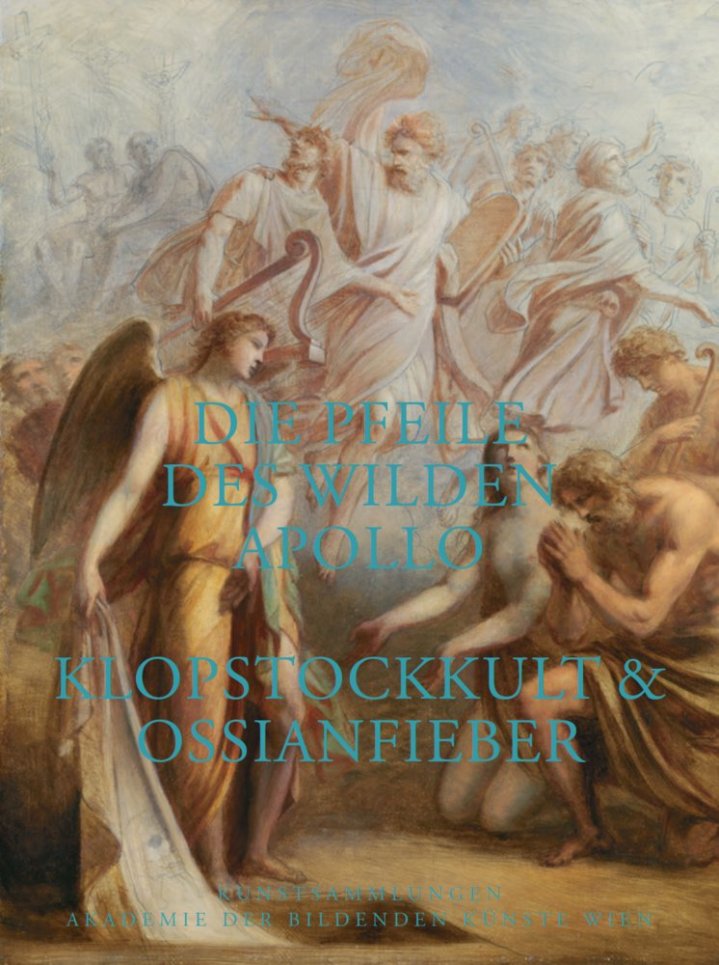
Wild Apollo’s Arrows: Klopstock Cult & Ossian Fever
Die Pfeile des wilden Apollo: Klopstockkult & Ossianfieber
Akademie der bildenden Künste Wien, 7 March — 25 May 2025
Curated by Alexander Roob
The exhibition Wild Apollo’s Arrows: Klopstock Cult & Ossian Fever presents significant artistic works that exemplify the epochal shift from the Enlightenment to the irrationalism of the Storm and Stress movement and Romanticism, exploring for the first time the immense influence of the poet Friedrich Gottlieb Klopstock (1724–1803) on the fine arts and music of his own age.
Decades before the French Revolution, the Age of Enlightenment saw a sudden outbreak of irrational sentiment, expressed in exuberant emotions, notions of spiritualistic gender switching, and a fragmented, heroic, and introspective view of art. This was the onset of an epochal shift with consequences for pictorial art: reliance on the actual appearance of things gave way to the mystical and diffuse, accompanied by a greater interest in the realm of acoustics. Nothing seems to better define this ‘acoustic turn’ than the trope of the blind prophet and lyrical poet, which functioned as a literary model for this new epoch, as seen in the figures of Homer, Ossian, and John Milton. Milton’s grand inner images were proclaimed to be the perfection of the romantic sublime, and the myth of the lost and regained paradise to which he had given literary form was associated with Mesmer’s notion of lucid dreaming. In the early 1750s, German poet Friedrich Gottlieb Klopstock positioned himself as an heir to Milton, with his pietistic epic The Messiah: A Heroic Poem, and in this he issued a challenge to the self-proclaimed English national bard William Blake.
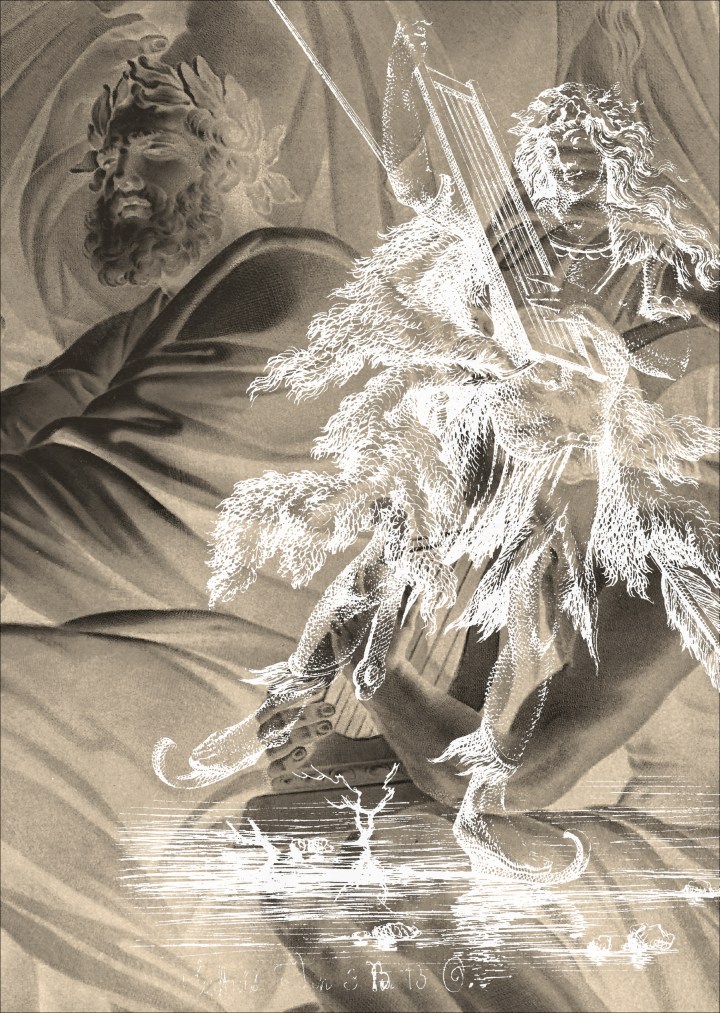
Motif combining works by Johann Peter Pichler after Heinrich Friedrich Füger, Homer Reciting, 1803 (Graphic Collection of the Academy of Fine Arts Vienna), and Carl Wilhelm Kolbe the Elder, Ice-skating Bard (‘Braga’), 1793–94 (Hamburger Kunsthalle, Kupferstichkabinett / bpk, photo by Julia Bau), design composite motif: Beton.
For cultural philosopher Johann Gottfried Herder, ‘wild Apollo’s arrows’ were the rousing sounds of an early folk movement and the Nordic dronescapes of a budding nationalist mysticism, which was all heralded in the pseudo-Celtic poem cycle Ossian. In the visions of the superstar poet Klopstock ‘wild Apollo’ appeared in a Celtic-Germanic mix, and the bard’s song and cosmic ice-dance put the world into creative turmoil. Klopstock, a keen ice-skater, who was nowhere more popular than in Austria, became a role-model for a sentimental skating trend that saw motion as a way to transcend limitations.
The exhibition presents art works that exemplify this epochal shift from the Enlightenment to the irrationalism of the Storm and Stress (Sturm und Drang) movement and Romanticism. For the first time, Klopstock‘s immense influence on the fine arts and music of his own age is explored. With interpretations of his work in art and music by Angelika Kauffmann, Heinrich Friedrich Füger, Josef Abel, and Franz Schubert, the republican poet Klopstock was surprisingly still very present in the Habsburg Empire at the time of the Napoleonic Wars. The exhibition blends works of Austrian classicism, evidence of international early romanticism, and the narcotic imagery of the Nazarenes to the accompaniment of music by Joseph Haydn, Christoph Willibald Gluck, and Franz Schubert.
Alongside works from the Paintings Gallery and numerous loans, this exhibition draws widely on works from the Academy of Fine Arts Vienna Graphic Collection. The project also integrates works by students from the Academy of Fine Arts Vienna, and it will be presented in the Exhibit Galerie and three rooms at the Paintings Gallery. A comprehensive publication with essays and illustrations will accompany the exhibition.
 With works by Josef Abel, Edmund Aigner, Johann Wilhelm Baur, Thomas Blackwell, William Blake, Filippo Caporali, Thomas Chatterton, Daniel Chodowiecki, Edward ‘Celtic’ Davies, Josef Dorffmeister, Bonaventura Emler, Heinrich Friedrich Füger, Johann Heinrich Füssli, Hendrick Goltzius, Christoph Willibald Gluck, Johann Valentin Haidt, Joseph Haydn, Anton Herzinger, William Hogarth, Bartholomäus Hübner, Anne Hunter, Archduchess Maria Clementina of Austria, Johann Evangelist Scheffer von Leonhardshoff, Friedrich John, Owen Jones, Angelika Kauffmann, John Kay, Friedrich Gottlieb Klopstock, Joseph Anton Koch, Carl Wilhelm Kolbe the Elder, Simon Petrus Klotz, Leopold Kupelwieser, Johann Caspar Lavater, Johann Friedrich Leybold, William James Linton, Johann Heinrich Lips, Johann Hieronymus Löschenkohl, Josef Löwy, James Macpherson, Charles-François-Adrien Macret, Jacob Wilhelm Mechau, Heinrich Merz, Isaac Mills, Jean-Michel Moreau, Wilhelm Müller, Friedrich Olivier, Carl Hermann Pfeiffer, Johann Peter Pichler, Albert Christoph Reindel, Johan Christian Reinhart, Ferdinand Ruscheweyh, Luigi Schiavonetti, Julius Schnorr von Carolsfeld, Ludwig Ferdinand Schnorr von Carolsfeld, Franz Schubert, Moritz von Schwind, William Bell Scott, Franz Xaver Stöber, Joseph Sutter, Johanna Dorothea Sysang, Giambattista Vico, Marianne von Watteville, Josef Wintergerst, Franz Wolf, Nikolaus Ludwig von Zinzendorf, Felice Zuliani, and others.
Works after William Blake, Asmus Jakob Carstens, Johann Nepomuk Ender, Heinrich Friedrich Füger, Bonaventura Genelli, Gerdt Hardorff, G. W. Hoffmann, William Hogarth, Angelika Kauffmann, Nicaise de Keyser, Giuseppe Longhi, Johann Friedrich Overbeck, Raffaello Santi, genannt Raffael, Bertel Thorvaldsen, Angiolo Tramontini, Richard Westall.
Contemporary works by students of the Academy such as Christian Azzouni, Ina Ebenberger, Hicran Ergen, Eginhartz Kanter, Julia Kronberger, Prima Mathawabhan, Amar Priganica, Liese Schmidt, Pia Wilma Wurzer, and Ancient Britons Team (ABK Stuttgart).
Alexander Roob, with Sabine Folie, Die Pfeile des wilden Apollo: Klopstockkult & Ossianfieber (Hamburg: Textem Verlag), 248 pages, ISBN: 978-3864853340, €32.
Conference | Painted Ceilings: France and Germany, 1600–1800

This week in Munich, as noted at ArtHist.net:
Eine Verflechtungsgeschichte der Deckenmalerei: Frankreich und Deutschland, 1600–1800
Une histoire croisée des plafonds peints: France-Allemagne, 1600–1800
Carl Friedrich von Siemens Stiftung, München, 12–14 March 2025
Registration due by 11 March 2025
Ziel der Tagung ist es, das historische, kulturelle, formale und technische Phänomen der Verbreitung von gemalten und skulptierten Deckenausstattungen im Europa des 17. und 18. Jahrhunderts zu erforschen. Deutschland und Frankreich bieten sich für dieses Unterfangen an: Die zahlreichen punktuellen und verstreuten Studien der letzten 20 Jahre sollen in einem umfangreichen Unternehmen systematisiert und mit aktuellen Fragestellungen verknüpft werden. Die Zeit ist günstig: Auf beiden Seiten des Rheins entstanden in den letzten Jahren Datenbankinitiativen und es besteht dringender Handlungsbedarf, um gemeinsame digitale Werkzeuge zu entwickeln und die Relevanz und Interoperabilität zu erhöhen.
Le projet propose d’étudier le phénomène historique, culturel, formel et technique qu’a constitué la multiplication des décors de plafonds, peints et sculptés en Europe aux XVIIe et XVIIIe siècles. Les terrains français et allemands se prêtent à cette enquête : ils ont fait l’objet de nombreuses études ponctuelles et différentes depuis 20 ans et appellent aujourd’hui une vaste entreprise de systématisation du corpus et d’enrichissement du questionnaire. Le moment est opportun : des bases de données naissent de part et d’autre du Rhin ces dernières années et il est urgent d’engager une réflexion afin d’adopter des outils numériques communs, afin de gagner en pertinence et en interopérabilité.
Gefördert von der Deutschen Forschungsgemeinschaft (DFG), der Agènce Nationale de Recherche (ANR) und der Carl Friedrich von Siemens Stiftung.
Eine Anmeldung unter ist erforderlich.
Weitere Informationen zum Projekt.
Deutsch-Französische Forschungsdatenbank.
Projektkennung Deutsche Forschungsgemeinschaft (DFG) – Projektnummer 469528261
m i t t w o c h , 1 2 m Ä r z
14.00 Begrüßung / Mot de bienvenue
14.05 Matteo Burioni (LMU) — Einführung : Vom Kulturtransfer zur Verflechtungsgeschichte / Introduction : D’une histoire des transferts à l’histoire croisée
Moderation: Christine Tauber (Zentralinstitut für Kunstgeschichte)
14.30 Hendrik Ziegler (Universität Marburg) — Die Spiegelgalerie von Versailles als deutsch-französischer Erinnerungsort / La galerie des glaces de Versailles comme lieu de mémoire franco-allemand
15.15 Diskussion
15.30 Pause
16.00 Ulrike Seeger (Universität Stuttgart/LMU) — Die Aeneasgalerie von Matthäus Günther im Neuen Schloss in Stuttgart / La galerie d’Énée de Matthäus Günther au nouveau château de Stuttgart
16.20 Matthieu Lett (Université Bourgogne Europe, IUF) — Jean Girardet (1709–1778), peintre de plafonds : perspectives croisées entre le duché de Lorraine, l’Italie et Saint-Empire romain germanique / Jean Girardet (1709–1778), Deckenmaler: Eine Verflechtungsgeschichte zwischen dem Herzogtum Lothringen, Italien und dem Heiligen Römischen Reich Deutscher Nation
16.40 Anne Ilaria Weiß (LMU) — Das Paradeappartement Augusts des Starken im Dresdner Residenzschloss. Zwischen dem Streben nach der Kaiserwürde, goût français und dynastischer Verflechtung mit Frankreich / L’appartement de parade d’Auguste le Fort dans le château de la résidence de Dresde. Entre aspiration à la dignité impériale, goût français et liens dynastiques avec la France
17.00 Diskussion
17.30 Pause
18.00 Olivier Bonfait (Université Bourgogne Europe, IUF) — Matthieu Lett (Université Bourgogne Europe, IUF), Sandra Bazin-Henry (Université Marie et Louis Pasteur), Plafond-3D outre Rhin / Plafond-3D jenseits des Rheins
18.30 Matteo Burioni (LMU), Elisabeth Mayer (LRZ) — Anne Ilaria Weiß (LMU), Appartement und Deckenmalerei in Schloss Rheinsberg / Appartement et plafond peint au château de Rheinsberg
d o n n e r s t a g , 1 3 m Ä r z
Projektpräsentation / Présentation du projet
Moderation: Hubertus Kohle (LMU)
9.00 Olivier Bonfait (Université Bourgogne Europe, IUF), Matteo Burioni (LMU), Maximilian Kristen (LMU), Matthieu Lett (Université Bourgogne Europe, IUF), Florian Zacherl (LMU) — Die Forschungsdatenbank: Metadaten zur Deckenmalerei in Frankreich und Deutschland / Le portail commun: données sur les peintures de plafond en France et en Allemagne
9.50 Diskussion
10.15 Sandra Bazin-Henry (Université Marie et Louis Pasteur) — Les plafonds français et la quadratura : réflexions autour de vestiges illusionnistes / Die französische Deckenmalerei und die Quadratura: Überlegungen zu illusionistischen Relikten
10.30 Marine Roberton (Université Bourgogne Europe) — Sous les ciels de Rennes. Typologie et hiérarchie des fonds des plafonds du parlement de Bretagne / Typologie und Hierarchie der Deckenmalerei im Parlament der Bretagne in Rennes
10.45 Theresa Baumann (LMU) — Künstlerischer Austausch in der Patronage von Henriette Adelaide von Savoyen / Échange artistique sous le patronage d’Henriette Adélaïde de Savoie
11.00 Diskussion
11.30 Pause
12.00 Cordula Mauss / Sandra Bucher-Fiuza (Bayerische Verwaltung der staatlichen Schlösser, Gärten und Seen) — Die Restaurierung des Festsaales von Schloss Ansbach / La restauration de la salle de fête du château d’Ansbach
12.20 Mona Hess (Universität Bamberg) — Die 3D-Vermessung im Festsaal von Schloss Ansbach / Le relevé 3D dans la salle de fête du château d’Ansbach
12.45 Diskussion
14.00 Führung Nymphenburg / Visite guidée de Nymphenburg
Produktion: Denken in der dritten Dimension / Les savoir-faire : penser en 3D
Moderation: Eva-Bettina Krems (Universität Münster)
15.00 Stephan Hoppe (LMU) — Wolf Caspar von Klengel und das Palais im Großen Garten in Dresden. Produktionsgeschichte als modulare Verflechtungsgeschichte / Wolf Caspar von Klengel et le Palais du Grand Jardin à Dresde. L’histoire de la production comme histoire croisée
15.45 Diskussion
16.00 Pause
16.30 Etienne Faisant (Musée du Grand Siècle) — L’architecte, le peintre et le plafond. De l’invention des plafonds en France au XVIIe siècle / Der Architekt, der Maler und die Decke. Von der Erfindung der Deckenmalerei in Frankreich im 17. Jahrhundert
16.45 Maxime Bray (Sorbonne Université) — Réceptions ‘en superficie’ des plafonds peints. Les expertises, un autre lieu des relations entre peintres et architectes au XVIIe siècle / Die ‘Oberflächen’ der Deckenmalerei. Begutachtungen, ein weiterer Schauplatz der Beziehung zwischen Maler und Architekten im 17. Jahrhundert
17.00 Turner Edwards (INHA, Université Bourgogne Europe) — Penser l’ensemble à l’écrit : sémantique des plafonds et du décor dans la première moitié du XVIIIe siècle / Das Gesamtkunstwerk schriftlich denken: Semantik der Deckenmalerei und der Dekorationssysteme in der ersten Hälfte des 18. Jahrhunderts
17.15 Diskussion
f r e i t a g , 1 4 m Ä r z
Die Bildmacht der Deckenmalerei / L’efficace de la peinture de plafond
Moderation: Léa Kuhn (Zentralinstitut für Kunstgeschichte)
9.00 Christian Quaeitzsch (Bayerische Verwaltung der staatlichen Schlösser, Gärten und Seen) — Rekonstruktion barocker Deckenmalereien in der Münchner Residenz – zwischen Aktualisierung und Musealisierung / Reconstruction des peintures de plafond baroques dans la résidence de Munich – entre actualisation et muséalisation
9.45 Diskussion
10.00 Pause
10.30 Anna Klug (Zentralinstitut für Kunstgeschichte) — François Lemoynes Deckenmalerei im Salon d’Hercule von Schloss Versailles und ihre Rezeption im 18. Jahrhundert / Le plafond peint par François Lemoyne au salon d’Hercule du château de Versailles et sa réception critique au 18e siècle
10.45 Vladimir Nestorov (Université Bourgogne Europe) — Depuis les cieux de Paris. Des plafonds parisiens comme modèles pour les provinces au XVIIe siècle / Deckenmalereien in Paris als Vorbilder für die Provinzen im 17. Jahrhundert
11.00 Markus Castor (Deutsches Forum für Kunstgeschichte, Paris) — Die Götter verlassen den Himmel. Zu den Folgen der Säkularisierungstendenzen für die Deckenmalerei des 18. Jahrhunderts / Les dieux quittent le ciel. Sur les conséquences des tendances à la sécularisation pour les peintures de plafond du 18ème siècle
11.15 Diskussion
Moderation: Thomas Kirchner (ehemaliger Direktor des Deutschen Forums für Kunstgeschichte, Paris)
13.30 Olivier Bonfait (Université Bourgogne Europe, IUF) — Premiers apports de la recherche en France sur les plafonds peints, 1600–1800 / Vorüberlegungen zu einer Erforschung der Deckenmalerei in Frankreich, 1600–1800
13.45. Matteo Burioni (LMU) — Austauschprozesse, Materialität und formale Lösungen. Die Deckenmalerei in Deutschland, 1600–1800 / Processus d’échange, matérialité et solutions formelles. La peinture de plafond en Allemagne, 1600–1800
14.30 Diskussion
15.00 Pause
15.30 Eva-Bettina Krems (Universität Münster) — Von Räumen und Menschen: Transgression und Grenze in der höfischen Architektur und Ausstattung / Des espaces et des personnes : Transgression et frontière dans l’architecture et le décor des cours européennes
16.15 Diskussion
16.45 Schlußworte / Conclusion
Exhibition | The Most Formidable Weapon against Errors
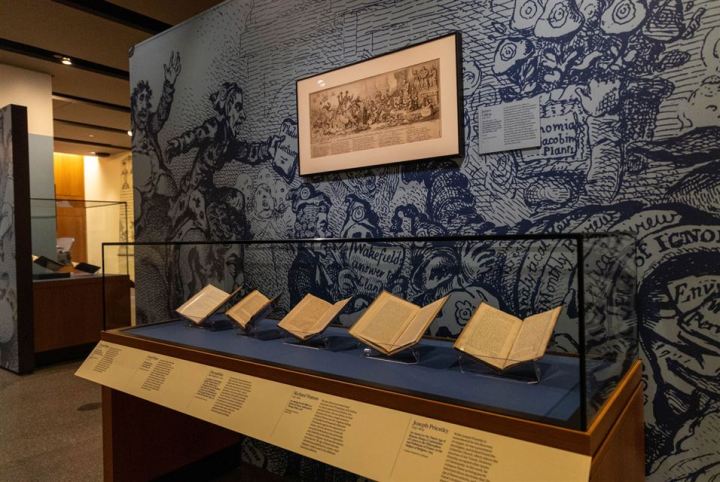
View of the exhibition The Most Formidable Weapon against Errors: The Sid Lapidus ’59 Collection and the Age of Reason, as installed at Princeton’s Firestone Library, 2025.
◊ ◊ ◊ ◊ ◊
Now on view at Princeton:
The Most Formidable Weapon against Errors
The Sid Lapidus ’59 Collection and the Age of Reason
Firestone Library, Princeton University, 19 February — 8 June 2025
Curated by Steven Knowlton
Thinking of the start of his long career as a collector of rare books, Sid Lapidus recalled, “My first antiquarian book was purchased in 1959. In a bookseller’s dusty window, I noticed a small book, a 1792 edition of Thomas Paine’s Rights of Man. The principal theme of my collection was even embedded in the title of [this first purchase].”
 That principal theme is the documenting of new conceptions of human liberty, political order, and scientific reasoning that emerged in the Anglo-American intellectual world between the 17th and 19th centuries. It resulted in a large book collection now dispersed in libraries on the East Coast. This exhibition attempts to provide an overview of Sid Lapidus’s overall achievement.
• Thomas Paine, The Age of Reason
• Thomas Paine, Rights of Man
• The Stamp Act Crisis
• Slavery and Emancipation
• Jewish Oppression and Liberation in England and the United States
• Medicine
• Astronomy and Atomic Science
A dedicated philanthropist, Lapidus has donated his books to several libraries, including Princeton University Library, the American Antiquarian Society, the Wolf Law Library at William & Mary Law School, the Schomburg Center for Research in Black Culture, the Center for Jewish History, the New York Historical, and the New York University Health Sciences Library. His contributions have strengthened the existing collections at those libraries, helping create collections of research value, with works that often are in conversation with one another.
The entire Sid Lapidus ’59 Collection on Liberty and the American Revolution in Princeton University Library has been digitized. You’re invited to browse or search within the collection here»
New Book | Yearning for Immortality
From The University of Chicago Press:
Rune Nyord, Yearning for Immortality: The European Invention of the Ancient Egyptian Afterlife (Chicago: The University of Chicago Press, 2025), 320 pages, ISBN: 978-0226838236 (hardback), $115 / ISBN: 978-0226838250 (paperback), $33.
 How our understanding of the ancient Egyptian afterlife was shaped by Christianity.
Many of us are familiar with the ancient Egyptians’ obsession with immortality and the great efforts they made to secure the quality of their afterlife. But, as Rune Nyord shows, even today, our understanding of the Egyptian afterlife has been formulated to a striking extent in Christian terms. Nyord argues that this is no accident, but rather the result of a long history of Europeans systematically retelling the religion of ancient Egypt to fit the framework of Christianity. The idea of ancient Egyptians believing in postmortem judgment with rewards and punishments in the afterlife was developed during the early modern period through biased interpretations that were construed without any detailed knowledge of ancient Egyptian religion, hieroglyphs, and sources. As a growing number of Egyptian images and texts became available through the nineteenth century, these materials tended to be incorporated into existing narratives rather than being used to question them. Against this historical background, Nyord argues that we need to return to the indigenous sources and shake off the Christian expectations that continue to shape scholarly and popular thinking about the ancient Egyptian afterlife.
Rune Nyord is associate professor of ancient Egyptian art and archaeology at Emory University. He is the author of Breathing Flesh: Conceptions of the Body in the Ancient Egyptian Coffin Texts and Seeing Perfection: Ancient Egyptian Images Beyond Representation, and he has edited or coedited several anthologies.
c o n t e n t s
Introduction
1 Antiquity’s Antiquity: Ancient Sources
2 Explaining the Remains: Medieval and Renaissance Sources
3 The Egyptian Afterlife in Universal History, 1650–1700
4 Death and Initiation, 1700–1750
5 Describing Egypt, 1750–1798
6 Invasion and Aftermath, 1798–1822
7 The Decline of Metempsychosis, 1822–1860
8 Emergence of the Modern Paradigm, 1860–1885
Conclusion: Where Do We Go from Here?
Acknowledgments
References
Index
Online Talks | Tempus Fugit / Time Flies
I’m sorry to have missed the first half of the series; the last two talks take place in March and April. –CH
Tempus Fugit / Time Flies: Measuring, Perceiving, and Living Time in Early America
Online, Historic Deerfield, Sundays: 26 January, 23 February, 30 March, 27 April 2025

Tall Clock, detail, by Aaron Willard of Boston for Asa Stebbins of Deerfield, Massachusetts, ca. 1799 (Historic Deerfield).
Early New Englanders frequently invoked the passage of time in religious terms, but the ‘horological revolution’ of the seventeenth and eighteenth centuries produced technological developments in timepieces that complemented older cultural views of time. These developments went on to play an important role in the standardization of timekeeping, the rise of market economies, and industrialization. Sundials, mechanical clocks, and pocket watches were not only scientific marvels but also style-bearing objects that displayed refinement. Such objects provide suggestive windows into everyday life, especially when we broaden our sense of the many different objects and practices that marked the passage of time for diverse early Americans. This series features speakers who will address both the abstract and material nature of time found not only in clocks but also in other objects and processes central to life in early New England such as brewing, needlework, husbandry, farming, and cooking. Together the presentations will complicate our sense of what the passage of time meant for early New Englanders who had more than one way to ‘keep’ and ‘spend’ time. All lectures are free of charge and will be presented virtually via Zoom webinar. Registration required.
January 26, 2pm
Bob Frishman | Edward Duffield and Colonial American Clockmaking
Bob Frishman has professionally repaired nearly 8,000 timepieces and sold more than 1,700 vintage clocks and watches. In recent years, he has reduced his clock-repair activities and now devotes his time to research, writing, and lecturing. He has organized horology-related conferences at the Winterthur Museum, the Museum of Fine Arts Boston, the Henry Ford Museum, the Museum of the American Revolution, and the Horological Society of New York; he was also an organizer of the 2019 Time Made in Germany symposium in Nuremberg. Along with more than 100 articles and reviews, his recent book on the Philadelphia clockmaker Edward Duffield was published by the American Philosophical Society Press in 2024.
February 23, 2pm
Alexandra Macdonald | ‘Regard Not Time, but This Sign’: Recipes and Embodied Knowledge
Alexandra M. Macdonald is an historian of labour and the body with a particular interest in embodied knowledge and practices of making in the Atlantic world in the eighteenth century. As part of her research, she is interested in using period specific ingredients and methods to recreate historical craft and culinary recipes, for example indigo vats and preserved food. Alexandra has received a number of fellowships to support her research, including a fellowship from the New England Regional Fellowship Consortium which brought her to Deerfield. Most recently she was a Postdoctoral Fellow at Winterthur Museum, Garden & Library where she worked closely with conservation scientists to analyze a canvaswork embroidery made in Connecticut in the mid-eighteenth century. She is currently the Social Science and Humanities Research Council Postdoctoral Fellow at Brock University where she is working on a book length study of indigo in the Atlantic world.
March 30, 2pm
Sara Schechner | Marking Time during the American Revolutionary Period: Sundials and Clocks
Sara J. Schechner is the David P. Wheatland Curator of the Collection of Historical Scientific Instruments at Harvard University.
April 27, 2pm
Elizabeth Bacon Eager | Mastering Time: Slavery, Self-Sovereignty, and the 18th-C. Clockmaker
Elizabeth Bacon Eager is an assistant professor of art history at Southern Methodist University, where she teaches courses on early American art, architecture, and material culture. Exploring intersections between art, science, and technology of the eighteenth- and nineteenth-century Atlantic World, she is particularly interested in questions of materiality and process and fascinated by the reconstruction of historical tools and techniques. Her current research examines the material culture of time in early America, with a particular focus on objects and images produced by Black, Indigenous, and female makers. Dr. Eager’s work has been published in The Art Bulletin, Journal18, and Panorama: Journal of the Association of Historians of American Art.
Call for Papers | Women and the Household in the Book Trade
From the Call for Papers:
Women and the Household in the Early Modern Book Trade, 1550–1750
Antwerp, 5–7 November 2025
Proposals due by 31 March 2025
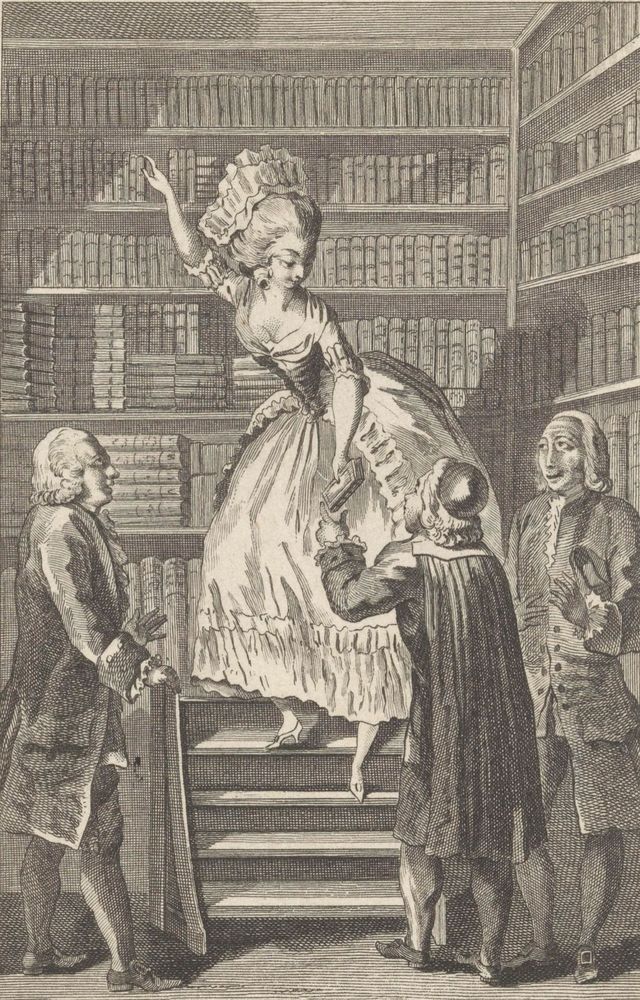
Young saleswoman in a bookstore, Paris, 1782, etching.
This two-day conference aims to share knowledge of women’s rich and varied lives and works in the period before the rapid industrialisation of book production, which changed the face of home labour for early modern women.
The growing field of feminist bibliography has been built upon a recognition that early modern books were mostly products of the interwoven sectors of domesticity and trade. Many book trade practices took place within the home, enabling the unofficial training and labour of women and children. It was only the most successful enterprises that prompted investment in bespoke buildings, prompting a public-private dialectic which was sometimes merely superficial, since many were also managed or served by female family members and domestic servants. Some women owned businesses, premises and stock; managed apprentices and shops; and held ijaza (licenses) or copyright. Many others laboured invisibly, printing and sewing volumes, engraving blocks, and making ink and paper from home.
Traditionally understood as a male-dominated domain, pioneering research of the 1990s by, for example, Helen Smith, Paula McDowell, Susan Broomhall, Mark Lehmstedt, and Leslie Howsam enabled us to reconsider the place of women in the book trade in a much more systematic way. Since then, scholars such as Sarah Werner, Saskia Limbach, Heleen Wyffels, and Rémi Jimenes have developed the field, and Kate Ozment, Cait Coker, and Michelle Levy have provided new and valuable tools for feminist bibliography in The Women in Book History Bibliography and The Women’s Print History Project. And yet, the work of recovering the history of women and their place in the book trade remains challenging and labour-intensive.
Historiography, record-keeping, and even the process of archiving have been androcentric, and the historical—and for the most part, printed—evidence that survives about women and book production predominantly concerns widows. Often, we need to look beyond the imprint and the advertisement to the material culture of book production, to the physical evidence of the codex and the personal records of journals and correspondence to identify female family members like daughters, sisters, and wives. With this turn to material cultural methodologies, the under-explored collections in museums and archives can provide a richer picture, one that is improving with new collections development practices and increased resources being allocated by heritage sites and major research libraries to women’s histories and to the recovery of marginalised figures in the History of the Book.
This conference, as a part of the FWO research project Partners in Innovation: Women Publishers as Knowledgeable Agents in the Low Countries’ Book Trade, 1550–1750, coincides with the year devoted to the many women living and working in the Officina Plantiniana in 2025 at Museum Plantin-Moretus, a UNESCO World Heritage Site, and is co-hosted with the Rubens House Museum, Antwerp. We invite participants to consider the supposed binary between home and work for women in the early modern book trade worldwide. Through this approach, we hope to share knowledge of women’s rich and varied lives and works in the period before the rapid industrialisation of book production which changed the face of home labour for early modern women. The event features a guided tour of Museum Plantin-Moretus and a show and tell of key artefacts from the collection.
We invite submissions for 20-minute papers addressing the following areas:
• Marriage and inheritance
• Networks, kinship, and patronage
• Representations of the household and women in the book trade
• Impact of women on the history of knowledge production
• Spatial and architectural perspectives
• Apprentices and apprenticing, formal and informal
• Reflections on methodologies for feminist recovery of women’s work in the book trade
• Transnational comparisons of home labour in the book trade
• Material cultural approaches to women’s book history
• Women’s work in all sectors of book production, including binding, paper making, etc.
Please send an abstract of 200 words to womenandplantin@antwerpen.be with your name, affiliation, email address, and a short bio of no more than 50 words by 31 March 2025. There will be a registration fee for presenters. Queries are welcomed.
Keynote Speakers
Susan Broomhall (Australian Catholic University) and Alicia Montoya (Radboud University)
Organising Committee
Nina Geerdink (Utrecht University), Kristof Selleslach (Museum Plantin-Moretus), Lieke van Deinsen (KU Leuven), Zanna Van Loon (Museum Plantin-Moretus), Helen Williams (Northumbria University), Patricia Stoop (University of Antwerp), and Pierre Delsaerdt (University of Antwerp)
Bernd Ebert Named General Director of the SKD
From the press release (4 March 2025) . . .
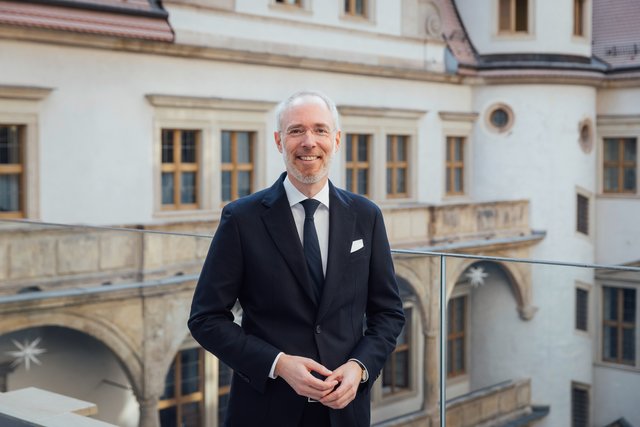
Dr. Bernd Ebert (Photo by Oliver Killig).
The Saxon state government agreed today that Dr Bernd Ebert will become the General Director of the Staatliche Kunstsammlungen Dresden (SKD or Dresden State Art Collections) from 1 May 2025 onwards. His contract will run until 30 June 2033. He will follow in the footsteps of Prof. Dr Marion Ackermann, who is becoming President of the Stiftung Preussischer Kulturbesitz (Prussian Cultural Heritage Foundation).
Dr Bernd Ebert is returning to Dresden after the previous stages in his career ideally prepared him for his new job at Saxony’s Art Collections. He impressed an international selection committee consisting of many prominent personalities, who unanimously recommended him to take up this internationally important museum position following a multi-stage selection procedure. Dr Bernd Ebert will move from his current leadership role at the Bayerische Staatsgemäldesammlungen (Bavarian State Painting Collections) to become the General Director of the SKD.
The Saxon State Culture Minister, Barbara Klepsch, issued the following strong statement. ”l’m delighted that we’ve once again been able to attract an outstanding person to Saxony: a high-profile and sought-after art historian and museum expert is taking over as the new General Director of our Dresden State Art Collections. He convinced us with his clear ideas about how he plans to lead the internationally renowned network of museums into a highly promising future. With his enthusiasm for the collections and thanks to his national and international experience and networks, he’s the ideal person to take over the position of General Director. We’re more than happy to hand over the responsibility for the successful Dresden State Art Collections to him from May 2025 onwards.”
Neil McGregor emphasized, “The search committee was fortunate in having a strong field of candidates, with a wide range of different experience: and we were unanimous in choosing Dr Bernd Ebert as the outstanding candidate to lead the SKD. He is of course a distinguished art historian with an international reputation as a scholar. But he is much more than that. He brings to the role a rare mix of legal, financial, and administrative skills; he has direct experience of tackling the intellectual, practical, and political complexities of a great encyclopaedic collection like the SKD; and he has an impressive track record of exhibitions, designed to win new audiences and to break down the traditional boundaries between art history and other disciplines. What most convinced us was his ambitious vision for the future of the collections as a whole, for what they can mean for Dresden, for Saxony, and for the world — and a clear understanding of how that vision can be made a reality.“
Dr Bernd Ebert comments, “In Saxony, lt’s wonderful to see how amazingly popular the collections and the multi-faceted programme formats at the SKD are with the general public and experience the depth of the bond between the population and their art treasures. Working with the team at SKD, it’s my goal to not only intensify the research work into the many and varied items in the collections, but also promote the way that their message is communicated in our modern world. One of the issues closest to my heart also involves extending the range of services for different groups of visitors and increasing the quality of the time that the general public spends in the SKD centres in order to make their overall experience even more attractive. l’m looking forward to publicising the cultural heritage, which is unique around the world in its quality and variety, to an even greater degree, both nationally and internationally, and l’m more than happy to commit myself to the passion for art that is part and parcel of life here in Saxony.”
Bernd Ebert (who was born in Berlin in 1972) started his career in Dresden with a training course to become a qualified banking clerk at Deutsche Bank AG. He then studied art history, jurisprudence, and business management in Bonn and simultaneously gained practical professional experience at the Metropolitan Museum of Art in New York, the Newtown Galleries in Johannesburg, the National Gallery of South Africa, and the lrma Stern Museum in Cape Town, as well as at renowned private collections and in the art trade.
He gained his doctorate (with the highest possible honours) in 2005 with a thesis focusing on the Dutch baroque painters, Simon and lsaack Luttichuys, having spent several years conducting research in the Netherlands as part of his doctorate.
Dr Ebert worked at the Staatliche Museen zu Berlin (State Museums in Berlin) from 2005 until 2013, initially as an academic museum assistant to the General Directorate and the painting gallery and then as an academic expert for the General Director. In this role, he coordinated the departments of research and scholarship as well as international cooperation arrangements across the collections, such as the EU twinning project with the Georgian National Museum in Tbilisi and the exhibition entitled ”The Art of the Enlightenment” at the Chinese National Museum in Beijing. He was a visiting fellow at the Getty Research Institute in Los Angeles in 2011.
Since 2013, Dr Ebert has been the Head of the Collection of Dutch and German Baroque Paintings at the Bavarian State Painting Collections and has been responsible for the state galleries in Bayreuth and Bamberg. His outstanding special exhibitions include Circle, Sphere, Cosmos (Berlin, Schwäbisch Hall, 2006/07); Utrecht, Caravaggio and Europe (Utrecht, Munich 2018/19); and Rachel Ruysch: Nature into Art (Munich, Toledo, and Boston, 2024/25).
Call for Papers | Carpentry and Sculpture
From ArtHist.net:
Carpentry and Sculpture from Gothic to Art Nouveau
Hôtel de la Roche, Mons, Belgium, 19–21 July 2025
Proposals due by 30 March 2025
A combined effort of the Centre de Recherches Historiques sur les Maîtres Ébénistes and The Low Countries Sculpture Society, whose libraries and archives have merged and are housed in the Hôtel de la Roche (1750) at Mons, the inaugural edition of the Annual Seminar on European Sculpture and Decorative Arts will take place in July 2025. This first edition will address questions about the production, consumption, collecting, and display of ‘carpentry furniture’ (in the Parisian sense of the expression) across Europe and North America, from the Gothic period to Art Nouveau. Issues of design history, collaborations between creators and producers, artists and artisans, as well as the relations with any other people involved are sought. Specificities of ‘carpentry furniture’, as opposed to other types of furniture design and production, may be investigated. This includes the study of relations between carpenters and sculptors, as well as that of historic sources, such as those published by André Jacob Roubo (1739–1791).
Its theme will draw, amongst others, but not exclusively, on the rich tradition of carpentry in the Low Countries, often in combination with magnificent sculpture in solid oak, particularly for church furniture, and on the Parisian tradition for meubles de menuiserie (‘carpentry furniture’), as differentiated from meubles d’ébénisterie (‘veneered furniture’) from the the 17th century onward, as formalised with separate guilds. ‘Carpentry furniture’ included seat furniture, console tables, floors and wall pannelling often with ornate sculptural elements, and always in solid wood, frequently painted and/or gilt, as opposed to veneered furniture. Gilt console tables were a particularly respected product of the Paris menuisiers.
The seminar has an international and multidisciplinary orientation. As such, we hope to attract lively participation from junior and senior scholars in the history of furniture and furnishings, sculpture, as well as practitioners of restoration-conservation in the same and other relevant fields. Short papers (maximum 30 minutes) of new research or work in progress may be presented in English or French. A minimal passive knowledge of both English and French is highly recommended to enable full participation in the ensuing discussions, which form the core of the seminar. The seminar will take place without an audience (apart from the speakers), but it will be filmed and broadcast live on YouTube.
The Society will cover accommodation expenses for foreign speakers at the seminar, as well as all group meals and the Sunday excursion. On the other hand, travel arrangements to and from Mons are the responsibility of the individual participants, and their travel expenses will not be reimbursed. We will endeavour to help with a shuttle from Maubeuge to Mons (20 km), as there is a direct train line from Paris to Maubeuge that is more reliable than the one to Mons.
Please send participation proposals with a 200-word abstract of the intended paper and a 200-word CV by email to info@lcsculpture.art by midday, 31 March 2025. We prefer to receive your abstract written in your mother tongue. We will then have it professionally translated into English and French for our scientific committee. News of the committee’s decisions will be sent in April. For further information, please contact The Low Countries Sculpture Society at info@lcsculpture.art.
Exhibition | Myth and Marble
Opening this month at AIC:
Myth and Marble: Ancient Roman Sculpture from the Torlonia Collection
Art Institute of Chicago, 15 March — 29 June 2025
Kimbell Art Museum, Fort Worth, 14 September 2025 — 25 January 2026
Montreal Museum of Fine Arts, 14 March — 19 July 2026
Curated by Lisa Ayla Çakmak and Katharine Raff
 From large-scale figures of gods and goddesses to portraits of emperors and magnificent funerary monuments, this exhibition brings to North America, for the first time, a selection of 58 rarely seen ancient Roman sculptures from Italy’s storied Torlonia Collection. Nearly half of these sculptures, which range in date from the 5th century BCE to the early 4th century CE, have not been publicly displayed in more than 70 years and have been newly cleaned, conserved, and studied specifically for this exhibition, making for a spectacular opportunity to experience their first public presentation in decades.
The Torlonia Collection is not only the largest private collection of Roman marble sculptures in Italy, but it is also arguably the most important of such private collections in the world. Comprising 622 works and a wide range of sculptural types and subjects, its holdings rival those of major institutions in Europe, including the Capitoline and Vatican Museums.
This veritable ‘collection of collections’ was formed in the 19th century by Prince Giovanni Torlonia (1754–1829) and his son Prince Alessandro (1800–1886), primarily through the purchase of several groups of ancient sculpture assembled in early modern Rome, as well as through extensive archaeological excavations on Torlonia estates in Italy. The taste at this time was for complete works of art, and restorations and other interventions carried out across the decades—in some instances by famed sculptors of the day—have impacted the sculptures’ current appearances while also enriching their histories.
By the 1870s, the collection was placed on view in a private museum in Rome, and a number of its masterworks became world-famous—among them the lovely portrait of a young woman known as the ‘Maiden of Vulci’ as well as the ‘Torlonia Girl’. In the wake of the Second World War, Alessandro Torlonia’s museum closed, and the collection went unseen for generations. During this closure, the Torlonia Foundation was created at the behest of Prince Alessandro Torlonia (1925–2017) to continue to both study and conserve the collection and the Villa Albani Torlonia.
Beginning in 2020, a series of exhibitions across Europe have brought selected highlights of the Torlonia Collection to public display once more. Myth and Marble debuts these masterpieces to a North American audience, presenting a once-in-a-lifetime opportunity to experience these exceptional ancient sculptures and explore the fascinating stories they reveal about both their ancient pasts and their modern afterlives.
Myth and Marble: Ancient Roman Sculpture from the Torlonia Collection is co-organized by the Art Institute of Chicago and The Torlonia Foundation, in collaboration with the Kimbell Art Museum, Musée des beaux-arts Montréal, and The Museum Box. The exhibition is curated by Lisa Ayla Çakmak, Mary and Michael Jaharis Chair and Curator, Arts of Greece, Rome, and Byzantium, and Katharine A. Raff, Elizabeth McIlvaine Curator, Arts of Greece, Rome, and Byzantium.
Lisa Ayla Cakmak and Katharine A Raff, eds., with contributions by Silvia Beltrametti and Salvatore Settis, Myth and Marble: Ancient Roman Sculpture from the Torlonia Collection (New Haven: Yale University Press, 2025), 160 pages, ISBN: 978-0300279658, $40.
New Book | Walking Rome’s Waters
From Yale UP:
Katherine Wentworth Rinne, Walking Rome’s Waters (New Haven: Yale University Press, 2025), 344 pages, ISBN: 978-0300276374, $35.
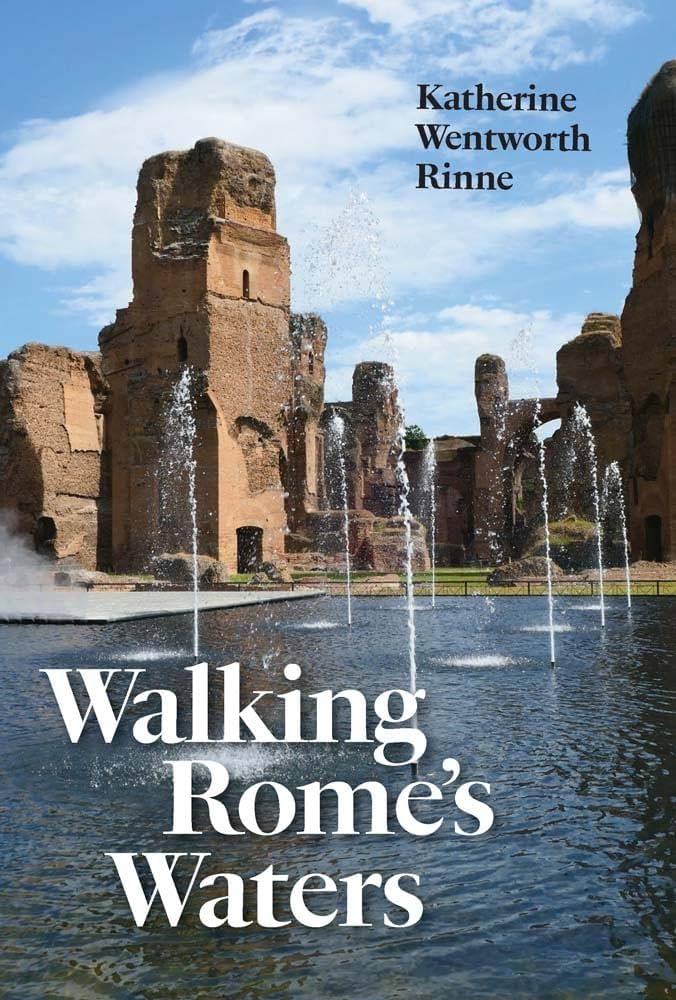 An engaging guide to the waterways of Rome and their role in shaping the city’s culture, history, and landscape
Written by a leading expert on the water infrastructure of Rome, this grand tour offers a new way to appreciate the history, geology, and character of the ancient and contemporary city. Richly illustrated itineraries wind through Rome’s streets, piazzas, and gardens, following the trail of water as it flows, propelled by gravity, through different neighborhoods. In addition to mapping thirteen walking tours, Katherine Wentworth Rinne also pulls the reader underground—where hidden springs and streams still flow—to illuminate how Rome’s complex topography has been transformed since antiquity, as well as into the sky, imaginatively flying over Rome’s villas and parks to give readers a sense of the infrastructure through an aerial view. Whether enjoyed from an armchair at home or as a companion on strolls next to aqueducts, fountains, and the Tiber River, this guidebook, filled with the author’s unique insights, brings the vibrant world of Rome’s water to life, with its eddies and whorls twisting throughout the city’s storied history.
Katherine Wentworth Rinne is a visiting scholar in the Center for Cultural Landscapes in the School of Architecture and an associate fellow at the Institute for Advanced Technology in the Humanities at the University of Virginia.










 Enfilade
leave a comment