Exhibition | Japanese Poetry, Calligraphy, and Painting
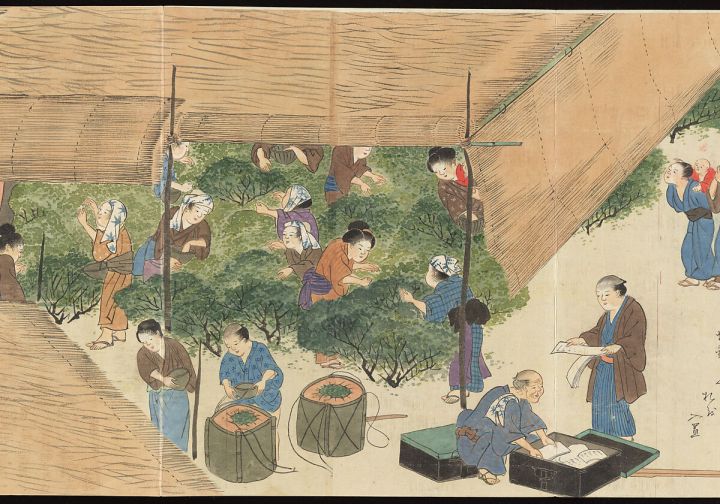
Saitō Motonari, Illustrations of Uji Tea Production, 1803, Edo period (1615–1868), handscroll (57 feet) of thirty-two sheets reformatted as a folding album (New York: The Metropolitan Museum of Art, 2023.237).
◊ ◊ ◊ ◊ ◊
Now on view at The Met:
The Three Perfections: Japanese Poetry, Calligraphy, and
Painting from the Mary and Cheney Cowles Collection
The Metropolitan Museum of Art, New York, 10 August 2024 — 3 August 2025
Curated by John Carpenter
In East Asian cultures, the arts of poetry, calligraphy, and painting are traditionally referred to as the ‘Three Perfections’. This exhibition presents over 160 rare and precious works—all created in Japan over the course of nearly a millennium—that showcase the power and complexity of the three forms of art. Examples include folding screens with poems brushed on sumptuous decorated papers, dynamic calligraphy by Zen monks of medieval Kyoto, hanging scrolls with paintings and inscriptions alluding to Chinese and Japanese literary classics, ceramics used for tea gatherings, and much more. The majority of the works are among the more than 250 examples of Japanese painting and calligraphy donated or promised to The Met by Mary and Cheney Cowles, whose collection is one of the finest and most comprehensive assemblages of Japanese art outside Japan.
The exhibition is made possible by The Miriam and Ira D. Wallach Foundation Fund.
Information on the objects exhibited can be found here»
◊ ◊ ◊ ◊ ◊
The catalogue is distributed by Yale UP:
John Carpenter, with Tim Zhang, The Three Perfections: Japanese Poetry, Calligraphy, and Painting (New York: The Metropolitan Museum of Art, 2025), 320 pages, ISBN: 978-1588397805, $65.
 In East Asian cultures, the integration of poetry, painting, and calligraphy, known as the ‘Three Perfections’, is considered the apex of artistic expression. This sumptuous book explores 1,000 years of Japanese art through more than 100 works—hanging scrolls, folding screens, handscrolls, and albums—from the Mary and Cheney Cowles Collection at The Metropolitan Museum of Art. John T. Carpenter provides an engaging history of these interrelated disciplines and shows evidence of intellectual exchange between Chinese and Japanese artists in works with poetry in both languages, calligraphies in Chinese brushed by Japanese Zen monks, and examples of Japanese paintings pictorializing scenes from Chinese literature and legend. Many of the works featured, including Japanese poetic forms, Chinese verses, and Zen Buddhist sayings, are deciphered and translated here for the first time, providing readers with a better understanding of each work’s rich and layered meaning. Highlighting the talents of such masters as Musō Soseki, Sesson Shūkei, Jiun Onkō, Ryōkan Taigu, Ike no Taiga, and Yosa Buson, this book celebrates the power of brush-written calligraphy and its complex visual synergy with painted images.
John T. Carpenter is the Mary Griggs Burke Curator of Japanese Art in the Department of Asian Art at The Metropolitan Museum of Art. He has been with The Met since 2011. From 1999 to 2011, he taught the history of Japanese art at the School of Oriental and African Studies (SOAS), University of London, and served as head of the London office of the Sainsbury Institute for the Study of Japanese Arts and Cultures. He has published widely on Japanese art, especially in the areas of calligraphy, painting, and woodblock prints, and has helped organize numerous exhibitions at the Museum, including Designing Nature (2012–13), Brush Writing in the Arts of Japan (2013–14), Celebrating the Arts of Japan (2015–17), The Poetry of Nature (2018–2019), and The Tale of Genji: A Japanese Classic Illuminated (2019).
Tim T. Zhang is Research Associate of Asian Art at The Metropolitan Museum of Art.
c o n t e n t s
Director’s Foreword
Preface
Becoming a Collector of Japanese Art — Cheney Cowles
Acknowledgments
Note to the Reader
Introduction
Inscribing and Painting Poetry: The Three Perfections in Japanese Art — John T. Carpenter
Catalogue
1 Courtly Calligraphy Styles: Transcribing Poetry in the Heian Palace
Entries 1–13
2 Spiritual Traces of Ink: Calligraphies by Medieval Zen Monks
Entries 14–31
3 Reinvigorating Classical Poetry: Brush Writing in Early Modern Times
Entries 32–59
4 Poems of Enlightenment: Edo-Period Zen Calligraphy
Entries 60–84
5 China-Themed Paintings: Literati Art of Later Edo Japan
Entries 85–111
Notes
Bibliography
Index
Credits










 Enfilade
leave a comment