The Sainsbury Wing of London’s National Gallery Reopens
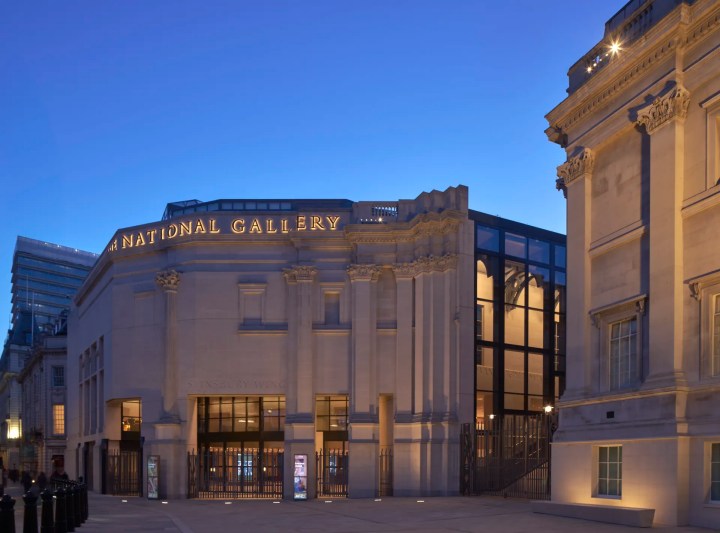
View of the National Gallery Sainsbury Wing from Trafalgar Square. After contentious early designs were scuttled in the 1980s, the Sainsbury Wing, as conceived by Robert Venturi and Denise Scott Brown, opened in 1991. The latest revisioning, an £85m project, was led by Annabelle Selldorf. (Photo by Edmund Sumner, ©The National Gallery, London).
◊ ◊ ◊ ◊ ◊
From the press release (9 May 2025) . . .
The National Gallery’s new main entrance reopened to the public on Saturday 10 May 2025, as part of the Gallery’s 200th birthday celebrations.
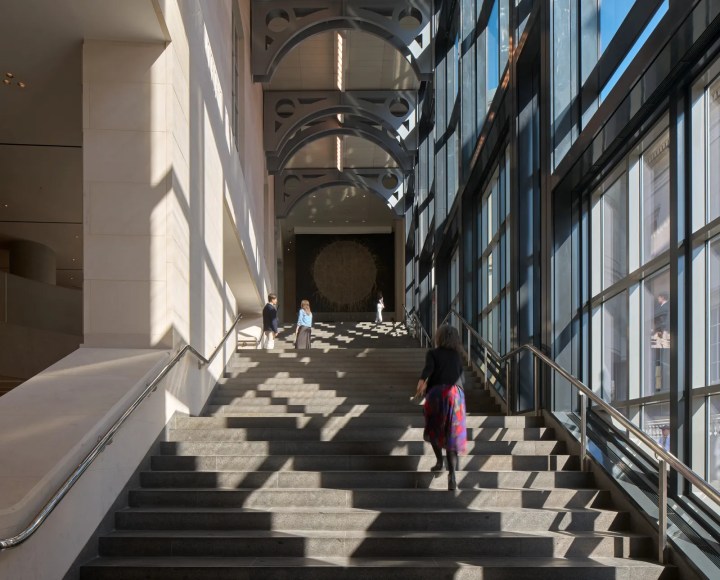
View looking up the main staircase of the Sainsbury Wing (Photo by Edmund Sumner, ©The National Gallery, London).
The Sainsbury Wing closed in February 2023 to undergo sensitive interventions to its external façade, foyer, and first floor, providing a better and more welcoming first experience to the National Gallery’s millions of visitors, in a plan designed by New York-based Selldorf Architects, working with heritage architects Purcell.
At the entrance, some of the Gallery’s footprint has been given over to public realm, creating a ‘square-within-a-square’, and leading to a more spacious entrance to the Gallery. The original dark glass of the stairs up to the gallery spaces has been replaced with clear glazing, bringing daylight across the foyer while revealing subtle views of the 1830s National Gallery building by William Wilkins (1778–1839). The glazing also allows people in Trafalgar Square to see directly into the Gallery for the first time.
This entrance opens into a new double-height foyer, which is larger, more open, and brightly lit. A 12-metre wide, 16K screen shows astounding details of National Gallery paintings. Visitors will find a new espresso bar, ‘Bar Giorgio’, by Giorgio Locatelli, on the ground floor. ‘Locatelli’, the restaurant by the same chef, will be on the mezzanine level, alongside a new bookshop and spaces for meetings and events. A bar will provide the to-date only publicly accessible space in London to enjoy a drink with views onto Trafalgar Square.
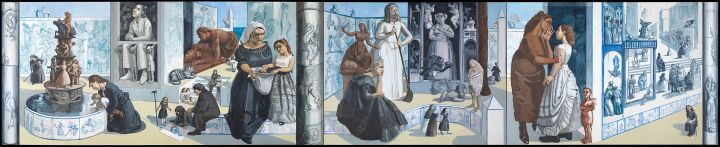
Paula Figueiroa Rego (1935–2022), Crivelli’s Garden, 1990–91, acrylic on canvas. Commissioned by the National Gallery in 1989, the painting responds to the predella of Carlo Crivelli’s Madonna of the Swallow (1491)—with an emphasis on the actions of strong women.
◊ ◊ ◊ ◊ ◊
Facing the restaurant diners will be Paula Rego’s (1935–2022) Crivelli’s Garden (1990–91). Rego was the National Gallery’s first Associate Artist and was inspired to create the work by looking at Renaissance paintings by Carlo Crivelli (about 1430/5 – about 1494) for the Sainsbury Wing Dining Room on its original opening in 1991.
Also reopening is the recently renamed Pigott Theatre, on the lower ground floor. The theatre has been fully refurbished with a new colour scheme and refitted for increased comfort and accessibility, including level access to the stage.
The palette of high-quality materials used throughout the new spaces includes the same grey Florentine limestone (pietra serena) employed in the Venturi-Scott Brown designed gallery spaces, along with Chamesson limestone from northern Burgundy, slate, oak, and black granite. Wherever possible existing materials have been re-used, recycled, or repurposed in other building projects.
The NG200 Welcome project has been made possible thanks to support from many generous donations, from both major benefactors and members of the public. In particular, The Linbury Trust and The Headley Trust which, together with The Monument Trust, funded the original establishment of the Sainsbury Wing 35 years ago, have been instrumental in helping the Gallery to realise the evolution of the building for its changing visitor needs.
Statements by Timothy Sainsbury, Gabriele Finaldi, Annabelle Selldorf, and Chris Bryant are available in the full press release.
◊ ◊ ◊ ◊ ◊
In his review of the newly unveiled spaces, Oliver Wainwright provides a useful summary of the architectural controversies that have always been part of the Sainsbury Wing’s history.
Oliver Wainwright, “‘Tranquillising Good Taste’: Can the National Gallery’s Airy New Entrance Exorcise Its Demons?” The Guardian (6 May 2025). When the Sainsbury Wing opened, it was called ‘vulgar pastiche’. Now, after an £85m revamp, it has become the famous gallery’s main entrance. But have its spiky complexities been tamed? And why all the empty space?
When the Sainsbury Wing first opened in 1991, it was not loved. It was variously slammed as “a vulgar American piece of postmodern mannerist pastiche” and “picturesque mediocre slime.” It was too traditional for modernists and too playful for traditionalists. Its dark, low-ceilinged entrance was damned as “a nasty cellar-like space” cluttered with a maze of (non-structural) columns. “It just didn’t work,” says the gallery’s deputy director, Paul Gray, adding that visitor numbers have swelled from three million back then to approaching six million now. The wing was never intended to handle such volumes. “The modern visitor expects so much more now. They want big, open, welcoming spaces, and it never felt like that.”
But time garners affection. And there is nothing like the threat of change to arouse fondness. When Selldorf’s modernising plans were first unveiled in 2022, the same critics who had pooh-poohed Venturi Scott Brown’s design leapt to its defence. . . .
The full article is available here»
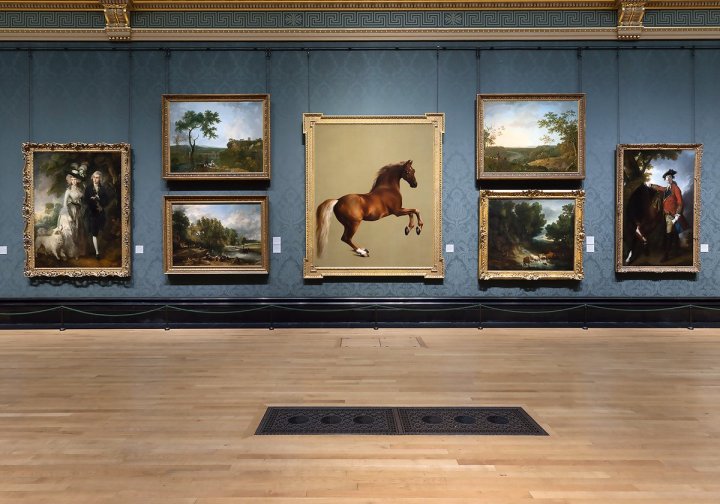
In Room 34 George Stubbs’s Whistlejacket (ca. 1762) is surrounded by a new ‘salon’ hang of British painting, 1740–1800.
◊ ◊ ◊ ◊ ◊
In addition to the reworking of the entrance and secondary spaces, galleries were rehung under the direction of Christine Riding, as described by Martin Bailey for The Art Newspaper:
Martin Bailey, “First Look: The ‘Once-in-a-Lifetime’ Rehang at London’s National Gallery,” The Art Newspaper (5 May 2025).
The Art Newspaper was given an early tour by Christine Riding, the director of collections and research, who has overseen the rehang. She describes her task as a “once-in-a-lifetime” opportunity. Now virtually completed, the rehang means that the National Gallery will show nearly 40% of its collection.
There will be 1,045 paintings hanging in the upper-floor rooms: 919 from the collection, plus 126 on loan. Nearly a third will be in the Sainsbury Wing and the rest on the main floor of the original Wilkins building. . . .
The number of works on display is slightly greater than before, thanks to a marginally denser hang, more glass cases in the centre of rooms, two walls with 34 plein-air landscape oil sketches (Room 39) and an additional space (Room 15a) with small Dutch pictures.
Riding has been particularly keen to emphasise “how artists have been influenced by their predecessors.” For instance, Elisabeth Vigée Le Brun’s Self Portrait in a Straw Hat (1782) is hung in the same octagonal space (Room 15) as the picture that inspired it, Peter Paul Rubens’s presumed Portrait of Susanna Lunden (1622–25). . . .
The Sainsbury Wing will now be the main entry point for visitors, with possibly more than 90% coming through there rather than via the portico or Getty entrances.
The full article is available here»










 Enfilade
leave a comment