Exhibition | Raphael to Cozens: Drawings from Richard Payne Knight
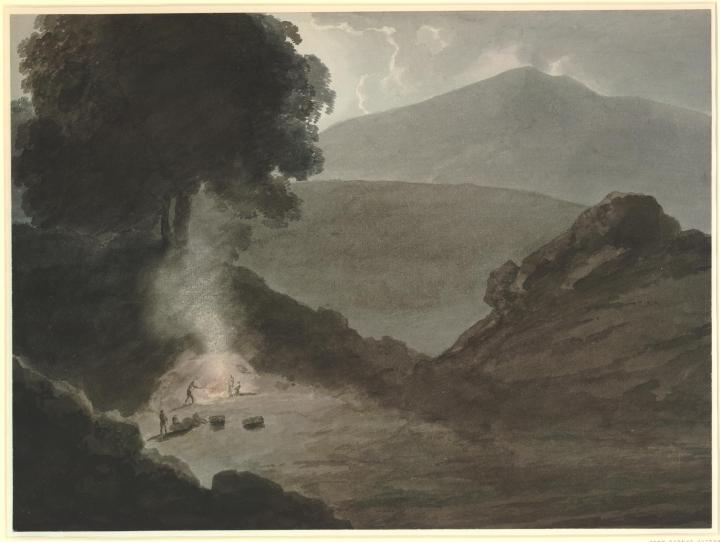
John Robert Cozens, Mount Etna from the Grotta del Capro; scene in a hollow on a hill-side, at left a group of figures gathered around a fire in a cave, above a clump of trees hiding the moon, beyond a further ridge rises a mountain, ca. 1777–78, watercolour over graphite with gum arabic and scratching out, 357 × 483 mm (London: The British Museum, Oo,4.38).
◊ ◊ ◊ ◊ ◊
Opening today at The British Museum:
Raphael to Cozens: Drawings from the Richard Payne Knight Bequest
The British Museum, London, 15 May — 14 September 2025
Raphael, Michelangelo, and Thomas Gainsborough are among the masters whose work will be on display at a new exhibition celebrating a transformative 19th-century bequest. The antiquarian and art collector Richard Payne Knight (1751–1824) bequeathed over a thousand drawings to the British Museum. The superb quality of his collection transformed the Museum’s graphic holdings and established it as a place where visitors could admire old master drawings alongside works of contemporary British art.
Born into a wealthy family of ironmasters from Herefordshire, Payne Knight was educated in the classics and complemented his studies, as many on the Grand Tour did, with extended travels in Italy. There he pursued his interests in ancient civilisations and languages, and formed the aesthetic sensibilities and tastes that would later shape his collecting and writing. His substantial financial means enabled him to acquire the best drawings available on London’s late 18th-century art market. The exhibition explores the breadth of Payne Knight’s intellectual interests through some of the most celebrated works from the bequest. Drawings by Renaissance and Baroque painters like Raphael, Michelangelo, and Claude Lorrain will be shown alongside work by Payne Knight’s contemporaries, including Thomas Gainsborough and John Robert Cozens. Together the drawings reveal Payne Knight’s enthusiasm for landscapes and for the romance of the classical past, as well as his admiration for the verve and spontaneity of the artists whose works he bought.
The exhibition marks the first time that a representative selection of this important bequest has been displayed since its arrival at the British Museum in 1824.
Exhibition | Colour and Line: Watteau Drawings
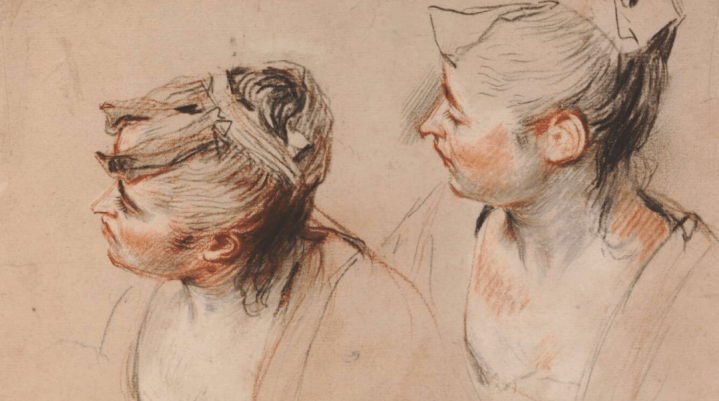
Antoine Watteau, Four Studies of a Young Woman’s Head, detail, 1716–17, drawing with black, red, and white chalks
(London: The British Museum, 1895,0915.941).
◊ ◊ ◊ ◊ ◊
Opening today at The British Museum:
Colour and Line: Watteau Drawings
The British Museum, London, 15 May — 14 September 2025
This Antoine Watteau (probably 1684–1721) was one of the most influential, prolific artists active in 18th-century France. In a short career lasting little more than a decade, he pushed painting in new directions that were to guide generations of French artists, blending genre, mythology and rococo frivolity in works so novel that they heralded a new genre: the fête galante.
Watteau won particular renown for the thousands of drawings he produced during his life. Drawing, as contemporaries realised, was his favourite creative outlet, bringing him ‘much more pleasure than his finished pictures’. He drew incessantly, and developed ideas about the value of drawing that were every bit as original as his paintings. Instead of making figure studies for a picture as academic practice dictated, Watteau drew speculatively, conceiving ideas that might be slotted into a picture months or even years later. The sheets he produced were to be enjoyed in their own right as the first, freshest iterations of ideas that he thought were dulled when translated into paint.
Nowhere were these qualities more appreciated than in Britain, and over the past two centuries British collectors have endowed the British Museum with one of the finest collections of Watteau drawings in the world. Featuring almost every autograph work in the collection, this display is the first exhibition of the Museum’s Watteau holdings to be held since 1980. Its varied contents demonstrate Watteau’s extraordinary talent as a draughtsman, his sophisticated, novel approach to drawing, and the prestige that his graphic works enjoyed among Europe’s connoisseurs.










 Enfilade
leave a comment