John Deare’s ‘Edward and Eleanor’ (1790) Acquired by the V&A
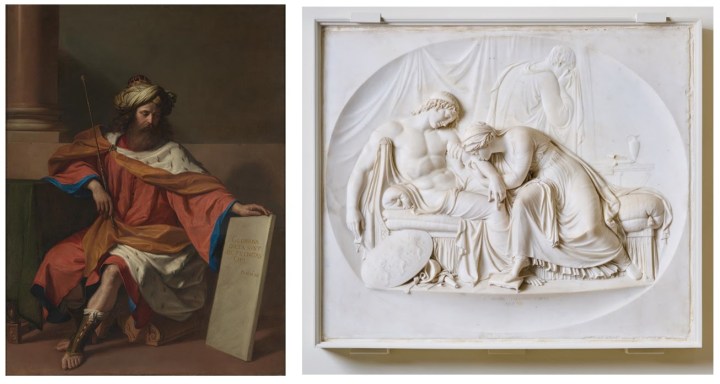
Left: Guercino, King David, 1651, oil on canvas, 224 × 170 cm (Accepted in lieu of Inheritance Tax by HM Government and allocated to the National Gallery). Right: John Deare, Edward and Eleanor, 1790, marble (Accepted in Lieu of Inheritance Tax from the Estate of Jacob, 4th Baron Rothschild and allocated to the Victoria and Albert Museum).
◊ ◊ ◊ ◊ ◊
From the press release:
The legacy of UK cultural luminary Jacob, 4th Baron Rothschild (1936–2024) is being celebrated by two of his artworks joining the collections of the National Gallery and the V&A, through the Acceptance in Lieu scheme. The National Gallery—where Jacob, 4th Baron Rothschild served as Chair of Trustees between 1985 and 1998—will receive King David (1651) by renowned Bolognese painter Giovanni Francesco Barbieri (1591–1666), known as Guercino, reuniting it with the two works both created to be its pendant, already part of the Trafalgar Square collection. The V&A will receive the marble relief Edward and Eleanor (1790) by John Deare (1759–1798), one of the most talented neoclassical sculptors working at the end of the 18th century.
Jacob, 4th Baron Rothschild, in addition to chairing the National Gallery, led the National Lottery Heritage Fund and the family’s flagship, Waddesdon Manor. He supported many causes, some close to his home in Buckinghamshire, others as far afield as Albania, Greece, Israel, and the United States. He was committed to helping communities, the environment, education and above all, the arts. His exemplary service to his country was recognised on several occasions, with a GBE, a CVO and as a member of the Order of Merit.
His daughter, Dame Hannah Rothschild—who also served as Chair of the National Gallery—said, “My father, Jacob, was a devoted patron of the arts and a steadfast champion of the National Gallery. He regarded Guercino’s King David, a masterwork of the Italian Baroque, as one of the crowning acquisitions of his lifetime. It was his wish to see King David reunited with its two Sibyls at the National Gallery and his family is grateful to the AIL Panel and to the National Gallery for giving it a distinguished home amongst such illustrious company. The exquisite marble relief by John Deare is of such rarity and importance that my father, Jacob, felt it must find its home in a national institution. Our family is delighted that the AIL Panel and the V&A have accepted this bequest, fulfilling his vision with such care and distinction.”
◊ ◊ ◊ ◊ ◊
Celebrated as one of the most innovative and gifted British neoclassical sculptors, John Deare (1759–1798) spent most of his career in Rome, where the relief of Edward and Eleanor was carved in 1790. Due to his early death at age 38, his production was limited to around fifty documented works, though very few of these are known today. The majority were reliefs of classical and allegorical subjects or related to English history, commissioned by British Grand Tourists to decorate their country houses.
Until now, only two other marble sculptures by Deare were held in British public collections: Cupid and Psyche (1791) at the Bradford District Museums & Galleries and Julius Caesar Invading Britain (1796) acquired by the V&A in 2011 (on display in the Hintze Gallery, G22). Plaster versions of the Edward and Eleanor composition are held at Wimpole Hall and at the Walker Art Gallery.
The relief depicting Eleanor of Castile sucking poison from the wound of Prince Edward (later Edward I) will be installed in the British Galleries (G119) at V&A South Kensington later this year—the first time it has been on public display. In this exceptional relief, which demonstrates Deare’s virtuoso technique in carving marble with great subtlety, the sculptor has adapted an episode of medieval British history into a depiction of Greek history, in a refined neoclassical style.
The work is of particular interest to the V&A, as it predates the Caesar Invading Britain relief and shows various sources of inspiration in the composition, including the paintings of Angelika Kauffman. The V&A also holds several albums of drawings by John Deare, including a study of a woman (E.260-1968) believed to be preparatory for the figure of Eleanor.
Much remains to be discovered about Deare’s production. The V&A is hosting an international conference on 16 and 17 May 2025 on the theme of sculptural exchanges between Italy and Britain in the 18th and 19th centuries, where the relief will be the focus of a spotlight presentation, marking the start of a new line of research into the artist’s work.
Tristram Hunt, Director of the V&A, said: “These remarkable acquisitions, made possible by the Acceptance in Lieu scheme, will forever represent Lord Rothschild’s legacy as a great connoisseur, champion of the arts and relentless supporter of British cultural institutions.”
John Deare (1759–1798) Edward and Eleanor: Accepted in Lieu of Inheritance Tax from the Estate of Jacob, 4th Baron Rothschild and allocated to the Victoria and Albert Museum. The acceptance of this sculpture settled £1,120,000 in tax.
Additional information about Guercino’s King David is available from the full press release»










 Enfilade
leave a comment