Conference | The Global Baroque, 1600–1750
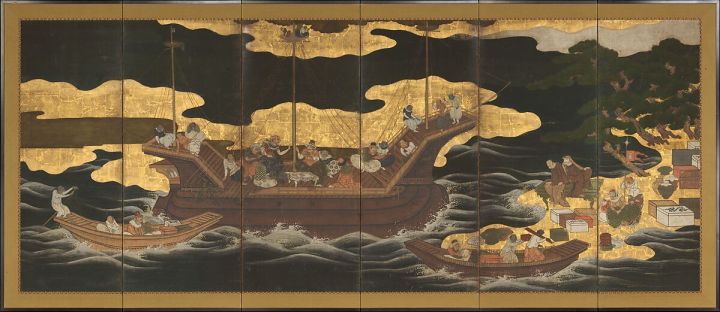
Japanese, Arrival of the Europeans, first quarter of the 17th century, one of a pair of folding screens, 105 × 261 cm
(New York: The Metropolitan Museum of Art, 2015.300.109.1, .2).
◊ ◊ ◊ ◊ ◊
From ArtHist.net and the University of York:
The Global Baroque
European Material Culture between Conquest, Trade, and Mission, 1600–1750
King’s Manor, University of York, 10–11 July 2025
Organized by Adam Sammut and Tomasz Grusiecki
Registration due by 1 July 2025
The period of Western art history known as ‘the Baroque’ has traditionally been interpreted as a stylistic phenomenon. However, artistic production in Europe from around 1600 to 1750 was enabled by a proto-industrial world system dominated by Spain and Portugal, the Netherlands, and later Britain. As a result, material culture became entangled in networks of trade, colonial rule, and Catholic global mission stretching from Naples to Nagasaki. This conference will broaden perspectives on the Baroque, embracing its transcontinental and multi-media character. By culturally decentring Europe and with materiality a special focus, the programme will recast the continent as a constituent part of an expanding artistic world driven by war, the exploitation of ecosystems, and the first information technology revolution. Bringing together scholars and museum curators from the UK and internationally, the conference will demonstrate how objects can offer intimate insights into global histories often characterised by vast, impersonal economic forces.
Part of The British Academy Conferences 2025/26
t h u r s d a y , 1 0 j u l y
9.00 Registration with coffee, tea, and pastries
9.40 Opening Remarks — Adam Sammut (University of York) and Tomasz Grusiecki (Boise State University)
10.00 Session 1 | Baroque Aesthetics
Chair: Adam Sammut (University of York)
• Black Beauty and the Canon: Nicolas Cordier’s Borghese Moor — Lorenzo Pericolo (Florida State University)
• Ancient Greece and the English Baroque — Matthew Walker (Queen Mary University of London)
11.20 Coffee and tea
11.50 Session 2 | New Geographies of the Low Countries
Chair: Cordula van Wyhe (University of York)
• Global Conversions: Peter Paul Rubens, King Philip IV of Spain, and the Coiners of Antwerp — Christine Göttler (University of Bern)
• Biting lines: Baroque Violence in Rembrandt’s Small Lion Hunt (1629) — Thomas Balfe (The Warburg Institute)
• A Taste for Blackness: Ebony in the Dutch Republic — Claudia Swan (Washington University in St. Louis)
13.20 Lunch break
14.20 Session 3 | Ottoman Worlds
Chair: Richard McClary (University of York)
• Style, Society, and the State: Ottoman Baroque Identities in 18th-Century Istanbul — Ünver Rüstem (Johns Hopkins University)
• Object Circulation and Networks on the Periphery of Eastern Central Europe: The Case Studies of the Ottoman Tributary States of Transylvania and Moldavia — Robert Born (Bundesinstitut für Kultur und Geschichte des östlichen Europa)
15.30 Coffee and tea
16.00 Keynote Address
• Necropastoral Worldscapes in Dutch-occupied Brazil — Angela Vanhaelen (McGill University)
18.00 Dinner at Ambiente Fossgate, by invitation
f r i d a y , 1 1 j u l y
9.30 Coffee, tea, and pastries
10.00 Session 4 | Where is Central and Eastern Europe?
Chair: Tomasz Grusiecki (Boise State University)
• Corpisanti between Rome and the Fringes of Catholicism: A Case Study in a Centripetal Approach to Material Culture of the Late Global Baroque — Ruth Sargent Noyes (Estonian Academy of Arts)
• Black Bodies as Baroque Decorations: Objectification of Africans in the Self-Representation of Polish-Lithuanian Elites — Vital Byl (University of Bonn)
11.00 Coffee and tea
11.30 Session 5 | The Asia-Pacific and the Indian Ocean
Chair: Tara Alberts (University of York)
• Objects and Empire on the Portuguese India Run — Elsje van Kessel (University of St Andrews)
• Indian Oceanic Travels of Coco-de-mer: Mythology and Materiality — Peyvand Firouzeh (University of Sydney)
• The Transcultural Body of the Mermaid — Anna Grasskamp (University of Oslo)
13.00 Lunch break
14.00 Session 6 | Atlantic Crossings
Chair: Simon Ditchfield (University of York)
• What’s in a Name? The Low Countries and the Global Turn — Stephanie Porras (Tulane University)
• A Counter-Baroque? Iroquois Town Planning and the Early Modern Imagination — Lorenzo Gatta (University College London)
• Emptied Orbs, or, A Case Against the Global — Aaron Hyman (University of Basel)
15.30 Coffee and tea
16.00 Roundtable discussion
17.30 Wine reception










 Enfilade
leave a comment