Exhibition | Unearthed: The Power of Gardening

◊ ◊ ◊ ◊ ◊
Now on view at the BL:
Unearthed: The Power of Gardening
British Library, London, 2 May — 10 August 2025
Curated by Maddy Smith
From beautiful botanical illustrations to the world’s oldest mechanised lawnmower, ancient herbals to guerrilla gardening zines, Unearthed reveals how gardeners have cultivated more than just plants—they’ve sown the seeds of change. Dive into gardening’s role in our health and wellbeing, see how people have reimagined our homes, towns and cities to create green spaces, and uproot the tangled histories of the plants that grow in our gardens today.
Among an incredible collection of books, manuscripts, photographs, artworks and historical tools, highlights include:
• the first English gardening manual: Thomas Hill’s 1558 guide on how to tend a garden
• Charles Darwin’s vasculum, for collecting plant specimens on the Beagle voyage
• the only surviving illustrated Old English herbal
• an oil portrait of John Ystumllyn, one of Britain’s earliest documented Black gardeners
• Gertrude Jekyll’s boots: a trailblazing gardener, writer, artist, and one of the 20th century’s most influential garden designers
• striking botanical art by European, Indian, Chinese, and Caribbean artists
• four short films following Coco Collective, an Afro-diaspora led community garden that opened as a response to the Covid-19 pandemic
• a Victorian Wardian case, the mini travelling greenhouse that enabled thousands of living plant specimens to be moved around the world.
Unearthed celebrates gardening as a force for creativity, resilience, and community through the remarkable stories of the people and plants that shape our gardens.
Exhibition | Picturing Nature: British Landscapes
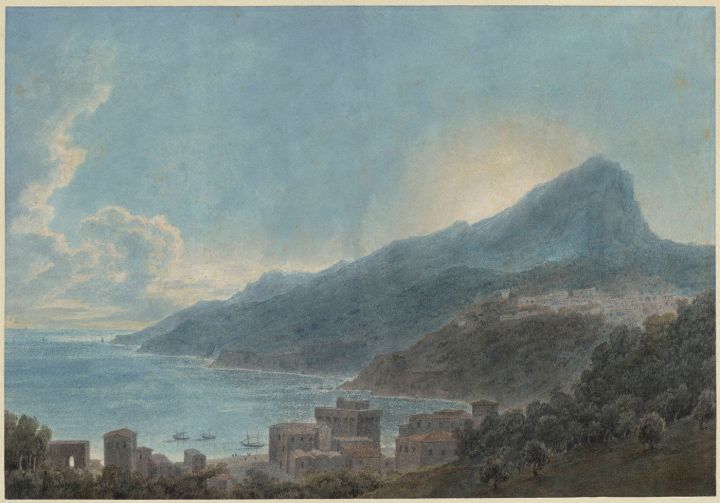
John Robert Cozens, View of Vietri and Raito, Italy, ca. 1783, watercolor over graphite on cream laid paper (The Museum of Fine Arts, Houston, The Stuart Collection, museum purchase funded by Francita Stuart Koelsch Ulmer in honor of Dena M. Woodall).
◊ ◊ ◊ ◊ ◊
Now on view at the MFAH:
Picturing Nature: The Stuart Collection
of 18th- and 19th-Century British Landscapes and Beyond
The Museum of Fine Arts Houston, 12 January — 6 July 2025
Featuring more than 70 works of art in a variety of media, Picturing Nature: The Stuart Collection of 18th- and 19th-Century British Landscapes and Beyond explores how the genre of landscape evolved during an era of immense transformation in Britain. This diverse collection of watercolors, drawings, prints, and oil sketches traces the shift from topographical and picturesque depictions of the natural world to intensely personal ones that align with Romantic poetry of the period. The exhibition spotlights the Stuart Collection, built over the past decade in collaboration with Houstonian Francita Stuart Koelsch Ulmer. This exceptional collection includes standout works by notable artists such as John Constable, John Robert Cozens, Thomas Gainsborough, J.M.W. Turner, and Richard Wilson, whose innovative approaches to watercolor raised its status as an art form and heralded a golden age for the medium.
Through the work of these luminaries and their contemporaries, Picturing Nature reveals how landscape emerged as a distinct artistic genre in England in the late 1700s, then reached its greatest heights the following century, attracting international response and inspiring both artists and collectors at home and abroad. Period publications and artist’s supplies, including drawing manuals and a mid-19th-century Winsor & Newton watercolor box, further illustrate the flowering of the landscape tradition.
Dena M. Woodall, Picturing Nature: The Stuart Collection of 18th- and 19th-Century British Landscapes and Beyond, $35. The online catalogue of the Stuart Collection is available here.
New Book | The Education of Things
From the University of Massachusetts Press:
Elizabeth Massa Hoiem, The Education of Things: Mechanical Literacy in British Children’s Literature, 1762–1860 (Amherst: University of Massachusetts Press, 2024), 328 pages, ISBN: 978-1625347565 (hardback), $99 / ISBN: 978-1625347558 (paperback), $31.
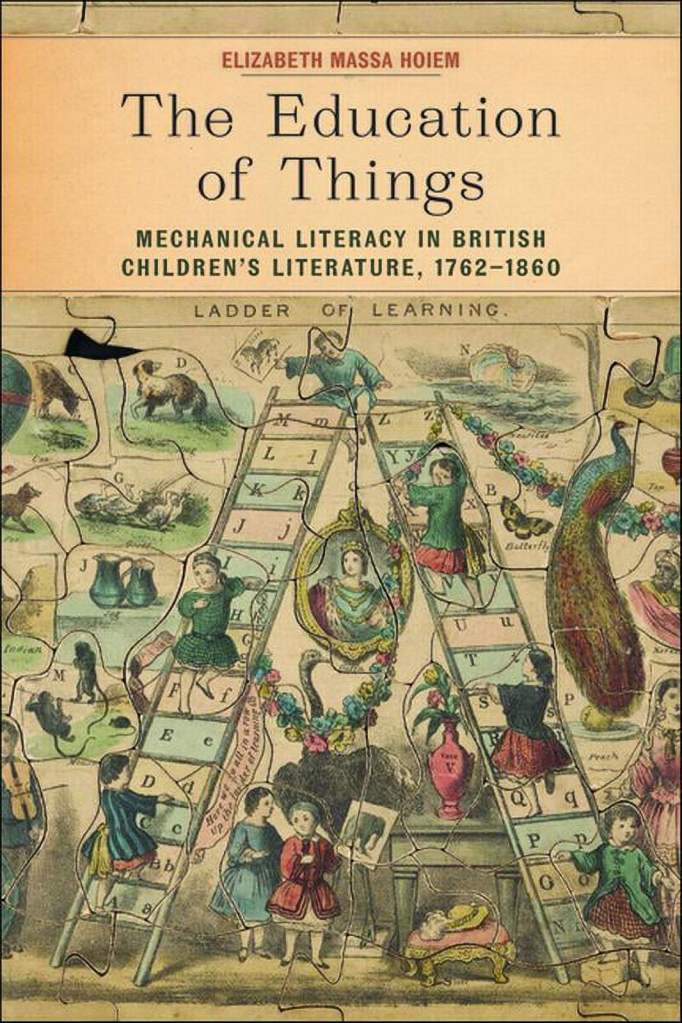 Winner of the 2025 Justin G. Schiller Prize for Bibliographical Work on Children’s Books from The Bibliographical Society of America
By the close of the eighteenth century, learning to read and write became closely associated with learning about the material world, and a vast array of games and books from the era taught children how to comprehend the physical world of ‘things’. Examining a diverse archive of popular science books, primers, grammars, toys, manufacturing books, automata, and literature from Maria Edgeworth, Jean-Jacques Rousseau, and Anna Letitia Barbauld, The Education of Things attests that material culture has long been central to children’s literature. Elizabeth Massa Hoiem argues that the combination of reading and writing with manual tinkering and scientific observation promoted in late eighteenth- and early nineteenth-century Britain produced new forms of ‘mechanical literacy’, competencies that were essential in an industrial era. As work was repositioned as play, wealthy children were encouraged to do tasks in the classroom that poor children performed for wages, while working-class children honed skills that would be crucial to their social advancement as adults.
Elizabeth Massa Hoiem is assistant professor in the School of Information Sciences at University of Illinois Urbana-Champaign.
c o n t e n t s
List of Illustrations
Preface
Introduction
1 What Children Grasp: The Tangible Properties of Objects
2 Moving Bodies: Manual Labor and Children’s Play in Mechanical Philosophy Books
3 ‘The Empire of Man over Material Things’: Children’s Books on Manufacturing and Trade
4 Self-Governing Machines: Automata and Autonomy in Maria Edgeworth’s Fiction
5 ‘Knowledge That Shall Be Power in Their Hands’: Radical Grammars for Working-Class Readers
Conclusion: William Lovett’s Case of Moveable Type
Notes
Index
London’s Treasure House Fair, 2025

Edmund Joy, ‘Mr. Joy’s Surprise’ (child’s wardrobe in the form of a doll’s house), 1709, 66 × 58 × 26 inches (Thomas Coulborn & Sons Ltd, UK). A similar piece, also made by Edmund Joy and dated 1712, is part of the V&A collection. The façades of both houses bear a considerable resemblance to Kew Palace in West London, a building formerly known as ‘The Dutch House’.
◊ ◊ ◊ ◊ ◊
From the press release:
The Treasure House Fair
Royal Hospital Chelsea, London, 26 June — 1 July 2025
Next month, Treasure House Fair returns to the historic Royal Hospital Chelsea for a festival of art and culture. Taking place from 26th June until 1st July, London’s much anticipated summer art fair will bring together 70 internationally renowned exhibitors in the fields of fine art, furniture, jewellery, watches, design, and classic cars. From a 50,000-year-old mammoth tusk and a childhood drawing by His Majesty King Charles III to one of the last surviving Union flags of the Battle of Trafalgar and masterpieces by titans of art history, Treasure House Fair reflects the new eclecticism of today’s collectors.
A ‘treasure house’ of the rare and the beautiful, the historic and the cutting-edge, the handpicked works and objects to go on view—all vetted by independent experts—also boasts prestigious provenance, from John Paul Getty to legendary Parisian art dealer Ambroise Vollard. Alongside the exhibitors’ presentations, the fair will stage a series of talks and special displays, including a landmark exhibition on the Bugatti family, a thought-provoking Sculpture Walk and a room at London’s annual showhouse WOW!house, in collaboration with acclaimed British decorator Daniel Slowik.

Thomas Hudson, Portrait of a Finely Dressed Gentleman, ca. 1750, oil on canvas, 50 × 40 inches (Philip Mould & Company, London).
Harry Van der Hoorn, co-founder of the Treasure House Fair and owner of the leading stand building company Stabilo said: “We are proud to carry the baton of our forebears and be part of the long tradition of summer fairs in London. With over a third of international exhibitors and a quarter of newcomers, this third edition corroborates the importance of London for the global trade and the strength of its local market.”
Thomas Woodham-Smith, director and co-founder said: “We like to think of ourselves as a festival rather than an art fair. People come to enjoy the art, meet up and spend time at the restaurant and the bar. It is altogether a social, sybaritic and scholarly experience which in just two years, has become integral to the London Summer social season. A bit like Prince Albert’s 1851 Great Exhibition and the 1951 Festival of Britain, the fair is a celebration of the greatest art and craftsmanship gathered from all four corners of the world.”
From the jewellery house that crafted Their Majesties King Charles and Queen Camilla’s wedding rings to Wahei Aoyama, the young Tokyo gallerist breaking new ground in the international art sphere, the fair will showcase galleries, working at the apex of their disciplines. The fair will see the return of some of the world’s leading antique dealers, including Ronald Phillips, Richard Green, Osborne Samuel, Wartski, Adrian Sassoon, Butchoff Antiques, MacConnal-Mason, Godson & Coles, Koopman Rare Art, Frank Partridge, S.J. Phillips, Adrian Alan, and Frank Partridge. Together, these galleries will present a spectacular selection of furniture, silver, decorative arts and jewellery, boasting extraordinary provenance and the aura of the greatest makers of their time.
They will be joined by internationally renowned galleries, including three New York institutions: the antique jewellerÀ La Vieille Russie, silver specialists S.J. Shrubsole, and the leading authority in antique porcelain Michele Beiny. Bringing her curatorial flair for merging treasures of the past with contemporary pieces, celebrated interior and furniture designer Rose Uniacke will also unveil her most recent antique and vintage finds.
As per last year, Fine Art will feature strongly, showcased by a roster of internationally renowned specialists in the fields of painting and sculpture. Fourth-generation Mayfair specialists in Old Masters, Impressionist, and Modern art, Richard Green and MacConnal-Mason will be present alongside Sladmore Gallery, specialists in animalier and monumental sculptures, the eminent art dealer and BBC ‘art detective’, Philip Mould, and Willow Gallery, London-based specialists in 15th- and 20th-century European paintings. They will be accompanied by an impressive contingent of modern British art experts, notably Osborne Samuel, Piano Nobile, and Christopher Kingzett.
Also returning are American galleries, such as Bernard Goldberg Fine Arts, specialists in early-20th-century art and Rhonda Long-Sharp, a former US attorney turned art dealer who represents young British sculptors. They will be joined by SmithDavidson whose galleries in Amsterdam and Miami renowned for their offering of Australian First Nations Art.
The full press release is available here»
John Deare’s ‘Edward and Eleanor’ (1790) Acquired by the V&A
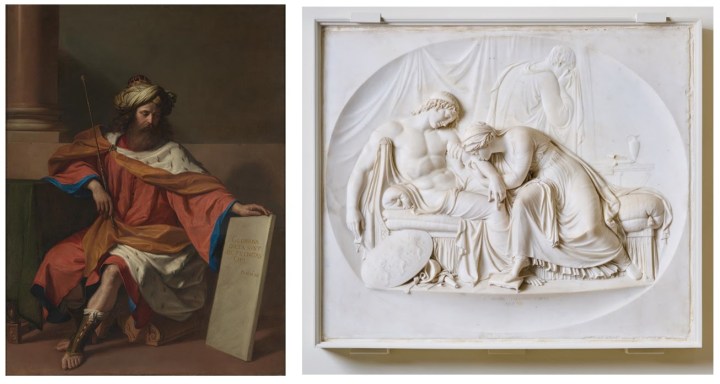
Left: Guercino, King David, 1651, oil on canvas, 224 × 170 cm (Accepted in lieu of Inheritance Tax by HM Government and allocated to the National Gallery). Right: John Deare, Edward and Eleanor, 1790, marble (Accepted in Lieu of Inheritance Tax from the Estate of Jacob, 4th Baron Rothschild and allocated to the Victoria and Albert Museum).
◊ ◊ ◊ ◊ ◊
From the press release:
The legacy of UK cultural luminary Jacob, 4th Baron Rothschild (1936–2024) is being celebrated by two of his artworks joining the collections of the National Gallery and the V&A, through the Acceptance in Lieu scheme. The National Gallery—where Jacob, 4th Baron Rothschild served as Chair of Trustees between 1985 and 1998—will receive King David (1651) by renowned Bolognese painter Giovanni Francesco Barbieri (1591–1666), known as Guercino, reuniting it with the two works both created to be its pendant, already part of the Trafalgar Square collection. The V&A will receive the marble relief Edward and Eleanor (1790) by John Deare (1759–1798), one of the most talented neoclassical sculptors working at the end of the 18th century.
Jacob, 4th Baron Rothschild, in addition to chairing the National Gallery, led the National Lottery Heritage Fund and the family’s flagship, Waddesdon Manor. He supported many causes, some close to his home in Buckinghamshire, others as far afield as Albania, Greece, Israel, and the United States. He was committed to helping communities, the environment, education and above all, the arts. His exemplary service to his country was recognised on several occasions, with a GBE, a CVO and as a member of the Order of Merit.
His daughter, Dame Hannah Rothschild—who also served as Chair of the National Gallery—said, “My father, Jacob, was a devoted patron of the arts and a steadfast champion of the National Gallery. He regarded Guercino’s King David, a masterwork of the Italian Baroque, as one of the crowning acquisitions of his lifetime. It was his wish to see King David reunited with its two Sibyls at the National Gallery and his family is grateful to the AIL Panel and to the National Gallery for giving it a distinguished home amongst such illustrious company. The exquisite marble relief by John Deare is of such rarity and importance that my father, Jacob, felt it must find its home in a national institution. Our family is delighted that the AIL Panel and the V&A have accepted this bequest, fulfilling his vision with such care and distinction.”
◊ ◊ ◊ ◊ ◊
Celebrated as one of the most innovative and gifted British neoclassical sculptors, John Deare (1759–1798) spent most of his career in Rome, where the relief of Edward and Eleanor was carved in 1790. Due to his early death at age 38, his production was limited to around fifty documented works, though very few of these are known today. The majority were reliefs of classical and allegorical subjects or related to English history, commissioned by British Grand Tourists to decorate their country houses.
Until now, only two other marble sculptures by Deare were held in British public collections: Cupid and Psyche (1791) at the Bradford District Museums & Galleries and Julius Caesar Invading Britain (1796) acquired by the V&A in 2011 (on display in the Hintze Gallery, G22). Plaster versions of the Edward and Eleanor composition are held at Wimpole Hall and at the Walker Art Gallery.
The relief depicting Eleanor of Castile sucking poison from the wound of Prince Edward (later Edward I) will be installed in the British Galleries (G119) at V&A South Kensington later this year—the first time it has been on public display. In this exceptional relief, which demonstrates Deare’s virtuoso technique in carving marble with great subtlety, the sculptor has adapted an episode of medieval British history into a depiction of Greek history, in a refined neoclassical style.
The work is of particular interest to the V&A, as it predates the Caesar Invading Britain relief and shows various sources of inspiration in the composition, including the paintings of Angelika Kauffman. The V&A also holds several albums of drawings by John Deare, including a study of a woman (E.260-1968) believed to be preparatory for the figure of Eleanor.
Much remains to be discovered about Deare’s production. The V&A is hosting an international conference on 16 and 17 May 2025 on the theme of sculptural exchanges between Italy and Britain in the 18th and 19th centuries, where the relief will be the focus of a spotlight presentation, marking the start of a new line of research into the artist’s work.
Tristram Hunt, Director of the V&A, said: “These remarkable acquisitions, made possible by the Acceptance in Lieu scheme, will forever represent Lord Rothschild’s legacy as a great connoisseur, champion of the arts and relentless supporter of British cultural institutions.”
John Deare (1759–1798) Edward and Eleanor: Accepted in Lieu of Inheritance Tax from the Estate of Jacob, 4th Baron Rothschild and allocated to the Victoria and Albert Museum. The acceptance of this sculpture settled £1,120,000 in tax.
Additional information about Guercino’s King David is available from the full press release»
Exhibition | Raphael to Cozens: Drawings from Richard Payne Knight
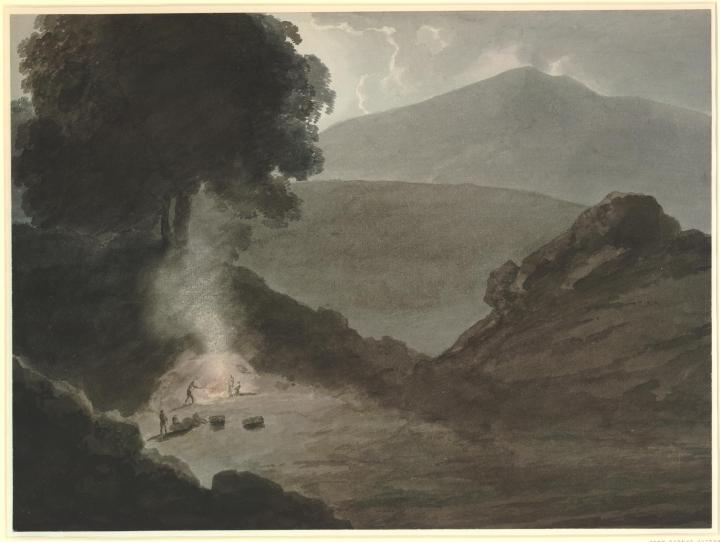
John Robert Cozens, Mount Etna from the Grotta del Capro; scene in a hollow on a hill-side, at left a group of figures gathered around a fire in a cave, above a clump of trees hiding the moon, beyond a further ridge rises a mountain, ca. 1777–78, watercolour over graphite with gum arabic and scratching out, 357 × 483 mm (London: The British Museum, Oo,4.38).
◊ ◊ ◊ ◊ ◊
Opening today at The British Museum:
Raphael to Cozens: Drawings from the Richard Payne Knight Bequest
The British Museum, London, 15 May — 14 September 2025
Raphael, Michelangelo, and Thomas Gainsborough are among the masters whose work will be on display at a new exhibition celebrating a transformative 19th-century bequest. The antiquarian and art collector Richard Payne Knight (1751–1824) bequeathed over a thousand drawings to the British Museum. The superb quality of his collection transformed the Museum’s graphic holdings and established it as a place where visitors could admire old master drawings alongside works of contemporary British art.
Born into a wealthy family of ironmasters from Herefordshire, Payne Knight was educated in the classics and complemented his studies, as many on the Grand Tour did, with extended travels in Italy. There he pursued his interests in ancient civilisations and languages, and formed the aesthetic sensibilities and tastes that would later shape his collecting and writing. His substantial financial means enabled him to acquire the best drawings available on London’s late 18th-century art market. The exhibition explores the breadth of Payne Knight’s intellectual interests through some of the most celebrated works from the bequest. Drawings by Renaissance and Baroque painters like Raphael, Michelangelo, and Claude Lorrain will be shown alongside work by Payne Knight’s contemporaries, including Thomas Gainsborough and John Robert Cozens. Together the drawings reveal Payne Knight’s enthusiasm for landscapes and for the romance of the classical past, as well as his admiration for the verve and spontaneity of the artists whose works he bought.
The exhibition marks the first time that a representative selection of this important bequest has been displayed since its arrival at the British Museum in 1824.
Exhibition | Colour and Line: Watteau Drawings
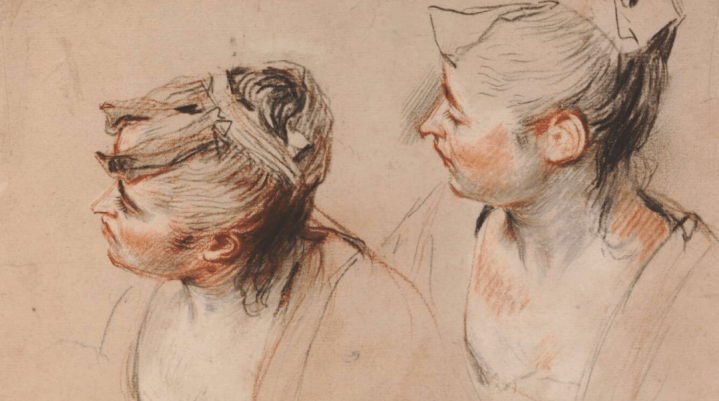
Antoine Watteau, Four Studies of a Young Woman’s Head, detail, 1716–17, drawing with black, red, and white chalks
(London: The British Museum, 1895,0915.941).
◊ ◊ ◊ ◊ ◊
Opening today at The British Museum:
Colour and Line: Watteau Drawings
The British Museum, London, 15 May — 14 September 2025
This Antoine Watteau (probably 1684–1721) was one of the most influential, prolific artists active in 18th-century France. In a short career lasting little more than a decade, he pushed painting in new directions that were to guide generations of French artists, blending genre, mythology and rococo frivolity in works so novel that they heralded a new genre: the fête galante.
Watteau won particular renown for the thousands of drawings he produced during his life. Drawing, as contemporaries realised, was his favourite creative outlet, bringing him ‘much more pleasure than his finished pictures’. He drew incessantly, and developed ideas about the value of drawing that were every bit as original as his paintings. Instead of making figure studies for a picture as academic practice dictated, Watteau drew speculatively, conceiving ideas that might be slotted into a picture months or even years later. The sheets he produced were to be enjoyed in their own right as the first, freshest iterations of ideas that he thought were dulled when translated into paint.
Nowhere were these qualities more appreciated than in Britain, and over the past two centuries British collectors have endowed the British Museum with one of the finest collections of Watteau drawings in the world. Featuring almost every autograph work in the collection, this display is the first exhibition of the Museum’s Watteau holdings to be held since 1980. Its varied contents demonstrate Watteau’s extraordinary talent as a draughtsman, his sophisticated, novel approach to drawing, and the prestige that his graphic works enjoyed among Europe’s connoisseurs.
Study Course | Drawings in Theory and Practice
From ArtHist.net:
Drawings in Theory and Practice: Connoisseurship – Collecting – Curatorial Practice
Albertina, Vienna, 28 July — 1 August 2025
Applications due by 6 June 2025
We are pleased to announce the Albertina’s 7th annual study course on drawings. The course is designed for doctoral students and early post-doc-researchers who are working in the field of drawings and prints and are interested in exploring curatorial practices. The course offers the opportunity to discuss current research on the graphic arts and, at the same time, to gain insight into one of the most renowned collections of prints and drawings. The course is organized jointly by the Institute of Art History at the University of Vienna and the Albertina and is generously supported by the Wolfgang Ratjen Foundation.
Participants are expected to present aspects of their current research in a 30-minute paper. Together we will discuss relevant drawings in the Albertina and gain insight into different curatorial practices: conception and planning of exhibitions, publication of catalogues, conservation and marketing, collecting and provenance research. Accommodation in Vienna will be covered as well as documented travel costs (economy flight, 2nd class train ticket) up to 350 Euros. The general course language is English, while individual papers can be presented in German, Italian, and French. The course is directed by Univ.-Prof. Dr. Sebastian Schütze and Dr. Christof Metzger.
Applications—including a cv, short description of the drawing or print related research project, and a reference letter from a university professor—should be sent by 6 June 2025 to Dr. Silvia Tammaro, silvia.tammaro@univie.ac.at. Applicants will be notified by 15 June 2025.
Conference | Publics of the First Public Museums: Visual Sources
From ArtHist.net:
Publics of the First Public Museums, 18th and 19th Centuries: Visual Sources
Online and in-person, Museo Nacional del Prado, Madrid, 5–6 June 2025
Organized by Carla Mazzarelli and David García Cueto
The conference Publics of the First Public Museums, 18th and 19th Centuries: Visual Sources is an integral part of the research project Visibility Reclaimed: Experiencing Rome’s First Public Museums (1733–1870), An Analysis of Public Audiences in a Transnational Perspective (FNS 100016_212922) directed by Carla Mazzarelli. Marking the third of three encounters (following I. Institutional Sources and II. Literary Discourses), this workshop delves into the examination of visual sources, vital to understanding the forms of representation of early museums and their publics. We intend to investigate a vast range of visual sources, from views of internal and external spaces to architectural and display projects, from caricatures to illustrations published in catalogues, guidebooks, voyages pittoresques up to the (self)representation of publics, museum staff (directors, custodians, ciceroni), and artists within the museum.
Visual sources have long represented a privileged source for investigating the origins of the first public museums and the impact on their publics. However, in the light of recent studies aimed at deepening the material history of the museum and the encounter of the public with the institutions, these sources deserve a closer scrutiny in both methodological and critical terms. As museums sought to define and engage their publics, visual sources often became both a mirror and a mould; they reflect and shape institutional and societal perceptions, contributing to build up the idea of museum but also to give a depiction of practices of access to public and private collections in Europe and in the World. The Museo Nacional del Prado welcomes this initiative as it has been involved since its foundation in 1819 in the process that the conference analyzes. The well known paintings that represent the spaces of Museo Nacional del Prado, since its opening, such as those of Fernando Brambilla, are an important starting and comparison point for the theme at the center of the conference discussion. On the other hand, paintings depicting ‘quadrerie’ have been a codified genre at least since the 17th century. Such artworks have also been read as sources for the study of the evolution of the display during the early modern age, but they also represent reference models for artists on how to represent the interiors of museum spaces, their publics and staff.
Direction
Carla Mazzarelli (Università della Svizzera italiana, Accademia di Architettura, Istituto di storia e teoria dell’arte e dell’architettura)
David García Cueto (Madrid, Museo Nacional del Prado)
It is possible to attend the sessions until all seats are filled or to follow the congress on line through the link to the Zoom platform that will be provided for all those enrolled. When enrolling you must choose a type of attendance.
Contact
visibilityreclaimed@gmail.com
congreso.visibily@museodelprado.es
t h u r s d a y , 5 j u n e
10.15 Registration
10.45 Welcoming Remarks — Alfonso Palacio (Director Adjunto de Conservación e Investigación del Museo del Prado)
11.00 Session 1 | Museums and Audiences in Image: Frameworks and Methodologies
Chair: David García Cueto (Museo Nacional del Prado)
• Carla Mazzarelli (Università della Svizzera italiana) — Alle origini del pubblico “esposto”. Proposte di lettura e confronto delle fonti visive
• Daniela Mondini (Università della Svizzera italiana) — Visiting Sacred Spaces as ‘Museums’
• Luise Reitstätter (Universität Wien) — Museums Ego Documents as Visual Source: Imaging First Publics within Founding Missions
• Javier Arnaldo Alcubilla (Museo Nacional del Prado) — La bohemia en el Prado: entre fuentes visuales y literarias
12.45 Keynote Address
• Sebastian Schütze (Universität Wien) — Going Public: The Gallery Picture and its Agencies
13.30 Lunch Break
14.45 Panel 2 | Mirroring Museums: The Public in Photographic Archives and Digital Atlases
Chair: Daniela Mondini (Università della Svizzera italiana)
• Beatriz Sánchez Torija (Museo Nacional del Prado) — El Museo del Prado y el uso de la fotografía como enlace con el público en la segunda mitad del siglo XIX
• Irina Emelianova (Università della Svizzera italiana) — European Art Museums and Their Audiences through the Photographic Collection of the Academy of Fine Arts in St. Petersburg: Between the End of the 19th Century and the Beginning of the 20th Century
• Paola D’Alconzo (Università degli studi di Napoli Federico II), Donata Levi (Università degli studi di Udine), Martina Lerda (Università di Pisa) — Dall’Atlante digitale dei musei italiani (DAIM): Immagini del pubblico, immagini per il pubblico
16.15 Coffee Break
16.30 Panel 3 | Museums in Sight: Visual Records of Visit and Display
Chair: Christoph Frank (Università della Svizzera italiana)
• Barbara Lasic (Sotheby’s Institute of Art) — Visualising Museal Trajectories at the Garde-Meuble de la Couronne
• Luca Piccoli (Università della Svizzera italiana) — ‘The colours of them so chosen to carry the eye forward’: alle origini dell’esperienza di visita del Museo Pio Clementino tra rappresentazione e realtà (1770–1796)
• Julia Faiers (Independent Scholar) — Experiencing Medieval Art at Toulouse’s First Public Museums
17.50 Break
18.00 Keynote Address
Andrew McClellan (Tufts University) — Towards a Machine for Looking: Science, Psychology, and Visitor Experience at the Museum of Fine Arts, Boston, 1900
f r i d a y , 6 j u n e
10.00 Panel 4 | Strategies of Self-Presentation: Museums between Politics and Cultural Stereotypes
Chair: Chiara Piva (Sapienza Università di Roma)
• Benjamin Carcaud (École du Louvre / Ministère de la Culture) — Quelle image du visiteur les artistes ont-ils construite dans leurs œuvres? Les stéréotypes du visiteur de musée dans les salles du Louvre
• Adrián Fernández Almoguera (Universidad Nacional de Educación a Distancia, Madrid) — ¿Imágenes como estrategia? A propósito del Musée des Antiques en la cultura visual del Louvre imperial
• Cynthia Prieur (University of Victoria, British Columbia) — Shaping the Image of the Louvre Museum: Maria Cosway’s Prints of the Exhibitions of Looted Art
11.20 Coffee Break
11.35 Panel 5 | The Critical Eye: Museums and Publics Between Promotion and Satire
Chair: Stefano Cracolici (Durham University)
• Grégoire Extermann (Université de Genève) — Un caricaturista en París: el ginebrino Wolfgang Adam Töppfer y el público del Louvre imperial
• Ludovica Scalzo (Università Roma Tre) — Il pubblico dei musei nei primi periodici illustrati europei (1830–1850)
• Gaetano Cascino (Università della Svizzera italiana) — I musei di Roma e i loro visitatori in satira nella pubblicistica dopo l’Unità
13.00 Lunch Break
14.00 Panel 6 | The Public Image of the Private Museum
Chair: Carlos G. Navarro (Museo Nacional del Prado)
• Federica Giacomini (Istituto Centrale per il Restauro, Roma) — La Galleria Borghese in un’illustrazione de ‘Le Magasin Pittoresque’: per un’indagine del pubblico nell’Ottocento
• Kamila Kludwiecz (Adam Mickiewicz University, Poznań) Aldona Tolysz (the Office of the Provincial Conservator of Monuments in Warsaw) — Between Documentation and Self-Creation: The Role of Illustration in the Activities of Polish Private Museums in the 19th Century
15.00 Panel 7 | From National to Global Image: The Identity of the Museum and Its Audiences
Chair: Giovanna Capitelli (Università Roma Tre)
• Susanne Anderson-Riedel (University of New Mexico) Caecilie Weissert (Universität Kiel) Joelle Raineau-Lehuédé (Petit Palais) — A Global Public for France’s National Museum
• Elizaveta Antashyan (Sapienza Università di Roma) — Visibility Granted: The Hermitage Museum in the 19th Century and Its Representation in Contemporary Imagery
• Raffaella Fontanarossa (Indipendent Scholar) — Le muse in Oriente. I primi visitatori dei musei in Cina e Giappone attraverso le fonti visive
• Jonatan Jair López Muñoz (Univesidad Complutense de Madrid) — La imagen omnipresente. La representación regia en los museos nacionales del siglo XIX en España e Italia
16.45 Coffee Break
17.00 Panel 8 | A Museum for All? The Variety of Audiences on Display
Chair: Daniel Crespo Delgado (Universidad Complutense de Madrid)
• Gemma Cobo (Universidad Nacional de Educación a Distancia, Madrid) — La mirada de la infancia: Nuevos museos y educación artística en la Europa de entresiglos, 1750–1850
• Anna Frasca-Rath (Friedrich-Alexander University) — Through the Eye of a Child? Visual Sources of/for Museum Publics in 19th-Century Vienna
• Marie Barras (Université de Genève) — See and Be Seen: Museums and Art Exhibitions as Fashion Stages, 1870–1900
18.20 Concluding Remarks by Carla Mazzarelli
The Sainsbury Wing of London’s National Gallery Reopens
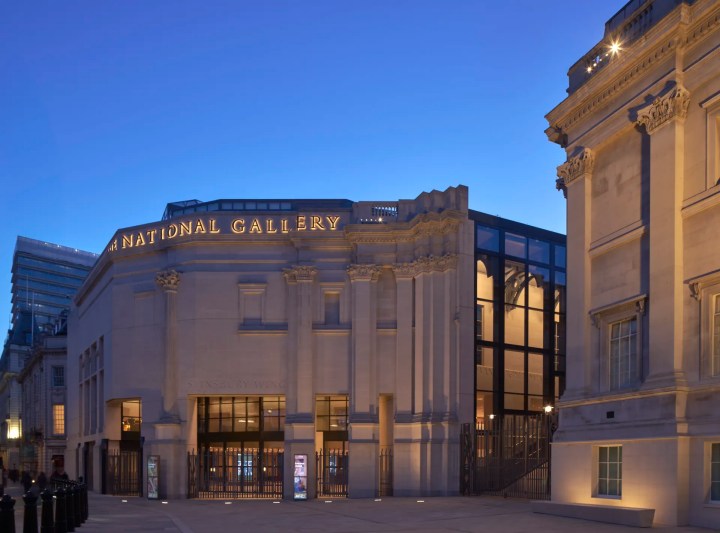
View of the National Gallery Sainsbury Wing from Trafalgar Square. After contentious early designs were scuttled in the 1980s, the Sainsbury Wing, as conceived by Robert Venturi and Denise Scott Brown, opened in 1991. The latest revisioning, an £85m project, was led by Annabelle Selldorf. (Photo by Edmund Sumner, ©The National Gallery, London).
◊ ◊ ◊ ◊ ◊
From the press release (9 May 2025) . . .
The National Gallery’s new main entrance reopened to the public on Saturday 10 May 2025, as part of the Gallery’s 200th birthday celebrations.
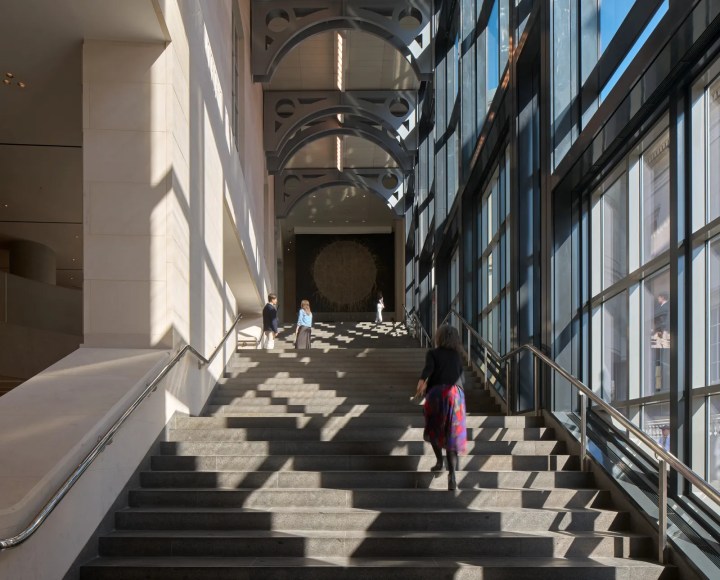
View looking up the main staircase of the Sainsbury Wing (Photo by Edmund Sumner, ©The National Gallery, London).
The Sainsbury Wing closed in February 2023 to undergo sensitive interventions to its external façade, foyer, and first floor, providing a better and more welcoming first experience to the National Gallery’s millions of visitors, in a plan designed by New York-based Selldorf Architects, working with heritage architects Purcell.
At the entrance, some of the Gallery’s footprint has been given over to public realm, creating a ‘square-within-a-square’, and leading to a more spacious entrance to the Gallery. The original dark glass of the stairs up to the gallery spaces has been replaced with clear glazing, bringing daylight across the foyer while revealing subtle views of the 1830s National Gallery building by William Wilkins (1778–1839). The glazing also allows people in Trafalgar Square to see directly into the Gallery for the first time.
This entrance opens into a new double-height foyer, which is larger, more open, and brightly lit. A 12-metre wide, 16K screen shows astounding details of National Gallery paintings. Visitors will find a new espresso bar, ‘Bar Giorgio’, by Giorgio Locatelli, on the ground floor. ‘Locatelli’, the restaurant by the same chef, will be on the mezzanine level, alongside a new bookshop and spaces for meetings and events. A bar will provide the to-date only publicly accessible space in London to enjoy a drink with views onto Trafalgar Square.
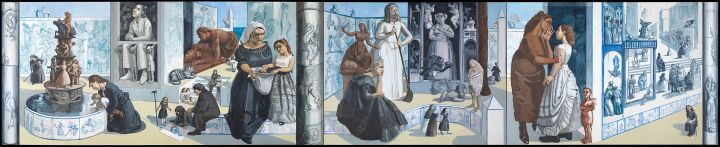
Paula Figueiroa Rego (1935–2022), Crivelli’s Garden, 1990–91, acrylic on canvas. Commissioned by the National Gallery in 1989, the painting responds to the predella of Carlo Crivelli’s Madonna of the Swallow (1491)—with an emphasis on the actions of strong women.
◊ ◊ ◊ ◊ ◊
Facing the restaurant diners will be Paula Rego’s (1935–2022) Crivelli’s Garden (1990–91). Rego was the National Gallery’s first Associate Artist and was inspired to create the work by looking at Renaissance paintings by Carlo Crivelli (about 1430/5 – about 1494) for the Sainsbury Wing Dining Room on its original opening in 1991.
Also reopening is the recently renamed Pigott Theatre, on the lower ground floor. The theatre has been fully refurbished with a new colour scheme and refitted for increased comfort and accessibility, including level access to the stage.
The palette of high-quality materials used throughout the new spaces includes the same grey Florentine limestone (pietra serena) employed in the Venturi-Scott Brown designed gallery spaces, along with Chamesson limestone from northern Burgundy, slate, oak, and black granite. Wherever possible existing materials have been re-used, recycled, or repurposed in other building projects.
The NG200 Welcome project has been made possible thanks to support from many generous donations, from both major benefactors and members of the public. In particular, The Linbury Trust and The Headley Trust which, together with The Monument Trust, funded the original establishment of the Sainsbury Wing 35 years ago, have been instrumental in helping the Gallery to realise the evolution of the building for its changing visitor needs.
Statements by Timothy Sainsbury, Gabriele Finaldi, Annabelle Selldorf, and Chris Bryant are available in the full press release.
◊ ◊ ◊ ◊ ◊
In his review of the newly unveiled spaces, Oliver Wainwright provides a useful summary of the architectural controversies that have always been part of the Sainsbury Wing’s history.
Oliver Wainwright, “‘Tranquillising Good Taste’: Can the National Gallery’s Airy New Entrance Exorcise Its Demons?” The Guardian (6 May 2025). When the Sainsbury Wing opened, it was called ‘vulgar pastiche’. Now, after an £85m revamp, it has become the famous gallery’s main entrance. But have its spiky complexities been tamed? And why all the empty space?
When the Sainsbury Wing first opened in 1991, it was not loved. It was variously slammed as “a vulgar American piece of postmodern mannerist pastiche” and “picturesque mediocre slime.” It was too traditional for modernists and too playful for traditionalists. Its dark, low-ceilinged entrance was damned as “a nasty cellar-like space” cluttered with a maze of (non-structural) columns. “It just didn’t work,” says the gallery’s deputy director, Paul Gray, adding that visitor numbers have swelled from three million back then to approaching six million now. The wing was never intended to handle such volumes. “The modern visitor expects so much more now. They want big, open, welcoming spaces, and it never felt like that.”
But time garners affection. And there is nothing like the threat of change to arouse fondness. When Selldorf’s modernising plans were first unveiled in 2022, the same critics who had pooh-poohed Venturi Scott Brown’s design leapt to its defence. . . .
The full article is available here»
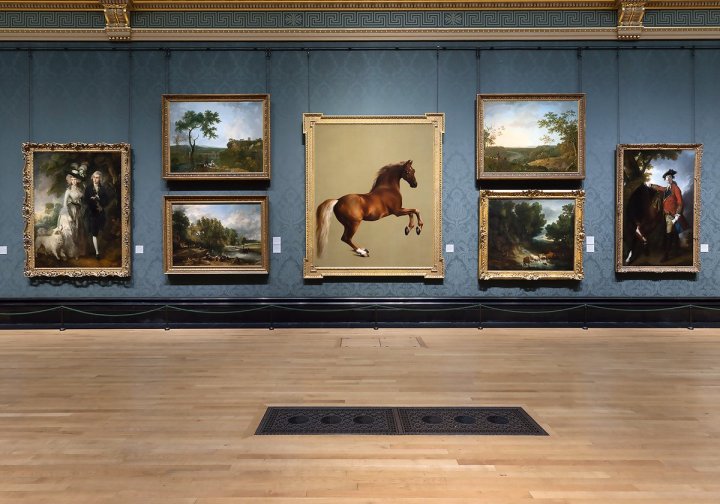
In Room 34 George Stubbs’s Whistlejacket (ca. 1762) is surrounded by a new ‘salon’ hang of British painting, 1740–1800.
◊ ◊ ◊ ◊ ◊
In addition to the reworking of the entrance and secondary spaces, galleries were rehung under the direction of Christine Riding, as described by Martin Bailey for The Art Newspaper:
Martin Bailey, “First Look: The ‘Once-in-a-Lifetime’ Rehang at London’s National Gallery,” The Art Newspaper (5 May 2025).
The Art Newspaper was given an early tour by Christine Riding, the director of collections and research, who has overseen the rehang. She describes her task as a “once-in-a-lifetime” opportunity. Now virtually completed, the rehang means that the National Gallery will show nearly 40% of its collection.
There will be 1,045 paintings hanging in the upper-floor rooms: 919 from the collection, plus 126 on loan. Nearly a third will be in the Sainsbury Wing and the rest on the main floor of the original Wilkins building. . . .
The number of works on display is slightly greater than before, thanks to a marginally denser hang, more glass cases in the centre of rooms, two walls with 34 plein-air landscape oil sketches (Room 39) and an additional space (Room 15a) with small Dutch pictures.
Riding has been particularly keen to emphasise “how artists have been influenced by their predecessors.” For instance, Elisabeth Vigée Le Brun’s Self Portrait in a Straw Hat (1782) is hung in the same octagonal space (Room 15) as the picture that inspired it, Peter Paul Rubens’s presumed Portrait of Susanna Lunden (1622–25). . . .
The Sainsbury Wing will now be the main entry point for visitors, with possibly more than 90% coming through there rather than via the portico or Getty entrances.
The full article is available here»










 Enfilade
leave a comment