National Gallery Names Room 34 for the Blavatnik Family Foundation
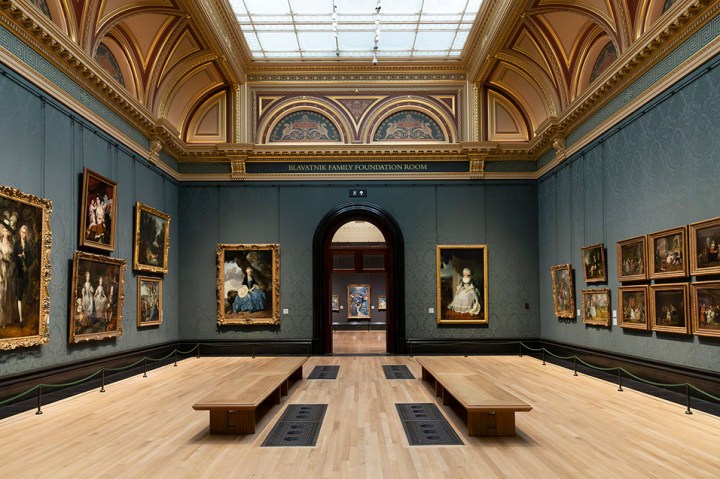
Room 34 of the National Gallery unveiled as the Blavatnik Family Foundation Room in recognition of its significant gift to the NG200 campaign.
◊ ◊ ◊ ◊ ◊
From the press release (7 May 2025) . . .
Room 34 of the National Gallery will today be unveiled as the Blavatnik Family Foundation Room in recognition of its significant gift to NG200. The generous gift marks the culmination of NG200, the National Gallery’s year-long bicentenary celebration of art, creativity, and imagination, marking two centuries of bringing people and paintings together.
Led by Sir Leonard Blavatnik, founder and chairman of Access Industries, the Blavatnik Family Foundation promotes innovation, discovery, and creativity to benefit the whole of society. Through the Foundation, the Blavatnik family has contributed over $1billion globally to advance science, education, arts and culture, and social justice. They have provided essential funding to dozens of scientists in the early stages of their careers through the Blavatnik Awards for Young Scientists, made major gifts to universities such as Harvard and Yale, and funded The Blavatnik School of Government at Oxford University. The Blavatnik Family Foundation has also supported more than 180 leading cultural organisations, including the National Portrait Gallery, Royal Academy, V&A, Courtauld, and the expansion of Tate Modern.
Room 34 of the National Gallery is a showcase of the best of British painting in the second half of the 18th century. It is home to such iconic works as the monumental horse painting Whistlejacket (about 1762) by George Stubbs (1727–1788), Mr and Mrs Andrews (about 1750) by Thomas Gainsborough (1727–1788), and William Hogarth’s (1697–1764) six painting series Marriage A-la Mode (about 1743).
Sir Leonard Blavatnik, said: “I’m delighted to support the National Gallery’s bicentenary and this magnificent room that celebrates Britain’s artistic heritage.”
Sir Gabriele Finaldi, Director of the National Gallery, said: “We are thrilled by the extraordinary and transformative philanthropy of the Blavatnik Family Foundation at this seminal moment in the National Gallery’s history and are delighted to recognise the generosity of the Blavatnik Family in one of our most beautiful and important rooms.”
New Book | The National Gallery: A History
Distributed by Yale UP:
Jonathan Conlin, The National Gallery: A History (London: National Gallery Global, 2025), 384 pages, ISBN: 978-1857097191, £35 / $45.
 Published in the National Gallery’s bicentenary year, this is the story of how one of the world’s finest collections of paintings was formed by (and for) the people of Britain.
For two hundred years the National Gallery has been at the heart of the nation’s life. Established in 1824 and situated in the centre of London with a commitment to free admission, it was conceived as a gallery to be enjoyed by all, while also serving as a place of refuge in times of war and crisis. The National Gallery: A History tells the story of an institution that holds education, social cohesion, and national heritage at its core, and whose outstanding collection has shaped the art historical canon over two centuries. Special focus on fifteen highlight paintings affords an opportunity to explore changes in taste over the decades, as well as the reactions of visitors to the Gallery’s great works of art.
Jonathan Conlin is professor of modern history at the University of Southampton. His books include The Met: A History of a Museum and Its People (2024) and a cultural history of the 1969 BBC2 television series Civilisation (2009).
New Book | Rethinking the Republic of Letters
Previously, Scholten has spent considerable time addressing the 970-page travel journal of the Utrecht-born Joannes Kool (1672–1712). From Amsterdam UP:
Koen Scholten, Rethinking the Republic of Letters: Memory and Identity in Early Modern Learned Communities (Amsterdam: Amsterdam University Press, 2025), 442 pages, ISBN: 978-9048559855, €159.
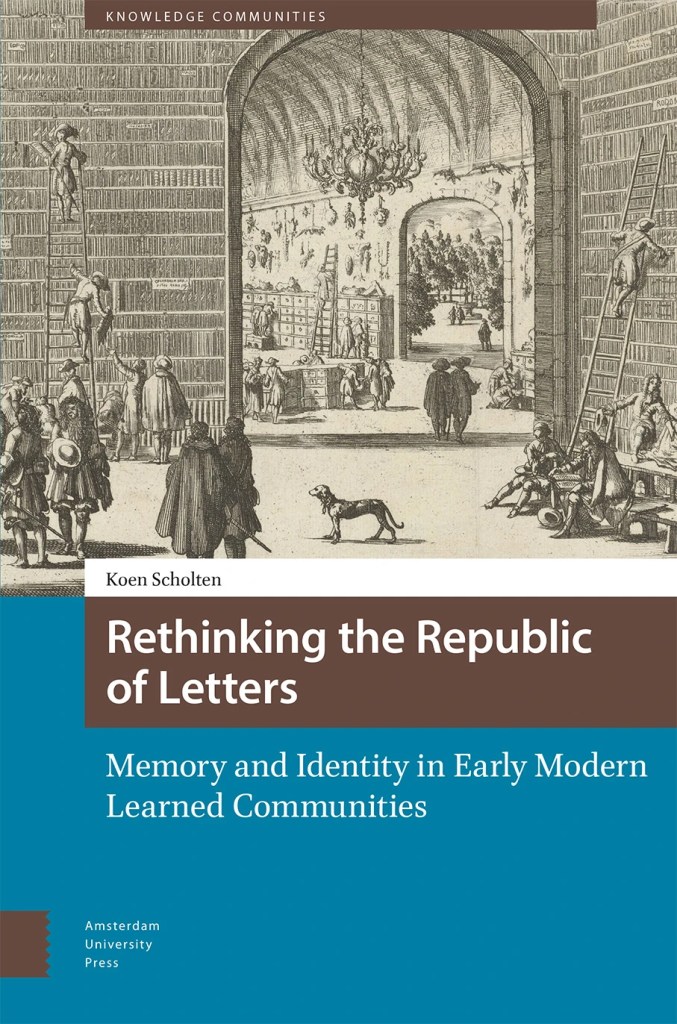 This book offers a revisionist look at the historiography of the Republic of Letters and the community of learning in early modern Europe. It suggests a new approach, conceptualising the learned world as a web of imagined communities in which the members do not know all their peers. These communities formed through distinct memory cultures and the representation of and identification with collective identities. Rethinking the Republic of Letters looks at early modern biographical dictionaries (vitae), eulogies, letters, travelogues, and funerary monuments of early modern learned men to trace the (re)formation of these communities. It thereby offers a novel perspective on early modern learned communities—the many Republics of Letters.
Koen Scholten is a historian of science and published on memory and identity in scholarly and scientific communities. He edited Memory and Identity in the Learned World (Brill, 2022) and received his PhD from Utrecht University on a thesis on the formation of early modern communities in the world of learning in 2023.
c o n t e n t s
Introduction: The Republic of Letters as an Imagined Community
1 An Inventory of Scholarly Values and Virtues
2 Collective History and Geographical Inclusion in Vitae and Elogia
3 Collective Memory and Identity in Hugo Grotius’s Correspondence
4 The Peregrinatio Literaria: Experiencing, Representing, and Forming Learned Communities
5 The Basilica di Santa Croce: The Florentine Site of Learned Memory
6 The Pieterskerk: Representing the Learned Community of Leiden University
Conclusion
Bibliography
List of Abbreviations
Manuscript Sources
Printed Sources, Before 1800
Printed Sources, Modern
Secondary Literature
Appendix 1
Corpus and Keyword Analysis
Main Corpus
Reference Corpus
Acknowledgements
Celebration of the York Georgian Society’s 2024 Nuttgens Award Winners
From the York Georgian Society:
Celebration of the York Georgian Society’s 2024 Nuttgens Award Winners:
Charlotte Goodge and Constance Halstead
York Medical Society, 18 June 2025, 6pm
Organised by Jemima Hubberstey, Charles Martindale, and Moira Fulton
York Georgian Society is delighted to host two talks given by our 2024 Nuttgens Award Winners: Constance Halstead and Charlotte Goodge. The event will start with a drinks reception in the garden of York Medical Society (weather permitting). Then in the Lecture Room, Professor Mary Fairclough (University of York) will give an introduction, followed by our award winners who will deliver two short talks. It will be a wonderful opportunity to network with other members of the Society and hear exciting new research in eighteenth-century studies. Current students at the University of York also have the chance to learn more about the Nuttgens Award and how the York Georgian Society supports early-career research. Ticket are £15 for members, £25 non-members, and free for students who book in advance. Booking is available here; please note that ticket purchase and free ticket registration must be done separately. In case of any questions, please email jemimahubberstey@hotmail.co.uk.
Charlotte Goodge | Colonial Strategies for Disempowerment and the ‘Deformed’ Mammae of Khoekhoe Mothers
Dr Charlotte Goodge submitted and successfully defended her AHRC-funded PhD thesis in December 2024. Her interdisciplinary doctoral research broadly examines the cultural constructedness of female fatness in the period, demonstrating that both the real-life and the fictional fat female figure was variously used as a vehicle through which ideologies of femininity, class hierarchy, and civilisation were reinforced. Charlotte has held fellowships at the Huntington Library (2023) and Chawton House (2021) and was recently awarded the ASECS Race & Empire Caucus’s Graduate Student Essay Prize (2024). Her work has been published in The Journal for Eighteenth-Century Studies (2023), Eighteenth-Century Life (2025), and in Studies in Eighteenth-Century Culture (2025). This talk will explore the way in which eighteenth-century European commentators and travel writers depicted Khoekhoe mothers and their breastfeeding practices in South Africa.
Constance Halstead | ‘Surely It Was Not Platonic’: Anne Lister’s Queer Account of the Ladies of Llangollen
Constance Halstead is a second year PhD student at the University of York’s Centre for Eighteenth Century Studies, where her research is funded by the Sally Wainwright Scholarship for the Study of Anne Lister. Her thesis, titled “Telling ‘All as It Really Is’: Form and Formation in Anne Lister’s Manuscript and Digitised Journal,” offers a literary study of Lister’s journal. It focuses on Lister’s generic, material, and textual negotiation of eighteenth-century traditions of diary writing. Constance completed her BA at the University of Oxford and MLitt at the University of St Andrews.
◊ ◊ ◊ ◊ ◊
The Nuttgens Award is named in honour of Patrick Nuttgens (1930–2004). A well-known and warmly remembered figure, both locally and nationally, Nuttgens was founding director of the Institute of Advanced Architectural Studies within the University of York and successively served as secretary, chairman, and president of the York Georgian Society. The Nuttgens Award was first offered in 2008, the result of a fruitful collaboration between York Georgian Society and the University of York. It provides a grant of £500 to be awarded annually to two PhD students researching any aspect of the Georgian period.
New Book | Fragmentary Forms: A New History of Collage
From Princeton UP (with most books now 50% off, until May 31 with code BLOOM50) . . .
Freya Gowrley, Fragmentary Forms: A New History of Collage (Princeton: Princeton University Press, 2024), 400 pages, ISBN: 978-0691253749, £50 / $60.
 A beautifully illustrated global history of collage from the origins of paper to today
While the emergence of collage is frequently placed in the twentieth century when it was a favored medium of modern artists, its earliest beginnings are tied to the invention of paper in China around 200 BCE. Subsequent forms occurred in twelfth-century Japan with illuminated manuscripts that combined calligraphic poetry with torn colored papers. In early modern Europe, collage was used to document and organize herbaria, plant specimens, and other systems of knowledge. In the eighteenth and nineteenth centuries, collage became firmly associated with the expression of intimate relations and familial affections. Fragmentary Forms offers a new, global perspective on one of the world’s oldest and most enduring means of cultural expression, tracing the rich history of collage from its ancient origins to its uses today as a powerful tool for storytelling and explorations of identity.
Presenting an expansive approach to collage and the history of art, Freya Gowrley explores what happens when overlapping fragmentary forms are in conversation with one another. She looks at everything from volumes of pilgrims’ religious relics and Victorian seaweed albums to modernist papiers collés by Pablo Picasso and Georges Braque and quilts by Faith Ringgold exploring African-American identity. Gowrley examines the work of anonymous and unknown artists whose names have been lost to history, either by accident or through exclusion. Featuring hundreds of beautiful images, Fragmentary Forms demonstrates how the use of found objects is an important characteristic of this unique art form and shows how collage is an inclusive medium that has given voice to marginalized communities and artists across centuries and cultures.
Freya Gowrley is a leading scholar of the cultural lives of images and objects. She is based at the University of Bristol, where she writes about the relationship between art and identity from the early modern period to the present day. She is the author of Domestic Space in Britain, 1750–1840: Materiality, Sociability, and Emotion.
c o n t e n t s
Introduction
1 New Material Possibilities
2 Divine Collections
3 Knowledge and Owning the World
4 Material Proliferations
5 Desire and Devotion
6 Craft into Canon
7 Objects of Modernity
8 Radical Possibilities
Conclusion
Bibliography
Index
Acknowledgments
Credits
Penn Dry Goods Market Textile Lecture Series
From the Schwenkfelder Library & Heritage Center, as noted by The Decorative Arts Trust:
Penn Dry Goods Market Textile Lecture Series
Schwenkfelder Library & Heritage Center, Pennsburg, Pennsylvania, 16–17 May 2025
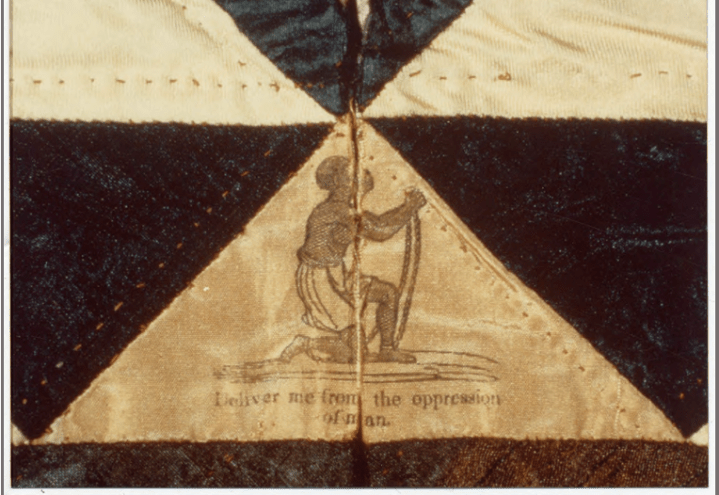
Image: Deborah Simmons Coates quilt detail, 1840s–1850s, Lancaster History — to be discussed in Mariah Kupfner’s talk.
The Penn Dry Goods Market Textile Lecture Series offers a chance to hear nationally recognized authorities in textile history on a broad range of topics—from embroidered hand towels to Appalachian weaving, from quilts to samplers, and from Scandinavian American and African American traditions. All lectures require a ticket ($25/lecture prepaid or $30 at door). Each ticket also provides access to the Penn Dry Goods Market antique show.
f r i d a y , 1 6 m a y
8.45am ‘This is the Way I Pass My Time’: Mennonite Hand Towels from Eastern Pennsylvania — Joel Alderfer (Collections Manager, Mennonite Heritage Center)
10.00 Colonialism, Power, and Identity: Fashion in American Portraits, 1670–1840 — Lynne Bassett (Independent scholar, curator, and author)
12.45 Heritage Craft, Community, and Continuity among Scandinavian Americans — Josh Brown (Skwierczynski University Fellow, University of Wisconsin-Eau Claire, and folk weaver)
2.00 Pennsylvania German Quilt Turning: 40 Examples from Both Sides of the Susquehanna — Debby Cooney (Independent quilt scholar)
3.15 Hidden in Plain Sight: Uncovering the Samplers of Black Girls — Lynne Anderson (President of the Sampler Consortium and Director of the Sampler Archive Project)
s a t u r d a y , 1 7 m a y
8.45am A Usable Past: American Hand-Weaving Revival in Appalachia, 1892–1940 — Matthew Monk (Linda Eaton Associate Curator of Textiles, Winterthur)
10.00 Pennsylvania German Quilt Turning: 40 Examples from Both Sides of the Susquehanna — Debby Cooney (Independent quilt scholar)
11.15 ‘So Intimately Are We Connected’: Antislavery Textiles and the Weight of Cotton — Mariah Kupfner (Assistant Professor of American Studies and Public Heritage, School of Humanities, Penn State Harrisburg)
12.45 The Joys of Tape Weaving as Viewed through the Eleanor Bittle Collection — Johannes Zinzendorf and Zephram de Colebi (The Mahantongo Heritage Center at the Hermitage)
2.00 A Legacy in Thread: Schoolgirl Needlework and Female Education in Dutchess County, New York — Stacy Whittaker (Independent needlework scholar)
3.15 The Quilt That Never Was: Solving the Mystery of the Inscribed Great Valley Quilt Blocks — Charlene Bongiorno Stephens and William Stephens (Independent quilt scholars)
Exhibition | Mama: From Mary to Merkel
From the press release for the exhibition:
Mama: From Mary to Merkel
Kunstpalast, Düsseldorf, 12 March — 3 August 2025
Curated by Linda Conze, Westrey Page, and Anna Christina Schütz

Marie-Victoire Lemoine, Portrait of Madame de Lucqui with Her Daughter Anne-Aglaé Deluchi, 1800, oil on canvas, 100 × 81 cm (Arp Museum Bahnhof Rolandseck, Rau Collection for UNICEF).
The exhibition Mama: From Mary to Merkel explores the many different aspects of motherhood over eight chapters. The focus is on the societal expectations that have always influenced motherhood and are reflected in art, culture, and everyday life. The approximately 120 works on display from the fourteenth century to the present day create a panorama that involves everyone, including fathers and those without children of their own. From the concept of the ‘good mother’ to care work and family configurations, the show illustrates how the role of mother quickly breaks down into different, highly individual perspectives that are nevertheless deeply intertwined in cultural history. A polyphonic sound installation uses pre-recorded voice messages to give space to personal experiences, memories, and visions.
“Everyone has a mother. By placing motherhood at the centre of an exhibition, the Kunstpalast is once again addressing a topic that directly touches the lives of our visitors and that everyone can relate to with their own experiences and opinions. The show combines seriousness with humour and art with everyday life and pop culture— thus tying in with the Kunstpalast’s mission statement on several levels,” says Felix Krämer, general director of the Kunstpalast.
Popular culture and art both emphasise societal expectations of mothers and the role of the GOOD MOTHER. We begin with figures of the Virgin Mary from the fourteenth to the eighteenth centuries. The image of Mary—probably the most prominent mother in Christian culture—remains a symbol of total maternal devotion today. The stereotype of the ‘good’ mother was established in the eighteenth century and is still widespread: contemporary artists in the exhibition explore the efforts involved in attaining this ideal. For a portrait of his mother, Aldo Giannotti (b. 1977) pressed a sign into her hands. The word ‘MOM’ on it only becomes an admiring exclamation of ‘WOW’ when she subjects herself to the strain of hanging upside down from the ceiling. Motherhood is a yardstick by which a woman’s achievement is measured—even if she is not a mother. A well-known example is Angela Merkel (b. 1954): nicknamed ‘Mutti’ (Mum) when she was German Chancellor, she can also be seen as Mother Theresa on the cover of Der Spiegel magazine.
The historical changeability of notions of ‘good’ motherhood is demonstrated by advice books from various decades of the twentieth and twenty-first centuries, whose recommendations to mothers are often fundamentally contradictory. ADVICE OR REGULATION—from the Weimar Republic to National Socialism, the early Federal Republic and the GDR to the present-day reunified Germany, this genre is characterised by both consistencies and inconsistencies. A bookshelf in the exhibition gathers advice literature from recent decades and invites visitors to pause and read.
“Ideals and role models, advice, expectations and emotions—the aim of this exhibition is to make the subject of motherhood tangible in all its artistic, cultural historical, social and, of course, highly personal dimensions,” agree the three curators of the show. Linda Conze, Westrey Page and Anna Christina Schütz have approached the topic from different angles, finding mothers and non-mothers in the Kunstpalast collection, supplementing these artists with important, sometimes international loans and bringing everything together to create a narrative. “Connections between the collectively selected works reveal continuities, but also the mutability of images of mothers, which are constantly being reappropriated, reinterpreted, contested and celebrated. We see the show as an invitation to open up a dialogue about care and motherliness and look forward to hearing the audience’s perspectives,” explains the curatorial team.
Looking after children is work. Nevertheless, CARE WORK remains mostly unpaid and has traditionally been automatically assigned to women. With a critical eye, artists have drawn attention to the fact that care is influenced by social norms and class affiliations. For a long time, only poor mothers breastfed their babies themselves, while wealthier women hired wet nurses. Around 1800, the idea that all women should take care of their babies themselves became prevalent; the presence of the biological mother became more important. In the present day, working mothers who focus “too much” on their careers are judged just as much as those who devote themselves entirely to their children and the household. The balancing of care and paid work as well as the role of caregiver and other identities is a recurring theme among the women artists in the exhibition. Several paintings in the exhibition are by Paula Modersohn-Becker (1876–1907), who was always fascinated by motifs of the bond between mother and child. However, she was also apprehensive about the effects of her own motherhood on her artistic work. In her sculpture of a body dissolving in the mechanics of a breast pump, Camille Henrot (b. 1978) focuses on the fine line between providing nourishment and self-sacrifice.
The exhibition delves deeper into the subject of the PLACES OF MOTHERHOOD: historical doll’s house kitchens are brought into dialogue with the video work Semiotics of the Kitchen by Martha Rosler (b. 1943), which examines the distance of the housewife’s domain from intellectual settings. Scottish artist Caroline Walker (b. 1982) portrays mothers with their newborns in the intimate yet isolating domestic sphere. Finnish artist Katharina Bosse (b. 1968) photographs herself in erotically charged poses with her toddler crawling beside her in natural landscapes. In this way, she disrupts the seemingly natural idyll that surrounds motherhood in art and cultural history.
Several women artists use their work to address the fact that the decision to (NOT) HAVE CHILDREN often could not and still cannot be made freely, despite all the progress that has been made. For centuries, female ‘nature’ was defined in a wide variety of societies by a woman’s ability to conceive and bear children. The Virgin Mary, whose life is depicted in Dürer’s Life of the Virgin, is both a female role model and a special case. Her actions are always centred on her son, whom she conceived by divine intervention.
The medical achievements and societal developments of the twentieth century allowed women to emancipate themselves from their socially prescribed destiny for the first time by taking the contraceptive pill or asserting their hard-fought right to terminate a pregnancy. Hannah Höch (1889–1978) paints her struggle with the decision to not have a child by Raoul Hausmann. Nina Hagen’s (b. 1955) protest against the expectations of fulfilling her duty as a mother in the song “Unbeschreiblich Weiblich” (Indescribably Feminine) is juxtaposed with Elina Brotherus’s (b. 1972) confrontation with her own involuntary childlessness.
For a long time, the physical bond between mother and child was unquestioningly viewed as a prerequisite for a motherly love that was regarded as intrinsic. The exhibition also shows that the often positively connoted intimate relationship between mother and child at all ages can also have a potentially traumatic side. In a series of photographs, Leigh Ledare (b. 1976) explores his CLOSENESS to his mother, who confronts her adult son with uncompromising desire. In a video work by performance artist Lerato Shadi (b. 1979), she and her mother lick sugar and salt off each other’s tongues and explore the space between repulsion and affection. The armchair by Italian designer Gaetano Pesce (1939–2024) promises a return to the mother’s womb, with the foot section connected to the main body of the furniture via an ‘umbilical cord’.
In German, the word MUTTERSEELENALLEIN describes the utmost loneliness. Mary, Our Lady of Sorrows, mourning her dead son Jesus Christ, is one of the central motifs in Western art history. Artists have repeatedly made reference to the so-called Pietà, appropriating and reinterpreting it as a motif. The loss of the child is juxtaposed with the loss of the mother, which artists of different generations have sometimes made an autobiographical theme and thus given expression and form to their personal grief. Finally, mutterseelenallein can also refer to anyone who has been denied motherhood, whether due to social norms, physical conditions or decisions that were not made voluntarily.
 The exhibition chapter FAMILY CONFIGURATIONS asks what influence family images have on motherhood. In the eighteenth century, the nuclear family rose to become the ideal of the Western world. In this model, the mother is the centre of care, while the father is responsible for financial support. Through processing their own personal or observed experiences, artists have questioned the dominance of this father-mother-child constellation. Alice Neel, who lived apart from her daughter, captures psychological subtleties in her family portraits that resist simple narratives. Oliviero Toscani’s photos for a campaign for the Benetton fashion brand around 1990 challenged conservative notions of family by placing homosexual parents at the centre. Queer lifestyles can inspire ways of thinking in which the burden of care is placed on several shoulders instead of being the sole responsibility of the biological mother. The circle of people who can be mothered also extends beyond biological relatives: foster, step-, adopted children and those in care are also looked after. In the complexity of modern living arrangements, the bond with a pet can be just as important as other relationships. Art reflects the shift from the question ‘Who is the mother?’ to ‘Who is mothering?’
The exhibition is an invitation to continue the dialogue about care and motherhood—for example in the diverse accompanying programme, which ranges from a midwife consultation in the exhibition to workshops with various collectives and organisations such as Düsseldorf family centres. One of Germany‘s most prominent mother figures has recorded the audio guide for the exhibition: Marie-Luise Marjan, aka ‘Mutter Beimer’ from the popular TV series Lindenstraße.
Mama: From Mary to Merkel is curated by Linda Conze, Head of Department of Photographs; Westrey Page, Curator Special Projects; and Anna Christina Schütz, Department of Prints and Drawings, Research Associate.
Linda Conze, Westrey Page, and Anna Christina Schütz, ed., Mama: Von Maria bis Merkel (Munich: Hirmer Verlag, 2025), 200 pages, ISBN: 978-3777444888, €45.
Online Conversation | Anne Nellis Richter on the Cleveland House Gallery
On Tuesday, from the Museums and Galleries History Group:
Anne Nellis Richter | The Gallery at Cleveland House
Online, 13 May 2025, 12pm (EDT)
 Join us for the second in our series of online MGHG In Conversation events with Dr. Anne Nellis Richter (the American University, Washington, DC) and Dr. Susanna Avery-Quash (MGHG board member and Senior Research Curator at the National Gallery, London). The discussion will focus on Anne’s recent book, The Gallery at Cleveland House: Displaying Art and Society in late Georgian London (2024). This event is hosted by the Museums and Galleries History Group. Tickets are £5 (free for members); registration is available via Eventbrite.
The Museums and Galleries History Group was founded in 2002 and inaugurated in 2003 with the symposium Museums and their Histories, held at the National Gallery in London. The MGHG provides a platform for debate and contact among all those who seek to understand museums and galleries from historical and theoretical perspectives. The interests represented are wide-ranging, interdisciplinary and international and the Group also acts as a forum for considerations of the place of museum history within academic discourse and its importance for current museum practice.
Please see the Group’s website to learn more or to join!
Exhibition | Rococo & Co: From Nicolas Pineau to Cindy Sherman
Closing soon at the Musée des Arts Décoratifs:
Rococo & Co: From Nicolas Pineau to Cindy Sherman
Musée des Arts Décoratifs, Paris, 12 March — 18 May 2025
Curated by Bénédicte Gady, with Turner Edwards and François Gilles
 This exhibition celebrates the restoration of a unique collection of nearly 500 drawings from the workshop of the sculptor Nicolas Pineau (1684–1754), one of the main proponents of the Rocaille style, which Europe adopted as Rococo. A practitioner of measured asymmetry and a subtle interplay of solids and voids, Nicolas Pineau excelled in many fields: woodwork, ornamental sculpture, architecture, prints, furniture and silverware. The presentation of this major Rococo figure is extended to include a workshop that plunges the visitor into the heart of the creation of Rococo panelling. Asymmetries, sinuous lines, chinoiserie dreams and animal images illustrate the infinite variations of the Rococo style. Finally, from the 19th to the 21st century, this aesthetic has found numerous echoes, from neo-styles to the most unexpected and playful reinterpretations.
The exhibition explores the evolution of the Rococo style and its reappearance in contemporary design and fashion, including Art Nouveau and psychedelic art. Nearly 200 drawings, pieces of furniture, woodwork, objets d’art, lighting, ceramics, and fashion items engage in a playful dialogue of curves and counter-curves. Nicolas Pineau and Juste Aurèle Meissonnier are joined by Louis Majorelle, Jean Royère, Alessandro Mendini, Mathieu Lehanneur, the fashion designers Tan Giudicelli and Vivienne Westwood, and the artist Cindy Sherman.
Bénédicte Gady, Turner Edwards, and François Gilles, eds., Nicolas Pineau 1684–1754: Un sculpteur de rocaille entre Paris et Saint-Pétersbourg (Paris: Éditions Les Arts Décoratifs, 2025), 504 pages, ISBN: 978-2847425123, €85.
Lecture | Wolf Burchard on Louis XIV’s Savonnerie Carpets
This AFA lecture is free and open to the public:
Wolf Burchard | Louis XIV’s Savonnerie Carpets: The World’s Largest Jigsaw Puzzle
American Friends of Attingham Albainy Memorial Lecture
The Metropolitan Museum of Art, New York, 22 May 2025, 6pm
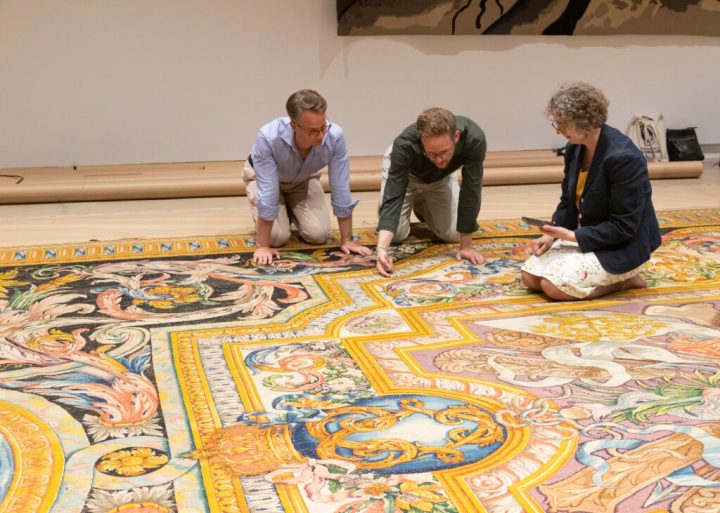
Wolf Burchard, Antonin Macé de Lepinay, and Elizabeth Cleland examine the Tapis Grande Galerie du Louvre, preserved by the Mobilier national in Paris, in 2023 (Photo by Justine Rossignol).
‘The King’s Carpet’, or le tapis du roi, was an enormous rug made up of 92 individual pieces that were intended to cover the entire span of the Grande Galerie of the Louvre, six times the length of the Hall of Mirrors at Versailles. Despite the monumental expense and energy lavished on this spectacular royal commission, Louis XIV appears never to have used the carpets. With time, the notion of ‘one’ carpet was forgotten and individual pieces were given away, some finding their way into the homes of English and American collectors, most notably the Rothschilds, Vanderbilts, and Wrightsmans. The altered and dispersed carpets thus became an enormous jigsaw puzzle, which Emmanuelle Federspiel and Antonin Macé de Lepinay of the Mobilier national in Paris, and Wolf Burchard of The Met in New York, are reconstructing, carpet by carpet, fragment by fragment.
Please join AFA as we welcome Dr. Wolf Burchard as the esteemed speaker for this Tracey L. Albainy Memorial Lecture, co-hosted by the American Friends of Attingham and The Metropolitan Museum of Art’s Department of European Sculpture and Decorative Arts. The AFA is delighted to welcome the public to this complimentary program, held in the Bonnie J. Sacerdote Lecture Hall at The Met. Registration is available here.
Tracey L. Albainy (1962–2007) served as Senior Curator of Decorative Arts and Sculpture, Art of Europe at the Museum of Fine Arts, Boston. She was a devoted Attingham supporter, completing multiple courses.
Wolf Burchard is Curator of European Sculpture and Decorative Arts at The Metropolitan Museum of Art and was recently appointed a Trustee of the Attingham Trust. He earned his MA and PhD in art history from the Courtauld Institute of Art and is the author of The Sovereign Artist: Charles Le Brun and the Image of Louis XIV (2016). He curated the exhibition Inspiring Walt Disney: The Animation of French Decorative Arts (2021) shown at The Met, The Wallace Collection, and The Huntington.










 Enfilade
leave a comment