Conference | Legacies: Why Museum Histories Matter
From ArtHist.net and the conference website (which includes abstracts) . . .
Legacies: Why Museum Histories Matter
Leiden, 13–15 January 2026
Organized by Laurie Kalb Cosmo, Marika Keblusek, Susanne Boersma, Raphaël Gerssen, and Margot Stoppels
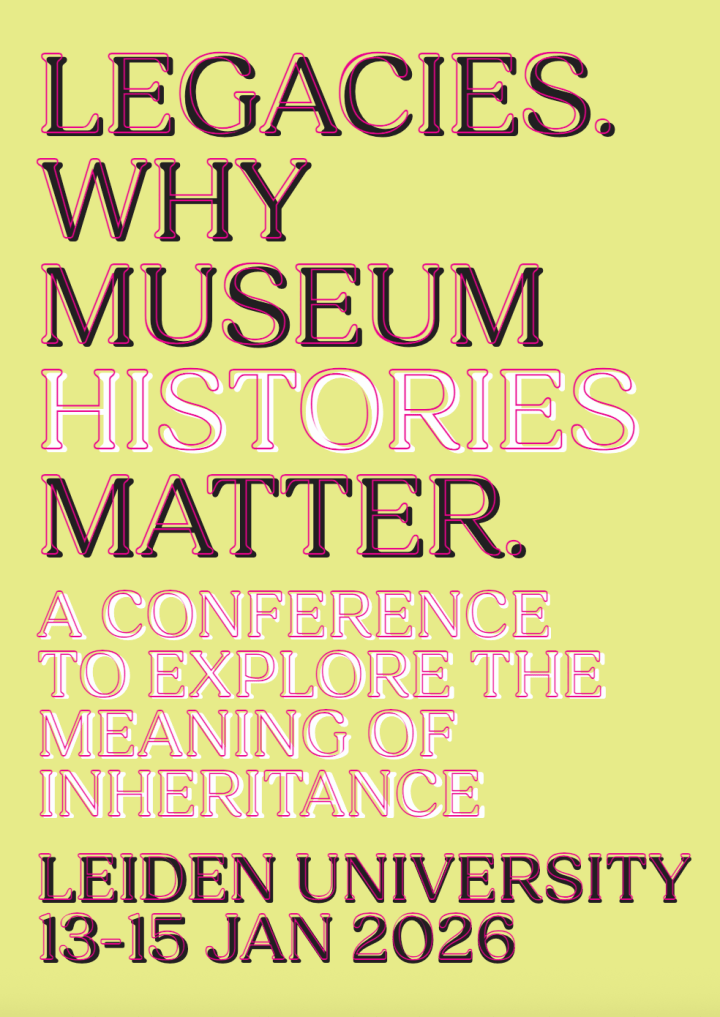 In January 2026, Leiden University’s Museum Lab will host the international conference Legacies: Why Museum Histories Matter. The conference reflects on museums with significant founding histories, broadly defined by their buildings, collections, commemorative functions, collectors or founders, that are currently engaged in some manner of institutional introspection, by way of exhibitions, acquisitions, restitutions, or renovations. International researchers and museum professionals from a range of institutions present their research and museum practices tied to museum legacies.
The three-day programme consists of twelve panels and four keynote speeches by Dr. Carole Paul (University of California, Santa Barbara), Monsignor Dr. Timothy Verdon (Museo dell’Opera del Duomo, Florence), Prof. Dr. Emile Schrijver (Jewish Cultural Quarter and National Holocaust Museum, Amsterdam), and Prof. Dr. Andrew McClellan (Tufts University, Boston).
Registration is available here»
t u e s d a y, 1 3 j a n u a r y
9.00 Registration
9.30 Welcome and Introduction
• Welcome — Stijn Bussels (Academic Director, Leiden University Centre for the Arts in Society)
• Introduction — Laurie Kalb Cosmo (University Lecturer and Project Director, Museum Lab, Leiden University)
9:50 Keynote
• Reflections on the History of the Public Art Museum — Carole Paul (Director of Museum Studies, University of California, Santa Barbara)
10.30 Coffee Break
11.00 Panel 1 | Monumental Legacies
Chair: Pieter ter Keurs (Emeritus, Leiden University)
• The Glyptotheque as a Site of Memory, Monumentality, and Transformation: Historical Identity and Contemporary Reflection of a Museum Institution in Croatia — Magdalena Getaldić (Glyptotheque of the Croatian Academy of Sciences and Arts)
• Obelisks and Totems: On Reframing Ethnographic Museums and Why Artistic Practice Matters — Irene Quarantini (Sapienza University, Rome)
• The Palatine Gallery: How Residents of the Pitti Palace Shaped Today’s Museum — Ilya Markov (Leiden University)
12.20 Lunch break
13.20 Panel 2 | Reshaping Legacies: Italian Museums
Chair: Irene Baldriga (Sapienza University)
• Reshaping the Oldest Italian National Museum — Paola D’Agostino, (Musei Reali Torino)
• Legacies Now: The Renewal of Institutional Inheritances at Five Museums in Rome — Laurie Kalb Cosmo (Leiden University)
• Two Centuries of Legacy, One Decade of Inclusion. Political Backlash and Strategic Reframing of Outreach at the Museo Egizio — Costanza Paolillo (New York University)
14.40 Panel 3 | Founders’ Legacies
Chair: Susanne Boersma (Leiden University)
• The Long Shadow of the Founder. Hero-Worship and the Construction of Continuity for a ‘National Museum’ — Joachim Berger and Darja Jesse (Germanisches Nationalmuseum, Nuremberg)
• National Gallery in Prague throughout the 20th Century: The Case of the Morawetz Collection — Lucie Němečková (Documentation Centre for Property Transfers of the Cultural Assets of WWII Victims, Prague)
• Leache & Wood: Rediscovering the Chrysler Museum’s Lost Founders — Mia Laufer and Drew Lusher (Chrysler Museum of Art, Norfolk)
16.00 Tea Break
16.30 Panel 4 | Unseen Legacies: Belgian Museum Buildings
Chair: Annemarie de Wildt (Former Curator at the Amsterdam Museum, Board Member of CAMOC, ICOM)
• Inherited Workspaces: Rethinking Creative Practice at the Constantin Meunier Museum — Ulrike Müller (University of Antwerp/Royal Museums of Fine Arts of Belgium, Brussels)
• Haunted Halls: Reclaiming Hidden Histories of the Royal Museums of Art and History in Brussels — Gerrit Verhoeven (University of Antwerp/Royal Museums of Art and History, Brussels)
• Between Immersion and Reflection. Old Antwerp and Museum Mayer van den Bergh Performing the Past — Stijn Bussels (Leiden University) and Bram van Oostveldt (Ghent University)
17.50 Day Closing — Laurie Kalb Cosmo
w e d n e s d a y , 1 4 j a n u a r y
9.00 Introduction — Laurie Kalb Cosmo
9.10 Keynote
• Legacies: Gifts of Love, Sacred Trusts, Investments — Timothy Verdon (Director of the Museo dell’Opera del Duomo/Museum of the Workshop of the Cathedral of Santa Maria del Fiore, Florence)
9.50 Keynote
• Developing and Opening Amsterdam’s National Holocaust Museum in a Politicized Era: Curatorial Challenges and Critical Choices — Emile Schrijver (Director of the Jewish Cultural Quarter and National Holocaust Museum, Amsterdam)
10.30 Coffee Break
11.00 Panel 5 | Revealing Histories and Reclaiming Heritage
Chair: Laurie Kalb Cosmo
• ‘My Heritage, Your Heritage?!’ Places of Jewish Heritage in Germany — Christiane Dätsch (Merseburg University of Applied Sciences
• POLIN Museum i Warsaw: A Place Where Memory Meets Responsibility — Joanna Fikus (POLIN, Warsaw)
• How to Celebrate the 75th Anniversary of the Museum Rietberg? Reflections on Researching and Curating the Institution’s History — Esther Tisa Francini (Museum Rietberg, Zurich)
12.20 Lunch break
13.20 Panel 6 | Eastern Europe: War and Recuperation
Chair: Seraina Renz (Leiden University)
• UNESCO and Museum Diplomacy: Geographies and Balances of Cultural Policy during the Cold War — Irene Baldriga (Sapienza University, Rome)
• Cultural Losses of Museums: The Polish Respond to World War II —Bartłomiej Sierzputowski and Elżbieta Przyłuska (Polish Ministry of Culture and National Heritage, Warsaw)
14.40 Panel 7 | Eastern Europe: (Post-)socialist Museums
Chair: Seraina Renz
• Shaping the Contemporary Art Museum Identity through its Complex Heritage. The Example of the Museum of Fine Arts in Split, Croatia —Jasminka Babić (Museum of Fine Arts, Split) and Dalibor Prančević (University of Split)
• Collecting to Forget: The Legacy of the Museum of Atheism in Vilnius — Karolina Bukovskytė (Lithuanian Culture Research Institute/National Museum of Lithuania, Vilnius)
• Whose Ethnography? Ethnographic Collections and Museums in Central Europe — Marika Keblusek (Leiden University)
16.00 Tea Break
16.30 Panel 8 | Revisiting Institutional Narratives
Chair: Wonu Veys, Leiden University/Wereldmuseum
• The Imperial Gaze Materialised: The Ten Thousand Chinese Things Museum as Archive — Yuansheng Luo (KU Leuven)
• Museum Histories in a Postcolonial Age: Collecting and Curating Netherlandish Art Legacies in the Global South — Laia Anguix-Vilches (Utrecht University)
• ‘You’re usually wrong’: Looking Back at the Anti-racism of the Past at One Museum — Deirdre Madeleine Smith (University of Pittsburgh/Carnegie Museum of Natural History)
17.50 Day Closing — Susanne Boersma
t h u r s d a y , 1 5 j a n u a r y
9.00 Panel 9 | Modernist Legacies in the Americas
Chair: Stephanie Noach (Leiden University)
• Lourival Gomes Machado and the Legacy of a Certain Brazilian Modernism at MAM-SP — Ana Avelar (University of Brasília)
• Legitimating Modernism: Art History and the Formation of Museum Authority in the United States — Laura Braden (Erasmus University Rotterdam)
• (Re)Making the San Francisco Museum of Art Modern — Berit Potter (California State Polytechnic University Humboldt, Arcata)
10.20 Coffee Break
10.50 Panel 10 | Crafts and Material Legacies
Chair: Lieske Huits (Leiden University)
• Donating Lace and Knowledge: Women and Early 20th-Century Historic Lace Acquisitions in the Belgian Royal Museums for Art and History — Julie Landuyt (Ghent University/Free University of Brussels)
• Crafts’ Networks and the National Museum of Capodimonte in Naples — Francesco Montuori (European University Institute, Florence)
• Preserving Heritage through Museums: The Case of the Kurdistan Region of Iraq — Chang Farhan Tahir (University of Duhok)
12.10 Lunch break
13.30 Panel 11 | Colonial Legacies
Chair: Wonu Veys (Leiden University/Wereldmuseum)
• Founding Myths and Colonial Entanglements: The Japan Folk Crafts Museum and the Politics of Mingei — Anna Stewart-Yates (University of Oxford)
• A Forgotten History: The Former Colonial Collection of the Royal Museums of Art and History, Belgium — Anke Hellebuyck (University of Antwerp)
• Rethinking Narratives: The ‘Animals of Africa’ in Bern — Sarah Csernay (Nordamerica Native Museum, Zurich)
14.50 Panel 12 | Prominent Figures and Entangled Histories
Chair: Susanne Boersma
• A Contested Museum History: Scenography and the Placement of the Islamic Collection at the Berlin Museums — Zehra Tonbul (Ozyegin University, Istanbul)
• Entangled Objects and Memory Sites in the Museum: Re-imagining the ‘Modern’ Collection — Juliet Simpson (Coventry University)
• The Museum as a Battleground: Political Art at the Israel Museum, 1967–1977 — Meital Raz (University of Amsterdam)
16.10 Tea Break
16.40 Keynote
• The Museum of Fine Arts, Boston, 1909: Towards a Machine for Looking — Andrew McClellan (Tufts University, Boston)
17.25 Closing Remarks — Marika Keblusek (Leiden University)
The Clark Names Lara Yeager-Crasselt as Tavitian Curator
From the press release (5 November 2025) . . .
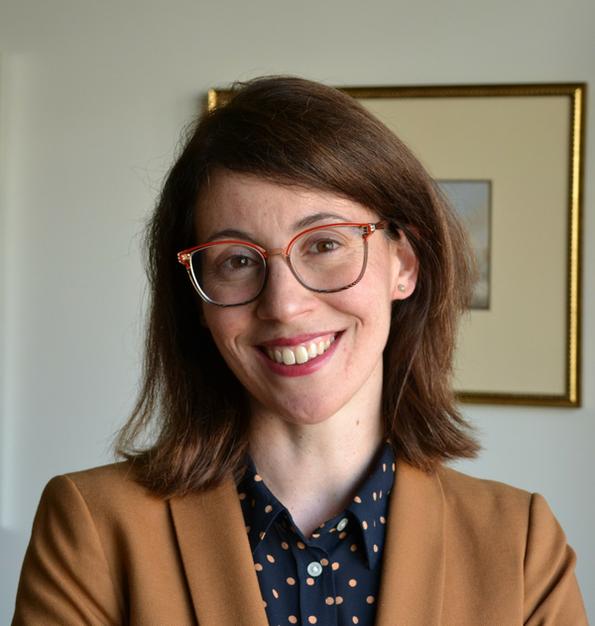 The Clark Art Institute, in Williamstown, Massachusetts, announced today that Lara Yeager-Crasselt has been appointed to serve as the first Aso O. Tavitian Curator of Early Modern European Painting and Sculpture.
Dr. Yeager-Crasselt is currently the Curator and Department Head of European Painting and Sculpture at the Baltimore Museum of Art, where she oversees the museum’s collection of fifteenth- through eighteenth-century painting and sculpture, including its research, exhibition, loans, acquisitions, and publication. Prior to her current role, she held prestigious curatorial and research positions at The Leiden Collection in New York and at KU Leuven, Belgium, among others. From 2015 until 2017, Yeager-Crasselt served as the Clark’s Interim Curator of Painting and Sculpture.
“We are delighted to welcome Lara Yeager-Crasselt back to the Clark and we feel incredibly fortunate to be able to entrust the Aso O. Tavitian Collection to her stewardship,” said Olivier Meslay, Hardymon Director of the Clark. “She is an ideal person to manage this collection, and we feel confident that Lara will play a major role in shaping the many ways in which we share these remarkable works of art with our visitors in the years ahead.”
Yeager-Crasselt’s curatorial experience includes a rich array of international exhibitions including Watershed: Transforming the Landscape in Early Modern Dutch Art (Baltimore Museum of Art); Exchanging Words: Women and Letters in Seventeenth-Century Dutch Genre Painting (Timken Museum of Art, San Diego); Rembrandt, Vermeer, and the Dutch Golden Age: Masterpieces of The Leiden Collection and the Musée du Louvre (Louvre Abu Dhabi); The Age of Rembrandt and Vermeer: Masterpieces of The Leiden Collection (Pushkin Museum, Moscow and The State Hermitage Museum, St. Petersburg, Russia), and Splendor, Myth, and Vision: Nudes from the Prado at the Clark.
“Lara is an exceptional scholar and curator and is well-regarded for her expertise in early modern painting and sculpture,” said Esther Bell, the Clark’s Deputy Director and Robert and Martha Berman Lipp Chief Curator. “Her deep knowledge and curatorial acumen will be a phenomenal addition to our team and will be so important to her research on the Tavitian Collection. Lara will also work with the Clark’s full collection of fifteenth- through eighteenth-century paintings and sculpture, and I know that her prior experience with our existing collection will be particularly important as she integrates this transformative gift and develops the plan for its installation in the new Aso O. Tavitian Wing. I look forward to collaborating with Lara on our summer 2026 exhibition An Exquisite Eye: Introducing the Tavitian Collection, which will provide the first opportunity for our visitors to see some of the magnificent treasures in the Tavitian Collection.”
An Exquisite Eye opens on 13 June 2026 and will showcase works by many of the most acclaimed artists of the early modern era—Jan van Eyck, Andrea della Robbia, Gian Lorenzo Bernini, Peter Paul Rubens, Jean-Antoine Watteau, and Jacques Louis David, among others. The exhibition will remain on view at the Clark through 21 February 2027.
The Aso O. Tavitian Collection was gifted to the Clark in 2024 from the foundation of the late collector, philanthropist, and connoisseur, Aso O. Tavitian. Between 2004 and 2020, Mr. Tavitian assembled the most significant private collection of European art assembled in North America in the twenty-first century. Representing one of the largest gifts in the Clark’s history, the Tavitian gift includes 331 works of art from Mr. Tavitian’s personal collection and more than $45 million to endow two new positions on the Clark’s curatorial staff to oversee the collection; provide necessary support for its long-term care; and fund construction of the Aso O. Tavitian Wing at the Clark, which is slated to open in 2028. The gift of art includes 132 paintings, 130 sculptures, thirty-nine drawings, and thirty decorative arts objects, creating an important addition to the Clark’s holdings and more than doubling the size of its sculpture collection.
“It is a tremendous honor to represent Aso O. Tavitian’s collection and his legacy at the Clark, as well as a great privilege and joy to be able to care for these extraordinary objects in my new role,” Yeager-Crasselt said. “I am truly thrilled to be returning to the Clark after these many years, and eager to join the team there in realizing the new Tavitian Wing and the first presentation of the collection this summer.”
In addition to her curatorial activity, Yeager-Crasselt has published widely on the art of the Netherlands, particularly its cross-cultural and artistic exchange with Italy, among which are studies on Michael Sweerts and François Duquesnoy. She is also a dedicated teacher, having taught art history to students at Johns Hopkins University, Baltimore; Vassar College; George Washington University, Washington, D.C., the University of Maryland, College Park; and The Catholic University of America, Washington, D.C. She holds a PhD in Art History from the University of Maryland and a bachelor of arts degree in History from Vassar College.
Yeager-Crasselt will begin work at the Clark in December 2025 and will immediately join the Institute’s cross-departmental team planning the construction of the Tavitian Wing. Designed by Selldorf Architects, New York City, the building project will get underway in early 2027 and will provide a permanent home for the Tavitian Collection.
Call for Papers | Gulliver’s Travels at 300
From the Call for Papers:
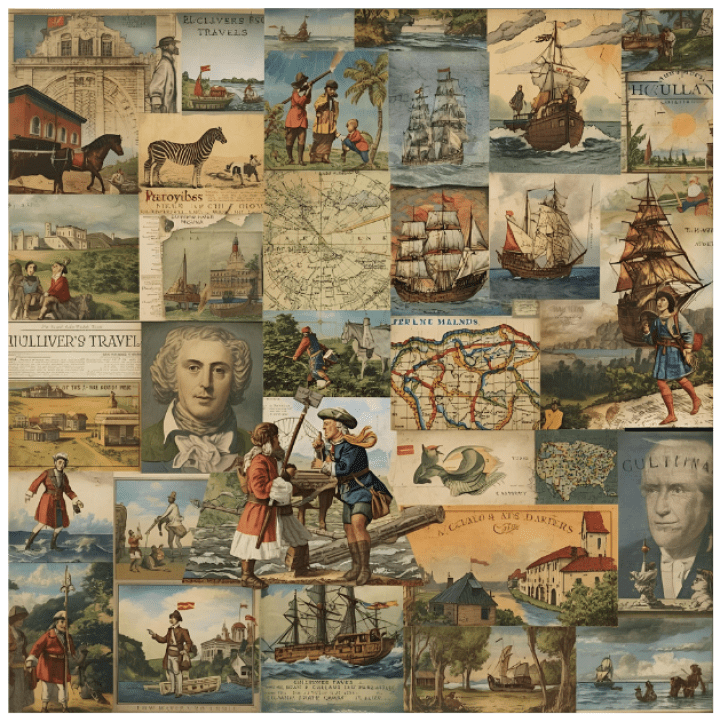
Gulliver’s Travels at 300: The Global Afterlives of a
Bestseller in Print, Transmedial Adaptations, and Material Cultures
The Seventh ILLUSTR4TIO International Symposium
St. Bride Library, London, 23–25 September 2026
Proposals due by 15 March 2026
 Plenary Lecture: Professor Daniel Cook (University of Dundee)
Artist’s Talk: Martin Rowson, in conversation with Brigitte Friant-Kessler
After Gulliver’s Travels was first published in 1726 and became, in the words of English dramatist John Gay, ‘universally read, from the cabinet council to the nursery’, Jonathan Swift’s contemporaries provided mixed reviews of this prose satire, reflecting on its moral value, social landscape, political subtext, comic scenes, and general appeal as a fictional travelogue. The long list of famous figures who commented publicly or privately during Swift’s century on Captain Lemuel Gulliver’s memoirs includes Alexander Pope, Lady Mary Wortley Montagu, Samuel Richardson, Walter Scott, Abbé Desfontaines, Voltaire, Madame du Deffand, Johann Christoph Gottsched, and Christoph Martin Wieland. During its three-centuries-old existence, Gulliver’s Travels has been rewritten and reedited, imitated and parodied, abridged and expanded, visualised and adapted, commodified and collected…. ‘If I had to make a list of six books which were to be preserved when all others were destroyed’, wrote George Orwell in 1946, ‘I would certainly put Gulliver’s Travels among them’. And as Will Rossiter (@Satyrane), who is an X (previously Twitter) user and literary scholar, summed up its appeal using this platform on 2 June 2016, ‘the afterlife of Gulliver’s Travels is built into the text itself’. Less concerned with literary rhetoric and textual semantics, artists seized upon Gulliver’s Travels to engage creatively with a text punctuated with humorous scenes, set in apocryphal lands, and sewn with inventive plot twists, and in which the main character interacts with miniature creatures, giants, flying islands, and talking horses. In the process, they generated a multifaceted iconographic corpus that rivals those of eighteenth-century bestsellers such as Robinson Crusoe and Candide, which have benefited, however, from substantial critical attention.
As its tercentennial anniversary approaches, Gulliver’s Travels has established itself as a canonical text and global bestseller. It still resonates with readers, young and old alike, throughout the world, is successfully taught in university classrooms, inspires new visual and textual remediations and adaptations, and captures the consumer’s gaze from a wealth of material objects. Considered ‘a great classic’ written by ‘the preeminent prose satirist in the English language’, it is ranked number 3 on The Guardian’s 100 Best Novels (as ‘a satirical masterpiece that’s never been out of print’), 35 in Raymond Queneau’s Pour une bibliothèque idéale (listing books forming an ideal library), 55 on the BBC’s 100 Greatest British Novels (based on a poll distributed to book critics outside the U.K.), 62 on The Telegraph’s 100 Novels Everyone Should Read (inventorying ‘the best novels of all time’), as well as unnumbered in Die Zeit’s Bibliothek der 100 Bücher (a collection with pedagogical aims from the well-respected German newspaper) and Harold Bloom’s Western canon, listing works ‘of great aesthetic interest’. In the Greatest Books of All Time, an inventory generated by an algorithm from 130 lists compiling the best books including the aforementioned ones, Gulliver’s Travels is classified as number 36. The Dean’s fictional travelogue has inspired a fascinating array of afterlives, ranging from the conventional (e.g. Sawney Gilpin’s 1760s oil paintings of Gulliver interacting with the Houyhnhnms and Thomas Stothard’s 1782 designs for The Novelist’s Magazine), to the loosely connected (Max Fleischer’s 1939 technicolour Gulliver’s Travels, recently restored for BluRay, and Gulliver’s Wife, Lauren Chater’s 2020 historical novel giving voice and agency to a midwife and herbalist whose presence in the source-text is minimal), to the transgressive (a fumetto: Milo Manara’s 1996 Gullivera; and American sailors from the Yokosuka Naval Base in Japan dressing up as Gulliver and parading in the Gulliver-Kannonzaki Festival), and to the playful (the giant Gulliver figure tied to the ground in Turia Gardens located in Valencia, Spain, with stairs, ramps, and ropes for children to climb up and down, as well as fast slides).
It is the enduring power and presence of Gulliver’s Travels in a diverse spectrum of fields, from scholarly editions to transmedial adaptations to popular culture events, that are of great interest to the conference organisers for this event. Papers that propose new, previously unpublished interpretations of the lively afterlives and global peregrinations of Gulliver’s Travels across time and space, or in various media and contexts, using interdisciplinary and cross-cultural approaches, are particularly welcomed.
Avenues for reflection include, but are not limited to, fresh perspectives on:
• the reception of Gulliver’s Travels in specific timeframes, geographic locations, and cultural contexts;
• Gulliver’s Travels in eighteenth- and nineteenth-century print (limited editions, serialised publications, chapbook adaptations, children’s books, ephemera, etc.);
• (illustrated) translations of Gulliver’s Travels in their editorial/linguistic/cultural contexts;
• Gulliver’s Travels and print culture (editorial paratexts, book collections, readers’ marginalia, extra-illustrated editions, etc.); or other graphic literature such as comics;
• images inspired by Gulliver’s Travels (paintings, frontispiece portraits, series of illustrations, standalone prints, graphic satire, maps, book covers, film posters, etc.) – focusing, for example, on visual commonplaces, iconographic paradigms, text-image relations, or Gulliver in the press;
• material Gulliveriana (board games, ceramic objects, playing cards, fans, keychains, bags, etc.) in relation to consumer culture and the Swift industry;
• the fun Gulliver (amusement parks, funfairs, cosplay, etc.);
• Gulliver’s Travels on stage (plays, musicals, operas, songs, sheet music) or on screen (film, TV, internet platforms, webzines, webcomics, video games, etc.)
• Gulliver’s Travels in the classroom: innovative pedagogical approaches to a world classic;
• decolonising Gulliver’s Travels and its links to the global British Empire;
• bringing Swift’s travelogue to life: curating exhibitions or events related to Gulliver’s Travels.
This international symposium celebrating the 300th anniversary of Gulliver’s Travels will be held under the auspices of the St. Bride Library in London, U.K. and in conjunction with a print workshop. In keeping with Illustr4tio’s aim to animate a dialogue between practitioners and critics, proposals are invited from illustrators, authors, printmakers, publishers, curators, collectors, and researchers. Papers can be presented in English or French. Proposals (500 words), accompanied by a bio-bibliographical note (100–150 words), should be sent to gulliverat300@yahoo.com by 15 March 2026. The publication of a selection of revised papers with previously unpublished material is envisaged. We will be able to accommodate requests for an early decision to support funding applications (please indicate your deadline in the submission).
Organising Committee
Nathalie Collé (Université de Lorraine)
Leigh G. Dillard (University of North Georgia)
Brigitte Friant-Kessler (Université de Valenciennes)
Christina Ionescu (Mount Allison University)
Illustr4tio is an international research network on illustration studies and practices. It aims at bringing together illustrators, authors, printmakers, publishers, curators, collectors, and researchers who have a common interest in illustration in all its forms, from the 16th century to the 21st century.
c o n t e n t s
Barchas, Janine. ‘Prefiguring Genre: Frontispiece Portraits from Gulliver’s Travels to Millenium Hall.’ Studies in the Novel 30.2 (Summer 1998): 260–86.
Borovaia, Olga V. ‘Translation and Westernization: Gulliver’s Travels in Ladino’. Jewish Social Studies, New Series 7.2 (Winter 2001): 149–68.
Bracher, Frederick. ‘The Maps in Gulliver’s Travels’. Huntington Library Quarterly 8.1 (November 1944): 59–74.
Bullard, Paddy, and James McLaverty. Jonathan Swift and the Eighteenth-Century Book. Cambridge: Cambridge University Press, 2013.
Collé, Nathalie. ‘“[T]o Mix Colours for Painters” and Illustrate and Adapt Gulliver’s Travels Worldwide: Street Murals, Adaptability and Transmediality’. In Adaptation and Illustration, edited by Shannon Wells-Lassagne and Sophie Aymes, Palgrave Studies in Adaptation and Visual Culture (London: Palgrave Macmillan, 2024), 47–68.
Cook, Daniel. Gulliver’s Afterlives: 300 Years of Transmedia Adaptation. London: Bloomsbury Publishing, 2025.
Colombo, Alice. ‘Rewriting Gulliver’s Travels under the Influence of J. J. Grandville’s Illustrations’. Word & Image: A Journal of Verbal/Visual Enquiry 30.4 (October-December 2014): 401–15.
Cook, Daniel. ‘Vexed Diversions: Gulliver’s Travels, the Arts and Popular Entertainment.’ In The Edinburgh Companion to the Eighteenth-Century British Novel and the Arts, edited by Jakub Lipski and M.-C. Newbould (Edinburgh: Edinburgh University Press, 2024), 228–43.
Cook, Daniel, and Nicholas Seager, eds. The Cambridge Companion to Gulliver’s Travels. Cambridge; New York: Cambridge University Press, 2024.
Didicher, Nicole E. ‘Mapping the Distorted Worlds of Gulliver’s Travels’. Lumen: Selected Proceedings from the Canadian Society for Eighteenth-Century Studies 16 (1997): 179–96.
Duthie, Elizabeth. ‘Gulliver Art’. The Scriblerian 10.2 (1978): 127–31.
Edwards, A. W. F. ‘Is the Frontispiece of Gulliver’s Travels a Likeness of Newton?’. Notes and Records of the Royal Society of London 50.2 (July 1996): 191–94.
Friant-Kessler, Brigitte. ‘L’encre et la bile: Caricature politique et roman graphique satirique au prisme de Gulliver’s Travels Adapted and Updated de Martin Rowson’. In L’Image railleuse, ed. Laurent Baridon, Frédérique Desbuissons, et Dominic Hardy (Paris: Publications de l’Institut National d’Histoire de l’Art, 2019), 315–44.
Gevirtz, Karen Bloom. Representing the Eighteenth Century in Film and Television, 2000-2015. Cham, Switzerland: Palgrave Macmillan, 2017.
Goring, Paul. ‘Gulliver’s Travels on the Mid-Eighteenth-Century Stage; Or, What is an Adaptation?’ Forum for Modern Language Studies 51.2 (2015): 100–15.
Halsband, Robert. ‘Eighteenth-Century Illustrations of Gulliver’s Travels’. In Proceedings of The First Münster Symposium on Jonathan Swift, ed. Hermann J. Real and Heinz J. Vienken (Munich: Wilhelm Fink, 1985), 83–112.
Hui, Haifeng. ‘The Changing Adaptation Strategies of Children’s Literature: Two Centuries of Children’s Editions of Gulliver’s Travels’. Hungarian Journal of English and American Studies 17.2 (Fall 2011): 245–62.
Léger, Benoit. ‘Nouvelles aventures de Gulliver à Blefuscu: traductions, retraductions et rééditions des Voyages de Gulliver sous la monarchie de Juillet’. Meta 49.3 (September 2004): 526–43.
Lenfest, David. ‘A Checklist of Illustrated Editions of Gulliver’s Travels, 1727-1914’. The Papers of the Bibliographical Society of America 62.1 (1968): 85–123.
Lenfest, David. ‘LeFebvre’s Illustrations of Gulliver’s Travels’. Bulletin of the New York Public Library 76 (1972): 199–208.
McCreedy, Jonathan, Vesselin M. Budakov, and Alexandra K. Glavanakova (eds.). Swiftian Inspirations: The Legacy of Jonathan Swift from the Enlightenment to the Age of Post-Truth. Newcastle-upon-Tyne: Cambridge Scholars Publishers, 2020.
Real, Hermann Josef. The Reception of Jonathan Swift in Europe. London: Thoemmes Continuum, 2005.
Rivero, Albert J., ed. Gulliver’s Travels: Contexts, Criticism. New York: Norton, 2002.
Sena, John F. ‘Gulliver’s Travels and the Genre of the Illustrated Book’. In The Genres of Gulliver’s Travels, ed. Frederik N. Smith (Newark: University of Delaware Press, 1990), 101–38.
Tadié, Alexis. ‘Traduire Gulliver’s Travels en images’. In Traduire et illustrer le roman au XVIIIe siècle, ed. Nathalie Ferrand (Oxford: Voltaire Foundation, 2011), 149–68.
Taylor, David Francis. ‘Gillray’s Gulliver and the 1803 Invasion Scare’. In The Afterlives of Eighteenth-Century Fiction, ed. Daniel Cook and Nicolas Seager (Cambridge: Cambridge University Press, 2015), 212–32.
Wagner, Peter. Reading Iconotexts: From Swift to the French Revolution. London: Reaktion, 1995.
Welcher, Jeanne K. ‘Eighteenth-Century Views of Gulliver: Some Contrasts between Illustrations and Prints’. In Imagination on a Long Rein: English Literature Illustrated, ed. Joachim Möller (Marburg: Jonas Verlag, 1988), 82–93.
Welcher, Jeanne K. Gulliveriana VII: Visual Imitations of Gulliver’s Travels, 1726–1830. Delmar, N.Y.: Scholars’ Facsimiles and Reprints, 1999.
Welcher, Jeanne K. Gulliveriana VIII: An Annotated List of Gulliveriana, 1721–1800. Delmar, NY: Scholars’ Facsimiles and Reprints, 1988.
Welcher, Jeanne K. and Joseph Randi. ‘Gulliverian Drawings by Richard Wilson’. Eighteenth-Century Studies 18.2 (Winter 1984-1985): 170–85.
Womersley, David. Gulliver’s Travels. New York: Cambridge University Press, 2012.










 Enfilade
leave a comment