Call for Applications | Painted Wall Preservation Scholarship
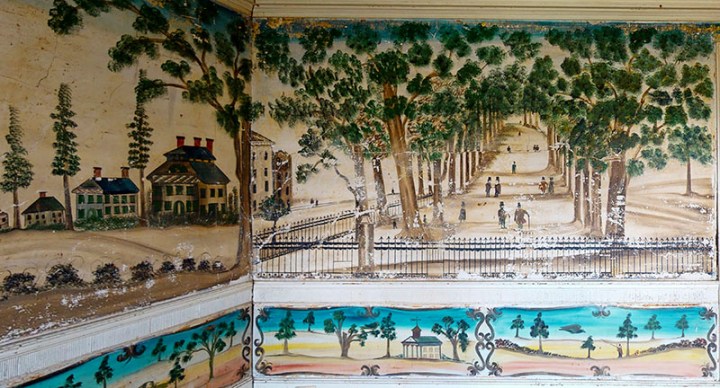 Interior of the Hersey-Whitten House, which was constructed in the late-18th or early-19th century in the village of Center Tuftonboro, New Hampshire. Originally built for the Copp family, it was once a dance hall and inn. Learn more from The Center for Painted Wall Preservation»
◊ ◊ ◊ ◊ ◊
From the scholarship announcement:
The Center for Painted Wall Preservation Scholarship
Applications due by 30 April 2026
The Center for Painted Wall Preservation (pwpcenter.org) invites undergraduate and graduate students, independent scholars, and artisans, whether established or in training, to apply for this scholarship, which aims to develop educational projects that further our mission through documentation, conservation, and preservation—where art, history, craft, and science meet.
This year’s scholarship of $2000 will be awarded to the individual whose proposal for an educational, scholarly project is deemed best designed to further the stated mission of our organization—to further the study, understanding, and appreciation of paint-decorated plaster walls and associated interior colorized items of the 18th and early 19th centuries in New England and New York, and to educate the public about this unique and vulnerable cultural heritage. Interested parties may apply for an Application Process Summary and Application Form by contacting info@pwpcenter.org with ‘Scholarship Fund’ in the subject line. Applications will be accepted from 1 January until midnight, 30 April 2026.
The Center for Painted Wall Preservation is a nationally recognized 501(c)(3) Nonprofit Organization.
Conference | Archives Unbound
From ArtHist.net and KHI:
Archives Unbound: Time and Memory in Romantic Visual Culture
Palazzo Grifoni Budini Gattai, Florence, 2–3 February 2026

The Sarcophagus of Seti I at Sir John Soane’s Museum, engraved by Mason Jackson (Illustrated London News, 1864).
In the Romantic period, the archive was more than a repository of the past: it was a living site of imagination, reconstruction, and desire. Today, archives are again central to debates on memory, preservation, and the recovery of histories. In an age of information overload, media excess, and destabilising fake news, the archive has become a hotly contested field: as verifiable record (resisting distortion) and as partial repository (erasing as much as it preserves). Archives Unbound: Time and Memory in Romantic Visual Culture seizes this moment to discuss Romanticism in dialogue with European and global perspectives, asking how art historians can engage the past with rigour, ethical awareness, and creative scope.
The workshop is a collaboration between the University of Jena’s research group European Romanticism or Romanticisms in Europe?, the University of York’s Department of History of Art, and the Kunsthistorisches Institut in Florenz (KHI). Set against the backdrop of Florence—itself a city-as-archive—the event will examine the archive as both repository and dynamic system of knowledge, memory and power. The workshop coincides with The City as Archive, a major KHI exhibition juxtaposing historical photographs with contemporary works by Armin Linke.
Organisers
Elisabeth Ansel, Hannah Baader, Christin Bates, Costanza Caraffa, Johannes Grave, and Richard Johns
Organising Institutions
University of Jena, University of York, and the Kunsthistorisches Institut in Florenz – Max-Planck-Institut
m o n d a y , 2 f e b r u a r y
9.30 Introduction, Elisabeth Ansel and Christin Bates
10.00 Exhibition | The City as Archive
• Hannah Baader and Costanza Caraffa (exhibition curators)
13.30 Lunch Break
14.30 Session 1
• Michael Smith (York), John Flaxman’s Roman Archive
• Gemma Shearwood (York), Westminster Abbey and St Paul’s Cathedral as Archives of National and Imperial Memory
16:00 Tea Break
16.30 Session 2
• Mira Claire Zadrozny (Jena), The Archival City in Distress: Time and Memory in Images of Paris’ Ephemeral Ruins
• John Norrman (Jena), The Image of the Barricade: Illustrated Periodicals as Archives of a Social Practice of Imagining Crisis, 1848
t u e s d a y , 3 f e b r u a r y
9.30 Greeting
9.45 Session 3
• Andrin Albrecht (Jena), Ludic Romanticism, or, the Five-Color Archive of Magic: The Gathering
• Kohta Nakajima (York), Metaphor as Fragment: Visualising Shakespeare in William Blake’s ‘Pity’ within Eighteenth-Century Reading Culture
11.15 Tea Break
11.45 Session 4
• Selina Kusche (Jena), Stories of a Single Figure? How Understanding History Paintings Requires a Mental Archive
• Jacob Bolda (York), Archives of Intimacy: The Portrait Miniature and the Romantic Subject
13.15 Lunch Break
14.15 Session 5
• Elisabeth Ansel (Jena), Fragmented Archives: The Manifold Aesthetics of Memory, Time, and Ecology in Ossianic Landscapes
• Christin Bates (Jena), Memories in Stone: Ruskinian Ecologies and Images as Climate Archives
• Kate Nankervis (York), ‘The Air Itself Is One Vast Library’: Atmosphere as Archive in British Romanticism
17.00 Final Discussion










 Enfilade
leave a comment