Call for Papers | Building Identities: Character in Architecture
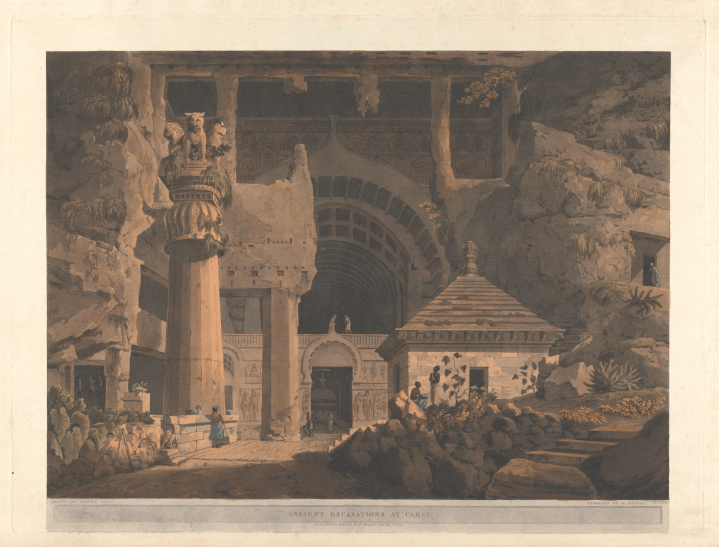
Henry Salt, Ancient Excavations at Carli, from Twenty-four Views in St. Helena, the Cape, India, Ceylon, the Red Sea, Abyssinia, and Egypt, London: Published by William Miller, Albemarle-Street, 1809 (New Haven: Yale Center for British Art, Paul Mellon Collection).
◊ ◊ ◊ ◊ ◊
From the Call for Papers:
Building Identities: Character in Architecture and Beyond, 1700–1900
Zurich, 2–4 September 2026
Organized by Sigrid de Jong, Maarten Delbeke, Nikos Magouliotis, and Dominik Müller
Proposals due by 1 March 2026
The term ‘character’ is part of today’s vocabulary of architecture: we casually refer to the ‘character’ of specific buildings or landscapes, and the ‘characteristics’ of projects or historical city centres, to emphasize their uniqueness, or the qualities attributed to them. We seem to resort to the term whenever more figurative terms fail to describe a certain formal or material je-ne-sais-quoi, which may also be associated with a distinct atmosphere or ethos. ‘Character’ often allows us to personify a building—to apply human empathy to inanimate matter.
‘Character’ emerged as a critical concept in the eighteenth century and developed into a key notion within architectural discourse of that period. It became ubiquitous in public debates concerning buildings, cities and landscapes between 1750 and 1850. Writers on architecture employed this notion to indicate how a building expressed the personality of its patron, its architect, a style or genre, how its form related to its use, or how it represented a culture or a nation; in short, a building’s character was synonymous with its identity. Borrowing from literary theory, architects such as Germain Boffrand, Jacques-François Blondel, William Chambers, Étienne-Louis Boullée, and Quatremère de Quincy elaborated on the notion of character in their writings. They used the term to articulate principles that ensured buildings properly express their function, or would be read and experienced appropriately by their audiences.
‘Character’ became especially versatile when the discovery of non-classical architectures rendered the Vitruvian orders insufficient to describe the different building cultures of the world, and when the stylistic repertoire of Western architecture broadened in all directions to include the gothic, the rural vernacular and various forms of non-European architecture. With questions of meaning and appropriateness becoming increasingly urgent, writers turned to the term ‘character’ when discussing landscapes, cities, buildings, and interiors in architectural theory, philosophy, travel literature, as well as literary fiction. Furthermore, as discussions regarding architectural proportions shifted from ideal systems and norms to the emotional effects of proportional modulation, ‘character’ came to encapsulate the affective dimensions of architecture and landscape. Our project Building Identity: Character in Architectural Debate and Design, 1750–1850 explores how such discussions were related to broader uses of the term ‘character’, rooted in its origins outside the discipline of architecture. A convenient vehicle for various metaphors and metonymies, ‘character’ often signifies both the means and instruments of classification and their intended effect.
While scholars usually studied the uses of the concept focusing on Western-Europe and on designers and architectural critics (Szambien, Forty, Grignon and Maxim), our conference ‘Building Identities’ is interested in examining character in a broader manner, across various disciplines and geographies. We aim to investigate the complexity, variety and contradictions surrounding its centrality in discourse. By foregrounding aspects that have long been undervalued, the conference Building Identities invites participants to collaborate in writing a critical history of ‘character’ tracing:
• How ‘character’ connects and relates to different fields (art history, landscape, urban history, travel, literature, the performing arts, philosophy, religion, cultural history, anthropology, nascent natural sciences).
• What ‘character’ presupposes in terms of ideologies, also in connection to notions such as identity, custom, mœurs, civilisation, etc.
• How and why ‘character’ operates in specific contexts (classification, subordination, naturalisation).
We invite proposals that
• Examine the notion of ‘character’ and its intellectual history in a variety of sources, within a diversity of disciplines and geographies.
• Question texts or practices that rely on ‘character’ in relation to architecture, landscape, and territory.
• Explore descriptions of the built environment that rely on ‘character’ to bridge the specific with the universal.
• Interrogate the notion in artistic practices, in building, urban, and landscape designs.
• Exemplify the problems, paradoxes, flaws, and possibilities of the notion.
We are interested in paper proposals treating and complicating ‘character’ as a historical concept, addressing specific uses of the term ‘character’ in sources from the period 1700–1900. Papers are welcomed that venture beyond the canonical sources of architectural theory, and engage with one or more of the following topics:
• The gender of architecture (buildings and interiors), cities and landscapes: usages of ‘character’ to gender the built environment, its relation to patrons, clients, and the public.
• The emotions of architecture, cities and landscapes: authors for whom ‘character’ served as a synonym for empathy, affect, or the emotional impact on the human mind and soul.
• The cultural or national identity of architecture, cities and landscapes: texts in which the term ‘character’ is employed to articulate cultural specificity and difference, or to construct ideas such as race, ethnicity and nation.
We particularly welcome papers that examine how the term migrated between different fields, semiotics, and epistemes, as well as how it was translated from one language to another.
Abstracts of max. 300 words should be submitted to buildingidentities@gmail.com by 1 March 2026, along with the applicant’s name, email address, professional affiliation, address, telephone number and a short curriculum vitae (maximum one page). Please combine both abstract and CV in one PDF file. Selected speakers will be notified by April.
The conference is part of the project Building Identity: Character in Architectural Debate and Design, 1750–1850, funded by the Swiss National Science Foundation, and based at the Chair for the History and Theory of Architecture, gta Institute, ETH Zurich.
Symposium | Women at Work
From AWARE (Archives of Women Artists, Research, and Exhibitions):
Women at Work: Collections in Museums of
Historical Art through the Lens of Gender
École du Louvre, Amphithéâtre Michel-Ange, Paris, 16–17 February 2026

Sandra Gamarra, Milagros, ca. 2008 (Courtesy of the artist).
In 2014, the Musée du Louvre held a lecture series, entitled Women Artists at the Museum? Current Perspectives. Building on this line of thought, the present symposium moves beyond acknowledging the under-representation of women artists in permanent collections: through a combination of theoretical approaches and real-world case studies, this symposium aims to explore the epistemological shift that must occur for women artists to take their rightful place in museum collections.
Museums play a key role in society as spaces of knowledge and, by extension, of power. By rendering objects visible and inscribing them within cultural narratives, museums contribute to creating dominant frameworks and, through them, collective imaginaries. Scholarship in art history, museology and, in particular, gender studies, challenges the existing hierarchies among artists, artworks and techniques, and critically examines the conditions under which artists trained and worked. This feminist approach, which also draws on postcolonial theory, is driving change in museum practices. By focusing on the permanent collections of historical art, an area still less studied from this angle than temporary exhibitions and modern or contemporary collections, this symposium will explore museum initiatives that generate new ways of seeing and understanding. Many historical art museums have launched research programmes, experimented with innovative display strategies, and developed new narratives and modes of transmission.
Such work challenges evaluation criteria grounded in the established canon and pushes back on the enduring myths and misconceptions that continue to shape art history. This naturally gives rise to pressing questions: Can gender studies play a role in fundamentally reconfiguring museums? Does a radical approach necessarily lose its force when articulated within an institutional setting? What initiatives of this kind, both past and present, have already been carried out, and with what outcomes?
Organised jointly by the non-profit organisation AWARE (Archives of Women Artists, Research and Exhibitions) and the Musée du Louvre Museum Studies and Research Support Department, this international symposium (Elles sont à l’œuvre: Les collections des musées d’art ancien au prisme du genre) will bring together curators, academics, and artists working at the intersection of art history, museology, and gender studies, to harness the transformative potential that this interdisciplinary space holds for building the museums of tomorrow.
m o n d a y , 1 6 f e b r u a r y 2 0 2 6
9.30 Welcome by Françoise Mardrus, Musée du Louvre, and Camille Morineau, AWARE, MNAM-Centre Pompidou
9.45 Introduction by Griselda Pollock, Feminist Art Historian, Professor Emerita, University of Leeds
10.30 Session 1 | Mapping Presence: Revisiting Permanent Collections
Moderator: Chương-Đài VÕ, Curator, Writer, Editor and Professor, ENSAPC
• Annabelle Ténèze, Director, Louvre-Lens Museum
• Ilaria Miarelli Mariani, Director, Museum of Rome and the Municipal Museums of the City of Rome, and Ilaria Arcangeli, Researcher
• Fabienne Dumont, Art Historian, Art Critic and Professor at Jean-Monnet-Saint-Etienne University
• Gloria Cortes, Heritage Curator at the Fine Arts Museum of Chile, in Spanish with consecutive translation into English
13.15 Lunch break
14.30 Session 2 | Beyond the Fine Arts: Hierarchies of Genre and Gender
Moderator: Stéphanie Deschamps-Tan, Heritage Curator, Musée du Louvre
• Andaleeb Badie Banta, Andrew W. Mellon Senior Curator of Prints and Drawings, National Gallery of Art, Washington DC
• Manon Lacaplain, Director and Heritage Curator, and Camille Belvèze, Heritage Curator, Musée Sainte-Croix, Poitiers
• Liliane Cuesta Davignon, Heritage Curator, González Martí National Museum of Ceramics and Decorative Arts
• Iris Moon, Associate Curator, European Sculpture and Decorative Arts, Metropolitan Museum of Art
17.15 End of the first day
t u e s d a y , 1 7 f e b r u a r y 2 0 2 6
9.30 Welcome by Carolina Hernández Muñoz, International networks project manager and coordinator, AWARE, and Matylda Taszycka, Head of Research Programmes, AWARE, MNAM-Centre Pompidou
9.45 Session 3 | Collections as Polysemous Spaces: Narrating Multiple Histories
Moderator: Clovis Maillet, Performance Artist and Medieval Historian
• Isabella Rjeille, Curator, Museu de Arte de São Paulo Assis Chateaubriand
• Stephanie Sparling Williams, Andrew W. Mellon Curator of American Art at the Brooklyn Museum
• Sandra Gamarra Heshiki, artist
• Pawel Leszkowicz, Art Historian and Professor of Contemporary Art and Curatorial Studies, Academy of Art, Szczecin
• Zorian Clayton, Curator of Prints, Victoria & Albert Museum
13.00 Lunch break
14.30 Session 4 | Networks and Transmission: Working Collectively
Moderator: Julie Botte, Musée du Louvre
• Charlotte Foucher Zarmanian, Art Historian and Research Director, CNRS (National Centre for Scientific Research)
• Laurien van der Werff and Magdalena Roosje Anker, Heritage Curators and Co-Chairs of ‘Women of the Rijksmuseum’, Rijksmuseum, Amsterdam
• Noelia Perez Garcia, Research Director of El Prado en femenino, Prado Museum and Professor of Art History, University of Murcia, and Carlos González Navarro, Heritage Curator of 19th-Century Painting, Prado Museum
• Susanna Avery Quash, Senior Research Lead and Head of ‘Women in the Arts Forum’, National Gallery, London
17.15 Conclusion by Anne Lafont, Art Historian and Research Director at EHESS (School of Advanced Studies in the Social Sciences)










 Enfilade
leave a comment