Call for Papers | Revolutions, Art, and the Market
From ArtHist.net:
Revolutions, Art, and the Market
Sotheby’s Institute of Art, London, 4–5 June 2026
Proposals due by 1 March 2026
Art market trends and practices, whether historical or contemporary, are affected by networks of complex and often competing forces. As moments of political, economic, intellectual or technological rupture, revolutions have significantly shaped art market systems and fortunes, refracting and redirecting collecting ambitions, displacing existing markets and creating new ones, and promoting novel modes of commercialisation of art.
Embracing wide chronological and geographical spans, this conference will consider how revolutions have inflected the circulation and consumption of art and facilitated the emergence of new art market practices and collecting paradigms. The conference is deliberately adopting a broad definition of the term Revolution, intending to encompass its political, cultural, intellectual, economic, and technological incarnations.
Interdisciplinary proposals and methodological approaches including empirical evaluations, economic analyses, and studies from the digital humanities are welcome. The conference is intended to foster rich discussions at the intersection of academic scholarship and professional practices, and contributions from both academics and art market professionals are actively sought. Papers addressing contemporary perspectives and practices, as well as under-represented regions of the art market and the Global South are particularly encouraged.
Proposals offering critical perspectives may consider (but are not limited to) the following themes:
• Political revolutions and shifting art market geographies
• The dispersal and looting of collections
• Revolutions and markets for luxury goods
• Political revolutions and artistic migrations
• The markets for revolutionary art
• The American Revolutionary War and transatlantic artistic exchanges
• The Russian Revolutions
• The aftermath of PCR’s Cultural Revolution
• Iran’s White and Islamic Revolutions and the national and international markets for Iranian art.
• The artistic expressions of the Arab Springs
• The Scientific Revolution and its new collecting paradigms
• The Printing Revolution and the markets for prints
• The digital revolution and the emergence of new art market commercial platforms
• Technological revolutions and innovations: NFTs, Blockchain, AR, VR, AI-generated art
Please submit an abstract of no more than 300 words for a 25-minute paper, along with a brief biography to Barbara Lasic, b.lasic@sia.edu, by 1 March 2026. Successful papers will be notified by 15 March.
Call for Articles | Spring 2027 Issue of J18: Untitled
From the Call for Papers:
Journal18, Issue #23 (Spring 2027) — Untitled
Issue edited by Catherine Girard, Sylvia Houghteling, Meredith Martin, and Hannah Williams
Proposals due by 3 April 2026; finished articles will be due by 1 September 2026
In 2026, Journal18 celebrates a decade of publishing cutting-edge scholarship on the art, material culture, and social life of the eighteenth century. To mark this tenth anniversary, for the first time since launching Journal18, we will take an open call approach. Unlike our usual tightly themed issues, this “Untitled” issue invites contributions from scholars working on any aspect of visual and material culture of the long 18th century from around the globe, drawing on diverse methodologies, perspectives, and global contexts.
Our “Untitled” issue of Journal18 offers an opportunity for open reflection and critical intervention in the field of eighteenth-century studies. What assumptions, canonical narratives, or disciplinary boundaries merit reconsideration today? What methods, sources, or frameworks might illuminate eighteenth-century art in new and unexpected ways? Which objects, artists, or practices remain unexplored, and why? Can we rethink the role of audiences—past or present—in shaping our understanding of the eighteenth century? How can our field speak to contemporary debates, challenges, or experiences affecting the world today?
We welcome contributions that explore, but are not limited to:
• Transnational and cross-cultural approaches to eighteenth-century art.
• New theoretical, methodological, or archival interventions.
• Reconsiderations of canonical objects, artists, or movements.
• Reflections on the evolving field of eighteenth-century art history and cultural studies.
• We are especially interested in work that offers fresh perspectives from underrepresented regions, traditions, or voices within the global eighteenth-century art world.
We anticipate an issue comprised of relatively short texts (max 4000 words). We also welcome contributions that do not follow the standard scholarly essay format, including pieces that are co-authored or take the form of an interview, data visualization, short film, audio recording, virtual exhibition, creative collaboration, or something that has yet to be dreamed up.
Proposals for issue #23 Untitled are now being accepted. The deadline for proposals is 3 April 2026. To submit a proposal, send an abstract (250 words) and a brief biography to editor@journal18.org. Articles should not exceed 4000 words (including footnotes) and will be due for submission by 1 September 2026. For further details on submission and Journal18 house style, see Information for Authors.
Issue Editors
Catherine Girard, St. Francis Xavier University, Nova Scotia
Sylvia Houghteling, Bryn Mawr College
Meredith Martin, NYU and Institute of Fine Arts, New York
Hannah Williams, Queen Mary University of London
Journal18, Fall 2025 — Clean
The latest issue of J18:
Journal18, Issue #20 (Fall 2025) — Clean
Issue edited by Maarten Delbeke, Noémie Etienne, and Nikos Magouliotis
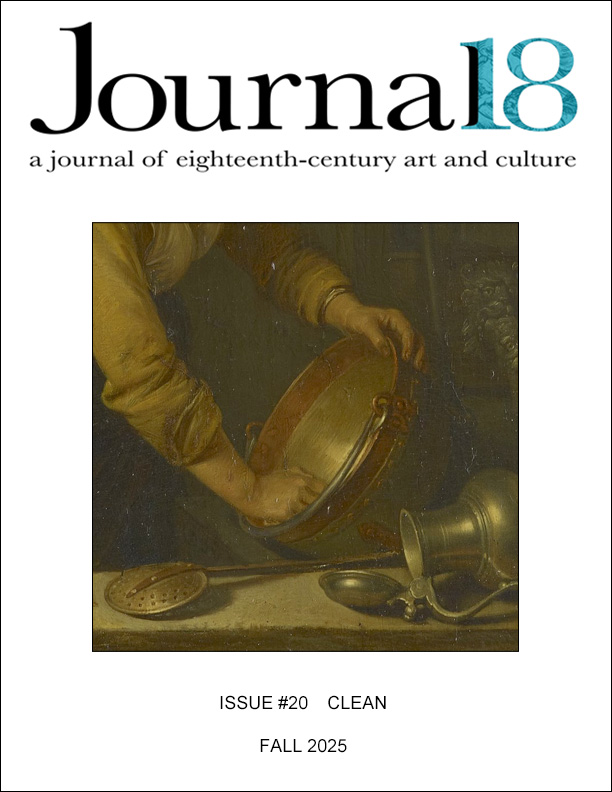 Cleaning is never a neutral act. In the eighteenth century, acts of cleaning became a way to decide what counted as disorder, to separate asserted purity from designated pollution, and to display authority over matter, space, and people. From the forecourt of Paris’s Notre-Dame to the Ganges river in Varanasi to Scotland’s filthy privies, practices of cleaning have shaped political order. Racial issues, colonization, and the management of public space revolved around the idea and implementation of cleaning, which could also involve the deliberate relocation or erasure of human beings.
a r t i c l e s
Economies of Waste: Revolutionary Administration and the Afterlives of the Kings of Notre-Dame — Demetra Vogiatzaki
‘Beneath the Waters of a Universal Ocean’: Containing, Contaminating, and Cleaning the Ganges River in Varanasi — Ushma Thakrar
Piss, Poison, and other Paths between Scotland and England in Caricature since 1745 — Laura Golobish
c o n v e r s a t i o n p i e c e
The Grammar of Cleaning: A Conversation — Maarten Delbeke, Noémie Etienne, and Nikos Magouliotis
All articles are available for free here, along with recent notes & queries:
r e c e n t n o t e s a n d q u e r i e s
Marie Antoinette Style: An Exhibition Catalogue Review — Madeleine Luckel
Room for the Lost Paradise: A Symposium — Jason M. Kelly
Reflections on Mai, Joshua Reynolds, and Eighteenth-Century Art — A Roundtable
Colonial Crossings: A Review — Juan Manuel Ramírez Velázquez
Call for Papers | Building Identities: Character in Architecture
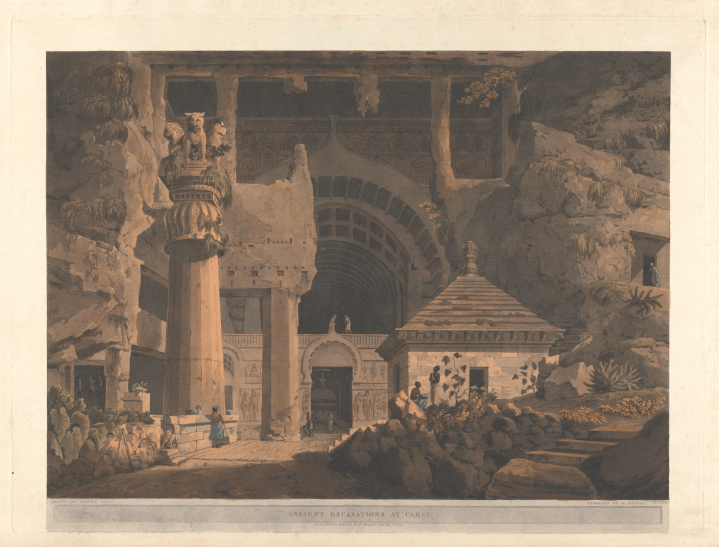
Henry Salt, Ancient Excavations at Carli, from Twenty-four Views in St. Helena, the Cape, India, Ceylon, the Red Sea, Abyssinia, and Egypt, London: Published by William Miller, Albemarle-Street, 1809 (New Haven: Yale Center for British Art, Paul Mellon Collection).
◊ ◊ ◊ ◊ ◊
From the Call for Papers:
Building Identities: Character in Architecture and Beyond, 1700–1900
Zurich, 2–4 September 2026
Organized by Sigrid de Jong, Maarten Delbeke, Nikos Magouliotis, and Dominik Müller
Proposals due by 1 March 2026
The term ‘character’ is part of today’s vocabulary of architecture: we casually refer to the ‘character’ of specific buildings or landscapes, and the ‘characteristics’ of projects or historical city centres, to emphasize their uniqueness, or the qualities attributed to them. We seem to resort to the term whenever more figurative terms fail to describe a certain formal or material je-ne-sais-quoi, which may also be associated with a distinct atmosphere or ethos. ‘Character’ often allows us to personify a building—to apply human empathy to inanimate matter.
‘Character’ emerged as a critical concept in the eighteenth century and developed into a key notion within architectural discourse of that period. It became ubiquitous in public debates concerning buildings, cities and landscapes between 1750 and 1850. Writers on architecture employed this notion to indicate how a building expressed the personality of its patron, its architect, a style or genre, how its form related to its use, or how it represented a culture or a nation; in short, a building’s character was synonymous with its identity. Borrowing from literary theory, architects such as Germain Boffrand, Jacques-François Blondel, William Chambers, Étienne-Louis Boullée, and Quatremère de Quincy elaborated on the notion of character in their writings. They used the term to articulate principles that ensured buildings properly express their function, or would be read and experienced appropriately by their audiences.
‘Character’ became especially versatile when the discovery of non-classical architectures rendered the Vitruvian orders insufficient to describe the different building cultures of the world, and when the stylistic repertoire of Western architecture broadened in all directions to include the gothic, the rural vernacular and various forms of non-European architecture. With questions of meaning and appropriateness becoming increasingly urgent, writers turned to the term ‘character’ when discussing landscapes, cities, buildings, and interiors in architectural theory, philosophy, travel literature, as well as literary fiction. Furthermore, as discussions regarding architectural proportions shifted from ideal systems and norms to the emotional effects of proportional modulation, ‘character’ came to encapsulate the affective dimensions of architecture and landscape. Our project Building Identity: Character in Architectural Debate and Design, 1750–1850 explores how such discussions were related to broader uses of the term ‘character’, rooted in its origins outside the discipline of architecture. A convenient vehicle for various metaphors and metonymies, ‘character’ often signifies both the means and instruments of classification and their intended effect.
While scholars usually studied the uses of the concept focusing on Western-Europe and on designers and architectural critics (Szambien, Forty, Grignon and Maxim), our conference ‘Building Identities’ is interested in examining character in a broader manner, across various disciplines and geographies. We aim to investigate the complexity, variety and contradictions surrounding its centrality in discourse. By foregrounding aspects that have long been undervalued, the conference Building Identities invites participants to collaborate in writing a critical history of ‘character’ tracing:
• How ‘character’ connects and relates to different fields (art history, landscape, urban history, travel, literature, the performing arts, philosophy, religion, cultural history, anthropology, nascent natural sciences).
• What ‘character’ presupposes in terms of ideologies, also in connection to notions such as identity, custom, mœurs, civilisation, etc.
• How and why ‘character’ operates in specific contexts (classification, subordination, naturalisation).
We invite proposals that
• Examine the notion of ‘character’ and its intellectual history in a variety of sources, within a diversity of disciplines and geographies.
• Question texts or practices that rely on ‘character’ in relation to architecture, landscape, and territory.
• Explore descriptions of the built environment that rely on ‘character’ to bridge the specific with the universal.
• Interrogate the notion in artistic practices, in building, urban, and landscape designs.
• Exemplify the problems, paradoxes, flaws, and possibilities of the notion.
We are interested in paper proposals treating and complicating ‘character’ as a historical concept, addressing specific uses of the term ‘character’ in sources from the period 1700–1900. Papers are welcomed that venture beyond the canonical sources of architectural theory, and engage with one or more of the following topics:
• The gender of architecture (buildings and interiors), cities and landscapes: usages of ‘character’ to gender the built environment, its relation to patrons, clients, and the public.
• The emotions of architecture, cities and landscapes: authors for whom ‘character’ served as a synonym for empathy, affect, or the emotional impact on the human mind and soul.
• The cultural or national identity of architecture, cities and landscapes: texts in which the term ‘character’ is employed to articulate cultural specificity and difference, or to construct ideas such as race, ethnicity and nation.
We particularly welcome papers that examine how the term migrated between different fields, semiotics, and epistemes, as well as how it was translated from one language to another.
Abstracts of max. 300 words should be submitted to buildingidentities@gmail.com by 1 March 2026, along with the applicant’s name, email address, professional affiliation, address, telephone number and a short curriculum vitae (maximum one page). Please combine both abstract and CV in one PDF file. Selected speakers will be notified by April.
The conference is part of the project Building Identity: Character in Architectural Debate and Design, 1750–1850, funded by the Swiss National Science Foundation, and based at the Chair for the History and Theory of Architecture, gta Institute, ETH Zurich.
Symposium | Women at Work
From AWARE (Archives of Women Artists, Research, and Exhibitions):
Women at Work: Collections in Museums of
Historical Art through the Lens of Gender
École du Louvre, Amphithéâtre Michel-Ange, Paris, 16–17 February 2026

Sandra Gamarra, Milagros, ca. 2008 (Courtesy of the artist).
In 2014, the Musée du Louvre held a lecture series, entitled Women Artists at the Museum? Current Perspectives. Building on this line of thought, the present symposium moves beyond acknowledging the under-representation of women artists in permanent collections: through a combination of theoretical approaches and real-world case studies, this symposium aims to explore the epistemological shift that must occur for women artists to take their rightful place in museum collections.
Museums play a key role in society as spaces of knowledge and, by extension, of power. By rendering objects visible and inscribing them within cultural narratives, museums contribute to creating dominant frameworks and, through them, collective imaginaries. Scholarship in art history, museology and, in particular, gender studies, challenges the existing hierarchies among artists, artworks and techniques, and critically examines the conditions under which artists trained and worked. This feminist approach, which also draws on postcolonial theory, is driving change in museum practices. By focusing on the permanent collections of historical art, an area still less studied from this angle than temporary exhibitions and modern or contemporary collections, this symposium will explore museum initiatives that generate new ways of seeing and understanding. Many historical art museums have launched research programmes, experimented with innovative display strategies, and developed new narratives and modes of transmission.
Such work challenges evaluation criteria grounded in the established canon and pushes back on the enduring myths and misconceptions that continue to shape art history. This naturally gives rise to pressing questions: Can gender studies play a role in fundamentally reconfiguring museums? Does a radical approach necessarily lose its force when articulated within an institutional setting? What initiatives of this kind, both past and present, have already been carried out, and with what outcomes?
Organised jointly by the non-profit organisation AWARE (Archives of Women Artists, Research and Exhibitions) and the Musée du Louvre Museum Studies and Research Support Department, this international symposium (Elles sont à l’œuvre: Les collections des musées d’art ancien au prisme du genre) will bring together curators, academics, and artists working at the intersection of art history, museology, and gender studies, to harness the transformative potential that this interdisciplinary space holds for building the museums of tomorrow.
m o n d a y , 1 6 f e b r u a r y 2 0 2 6
9.30 Welcome by Françoise Mardrus, Musée du Louvre, and Camille Morineau, AWARE, MNAM-Centre Pompidou
9.45 Introduction by Griselda Pollock, Feminist Art Historian, Professor Emerita, University of Leeds
10.30 Session 1 | Mapping Presence: Revisiting Permanent Collections
Moderator: Chương-Đài VÕ, Curator, Writer, Editor and Professor, ENSAPC
• Annabelle Ténèze, Director, Louvre-Lens Museum
• Ilaria Miarelli Mariani, Director, Museum of Rome and the Municipal Museums of the City of Rome, and Ilaria Arcangeli, Researcher
• Fabienne Dumont, Art Historian, Art Critic and Professor at Jean-Monnet-Saint-Etienne University
• Gloria Cortes, Heritage Curator at the Fine Arts Museum of Chile, in Spanish with consecutive translation into English
13.15 Lunch break
14.30 Session 2 | Beyond the Fine Arts: Hierarchies of Genre and Gender
Moderator: Stéphanie Deschamps-Tan, Heritage Curator, Musée du Louvre
• Andaleeb Badie Banta, Andrew W. Mellon Senior Curator of Prints and Drawings, National Gallery of Art, Washington DC
• Manon Lacaplain, Director and Heritage Curator, and Camille Belvèze, Heritage Curator, Musée Sainte-Croix, Poitiers
• Liliane Cuesta Davignon, Heritage Curator, González Martí National Museum of Ceramics and Decorative Arts
• Iris Moon, Associate Curator, European Sculpture and Decorative Arts, Metropolitan Museum of Art
17.15 End of the first day
t u e s d a y , 1 7 f e b r u a r y 2 0 2 6
9.30 Welcome by Carolina Hernández Muñoz, International networks project manager and coordinator, AWARE, and Matylda Taszycka, Head of Research Programmes, AWARE, MNAM-Centre Pompidou
9.45 Session 3 | Collections as Polysemous Spaces: Narrating Multiple Histories
Moderator: Clovis Maillet, Performance Artist and Medieval Historian
• Isabella Rjeille, Curator, Museu de Arte de São Paulo Assis Chateaubriand
• Stephanie Sparling Williams, Andrew W. Mellon Curator of American Art at the Brooklyn Museum
• Sandra Gamarra Heshiki, artist
• Pawel Leszkowicz, Art Historian and Professor of Contemporary Art and Curatorial Studies, Academy of Art, Szczecin
• Zorian Clayton, Curator of Prints, Victoria & Albert Museum
13.00 Lunch break
14.30 Session 4 | Networks and Transmission: Working Collectively
Moderator: Julie Botte, Musée du Louvre
• Charlotte Foucher Zarmanian, Art Historian and Research Director, CNRS (National Centre for Scientific Research)
• Laurien van der Werff and Magdalena Roosje Anker, Heritage Curators and Co-Chairs of ‘Women of the Rijksmuseum’, Rijksmuseum, Amsterdam
• Noelia Perez Garcia, Research Director of El Prado en femenino, Prado Museum and Professor of Art History, University of Murcia, and Carlos González Navarro, Heritage Curator of 19th-Century Painting, Prado Museum
• Susanna Avery Quash, Senior Research Lead and Head of ‘Women in the Arts Forum’, National Gallery, London
17.15 Conclusion by Anne Lafont, Art Historian and Research Director at EHESS (School of Advanced Studies in the Social Sciences)
Conference | Kunst um 1800
In connection with the exhibition Art around 1800: An Exhibition about Exhibitions in Hamburg, as noted at ArtHist.net:
Kunst um 1800
Hamburger Kunsthalle, 29–30 January 2026
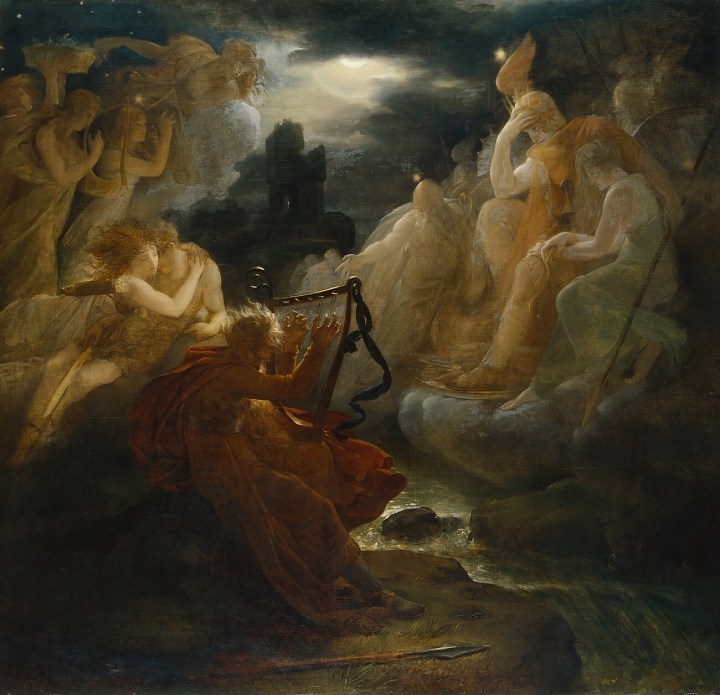
François Gérard, Ossian am Ufer der Lora beschwört die Geister beim Klang der Harfeum, 1810, oil on canvas, 211 × 221 cm (Hamburger Kunsthalle; photo by Elke Walford).
Der Workshop findet im Rahmen der Ausstellung Kunst um 1800. Eine Ausstellung über Ausstellungen statt, die den gleichnamigen Zyklus der Hamburger Kunsthalle in den Mittelpunkt stellt: Von 1974 bis 1981 widmete sich die legendäre Ausstellungsreihe in neun Teilen der Wirkmacht von Kunstwerken im „Zeitalter der Revolutionen“ und prägte Debatten über die gesellschaftliche Relevanz von Kunst, die bis heute nachwirken. Die Ausstellungen revidierten Narrative der europäischen Kunstgeschichte, indem sie Themen und Künstler ins Zentrum stellten, die mit den Konventionen ihrer Zeit brachen: Ossian, Caspar David Friedrich, Johann Heinrich Füssli, William Blake, Johan Tobias Sergel, William Turner, Philipp Otto Runge, John Flaxman und Francisco Goya. Die gegenwärtige Ausstellung Kunst um 1800 kommentiert und aktualisiert aus einer heutigen Perspektive die historischen Ordnungen und Präsentationen der Dinge, die unter der Regie des damaligen Direktors Werner Hofmann entstanden. Dazu werden über 50 Gemälde, Bücher und graphische Arbeiten der Sammlung der Kunsthalle aus der Zeit um 1800 in ein Zusammenspiel mit über 70 ausgewählten Leihgaben und Werken zeitgenössischer Künstler:innen gebracht. Das komplexe Gefüge im Kuppelsaal versteht sich als eine kritische Edition der Ausstellungen der 1970er Jahren und unternimmt zugleich einen Remix der künstlerischen Formen und Formate um 1800.
Bis zum 29. März 2026 entfaltet Kunst um 1800 in zehn Stationen mit damals gezeigten Werken ein Panorama der Epoche und widmet sich Themen wie Aufklärung, Gewalt, Träumen, politischer Landschaft, Industrialisierung sowie Revolution und Freiheit – stets aus heutiger Perspektive. Diesen Fragen geht auch der interdisziplinäre Workshop nach. In dieser Veranstaltung setzen sich Künstler- und Wissenschaftler:innen mit dem historischen Zyklus, der Musik um 1800, forschendem Kuratieren und historischen Leerstellen auseinander. So werden punktuell Aspekte betont, die im Zyklus der 1970er Jahre fehlten oder nur ansatzweise zum Vorschein kamen, jedoch für die Zeit um 1800 relevant sind: Der Kampf um Frauenrechte, die jüdische Aufklärung, Kolonialismus, Sklaverei, Abolitionismus und die Haitianische Revolution.
Eine Veranstaltung von Petra Lange-Berndt, Kunstgeschichtliches Seminar der Universität Hamburg, und Dietmar Rübel, Akademie der Bildenden Künste München, in Zusammenarbeit mit und der Hochschule für Musik und Theater sowie der Hamburger Kunsthalle. Der Eintritt zum Liederabend und zur Tagung ist frei.
Mit freundlicher Unterstützung der Hamburgischen Wissenschaftlichen Stiftung, der Franz Wirth-Gedächtnis-Stiftung und der Liebelt-Stiftung, Hamburg.
d o n n e r s t a g
19.00 Begrüßung — Alexander Klar (Direktor der Hamburger Kunsthalle)
Ossian und die Musik um 1800
Lieder u. a. von Franz Schubert, Joseph Haydn und Nan-Chang Chien nach Texten von u. a. James Macpherson, Matthäus von Collin, Anne Hunter, Johann Wolfgang Goethe, Friedrich Gottlieb Klopstock und Ludwig Rellstab; Konzept: Burkhard Kehring (Hochschule für Musik und Theater Hamburg)
Einführung — Ivana Rentsch (Institut für Historische Musikwissenschaft, Universität Hamburg)
Musikerinnen, Studierende der Hochschule für Musik und Theater: Anna Bottlinger (Sopran), Yi-Wen Chen (Klavier), Chen-Han Lin (Countertenor), Rita Rolo Morais (Sopran), João Sousa (Klavier)
f r e i t a g
10.15 Begrüßung — Petra Lange-Berndt (Kunstgeschichtliches Seminar, Universität Hamburg) & Dietmar Rübel (Akademie der Bildenden Künste München)
10.30 Hans Hönes (History of Art, University of Aberdeen) — Blick auf die Insel: Deutsch-britische Dialoge
11.15 Elisabeth Ansel (Institut für Kunstwissenschaften, Friedrich-Schiller-Universität Jena) — „Gälische Überreste“: Ossian, Kolonialismus und die Schattenseiten der Romantik
12.00 Marten Schech (Künstler, Berlin) — Eine Innenwelt der Außenwelt der Innenwelt. Die An-, Ein- und Umbauten für die Ausstellung Kunst um 1800
12.45 Mittagspause
14.00 Lucas Stübbe (Kunstgeschichtliches Seminar, Universität Hamburg) — Körper, Kolonialismus und Kunst um 1800. Eine kritische Impulsführung
14.45 Uta Lohmann (Institut für Judaistik, Universität Hamburg) — Moses Samuel Lowe und Benedict Heinrich Bendix. Zwei jüdische Künstler um 1800
15.30 Kaffeepause
16.00 Lea Kuhn (Zentralinstitut für Kunstgeschichte München) — Marie-Gabrielle Capet: Kunst der Konstellation
17.00 Ende der Tagung
Exhibition | Satirical Prints in Georgian London and Dublin
The exhibition recently closed in Dublin with the catalogue available from Churchill House Press and Centro Di:
Artists and Pirates: Satirical Prints in Georgian London and Dublin
Irish Architectural Archive, Dublin, 13 November 2025 — 8 January 2026
The Driehaus Museum, Chicago, 15 May — 13 September 2026
Curated by Silvia Beltrametti and William Laffan
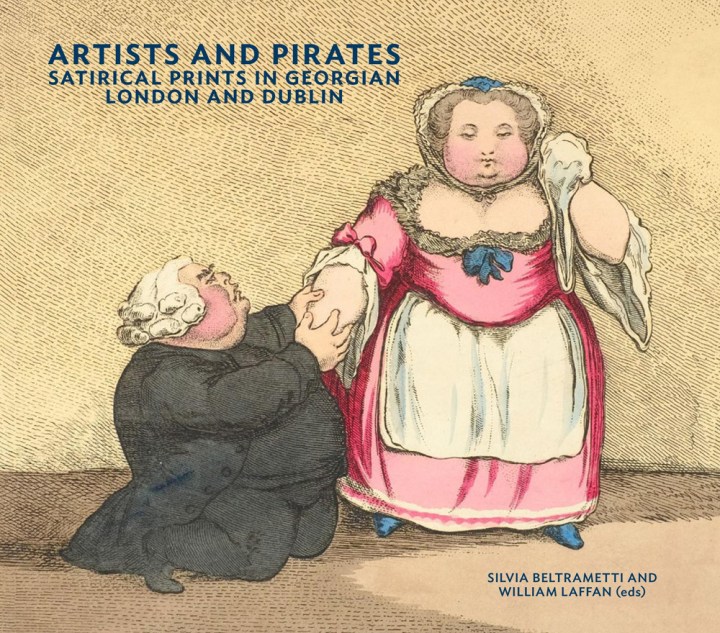 Single-sheet satire emerged in the louche milieu where politics and high society of late Georgian London intersected. Artists such as James Gillray (1756–1815) and Thomas Rowlandson (1757–1827) combined devastating wit with graphic brilliance to lampoon the great and the good, the vain and the vacuous, creating timeless images inspired by moments of fleeting controversy or scandal. Availing of a legal loophole under which copyright law protecting images did not apply to Ireland, a business of pirating caricatures by London satirists also flourished in Regency Dublin. The work of these Dublin plagiarists—which though derivative is paradoxically inventive and vibrant—as well as prints of Irish subject matter by English caricaturists such as Gillray, is the subject of this exhibition and the accompanying publication. Caricature dealt with the great political issues of the day, including religious toleration and contested concepts of liberty, but was also a vehicle to explore less elevated and often risqué (sometimes scatological or pornographic) subject matter. Single-sheet satire, Georgian England’s greatest artistic innovation, and its smaller but still dynamic offshoot in early nineteenth-century Dublin offer a fascinating—and very funny—chronicle of the human comedy.
Silvia Beltrametti and William Laffan, eds., Artists and Pirates: Satirical Prints in Georgian London and Dublin (Fenit, County Kerry: Churchill House Press with Centro Di, 2025), 184 pages, ISBN: 978-8870385939, €30. With additional contributions by James Kelly (Professor of History at Dublin City University), David Fleming (Professor of History at the University of Limerick), and Ben Casey (PhD candidate, University of Maynooth).
◊ ◊ ◊ ◊ ◊
Note (added 15 February 2026) — The original posting omitted the Chicago venue, though a note suggested the possibility, with reference to the Centro Di website. At The Driehaus Museum, the show will be titled Ink and Outrage: 18th-Century Satirical Prints in London and Dublin.
Online Conversation | Reflecting on Turner in 2025
Registration for this HECAA Great Conversation (open to non-HECAA members) is available here:
Turner in 2025: Reflecting on the Anniversary Year’s Exhibitions
With Chloe Wigston Smith, Richard Johns, Lucinda Lax, and Melissa Gustin
Online, 23 January 2026, 12.30 EST / 5.30 GMT
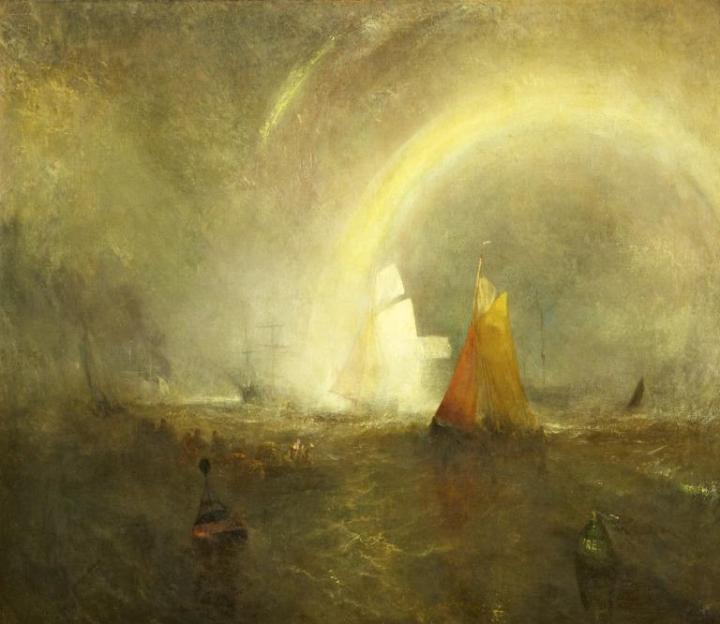
J.M.W. Turner, The Wreck Buoy, first exhibited in 1849, oil on canvas, canvas: 93 × 123 cm (Liverpool: Walker Art Gallery).
Joseph Mallord William Turner was born in 1775. To mark 250 years since his birth, a number of anniversary exhibitions were organized across the United Kingdom and the United States in 2025. Some contextualized Turner with other notable contemporaries; others focused on specific aspects of his career or mined collection holdings. This roundtable will bring together four curators of three Turner anniversary exhibitions to ask them to reflect on their exhibitions and ponder together what it means to exhibit Turner today.
• Melissa Gustin is Curator of British Art at the National Museums Liverpool, and curator of Turner: Always Contemporary at the Walker Art Gallery.
• Lucinda Lax is Interim Head of the Curatorial Division and Curator of Paintings and Sculpture at the Yale Center for British Art, and curator of J.M.W. Turner: Romance and Reality.
• Richard Johns is Senior Lecturer in the Department of History of Art at the University of York. Along with Smith, he was a co-curator of Austen and Turner at Harewood House.
• Chloe Wigston Smith is Professor in the Department of English at the University of York and Director of its Centre for Eighteenth-Century Studies. Along with Johns, she was a co-curator of Austen and Turner at Harewood House.
Join us on Friday, 23 January 2026 at 12.30pm EST / 5.30pm GMT for this HECAA Great (Zoom) Conversation. The event is open to current and prospective HECAA members; so please share widely in your networks.
Conference | Reflections at Work
From ArtHist.net:
Reflections at Work / Le reflet à l’oeuvre
Institut national d’histoire de l’art (INHA), Paris, 22–23 January 2026
Organized by Anne Pillonnet, Marie Thébaut-Sorger, and Romain Thomas
How do reflections (both physical and depicted) and lighting influence our perception of artworks and their presentation? Art historians, physicists, digital specialists and experts in perceptual phenomena will gather to discuss this question at the international conference ‘Reflections at Work’. Jointly organised by the teams of AORUM project (Analyse de l’Or et de ses Usages comme Matériau pictural, XVIe–XVIIe siècles) and FabLight project (La fabrique de l’éclairage dans les arts visuels au temps des Lumières, 1760–1820), this event is part of an interdisciplinary research initiative that aims to promote a collective exploration of reflections, light, and their role in past and present aesthetic experience.
t h u r s d a y , 2 2 j a n u a r y
9.00 Accueil des participants
9.10 Mot de bienvenue — Anne-Solène Rolland (INHA)
9.15 Introduction — Anne Pillonnet (Institut Lumière Matière, université Lyon 1), Marie Thébaud-Sorger (Centre Alexandre-Koyré CAK-CNRS, Paris) et Romain Thomas (INHA)
9.40 Session 1 | Reflection of Matter, Matter of Reflection
Présidence: Christophe Renaud (Laboratoire d’Informatique Signal et Image LISIC, université du Littoral Côte d’Opale) et Romain Thomas (INHA)
• ‘Alle de verwen van een regenboog vertoonend’ (« Montrant toutes les couleurs d’un arc-en-ciel ») : peindre l’iridescence de la nacre dans la nature morte néerlandaise du XVIIe siècle — Clara Langer (Laboratoire de Recherche Historique Rhône-Alpes LARHRA, université Lyon 2 /université de Constance)
• Reflets de matière, ce qu’ils révèlent — Anne Pillonnet (Institut Lumière Matière, université Lyon 1)
• La perception visuelle du brillant et des reflets — Pascal Mamassian (Laboratoire des Systèmes Percerptifs LSP, École normale supérieure PSL)
• Rendu des surfaces brillantes : entre réalisme physique et réalisme perceptuel — Samuel Delepoulle (Laboratoire d’Informatique Signal et Image LISIC, Université du Littoral Côte d’Opale)
• Peindre la lumière : les femmes, le portrait et la luminosité matérielle dans la Gênes du début de l’époque moderne / Painting Light: Women, Portraiture, and Material Luminosity in Early Modern Genoa — Ana Howie (Département d’histoire de l’art et d’études visuelles, université Cornell, Ithaca) (Intervention en anglais)
12.45 Pause déjeuner
14.00 Session 2 | Reflection on the Artwork: The Lighting Atmosphere
Présidence: Christine Andraud (Centre de Recherche sur la Conservation CRC, Muséum national d’Histoire naturelle) et Ralph Dekoninck (Faculté de philosophie, arts et lettres, université catholique de Louvain)
• Du bruit à l’extase, en quête de contemplation — Viviana Gobbato (Département Culture et Education Arc de Triomphe – CMN / Centre d’Histoire Culturelle des Sociétés Contemporaines CHCSC, université Paris-Saclay)
• L’art aux mains de la fée Électricité. Visiter le Salon la nuit (1879–1880) — Agathe Ménétrier (INHA)
• Capter le reflet, sonder la matière : dispositifs d’imagerie pour l’œuvre d’art et le corps humain — Mathieu Hébert (Institut d’Optique, université Jean Monnet Saint-Étienne)
• La lumière du jour comme source lisible pour les contextes spatiaux et visuels de la fin du Moyen Âge : la nef de la cathédrale Notre-Dame de Freiberg (Saxe) / Daylight as a readable Source for Late Medieval Spatial and Visual Contexts: The Hall Nave of St. Mary’s Cathedral, Freiberg (Saxony) (Intervention en anglais) — Lia Bertram (École des Beaux-Arts, Dresde)
• Le calcul des reflets — Christophe Renaud (Laboratoire d’Informatique Signal et Image LISIC, université du Littoral Côte d’Opale)
17.00 Conclusion de la journée
f r i d a y , 2 3 j a n u a r y
9.00 Accueil des participants
9.20 Session 3 | Reflection in the Artwork: Symbol and ‘Off-screen’
Présidence: Martial Guédron (Laboratoire Arts, civilisation et histoire de l’europe ARCHE, université de Strasbourg) et Marie Thébaud-Sorger (Centre Alexandre-Koyré CAK-CNRS, Paris)
• Au miroir de l’armure — Diane Bodart (Département d’histoire de l’art et d’archéologie, université Columbia, New York)
• Quelques dispositifs réflexifs chez Philippe de Champaigne à Port-Royal de Paris : retour sur « une hypothèse saugrenue » de Louis Marin — Frédéric Cousinié (Groupement de Recherche en Histoire GRHis, université de Rouen-Normandie)
• Usages du reflet chez Clara Peeters, Pieter Janssens Elinga et Jean Siméon Chardin — Matthieu Somon (Institut de recherche Religions, Spiritualités, Cultures, Sociétés RSCS, université catholique de Louvain)
• Réfléchir les reflets dans l’emblématique du XVIIe siècle — Ralph Dekoninck (Faculté de philosophie, arts et lettres, université catholique de Louvain)
• « Une journée au XVIIIe siècle. Chronique d’un hôtel particulier » : Lumière sur une exposition — Ariane James-Sarrazin (Musée des Arts décoratifs)
11.55 Discussion
New Book | Let the Oppressed Go Free
From Penn Press:
Nicholas Wood, Let the Oppressed Go Free: Abolitionism in Colonial and Revolutionary America (Philadelphia: University of Pennsylvania Press, 2025), 384 pages, ISBN: 978-1512828320, $45.
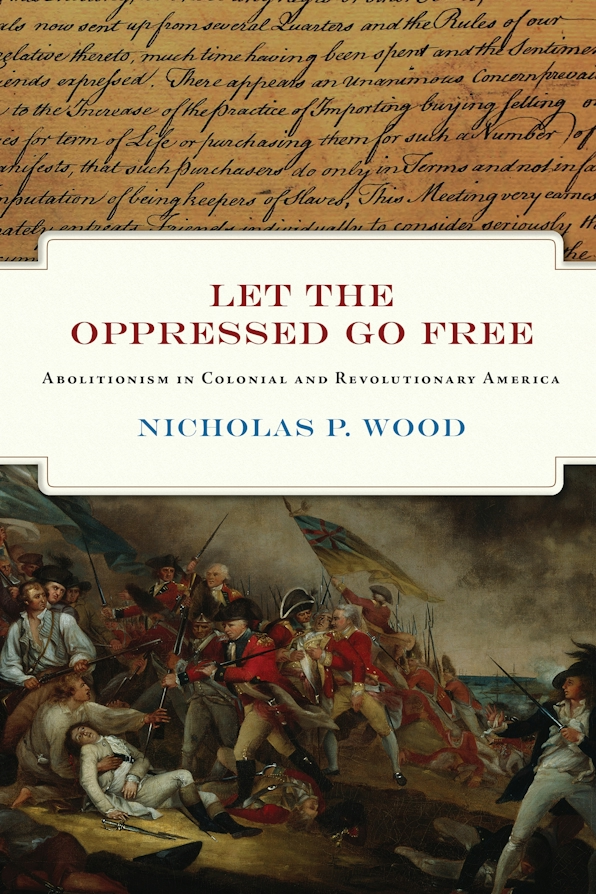 Tenacious activism by Quakers, African Americans, and antislavery evangelicals made antislavery central to the American Revolution.
In Let the Oppressed Go Free, Nicholas P. Wood presents the opponents of slavery who sustained and expanded the antislavery movement during the American Revolution in the face of widespread hostility. These early abolitionists were inspired by antislavery theology: the view that slavery was a sinful form of oppression that would provoke God’s wrath against slaveholding societies. These principles were first advanced by a handful of Quakers and Puritans as early as the 1600s, but they did not become widespread until the second half of the eighteenth century. Quakers embraced antislavery theology during the French and Indian War, which they interpreted as divine chastisement for the sin of colonial slavery. Citing the prophet Isaiah, they pledged to please the Lord by letting the oppressed go free.
Antislavery theology became even more prominent during the American Revolution. When Parliament provoked an imperial crisis in the 1760s, abolitionists argued it was further evidence of God’s anger over slavery. The outbreak of war in 1775 made these arguments increasingly persuasive. Let the Oppressed Go Free demonstrates that antislavery activism during the Revolution by Quakers, African Americans, and evangelical patriots was more sophisticated and influential than historians have recognized. The northern states that began abolishing slavery during the Revolution did so in response to tenacious agitation and generally described their actions as designed to earn God’s blessing.
Let the Oppressed Go Free challenges many common assumptions about abolitionism and the American Revolution. Wood demonstrates that religion remained central to abolitionism rather than being displaced by ‘secular’ arguments about natural rights. And whereas some have argued that the Revolutionary War hindered antislavery progress and fueled racism, Wood shows that the war accelerated reform.
Nicholas P. Wood is Associate Professor of History at Spring Hill College.










 Enfilade
leave a comment