Symposium | Diplomatic Gifts
Today and tomorrow at the Villa Medici, from the conference programme:
Diplomatic Gifts in the Modern and Contemporary Periods
L’Académie de France à Rome, 2–3 March 2026
Organized by Alessandro Gallicchio, Valentina Hristova, and Natacha Pernac
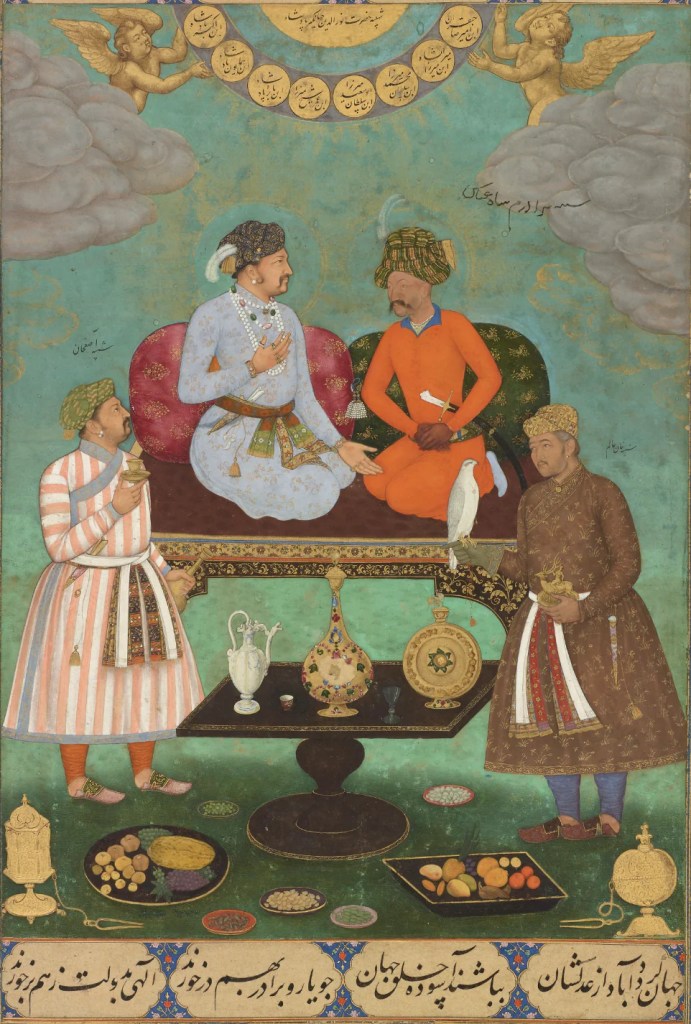
Attributed to Bishandas, Jahangir Entertains Shah Abbas, from the St. Petersburg Album, ca. 1618 (Washington DC, Freer Gallery of Art).
On March 2–3, 2026, the French Academy in Rome – Villa Medici will host an international symposium dedicated to diplomatic gifts in the modern and contemporary periods, examined in terms of their definitions, transformations, and processes of heritage-making on a global scale. These ‘ambassador objects’ will be studied in their material, political, and symbolic dimensions, as well as in their role in shaping international relations and ritualizing exchanges. Adopting polycentric perspectives, the conference encourages cross-views and bilateral or multilateral analysis of the sources.
Organizing Committee
• Alessandro Gallicchio, Director of the Department of Art History, Académie de France à Rome – Villa Médicis
• Valentina Hristova, senior lecturer in History of Modern Art, Université de Picardie Jules Verne, Amiens
• Natacha Pernac, senior lecturer in History of Modern Art, Université Paris-Nanterre
Scientific Committee
• Lucien Bély, professor emeritus of modern history, Paris, Sorbonne University, member of the Institut, Académie des sciences morales et politiques
• Francesco Freddolini, Associate professor of modern art history, Rome, Sapienza – University of Rome
• Serge Gruzinski, Director Emeritus of Historical Research, Paris, CNRS / EHESS
• Guido Guerzoni, historian and economist, Milan, Luigi Bocconi University
• Mei Mei Rado, assistant professor of Textile and Dress History, New York, Bard Graduate Center
m o n d a y , 2 m a r c h
9:00 Accueil
9.30 Ouverture — Sam Stourdzé et Alessandro Gallicchio (Académie de France à Rome – Villa Médicis)
Introduction — Valentina Hristova (Université de Picardie Jules-Verne, Amiens) et Natacha Pernac (Université Paris-Nanterre)
10.00 Les Définitions en Question
Présidence de session: Valentina Hristova
• Sur les dons (réels ou imaginaires) d’Uzun Hasan à l’État vénitien — Matthew Gillman (Columbia University, NY)
• Une collection des tranchées: Les œuvres découvertes par l’Armée française d’Orient au Louvre. Don diplomatique
ou butin de guerre? — Violette Gautier (Université de Picardie Jules-Verne, Amiens)
• Between Transnational Production and Cultural Diplomacy: Making and Managing Chinese Gardens Overseas — Zeming Taro Cai (University of Toronto)
11.30 Pause café
11.45 Récits Croisés, Sources et Représentations en Regard
Présidence de session: Francesco Freddolini
• Les cadeaux diplomatiques entre Empire ottoman et souverains occidentaux au XVIe siècle. Peut-on parler de réciprocité? — Frédéric Hitzel (EHESS, CETOBaC, Paris)
• The Geography of Diplomatic Gifts: Gift Giving and the Diverse Gift Profiles of State Ambassadors in 18th-Century Ottoman Diplomatic Ceremonial — Hümeyra Şahin Oktay (İstanbul Üniversitesi / Tobb Üniversitesi, Ankara)
12.40 Pause déjeuner
14.15 Les Vies de l’Objet: Fabrication, Reception, Display
Présidence de session: Guido Guerzoni
• « Que lui avions-nous apporté ? » : Les déboires des cadeaux diplomatiques du Portugal au souverain éthiopien Lebna Dengel, 1515–20 — Alain Mathilde (Université de Grenoble Alpes)
• Versailles et le monde: Les présents de Louis XV, 1715–74 — Marie-Laure Buku Pongo (Frick Collection, NY)
• Crafting Diplomacy: Extraordinary Embassies’ Visits to the Gobelins Manufacture and the Garde-Meuble de la Couronne, 1662–1789 — Barbara Lasic (Sotheby’s Institute of Art, Londres)
15.45 Pause café
16.00 Les Vies de l’Objet: Patrimonialisation
Présidence de session: Natacha Pernac
• Représentation et patrimonialisation des visites et dons diplomatiques en un haut lieu militaire, de l’Hôtel des Invalides au musée de l’Armée, 1675–2025 — Sylvie Le Ray-Burimi (Musée de l’Armée, Paris)
• The Qing Empire’s Gift to the Permanent Court of Arbitration: Transforming the Logic of Gift-Giving in Late Qing Diplomacy, 1907–11 — Yuxuan Zhou (Université de Genève)
• Le musée Senghor, une vitrine de la diplomatie culturelle du Sénégal, 1960–80 — Mohamadou M. Dieye (Musée d’art africain Théodore Monod, École doctorale ETHOS, Dakar)
17.30 Pause café
17.45 Special Lecture
• French Diplomatic Gifts in the Shaping of Qing Imperial Arts during the Long 18th Century — Mei Mei Rado (Bard Graduate Center, NY)
t u e s d a y , 3 m a r c h
9.00 Accueil
9.30 Stratégies et Politique des Dons Diplomatiques (Temps Long / Sérialité)
Présidence de session: Lucien Bély
• Entre jeux d’échelles et variété des typologies: Les cadeaux diplomatiques des Médicis et des Este au second Cinquecento — André Rocco (Université de Liège)
• Les dons cycliques de « pietra dura » entre l’Inde et l’Italie, 1620–2020: Entre charge historique et enjeux de supériorité — Lola Cindric (EHESS, Paris)
• Giulio Rospigliosi and Pascual de Aragón: The Role of Gifts in Relations between Madrid and Rome and Their American Projection — Carrio Invernizzi Diana (UNED, Madrid)
• Dono Dedimus Sacrum Corpus Christi Martyris, Corpisanti as Diplomatic Gifts from the Holy See to Mexico, 1833–60 — Montserrat A. Báez Hernández (Università di Teramo, KU Leuven)
11:45 Pause café
12:00 Special Lecture
• Du Japon à Madrid via México: Mondialisation, chocs des cultures et dons diplomatiques au sein de la Monarchie catholique, 1580–1640 — Serge Gruzinski (CNRS, EHESS, Paris)
12.45 Pause déjeuner










 Enfilade
leave a comment